


When bulk material transportation involves large volumes, demanding road conditions and repeated unloading cycles, choosing the right dump trailer becomes an important business decision.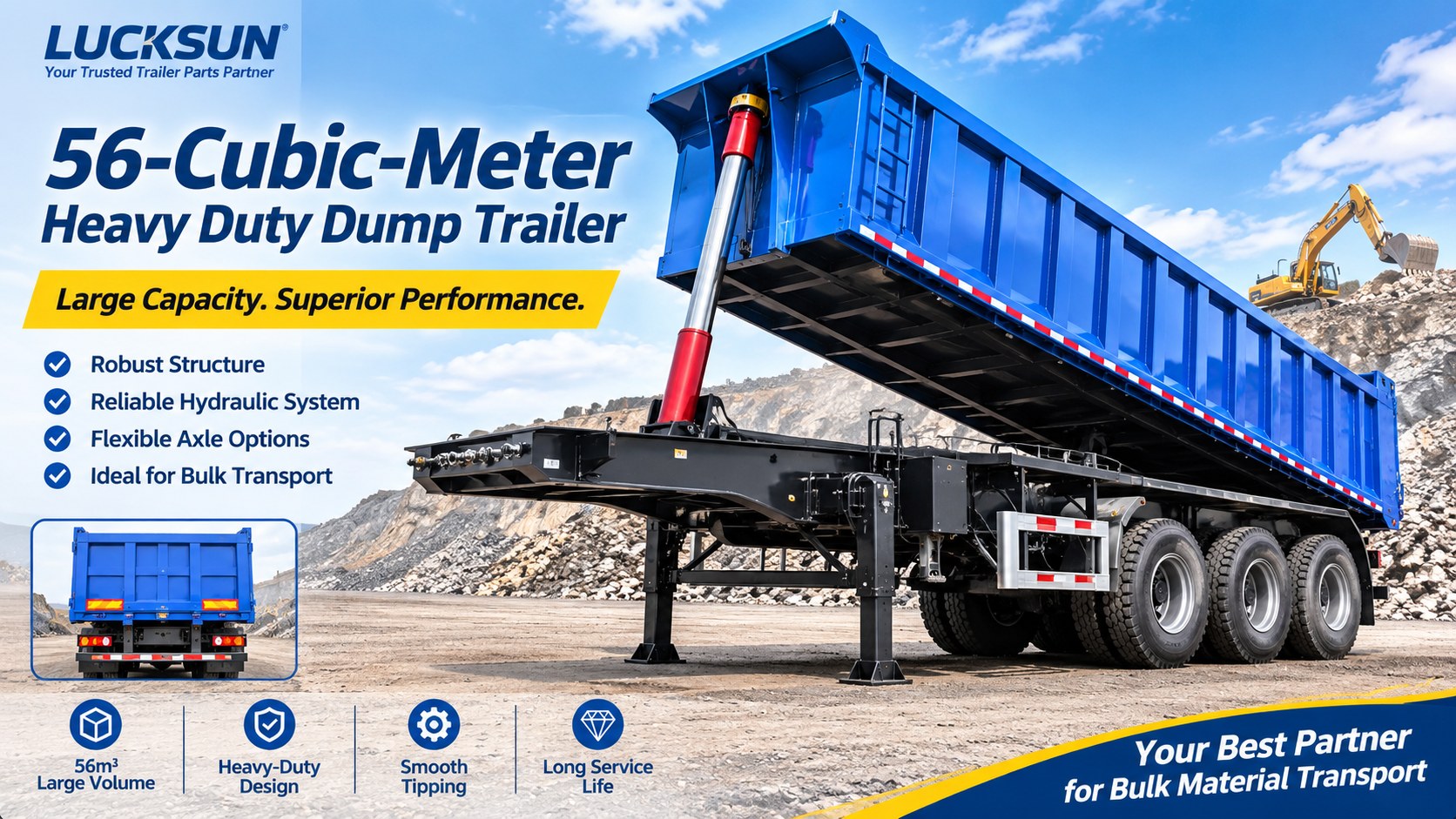
56 cubic meter heavy duty dump trailer with hydraulic lifting system for bulk material transportation
A 56-cubic-meter heavy-duty dump trailer featuring a reinforced blue cargo body, hydraulic lifting system and heavy-duty multi-axle chassis. Designed for high-volume bulk material transportation in mining, quarrying and construction applications.
A 56-cubic-meter heavy duty dump trailer is designed around a large cargo volume, making it a configuration worth considering for suitable bulk transportation operations. It can be used for applications involving coal, sand, gravel, aggregates, construction materials and selected mining cargo, depending on material density, trailer design and legal load limits.
However, a larger cargo body does not automatically mean a higher payload. The actual operating capacity depends on the trailer's tare weight, axle ratings, tractor capacity, material density, road conditions and local transport regulations.
At LUCKSUN, we focus on semi-trailers and related components for international markets. This guide explains what buyers should consider when selecting a 56m³ heavy duty dump trailer, from cargo body design and hydraulic lifting to chassis structure, running gear and long-term maintenance.
A 56-cubic-meter dump trailer is a bulk material transport semi-trailer with a nominal cargo body volume of 56m³.
It is generally designed for transporting loose materials that can be discharged by raising the cargo body and allowing gravity to move the material through the rear opening.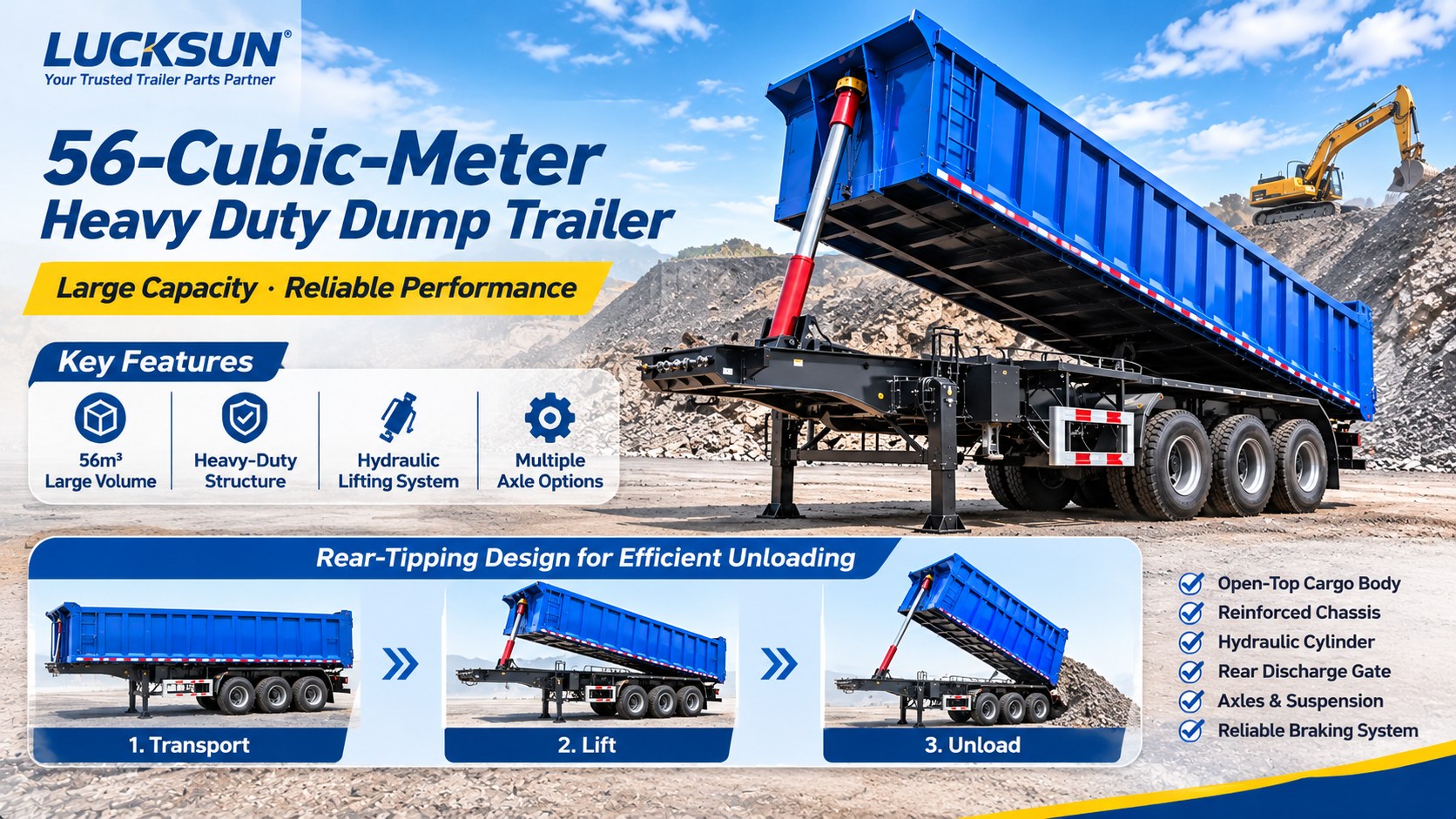
56m3 heavy duty dump trailer structure with hydraulic lifting cylinder and rear tipping system
A 56-cubic-meter heavy-duty dump semi-trailer featuring an open-top cargo body, reinforced chassis, hydraulic lifting cylinder, rear discharge gate and multi-axle suspension system. The illustration demonstrates the rear-tipping process, from transportation and hydraulic lifting to bulk material unloading.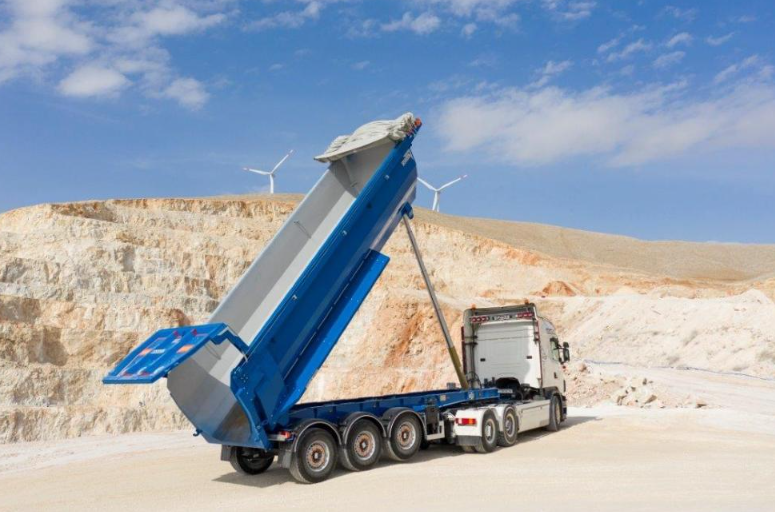
56-cubic-meter heavy duty tipper semi-trailer with blue cargo body, hydraulic lifting system and tri-axle chassis, showing the transport, lift and unload stages of rear tipping.
A typical rear-tipping system consists of:
An open-top cargo body
A reinforced chassis and supporting frame
A hydraulic lifting cylinder
A rear pivot and hinge assembly
A rear discharge gate
Axles, suspension and braking components
A tractor-compatible hydraulic power arrangement
During unloading, the hydraulic system raises the front section of the cargo body. As the body tilts, the material moves toward the rear discharge opening.
The exact tipping angle, hydraulic cylinder arrangement and tailgate mechanism depend on the trailer's engineering design.
For buyers comparing different trailer configurations, the LUCKSUN dump semi-trailer collection provides an overview of available dump trailer solutions.
The main reason to consider a 56m³ configuration is the need to transport a relatively large volume of suitable bulk material.
For businesses moving high-volume cargo, body capacity can influence the number of transport cycles required to move a target quantity of material.
However, the advantages depend on the type of cargo and the permitted operating weight.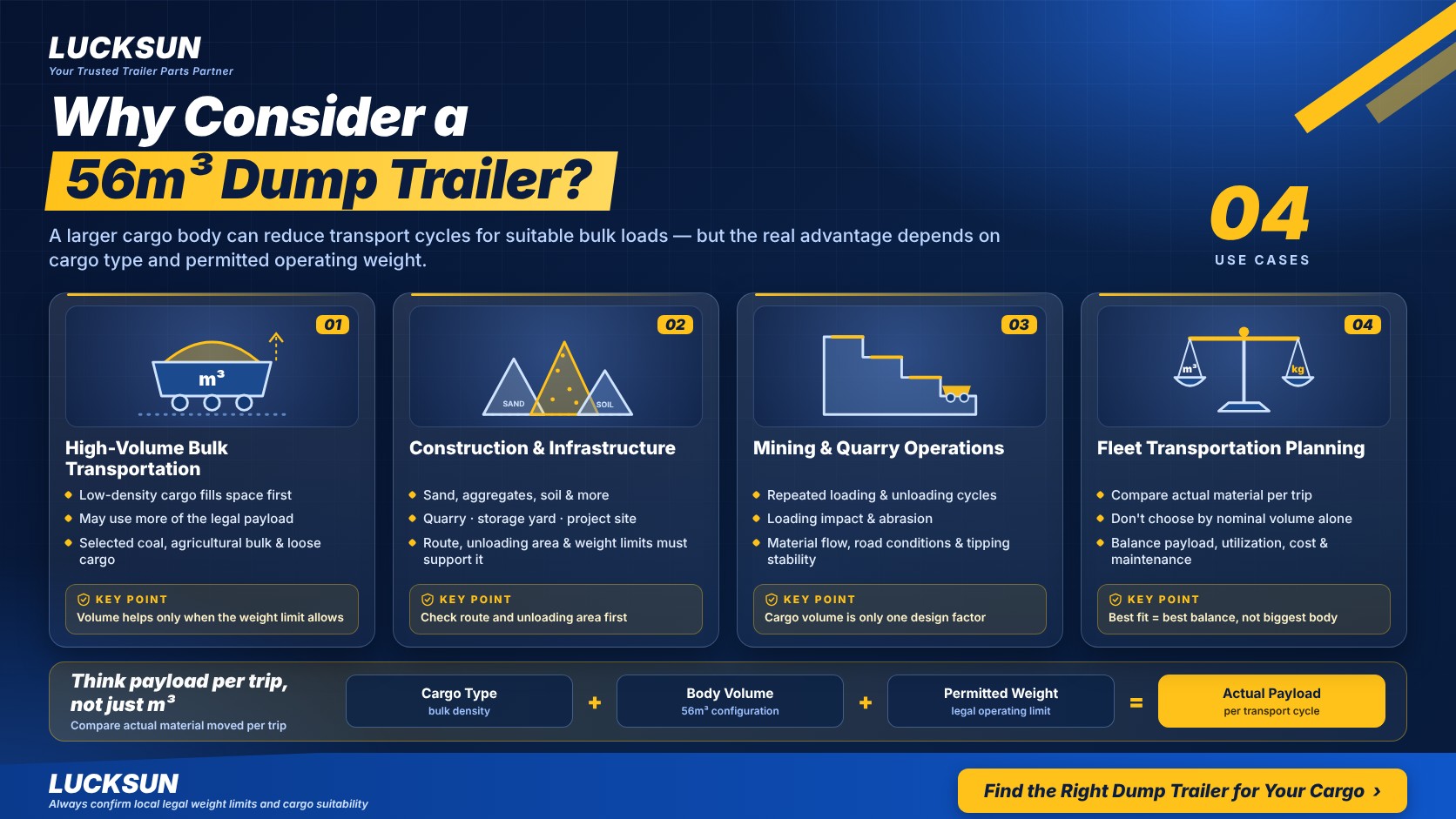
Why consider a 56m³ dump trailer: use cases in high-volume bulk transport, construction projects, mining and quarry operations, and fleet planning based on actual payload per trip.
Materials with relatively low bulk density may occupy considerable space before reaching the vehicle's permitted weight limit.
In these applications, a larger cargo body may help make better use of the available legal payload.
Examples include selected coal, agricultural bulk materials and other compatible loose cargo.
Construction projects often require continuous transportation of sand, aggregates, soil and other materials between quarries, storage yards and project locations.
A large-volume dump trailer may be considered where the transport route, unloading area and legal weight limits support this configuration.
Mining and quarrying operations may involve high transportation demand and repeated loading and unloading cycles.
A suitable heavy-duty dump trailer needs to account for more than cargo volume. Loading impact, abrasion, material flow, road conditions and tipping stability all influence the design.
Fleet operators should compare the actual material transported per trip rather than choosing a trailer based only on its nominal volume.
The most useful configuration is the one that balances legal payload, vehicle utilization, operating cost and maintenance requirements.
This is one of the most important points for international dump trailer buyers.
The figure 56m³ describes the nominal cargo body volume. It does not mean that the trailer can legally carry a fixed number of tonnes.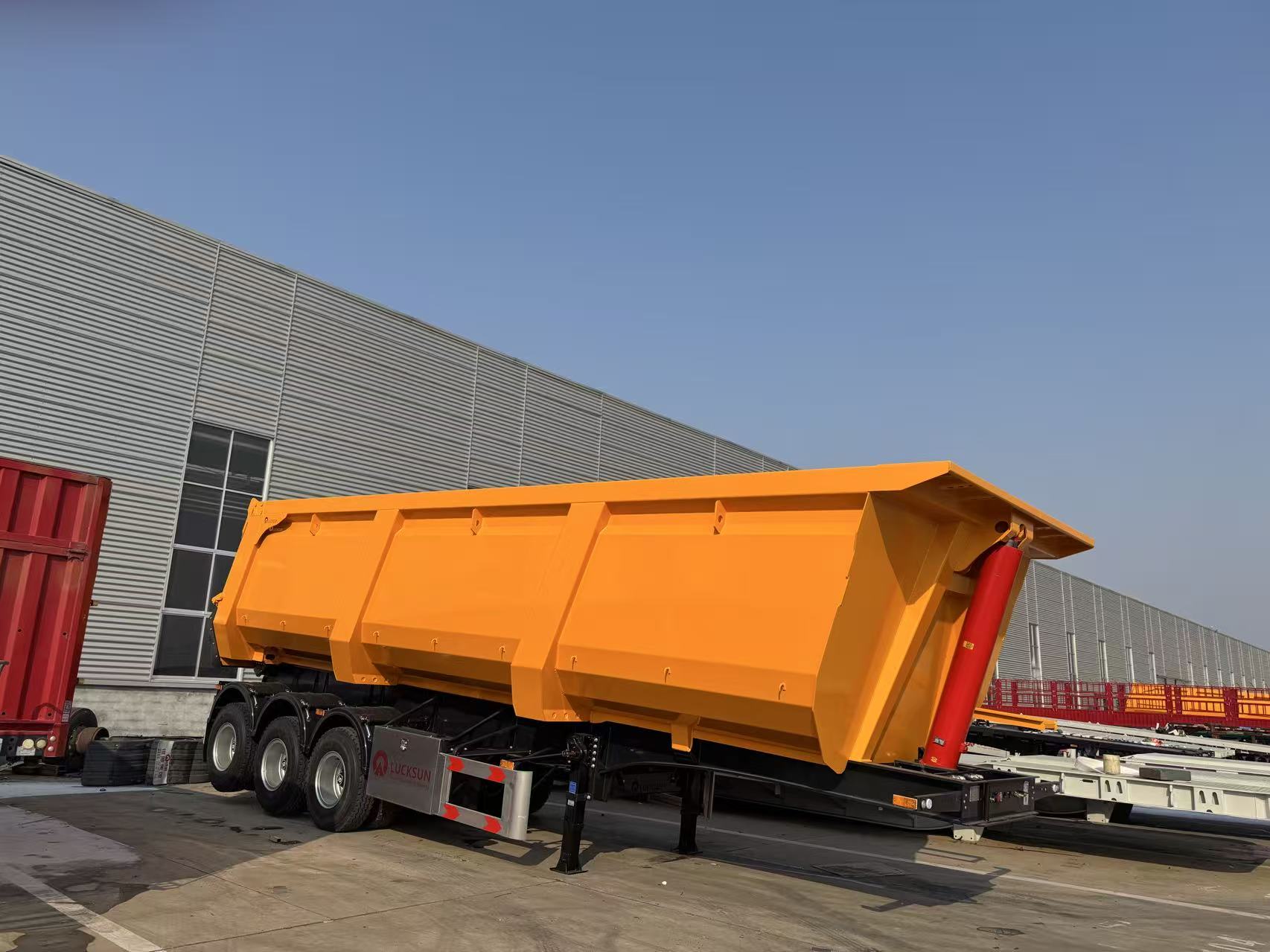
What Is a 56-Cubic-Meter Heavy Duty Dump Trailer?
Cargo weight is affected by material density.
The basic calculation is:
Cargo Weight (tonnes) = Cargo Volume (m³) × Bulk Density (tonnes/m³)
For example, the same 56m³ cargo body can contain very different cargo weights depending on whether it is filled with lightweight material, coal, dry sand, wet sand or dense crushed stone.
This means that a trailer suitable for high-volume, lower-density cargo may not be appropriate for the same volume of heavy mineral material.
Before ordering, buyers should confirm:
The actual material to be transported
Its typical and maximum bulk density
Whether the material is dry, wet or mixed
The required payload
The trailer's tare weight
The permitted axle loads
The tractor's approved combination weight
The applicable road regulations
A 56m³ body should be designed around the intended material and operating conditions, not simply the largest possible volume.
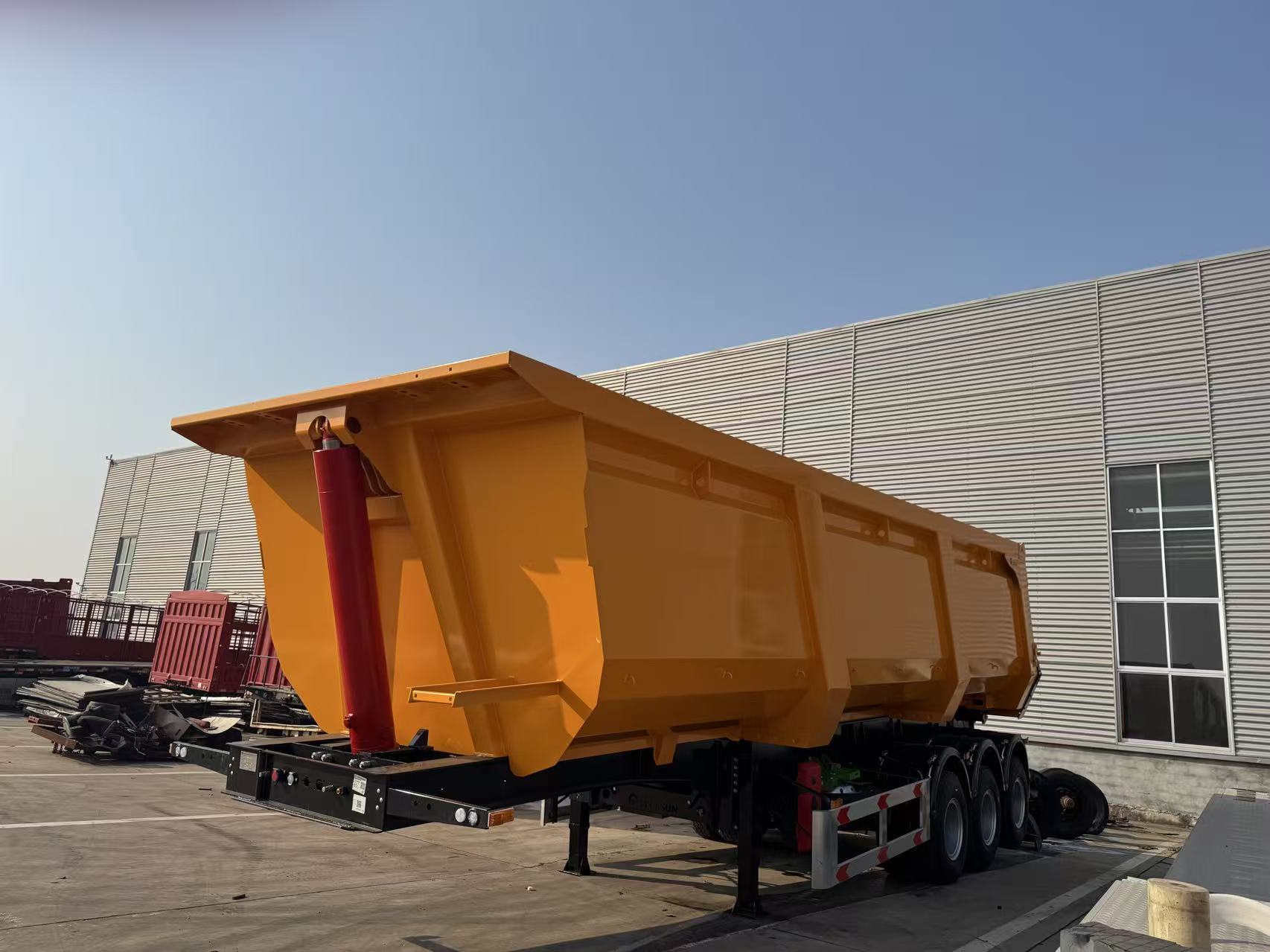
LUCKSUN 56-cubic-meter tri-axle dump semi-trailer with orange U-shaped cargo body, front-mounted red hydraulic cylinder, black chassis and landing gear, parked in a factory yard.
For a large-volume dump trailer, the cargo body is one of the most important structural assemblies.
Its design influences cargo capacity, loading impact resistance, material discharge and maintenance requirements.
A U-shape or half-pipe body has a rounded internal profile.
The curved floor and side transitions can help loose material move toward the discharge opening during unloading.
Potential applications include compatible sand, gravel, soil and bulk mineral transportation.
The final design should consider material flow, wear resistance, body dimensions and the loading method.
A rectangular body uses a more angular internal structure, often with reinforcement members along the floor and side walls.
It may be considered for cargo that requires a different internal shape or for operations where the loading and discharge characteristics suit this design.
The reinforcement arrangement should be designed to resist cargo pressure, impact and repeated operating loads.
A 56m³ cargo body needs a suitable reinforcement structure.
Important areas include:
Floor plate support
Side wall stiffeners
Front wall reinforcement
Rear gate structure
Upper side rails
Body-to-chassis contact points
Rear hinge mounting areas
A larger body should not simply be made taller without checking the overall structure and weight distribution.
The body design needs to balance volume, structural strength, tare weight and operating requirements.
Steel selection should reflect the material being transported and the severity of the operating environment.
Different parts of a dump trailer experience different types of stress.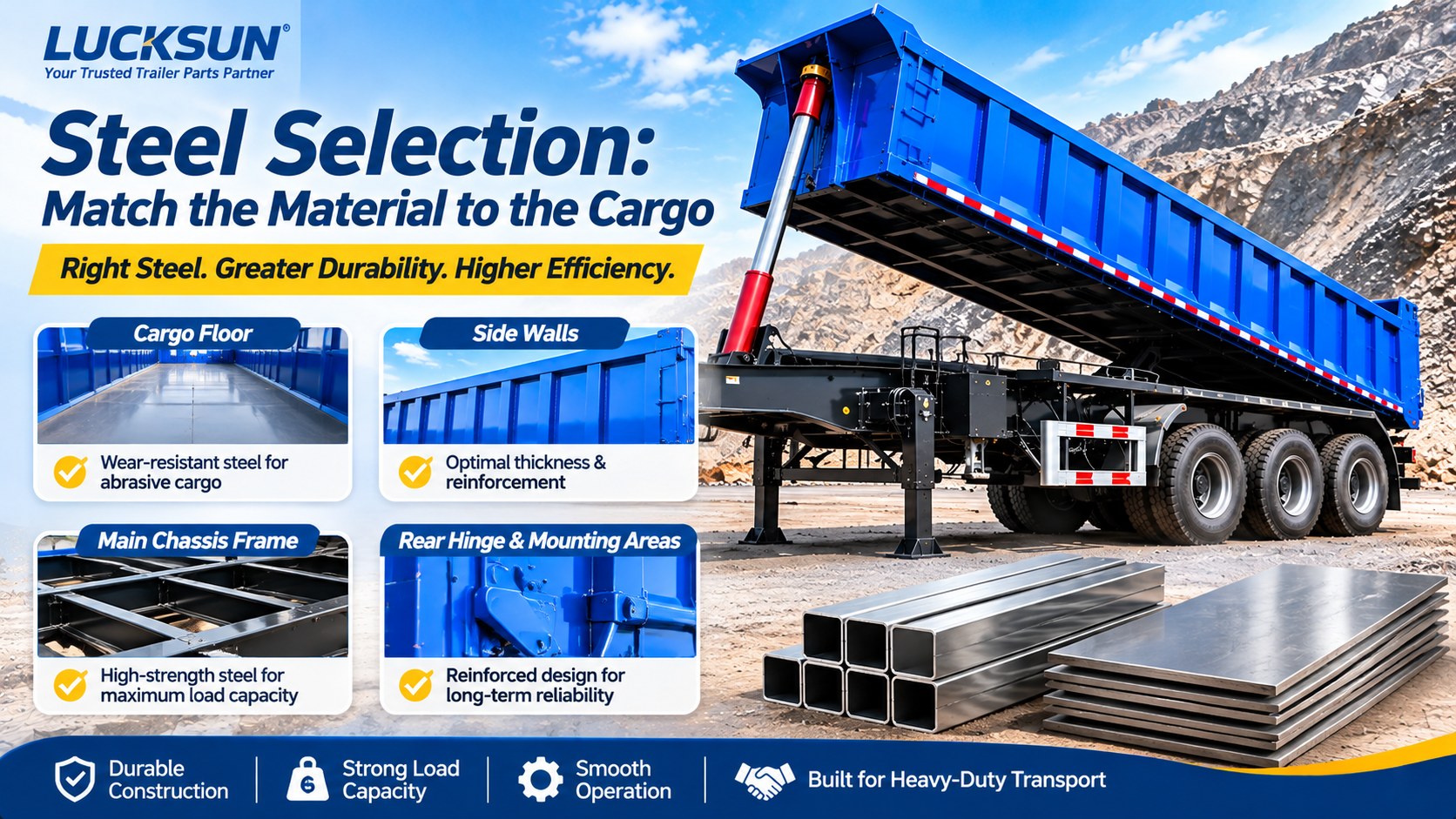
Heavy duty dump trailer steel selection for cargo floor side walls chassis frame and rear hinge
A detailed overview of steel selection for a heavy-duty dump trailer, highlighting four critical structural areas: the cargo floor, side walls, main chassis frame, and rear hinge assembly. The design illustrates how material selection, reinforcement and structural engineering contribute to durability and reliable bulk material transportation.
The floor is exposed to loading impact, abrasion and repeated contact with bulk material.
For abrasive cargo such as crushed stone and mineral materials, buyers may consider wear-resistant steel options, subject to engineering requirements.
Side walls experience cargo pressure, vibration and impact during loading.
Their thickness and reinforcement should be selected according to the cargo type, body dimensions and structural calculations.
The main frame supports the cargo body and transfers loads to the kingpin and axle assemblies.
High-strength structural steel may be considered where the design requires a balance between strength and tare weight.
The rear hinge, pivot pins and associated brackets are important load-transfer components during tipping.
These areas should be reviewed carefully because they experience concentrated forces throughout repeated lifting and lowering cycles.
Important: Do not choose steel only by its grade or nominal thickness. The complete design, material certification, welding quality and structural arrangement all matter.
The hydraulic system provides the force required to raise the cargo body.
For a heavy-duty dump trailer, the lifting system must be compatible with the body dimensions, loaded weight, tipping geometry and operating cycle.
A multi-stage telescopic cylinder is commonly used in front-mounted rear-tipping arrangements.
The cylinder extends to raise the front of the cargo body and retracts when the body returns to its resting position.
The cylinder selection should account for:
Required lifting force
Stroke length
Maximum operating pressure
Mounting geometry
Tipping angle
Hydraulic flow requirements
Duty cycle
The tractor's power take-off (PTO) system may supply power to the hydraulic pump.
The pump delivers hydraulic oil to the lifting cylinder through the relevant control and hose arrangement.
The tractor, pump, hydraulic tank, valves and cylinder should be selected as a compatible system.
Before tipping, the operator should check that the trailer is positioned on suitable firm and level ground.
The load should be distributed appropriately, and the unloading area should have sufficient overhead and rear clearance.
The operator should follow the manufacturer's instructions and avoid lifting when the trailer is leaning, unstable or exposed to unsuitable ground conditions.
A large-volume dump trailer needs a running gear configuration that matches its designed gross weight, axle loads and operating environment.
The correct number of axles cannot be determined by cargo volume alone.
Depending on the design and local regulations, a dump trailer may use a 2-axle, 3-axle, 4-axle or other configuration.
The selection should consider:
Gross combination weight
Permitted axle loads
Trailer tare weight
Load distribution
Road and route restrictions
Tractor compatibility
For related components, review the LUCKSUN trailer axle kit range.
Mechanical leaf spring suspension is commonly considered for heavy-duty applications, particularly where road conditions are demanding.
Air suspension may also be considered where the operating requirements and trailer design support it.
The choice should account for load distribution, road conditions, maintenance arrangements and local service availability.
Explore the LUCKSUN trailer leaf spring collection.
The braking system must be matched to the trailer's approved weight and operating requirements.
Depending on the configuration and destination market, the system may include pneumatic brakes and ABS or EBS equipment.
The complete system should be checked for compatibility with the tractor and applicable local requirements.
See the LUCKSUN trailer ABS product range for related braking components.
A 56m³ dump trailer may be considered for several bulk transportation applications. The suitability of each material depends on density, flow characteristics, abrasion and the permitted vehicle weight.
| Cargo Type | Main Selection Considerations |
|---|---|
| Coal | Bulk density, particle size, moisture and body volume |
| Dry Sand | Material flow, dust control and legal payload |
| Wet Sand | Higher actual weight, adhesion and unloading conditions |
| Gravel | Abrasion resistance and loading impact |
| Crushed Stone | Floor wear, side wall strength and loading method |
| Soil | Moisture content, density and material flow |
| Construction Waste | Irregular cargo shape, impact and unloading clearance |
| Selected Minerals | Density, abrasion, loading impact and legal axle loads |
Not every 56m³ configuration is suitable for every cargo type.
For example, a body designed around lightweight, high-volume materials may need different structural and weight considerations when used for dense mineral cargo.
Buyers should provide the actual cargo information before confirming the final design.
Both rear dump and side dump trailers are designed for bulk material transportation, but their unloading methods are different.
| Comparison | Rear Dump Trailer | Side Dump Trailer |
|---|---|---|
| Unloading Direction | Through the rear | Through the side |
| Main Discharge Area | Behind the trailer | Alongside the trailer |
| Typical Application | Bulk cargo and general tipping operations | Selected construction and material discharge operations |
| Unloading Space | Requires sufficient rear clearance | Requires suitable side clearance |
| Structural Design | Rear pivot and rear discharge arrangement | Side tipping structure and corresponding support design |
| Selection Priority | Rear unloading access and tipping stability | Side unloading space and operating procedure |
Neither design is universally better.
The right choice depends on the available unloading area, material characteristics, site layout and operating method.
For buyers comparing different trailer types, the LUCKSUN side wall semi-trailer collection provides another cargo transportation option.
Before requesting a quotation, it is helpful to prepare a clear technical requirement list.
This allows the manufacturer to evaluate the trailer as a complete transport system.
Material name
Typical bulk density
Maximum expected density
Moisture condition
Particle size
Abrasion level
Loading equipment and method
Nominal body volume: 56m³
Rear-tipping or other required structure
Required overall dimensions
Target payload
Axle configuration
Suspension type
Tire size
Kingpin specification
Braking requirements
Main transport route
Highway or off-road operation
Road surface conditions
Loading and unloading frequency
Available unloading space
Local legal weight and dimension limits
Required component brands, if specified
Surface treatment and paint requirements
Spare parts availability
Destination country and port
Required quantity
Delivery schedule
The final technical drawing should confirm the body volume, dimensions, tare weight, axle loads, hydraulic arrangement and other agreed specifications.
Regular maintenance helps identify wear and operating problems before they affect the trailer's availability.
For a large-volume dump trailer, inspections should cover the body, chassis, hydraulic system and running gear.
Inspect the cylinder for oil leakage.
Check hydraulic hoses and connections.
Monitor hydraulic oil condition.
Inspect the cylinder mounting points.
Check lifting and lowering operation.
Inspect the cargo floor for excessive wear.
Check the side wall reinforcement.
Examine weld areas and main beams.
Inspect rear hinges and pivot pins.
Check body mounting and support points.
Inspect leaf springs and suspension brackets.
Check U-bolts and fasteners.
Monitor tire wear.
Inspect wheel bearings.
Check axle alignment and related components.
Inspect brake chambers and air lines.
Check ABS/EBS connections where fitted.
Inspect brake adjustment and wear.
Check lights, wiring and reflective markings.
For related wheel-end and braking components, explore the LUCKSUN trailer brake drum range.
Choosing a dump trailer supplier involves more than comparing the initial quotation.
Buyers need to understand whether the proposed configuration matches the cargo, operating environment, tractor and local regulations.
LUCKSUN focuses on semi-trailers and related components for international markets.
Our dump trailer product range covers different configurations for bulk material transportation, including rear-dump and side-dump applications.
The trailer can be discussed according to the intended cargo, required volume, axle arrangement, road conditions and destination market.
A complete dump trailer depends on the compatibility of its running gear and supporting components.
These include axles, suspension, wheels, bearings and braking equipment.
In addition to dump trailers, LUCKSUN supplies other commercial trailer types, including flatbed semi-trailers and low-bed semi-trailers.
LUCKSUN welcomes inquiries from trailer importers, construction companies, mining contractors, fleet operators and spare parts distributors.
Learn more about LUCKSUN and our semi-trailer business.
It refers to the nominal cargo body volume of 56 cubic meters. It does not represent the trailer's payload in tonnes.
The actual payload depends on material density, trailer tare weight, axle ratings, tractor capacity and local road regulations. A 56m³ volume alone is not enough to determine the legal payload.
It may be suitable for compatible coal transportation applications where the cargo density, body design, vehicle weight and local regulations are appropriate.
Yes, it can be considered for suitable sand and gravel applications. However, wet sand and dense gravel can produce much higher cargo weights than some lower-density materials.
A U-shape body has a rounded internal profile, while a rectangular body has a more angular structure. The choice depends on material flow, wear requirements, loading conditions and structural design.
The correct axle configuration depends on the trailer's designed gross weight, payload distribution, route restrictions and applicable regulations. It should be confirmed through engineering calculations rather than selected by volume alone.
A typical rear dump trailer may use a tractor PTO-powered hydraulic pump and a multi-stage telescopic lifting cylinder. The exact cylinder and hydraulic system should be selected according to the body dimensions, loaded weight and tipping geometry.
The body material and plate thickness can be discussed according to cargo abrasion, impact conditions, required tare weight and structural design. Final material grades and dimensions should be confirmed in the technical documentation.
LUCKSUN provides customized semi-trailer solutions. Buyers should provide cargo details, operating conditions, required dimensions, axle requirements and destination market for technical review.
Please provide the cargo type, required 56m³ volume, material density if available, target payload, axle configuration, road conditions, destination country and quantity. A reference photograph or technical drawing is also helpful.
Looking for a 56-cubic-meter heavy duty dump trailer for construction, mining, quarrying or bulk material transportation?
LUCKSUN welcomes inquiries from international importers, construction contractors, mining companies, fleet operators and trailer distributors.
To help us review your requirements, please share:
Required cargo body volume: 56m³
Material to be transported
Material density and moisture condition
Required payload
Preferred axle configuration
Road and operating conditions
Required hydraulic and braking configuration
Destination country and quantity
Our team can review your application and discuss a suitable trailer configuration, technical specifications and quotation.
Contact LUCKSUN today to discuss your 56m³ heavy-duty dump trailer project.
LUCKSUN – Semi-Trailers and Spare Parts for Global Markets.
Official Website: https://www.lucksunvehicle.com/
Product Overview
The LUCKSUN 56m³ Heavy Duty Dump Trailer is designed for high-volume bulk material transportation in construction, quarrying, mining and other demanding transport operations.
Its large-capacity cargo body provides space for materials such as coal, sand, gravel, aggregates and other compatible bulk cargo. The rear-tipping design allows the cargo body to be raised hydraulically for unloading at designated discharge areas.
The trailer configuration can be reviewed according to material density, road conditions, axle requirements, tractor compatibility and local transport regulations.
Technical Configuration
Nominal cargo volume: 56 m³
Trailer type: Heavy-duty dump semi-trailer
Tipping direction: Rear tipping
Cargo body: Reinforced steel body, design to be confirmed
Hydraulic system: Tractor PTO-powered hydraulic lifting system, subject to configuration
Axle configuration: To be confirmed according to load and regulations
Suspension: Mechanical or air suspension, subject to design
Braking system: Air brake system, ABS/EBS options subject to configuration
Tires: Size and quantity to be confirmed
Main frame: High-strength structural steel, grade to be confirmed
Final dimensions, material thicknesses, axle ratings and load capacity must be confirmed in the approved technical drawing.
Applications & Customization
Suitable for consideration in bulk material transportation, including coal, aggregates, sand, gravel, construction materials and selected mining applications.
Buyers can discuss cargo body dimensions, material selection, reinforcement structure, axle configuration, suspension, hydraulic equipment, braking system and other requirements.
LUCKSUN welcomes inquiries from trailer importers, mining contractors, construction companies, fleet operators and commercial vehicle distributors.
Send us your cargo type, required volume, operating conditions and destination country to discuss a suitable trailer configuration.
