


A 9.6-meter dump trailer is a practical transportation solution for businesses moving sand, gravel, crushed stone, laterite, construction waste and other bulk materials in Nigeria. Its relatively compact body length can make it suitable for construction projects, quarry operations, mining sites and regional material transportation where loading conditions, unloading space and route requirements need to be considered together.
LUCKSUN 9.6-Meter Rear Dump Trailer – Chassis, Axle and Suspension Details
For Nigerian transport operators, choosing a dump trailer is not simply about selecting a body length or maximum payload. The trailer must match the type of cargo, loading equipment, road conditions, tractor head, unloading location and applicable axle-load regulations.
This guide explains the main uses of a 9.6-meter dump trailer in Nigeria, how to select its body structure and hydraulic system, which specifications deserve attention, and what buyers should confirm before ordering from a manufacturer.
A 9.6-meter dump trailer is a semi-trailer with a cargo body approximately 9,600 mm long. It is designed to transport loose bulk materials and discharge them through a hydraulic tipping system.
Unlike a conventional flatbed trailer, which requires external equipment to unload most bulk cargo, a dump semi-trailer can raise its cargo body to release materials through gravity.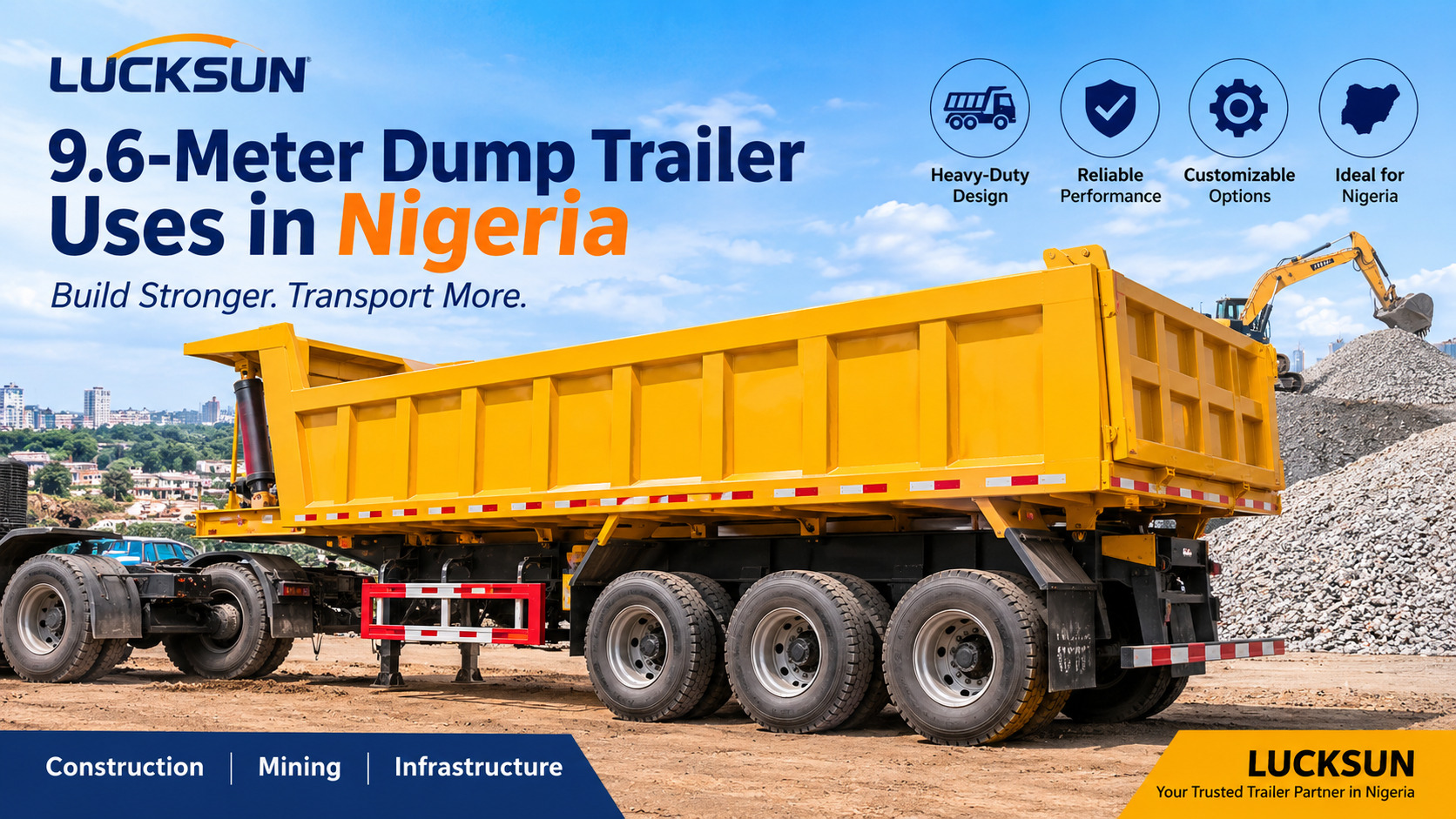
LUCKSUN 9.6-meter dump semi-trailer designed for bulk material transportation in Nigerian construction, mining and quarry operations.
Depending on the design, a dump trailer may use a rear-tipping or side-tipping structure. Rear tipping is commonly selected for general construction materials, while side tipping may be considered for operations where the unloading direction and available working space require a different arrangement.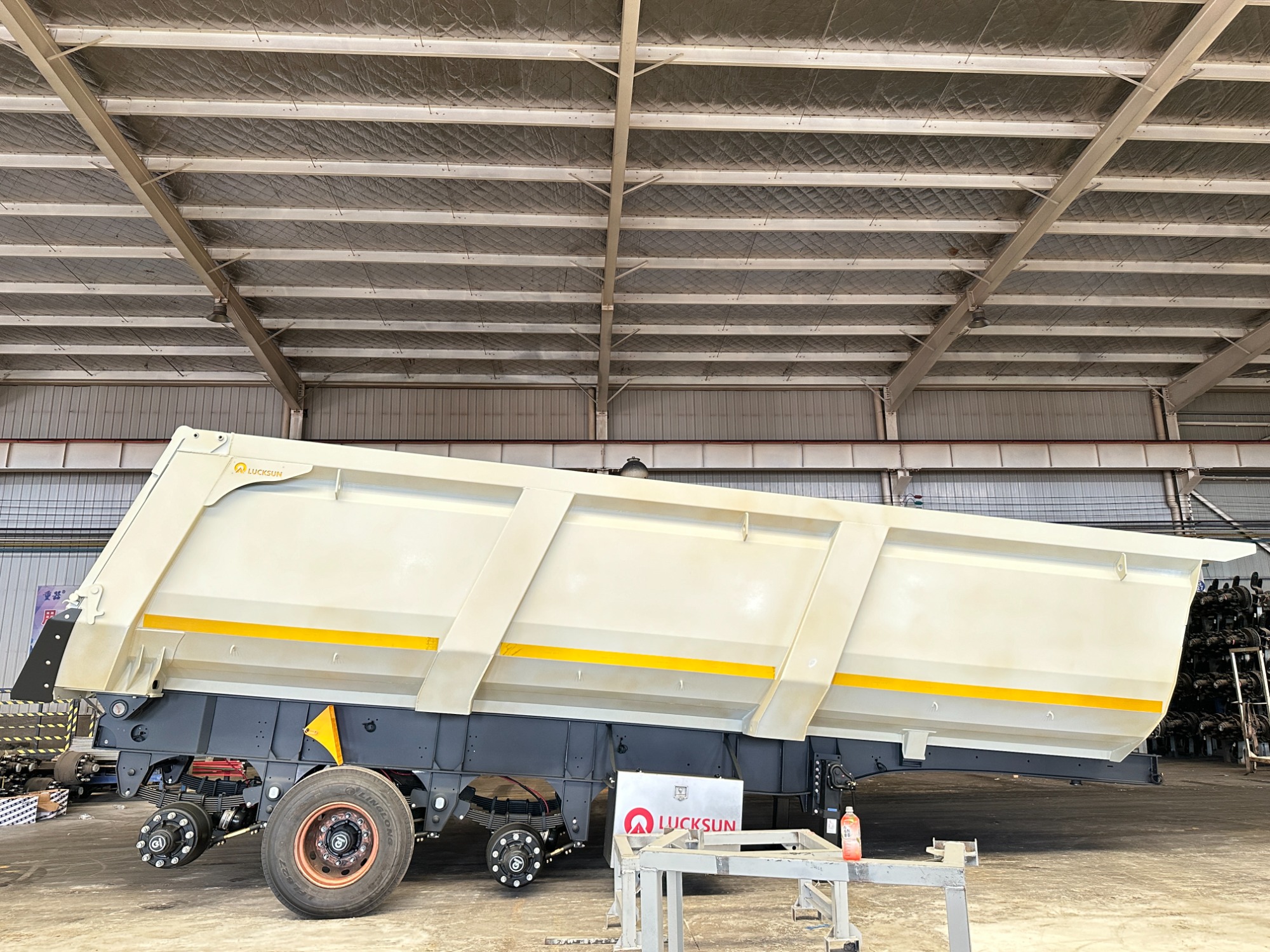
A heavy-duty 9.6-meter dump semi-trailer designed for transporting sand, gravel, crushed stone and other bulk materials in Nigeria. Suitable for construction projects, quarry operations, mining sites and infrastructure development, with customizable cargo body dimensions, hydraulic tipping systems and axle configurations.
The 9.6-meter dimension generally refers to the cargo body or specified trailer section, not automatically the complete articulated vehicle length. Buyers should confirm the manufacturer's dimension drawing to understand exactly how the measurement is defined.
For operators comparing different models, the LUCKSUN dump semi-trailer range provides a starting point for reviewing available dump trailer designs and configurations.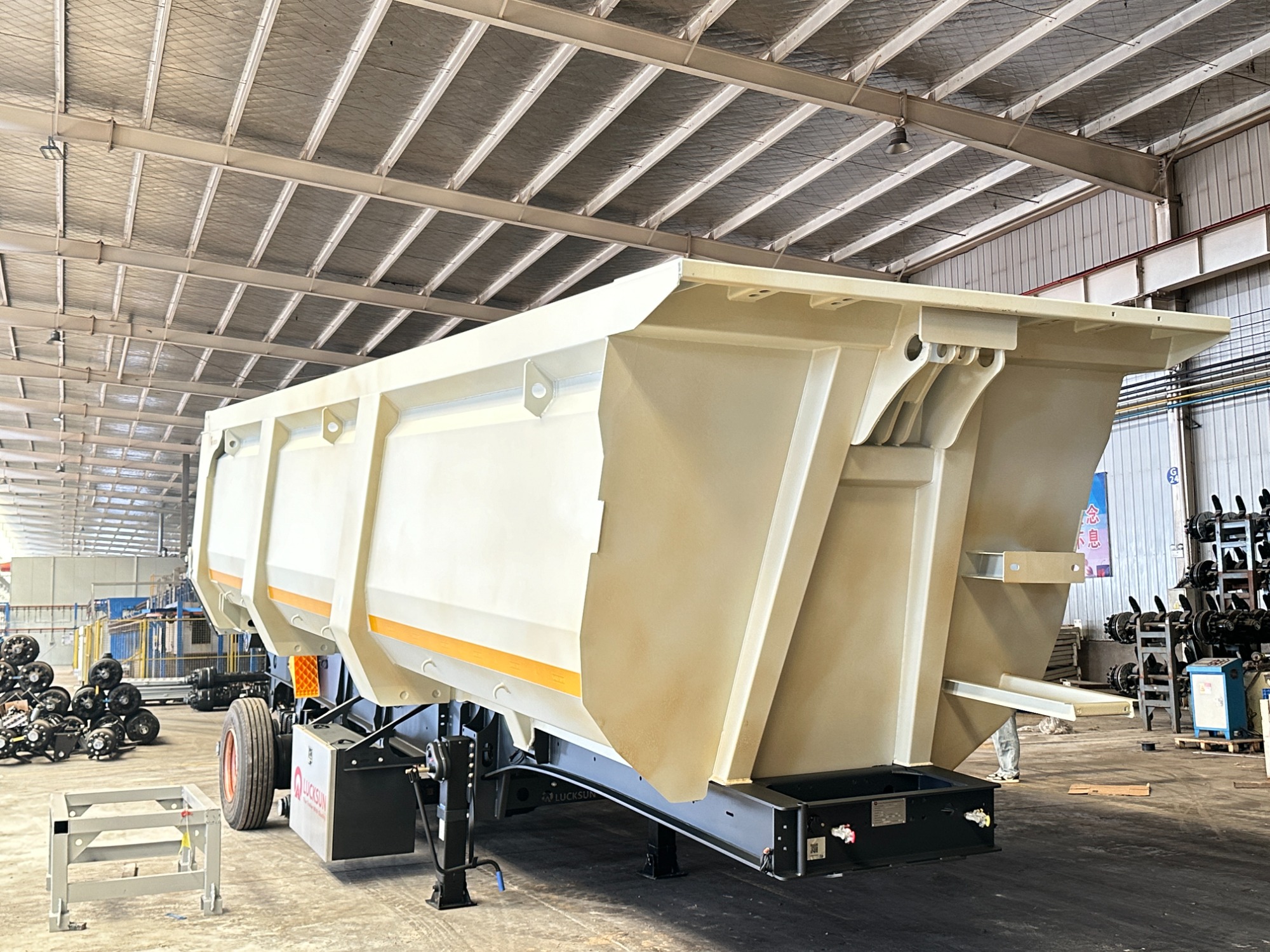
9.6-Meter Dump Trailer Uses in Nigeria | LUCKSUN
A 9.6-meter body can offer a useful balance between cargo space and maneuverability, depending on the overall trailer design.
Its potential advantages include:
Suitable body length for many regional construction and bulk-material transportation jobs.
Easier matching with certain loading equipment compared with some longer configurations.
Flexible customization of body height, width and internal volume.
Compatibility with different axle and suspension arrangements, subject to engineering review.
Practical use in operations involving repeated loading and unloading cycles.
However, a shorter body does not automatically mean a higher payload or lower operating cost. The actual result depends on body volume, tare weight, cargo density, axle configuration and legal weight limits.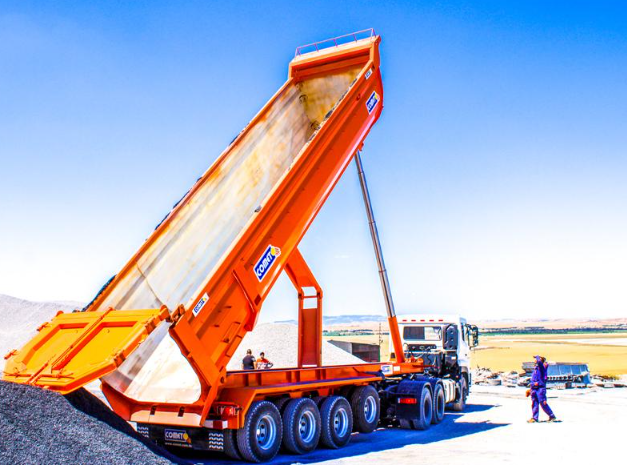
9.6-meter dump semi-trailer for construction, mining and gravel transportation in Nigeria by LUCKSUN.
Nigeria has a wide range of transportation requirements across construction, mining, quarrying, infrastructure development and agricultural supply chains. A properly configured dump trailer can support several of these industries.
Sand is one of the most common materials used in construction. It is required for concrete production, block manufacturing, road construction and general building activities.
A 9.6-meter dump trailer can transport different types of sand, including:
River sand
Sharp sand
Washed sand
Filling sand
Selected construction sand
For businesses supplying construction sites, the trailer's hydraulic unloading function can reduce manual handling and help shorten unloading cycles.
Body height and volume should be selected according to the density and moisture content of the sand. Wet sand can be considerably heavier than dry sand, so filling the body to its maximum volume is not necessarily the correct loading method.
Operators should calculate the expected cargo weight before dispatch and distribute the material evenly throughout the cargo body.
Gravel and crushed stone are widely used in concrete production, road foundations, drainage construction and building projects.
These materials can create significant impact and abrasion inside the dump body, particularly when loaded by wheel loaders or excavators.
For this application, buyers should pay attention to:
Floor plate thickness and material selection.
Sidewall reinforcement.
Wear resistance around the lower body sections.
Structural support between the chassis and cargo body.
Hydraulic lifting capacity under the intended loading conditions.
For frequent quarry transportation, a reinforced cargo body and suitable wear-resistant steel can help reduce maintenance caused by repeated material impact.
The right material grade should be selected according to the cargo type, loading method, expected service life and total trailer weight.
Laterite is commonly used in road construction, land preparation, foundation filling and infrastructure projects in Nigeria.
A 9.6-meter dump trailer can be configured to transport laterite and excavated soil between construction sites, borrow pits and roadwork locations.
This application requires attention to cargo moisture, material density and unloading conditions.
Laterite may become sticky after rainfall, increasing the possibility of material remaining inside the cargo body. This can affect unloading efficiency and create additional cleaning requirements.
A suitable body shape, smooth internal surfaces and correctly selected hydraulic system can help improve discharge performance.
Before ordering, buyers should explain whether the trailer will mainly operate on paved roads, construction access roads or unpaved project sites.
Nigeria's mineral and quarry industries require equipment capable of handling abrasive materials and repeated loading cycles.
A dump trailer can be used to transport:
Crushed limestone
Granite
Quarry aggregates
Selected mineral ores
Excavated earth
Mining overburden
For heavy-duty mining applications, body strength becomes particularly important.
Loading large rocks directly into a cargo box can generate concentrated impact forces. A body designed only for ordinary sand transportation may not be suitable for continuous quarry operations.
Buyers should consider reinforced floors, stronger sidewall structures, appropriate crossmembers and wear-resistant materials.
The axle assembly, suspension and braking system must also be matched to the intended operating weight and road conditions.
For fleets running frequent quarry cycles, a correctly engineered trailer is generally more valuable than simply choosing the largest advertised payload.
Demolition and infrastructure projects generate mixed waste, including broken concrete, bricks, soil and other non-hazardous construction materials.
A dump trailer can help transport these materials from project locations to approved disposal or recycling facilities.
Compared with conventional cargo trailers, the hydraulic tipping structure provides a more convenient way to discharge loose materials.
For this application, buyers should consider:
Resistance to impact from irregular materials.
Reinforced floor and sidewall sections.
Protection against sharp material edges.
Suitable unloading clearance.
Easy inspection and cleaning access.
Where waste contains unusually large or heavy objects, the body design and loading method should be reviewed before use.
Although dump trailers are commonly associated with construction, they can also be used for selected agricultural transportation tasks.
Possible applications include:
Soil and farm earth movement.
Sand and gravel for farm infrastructure.
Selected bulk agricultural materials.
Organic waste and suitable loose materials.
Fertilizer-related materials where the body and unloading arrangement are compatible.
For grain and other free-flowing agricultural products, operators should evaluate whether a dedicated grain trailer or enclosed bulk transportation solution would provide better protection and unloading performance.
The best trailer is determined by the actual cargo and operating process rather than by the general product category.
LUCKSUN 9.6-Meter Rear Dump Trailer – Chassis, Axle and Suspension Details
The cargo body is one of the most important parts of a dump semi-trailer because it directly handles the transported material.
For Nigerian operators, material selection should consider cargo weight, abrasion, impact, moisture and daily working frequency.
The floor experiences repeated impact during loading and continuous abrasion during transportation.
For sand and ordinary construction materials, a properly designed structural steel floor may be sufficient, depending on the expected working intensity.
For crushed stone, granite and mining materials, buyers should consider higher-strength or wear-resistant steel options.
The objective is to balance durability, tare weight and manufacturing cost.
Sidewall height directly affects the available cargo volume.
Higher sidewalls can increase the theoretical volume, but they also increase the potential total cargo weight and may change the trailer's center of gravity.
A higher cargo body is therefore not always the best choice.
For sand, laterite and aggregates, sidewall dimensions should be calculated according to material density and the intended legal operating weight.
The main chassis carries the loads transferred from the cargo body, suspension and fifth-wheel coupling.
A dump trailer operating on uneven construction roads may experience additional bending and twisting forces.
Important structural components include:
Main longitudinal beams.
Crossmembers.
Suspension mounting areas.
Kingpin connection structure.
Rear tipping support and hinge assemblies.
Hydraulic cylinder mounting points.
For repeated heavy-duty use, these components should be designed as one coordinated structural system rather than selected independently.
The hydraulic system determines how the cargo body lifts and returns to its original position.
For a rear dump trailer, a front-mounted telescopic hydraulic cylinder is a common configuration. The actual cylinder arrangement should be determined by the body dimensions, lifting geometry and required operating capacity.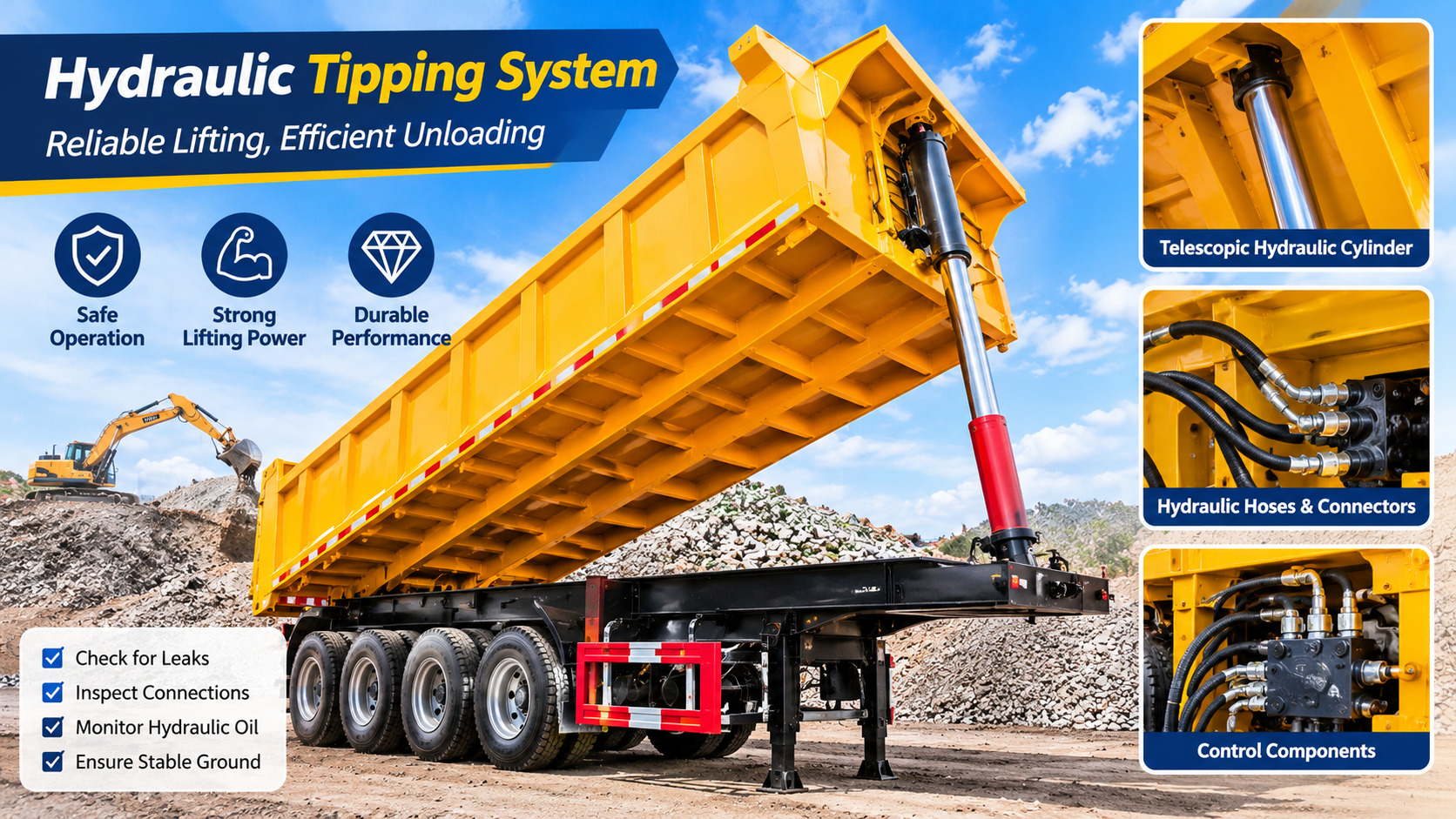
Hydraulic Tipping System: What Should Nigerian Buyers Check?Hydraulic rear tipping system featuring a telescopic cylinder, hydraulic hoses and control components for efficient dump trailer unloading.A detailed illustration of the hydraulic tipping system used on a rear dump semi-trailer. The image highlights the telescopic hydraulic cylinder, hydraulic hoses, connectors and control components responsible for lifting and lowering the cargo body. It also emphasizes important maintenance checks, including hydraulic oil condition, hose leakage, connection inspection and stable ground preparation before unloading.
A complete hydraulic system normally includes:
Hydraulic cylinder.
Hydraulic power source supplied by the tractor head.
Hydraulic hoses and connectors.
Control components.
Suitable hydraulic oil.
Safety and supporting components specified by the manufacturer.
Buyers should not select a hydraulic cylinder based only on its maximum advertised lifting force.
The system must be matched to the cargo body's weight, expected material load, lifting angle and structural design.
Unbalanced cargo, excessive loading or unstable ground can increase the risk of tipping accidents.
Before unloading, the driver should confirm that the ground is sufficiently firm and level, the vehicle is correctly positioned and the surrounding area is clear.
Routine inspection helps identify potential problems before they cause downtime.
Recommended checks include:
Inspect hydraulic hoses for cracks, leakage and abrasion.
Check cylinder surfaces for damage.
Inspect hose connections and fittings.
Monitor hydraulic oil condition and level.
Check for unusual lifting noise or uneven movement.
Inspect the cylinder mounting points and body support structure.
Hydraulic components should be maintained according to the manufacturer's instructions.
A dump trailer's running gear has a direct influence on stability, braking performance and maintenance costs.
The correct configuration depends on the tractor head, trailer tare weight, cargo weight, axle-load distribution and applicable regulations.
Three-axle configurations are commonly considered for heavy-duty dump semi-trailers, but axle quantity alone does not determine legal payload.
A 3-axle trailer should be evaluated together with the tractor's drive axle group, steering axle, axle spacing and complete vehicle combination.
The buyer should request an axle-load distribution calculation rather than relying only on a nominal payload figure.
For suitable applications, operators can review the LUCKSUN 3-axle tipper dumper trailer range.
Mechanical leaf spring suspension is often considered for commercial trailers operating in demanding environments.
Its advantages include a relatively straightforward structure, accessible inspection points and practical maintenance requirements.
However, spring capacity, leaf arrangement, equalizer design, mounting brackets and axle compatibility must all be specified correctly.
For replacement and maintenance requirements, LUCKSUN also supplies trailer leaf springs.
Tires should be selected according to the axle load, speed rating, operating surface and manufacturer's recommendations.
Common heavy-duty trailer tire sizes include 12R22.5 and 12.00R22.5, subject to the actual wheel and axle configuration.
For operations involving construction access roads and frequent heavy loading, tire pressure and sidewall condition deserve particular attention.
Operators should inspect tires regularly for uneven wear, cuts, deformation and abnormal temperature.
The braking system must be compatible with the tractor head and the intended operating environment.
Buyers should confirm the air brake configuration, brake chamber specifications, wheel-end compatibility and whether ABS or other electronic braking options are required.
The LUCKSUN trailer ABS product range provides additional information about trailer braking components.
One important issue when purchasing a dump trailer for Nigeria is compliance with vehicle dimension, gross weight and axle-load requirements.
The Federal Highways (Control of Dimensions, Weights and Axle Load of Heavy Duty Goods Transport Vehicles) Regulations, 2018 establish requirements for heavy-duty goods vehicles operating on federal highways.
The regulations address:
Vehicle and combination dimensions.
Axle-load limits.
Authorized laden weight.
Load and dimension inspection.
Technical inspection requirements.
Weighbridge checks and enforcement.
The regulations specify a maximum of 11.5 tonnes for a single load-carrying axle under Regulation 5, while the applicable axle-group limits are set out in Schedule 2.
The published schedule also distinguishes between a semi-trailer, an articulated vehicle and other vehicle combinations.
This distinction is important because the cargo body length of 9.6 meters does not independently establish whether a complete tractor-trailer combination is legally compliant.
Before purchasing, Nigerian buyers should confirm:
The complete vehicle combination's permitted dimensions.
The tractor head's axle configuration and rated capacity.
The trailer axle group and spacing.
The permitted gross and axle loads for the intended route.
The required vehicle inspection and documentation.
Whether any special authorization is needed for the proposed operation.
Always verify the current requirements with the relevant Nigerian authorities and qualified local transport compliance professionals.
Official reference: Federal Highways (Control of Dimensions, Weights and Axle Load of Heavy Duty Goods Transport Vehicles) Regulations, 2018.
https://fmw.gov.ng/themes/front_end_themes_01/images/download/15199720841453.pdf
Is a 9.6-meter dump trailer better than a 10.5-meter or 12-meter model?
There is no universal answer. The correct choice depends on the cargo, material density, project distance, loading equipment and available unloading space.
| Comparison | 9.6-Meter Dump Trailer | Longer Dump Trailer |
|---|---|---|
| Cargo body length | Approximately 9.6 m | Depends on configuration |
| Typical application | Regional construction and bulk transport | Applications requiring a longer cargo body |
| Loading requirements | Depends on loading equipment | May require a different loading arrangement |
| Cargo volume | Depends on body width and height | Potentially greater with comparable cross-section |
| Maneuverability | May suit certain restricted work areas | Requires route and turning-space assessment |
| Payload | Determined by legal and engineering limits | Determined by legal and engineering limits |
A longer body can provide additional theoretical cargo volume when other dimensions remain unchanged.
However, the actual payload cannot be calculated from length alone.
For example, transporting wet sand in a high-sided body can reach the permissible weight limit before the available cargo volume is fully used.
For this reason, buyers should provide the manufacturer with the expected material type, density, daily transport distance and loading method before finalizing the body dimensions.
The theoretical cargo body volume can be estimated using the following formula:
Volume (m³) = Internal Length × Internal Width × Internal Height
For example, consider an illustrative cargo body with these internal dimensions:
Internal length: 9.6 m
Internal width: 2.3 m
Internal height: 1.2 m
The theoretical rectangular volume is:
9.6 × 2.3 × 1.2 = 26.496 m³
This is a calculation example, not a confirmed LUCKSUN product specification.
The actual usable volume may differ because of the body shape, floor design, loading profile and material characteristics.
The approximate cargo weight can be estimated as:
Cargo Weight (tonnes) = Cargo Volume (m³) × Bulk Density (tonnes/m³)
However, the final loading quantity must remain within the permitted gross weight and axle-load limits.
For example, a trailer transporting relatively dense gravel may reach its legal weight limit at a lower cargo volume than a trailer carrying a lighter material.
This is why a buyer should not select a dump trailer simply by comparing cubic-meter capacity.
A maintenance plan should reflect the trailer's actual working environment and transportation frequency.
Construction and quarry operations can expose the trailer to abrasive materials, dust, impact loads, vibration and repeated hydraulic lifting cycles.
Before operation, drivers should check:
Tire pressure and visible tire damage.
Air brake connections.
Lights and electrical connections.
Hydraulic hoses and visible leakage.
Kingpin and fifth-wheel coupling.
Landing gear condition.
Cargo body locking and support components.
During scheduled maintenance, inspect:
Main beams and crossmembers.
Cargo floor and sidewall wear.
Welding areas around high-stress connections.
Rear tipping hinges.
Hydraulic cylinder mounting points.
Axle and suspension mounting brackets.
Any visible cracks, serious deformation or unusual structural movement should be assessed before the trailer returns to service.
Hydraulic oil, cylinder seals, hoses and fittings should be maintained according to the manufacturer's service schedule.
Suspension components should be inspected for damaged spring leaves, loose fasteners, worn bushes and abnormal alignment.
A correctly selected trailer axle kit can also support routine replacement and running gear maintenance.
Preventive maintenance helps reduce unexpected downtime and can improve the overall operating life of the trailer.
For Nigerian importers and fleet owners, purchasing directly from a qualified manufacturer can make it easier to discuss the required dimensions, materials, axle arrangements and hydraulic specifications.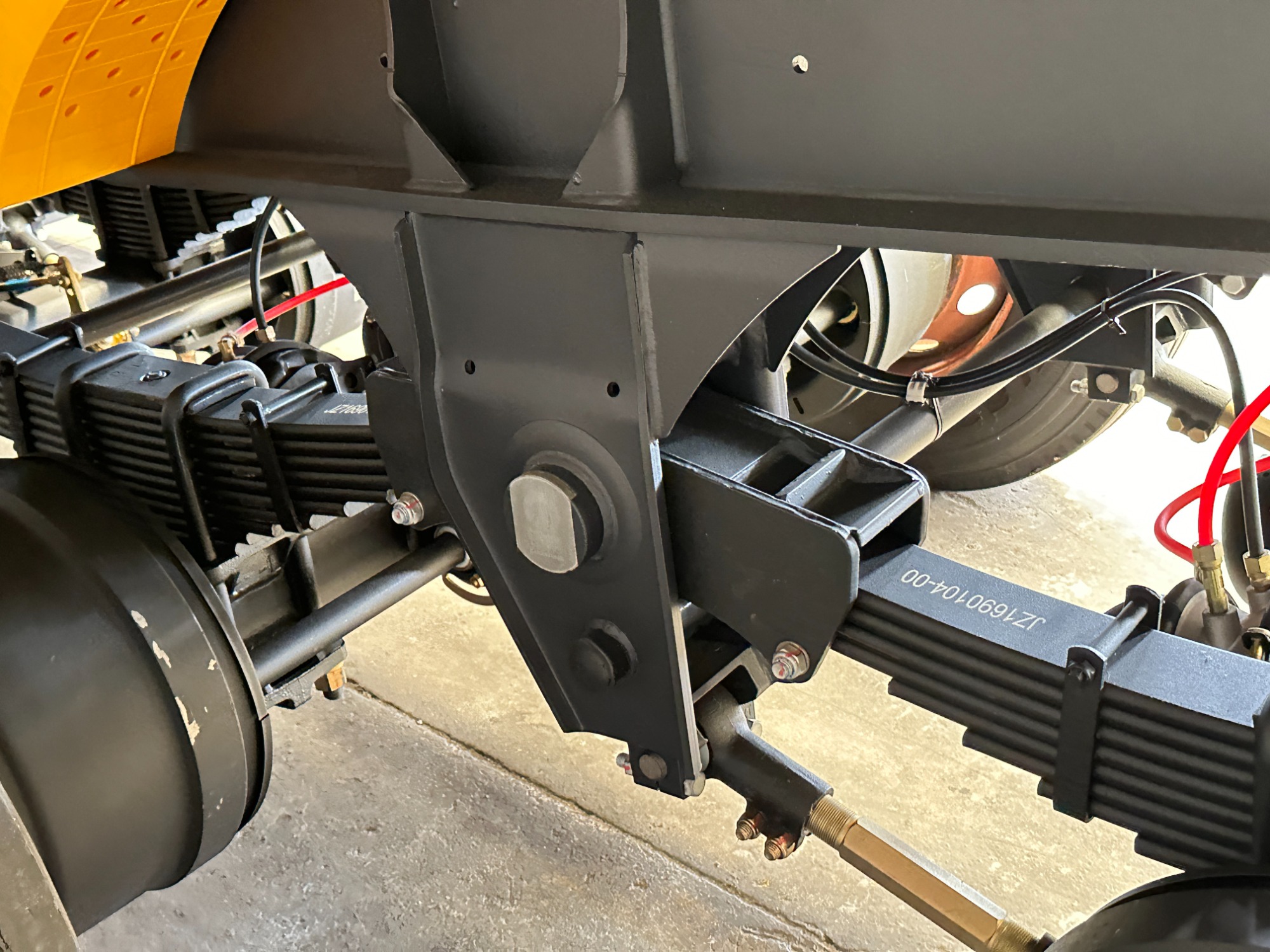
Dump Trailer Hydraulic Tipping System | LUCKSUN Product Details
Before requesting a quotation, prepare the following information:
1. Cargo information
Specify whether you transport sand, gravel, granite, laterite, ore or construction waste.
2. Body dimensions
Confirm whether 9.6 meters refers to the internal cargo body length, external body length or another measurement.
3. Payload requirements
Provide your expected cargo weight and the tractor head information. The manufacturer should check the complete combination and applicable road limits.
4. Axle and suspension
Confirm the number of axles, axle rating, suspension type, tire size and braking requirements.
5. Hydraulic system
Explain the intended unloading frequency, loading method and working environment.
6. Export requirements
Confirm the destination port, shipping arrangement, documentation and any applicable conformity or inspection requirements before production and shipment.
For companies transporting general construction materials rather than loose bulk cargo, a side wall semi-trailer may be worth comparing.
For machinery and other equipment, a low-bed semi-trailer may be more appropriate. A flatbed semi-trailer is another option for general cargo and construction materials.
LUCKSUN focuses on semi-trailers and trailer components for international commercial vehicle markets.
For customers in Nigeria, the most important part of a trailer quotation is not simply the listed price. It is whether the proposed configuration matches the actual cargo, working environment and local transportation requirements.
LUCKSUN can discuss customized dump trailer solutions based on:
Cargo body dimensions and volume.
Rear-tipping or side-tipping structures.
Cargo floor and sidewall material.
Axle quantity and configuration.
Mechanical or air suspension options.
Tire and braking system requirements.
Hydraulic lifting arrangements.
Export and shipping requirements.
Customers can also explore the wider LUCKSUN semi-trailer product range to compare different trailer types and supporting components.
Instead of choosing a trailer from a standard specification sheet alone, provide your cargo information and operating requirements first. This makes it easier to evaluate the appropriate design and avoid unnecessary configuration costs.
It is commonly considered for transporting sand, gravel, crushed stone, laterite, construction waste and selected bulk materials. Its final suitability depends on cargo weight, body volume, road conditions and legal loading limits.
Yes, provided the cargo body, floor, chassis, axle system and suspension are engineered for the intended granite size and operating conditions. Large stones create greater impact and abrasion, so ordinary sand-transport specifications may not be sufficient.
It can be suitable for certain mining and quarry transportation tasks. Buyers should specify the material type, loading method, expected daily operating cycles and road conditions before selecting the body and running gear.
There is no fixed volume based on length alone. The usable capacity depends on the internal width, sidewall height and cargo body design. Actual loading must also comply with the permitted vehicle and axle weights.
A 3-axle configuration may be appropriate for many heavy-duty applications, but suitability must be checked against the tractor head, axle group, axle spacing, gross combination weight and applicable Nigerian regulations.
A common rear-tipping design uses a telescopic hydraulic cylinder connected to a hydraulic power source from the tractor head. Cylinder capacity and lifting geometry should be selected according to the trailer design and working load.
Customization can be discussed according to cargo type, body dimensions, material selection, axle configuration, suspension, tires and hydraulic requirements. Final specifications are subject to technical confirmation.
Buyers should provide the required body length, cargo type, estimated payload, axle configuration, tractor head details, destination port and preferred equipment. Photos or reference drawings can also help clarify the requirements.
A 9.6-meter dump trailer can be a practical option for Nigerian construction companies, quarry operators, mining contractors and bulk-material transport businesses.
Its real value comes from selecting the right cargo body, hydraulic lifting system, chassis, axles, suspension and tires for the intended application.
For buyers, the best approach is to start with the cargo and operating conditions rather than choosing a trailer based only on its advertised length or capacity.
If you are looking for a 9.6-meter dump trailer for Nigeria, contact LUCKSUN with your cargo type, expected payload, tractor head specifications and destination port. Our team can discuss a suitable configuration and prepare a quotation based on your requirements.
A 9.6-meter dump semi-trailer is designed for transporting and unloading bulk materials in construction, mining, quarrying and infrastructure projects. It can be configured for sand, gravel, crushed stone, laterite and other suitable loose materials. LUCKSUN offers customizable cargo body dimensions, steel options, axle configurations and hydraulic tipping systems to match different operating conditions in Nigeria.
A 9.6-meter dump semi-trailer is designed for transporting and unloading bulk materials in construction, mining, quarrying and infrastructure projects. It can be configured for sand, gravel, crushed stone, laterite and other suitable loose materials. LUCKSUN offers customizable cargo body dimensions, steel options, axle configurations and hydraulic tipping systems to match different operating conditions in Nigeria.
Suitable for construction material transportation, quarry operations, mining projects, road building and selected agricultural applications. The trailer configuration can be adjusted according to cargo density, loading equipment, road conditions and unloading requirements. Reinforced body structures and suitable running gear can be specified for demanding working environments.
LUCKSUN supports customized dump trailer solutions based on cargo type, body dimensions, payload requirements, axle arrangement, suspension, tire specifications and hydraulic system design. Before ordering, buyers should confirm tractor head compatibility, applicable Nigerian road regulations, axle-load distribution, export documentation and destination port requirements.
