


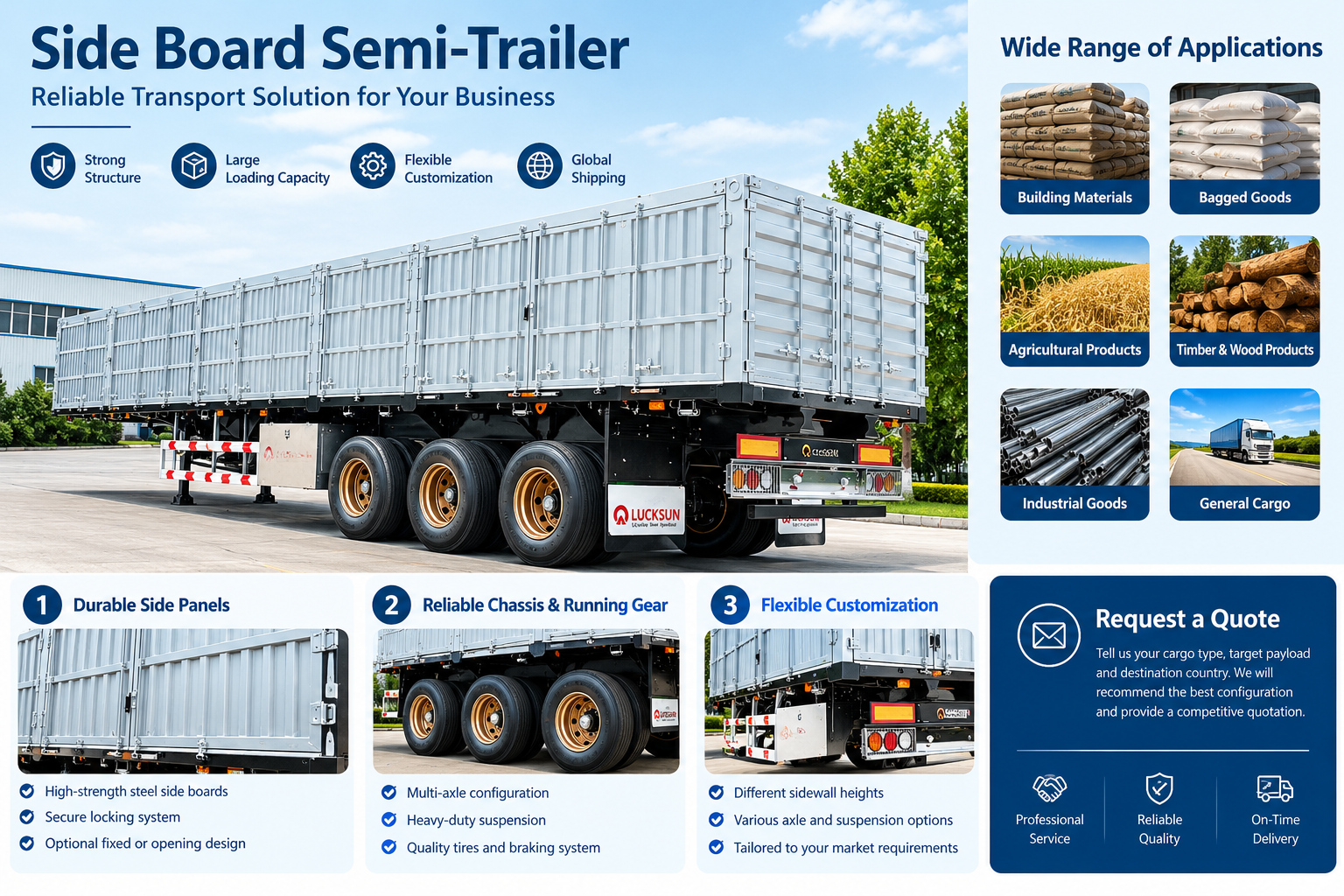
A side board semi-trailer, also known as a sidewall semi-trailer or sideboard cargo trailer, is designed to transport general freight using a flat cargo platform surrounded by metal side panels.
The side panels provide additional lateral containment compared with an open flatbed trailer, making this configuration suitable for a wide range of commercial transport applications. Depending on the design, the panels may be fixed, removable or capable of opening in sections.
Side board semi-trailers are commonly considered by logistics operators, construction material suppliers, agricultural businesses, fleet owners and commercial vehicle importers looking for a flexible cargo transport solution.
However, not every side board trailer is suitable for every type of cargo. The right configuration depends on load dimensions, weight distribution, loading methods, road conditions and destination-market requirements.
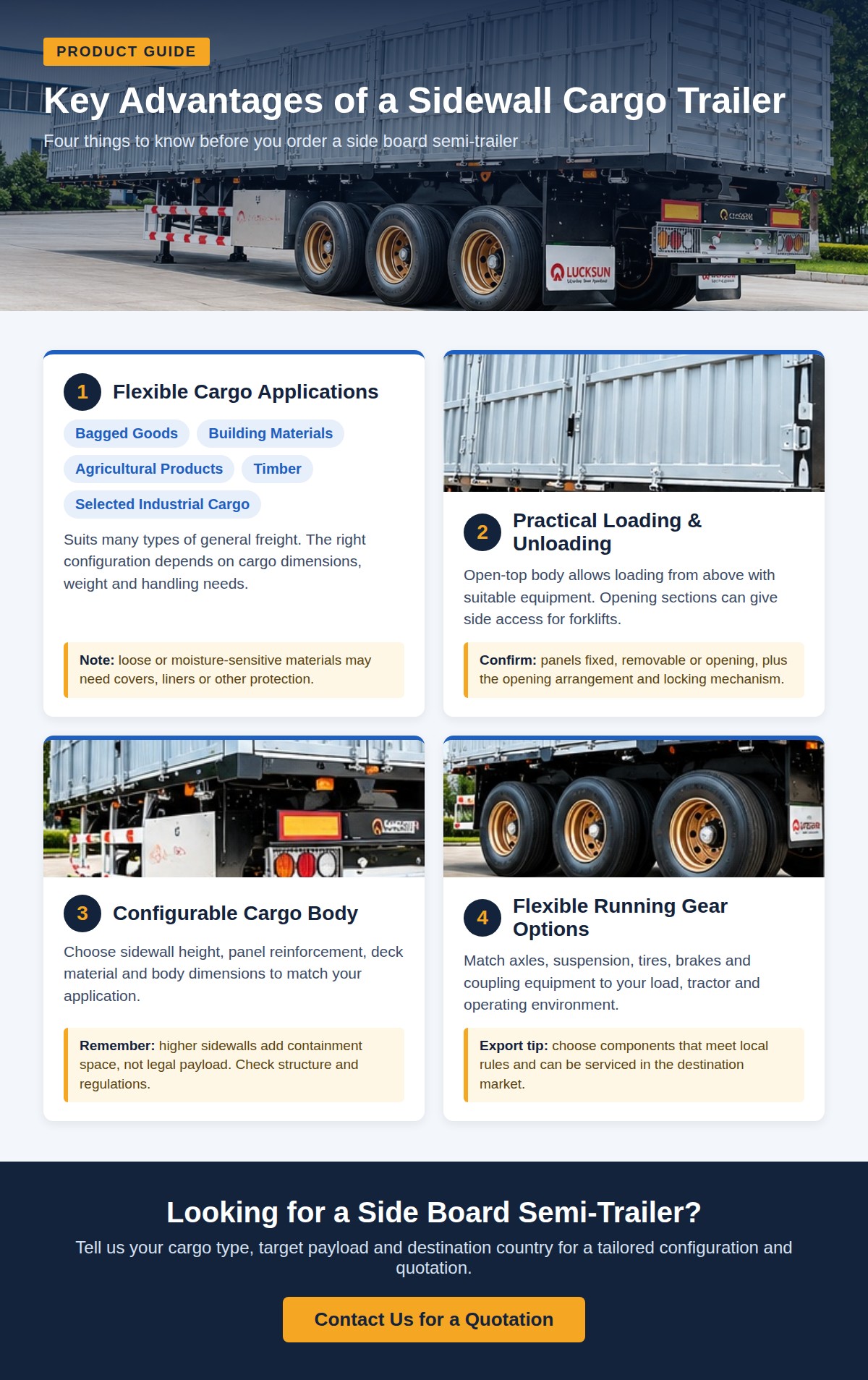
A side board trailer can accommodate many types of general freight, including bagged goods, building materials, agricultural products, timber and selected industrial cargo.
The appropriate configuration depends on the dimensions, weight and handling requirements of the cargo. Loose or moisture-sensitive materials may require suitable covers, liners or other cargo-protection measures.
An open-top cargo body allows loading from above when suitable equipment is available. Depending on the side-panel design, opening sections can also provide side access for forklifts and other material-handling equipment.
Before ordering, confirm whether the panels are fixed, removable or opening, and check the actual opening arrangement and locking mechanism.
Sidewall height, panel reinforcement, deck material and body dimensions can be selected according to the intended application.
Higher sidewalls may provide additional containment space for suitable bulky cargo, but they do not automatically increase the trailer's legal payload. The final configuration must be assessed against structural requirements and applicable regulations.
Axle configuration, suspension, tires, braking components and coupling equipment should be matched to the intended load, tractor and operating environment.
For export buyers, selecting components that meet local requirements and can be serviced in the destination market can help simplify long-term fleet maintenance.
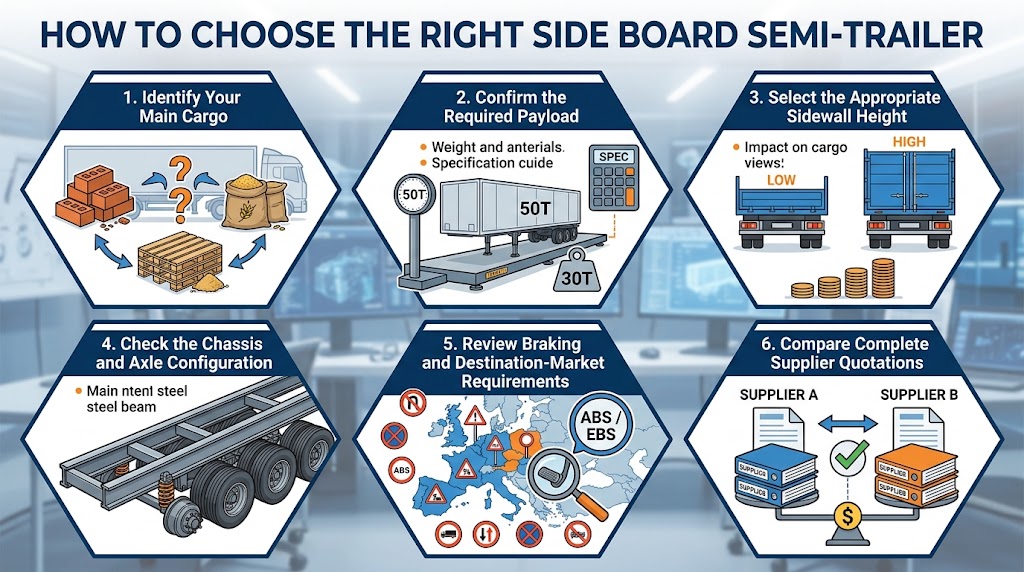
Start by defining what the trailer will carry most frequently. Building materials, palletized goods, agricultural products and industrial components may have different loading and restraint requirements.
Consider cargo weight, dimensions, stacking method and loading equipment before choosing the sidewall structure.
The trailer's rated payload should be established from its approved design, tare weight, axle-load limits, tractor capacity and the applicable legal limits.
Do not select a trailer based only on a supplier's maximum advertised tonnage. Ask for the relevant technical specification and confirm the permissible operating weight in your destination market.
Sidewall height affects cargo containment, loading access, body weight and the type of freight the trailer can accommodate.
Lower panels may suit cargo that requires frequent side access. Higher panels may be appropriate for certain bulky loads or specific transport operations.
The best choice depends on the cargo and the trailer's structural design rather than height alone.
The main beam, cross-members, deck and running gear must be suitable for the intended loading conditions.
Confirm the axle quantity, axle rating, suspension type, tire size, kingpin specification and landing gear before finalizing the order.
For frequent operation on uneven roads or demanding routes, discuss the appropriate chassis and suspension configuration with the supplier.
Braking systems, ABS or EBS availability, lighting, overall dimensions and axle loads may be subject to different requirements in different countries.
Provide your destination country and, where possible, the applicable vehicle standards before production. A configuration suitable for one market may require changes for another.
A reliable comparison should cover the complete specification rather than the headline price alone.
Check which components are included, the material and structural specifications, warranty conditions, spare parts, inspection arrangements, production lead time and shipping terms.
Make sure that the final quotation, technical drawing and agreed bill of materials describe the same product.
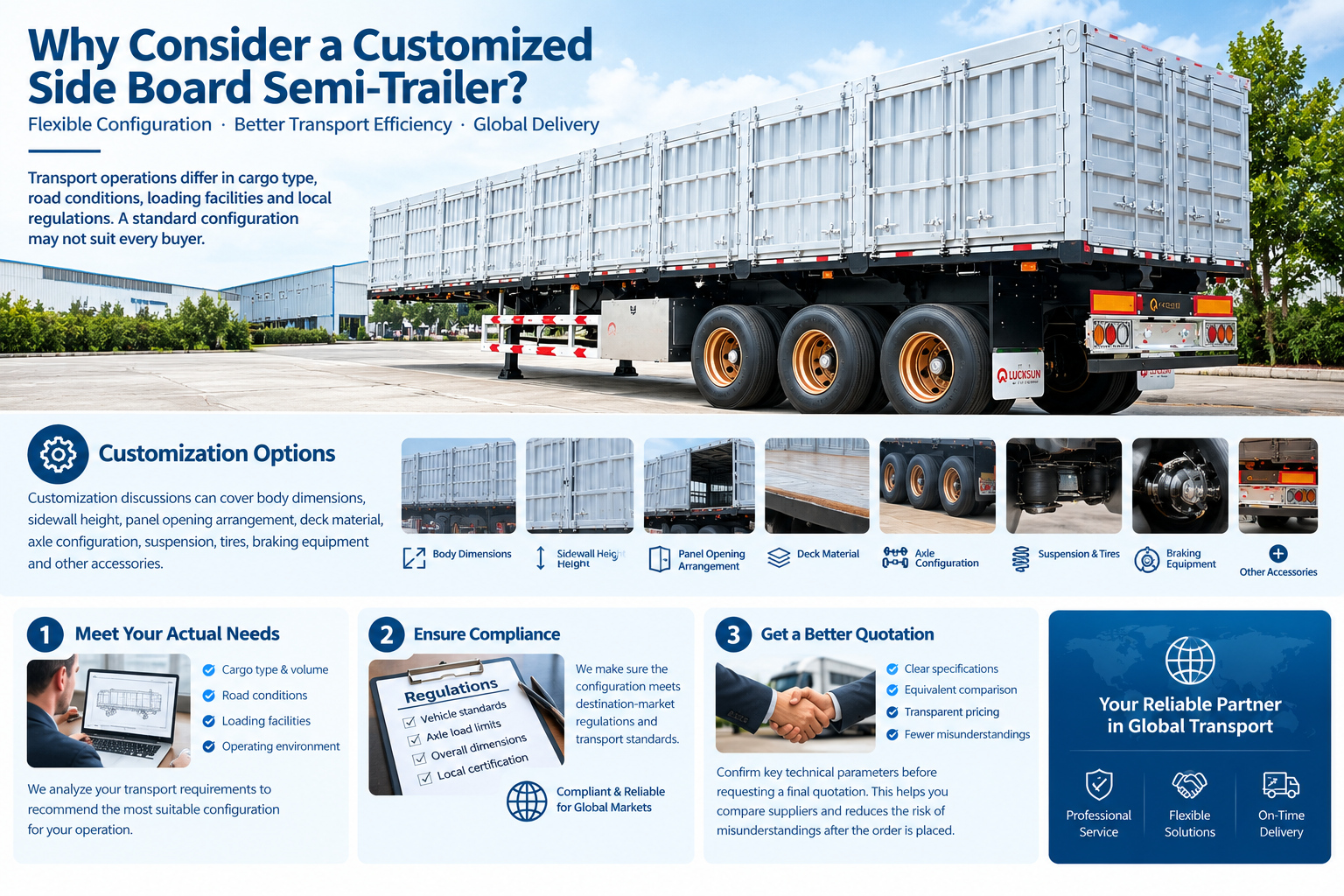
Transport operations differ in cargo type, road conditions, loading facilities and local regulations. A standard configuration may not suit every buyer.
Customization discussions can cover body dimensions, sidewall height, panel opening arrangement, deck material, axle configuration, suspension, tires, braking equipment and other accessories.
For international procurement, the objective is to identify a practical configuration that meets the buyer's actual operating requirements while remaining compliant with destination-market regulations.
We recommend confirming the key technical parameters before requesting a final quotation. This makes it easier to compare suppliers and reduces the risk of misunderstandings after an order is placed.
Q1: What is the difference between a side board semi-trailer and a flatbed semi-trailer?
A flatbed semi-trailer has an open cargo platform without conventional enclosing side panels. A side board semi-trailer adds metal side panels to help contain cargo. The appropriate choice depends on the type of freight, loading method and required cargo restraint.
Q2: Can the side panels be opened?
That depends on the selected design. Some trailers use fixed panels, while others have opening sections or removable panels. Confirm the exact opening arrangement before ordering.
Q3: What cargo can a side board semi-trailer transport?
Typical applications include building materials, bagged goods, agricultural products, timber and general freight. Cargo suitability depends on weight distribution, dimensions, restraint requirements and the trailer's technical specification.
Q4: Can the sidewall height and payload be customized?
Sidewall height and other structural parameters may be customizable, subject to engineering feasibility and applicable regulations. Payload must be confirmed through the approved design and relevant weight limits.
Q5: What information do I need to request a quotation?
Please provide your destination country, cargo type, target payload, required dimensions, sidewall height, preferred components and order quantity. A reference photo or technical drawing is also helpful.
Side Board Semi-Trailer for Sale – Heavy-Duty Sidewall Cargo Trailer
Our side board semi-trailer is designed for the transportation of general cargo, building materials, bagged goods, agricultural products and other suitable freight.
Featuring a steel cargo platform and sectional metal side panels, this trailer provides practical cargo containment while allowing flexible loading and unloading according to the body configuration. It is suitable for transport operators, fleet owners, construction material suppliers and commercial vehicle importers.
The trailer can be configured according to cargo requirements, payload targets, road conditions and destination-market regulations. Options may include sidewall height, opening arrangement, axle configuration, suspension, tires, braking system and other components, subject to technical confirmation.
The right side board semi-trailer should match your cargo, loading process and local operating conditions.
We welcome inquiries from trailer importers, fleet operators, logistics companies, construction material suppliers and commercial vehicle distributors looking for a suitable cargo transport solution.
Share your destination market, cargo requirements and preferred configuration to discuss technical specifications, customization options and export quotations.
Contact us today to discuss your side board semi-trailer requirements.
Looking for a Side Board Semi-Trailer for Your Market?
Tell us what you need to transport, your target payload and your destination country. We will help you review the suitable trailer configuration and prepare a quotation based on your requirements.
Send us your inquiry to discuss specifications, customization and export options.
The Side Board Semi-Trailer is a versatile cargo transport solution designed for commercial freight operations. Its flat cargo deck and metal side panels help contain and organize loads while supporting practical loading and unloading.
Compared with an open flatbed trailer, a side board trailer provides additional lateral cargo containment. Depending on the sidewall design, cargo can be loaded from the top, rear or sides. Opening side panels can improve forklift access, while fixed panels may be more suitable for applications where a simpler body structure is preferred.
This trailer can be configured for different cargo types, payload requirements and operating environments. Sidewall height, panel construction, deck material, axle arrangement and running gear should be selected according to the intended application.
For export orders, we recommend confirming the cargo dimensions, target payload, tractor compatibility and destination-country requirements before finalizing the technical specification.
Contact us with your requirements to discuss a suitable side board semi-trailer configuration and quotation.
1. Sectional Metal Side Panels
The side panels provide lateral cargo containment and help organize general freight during transportation. Panel height, reinforcement, opening arrangement and locking hardware should be selected according to the cargo and operating requirements.
2. Heavy-Duty Chassis Structure
The chassis supports the cargo platform and running gear. Main beam dimensions, steel grade, cross-member arrangement and welding specifications should be confirmed against the required payload and engineering design.
3. Practical Loading and Unloading
The open-top design supports top loading, while suitable side-opening panels can improve access for forklifts and other handling equipment. Actual access depends on the panel design and opening mechanism.
4. Configurable Running Gear
Axles, suspension, tires, wheels and landing gear can be specified according to the intended payload, tractor compatibility, road conditions and destination-market regulations.
5. Braking and Electrical Systems
The braking configuration, ABS or EBS availability, lighting system, voltage and electrical connections should be confirmed for the target market and towing vehicle.
6. Export-Oriented Configuration
Dimensions, coupling components, tires, paint color and optional accessories can be discussed for different export requirements. Final specifications are subject to engineering confirmation and applicable regulations.
Typical Applications
Building materials, including bricks, steel products and construction supplies.
Bagged cargo, packaged goods and palletized freight.
Agricultural products, subject to appropriate cargo protection.
Timber, pipes and other suitable general cargo.
Regional and long-distance commercial freight transportation.
Customization Options
Depending on the selected design, buyers may specify sidewall height, opening arrangement, cargo deck material, axle quantity, axle brand, mechanical or air suspension, tire size, braking system, kingpin, landing gear, paint color and accessories.
For international orders, the configuration should be reviewed against local road regulations, permissible axle loads, overall dimensions and tractor compatibility.
Information to Include in Your Inquiry
Please provide your destination country, cargo type, target payload, preferred trailer dimensions, required sidewall height, tractor specifications and order quantity.
If you have a reference photo, technical drawing or an existing trailer configuration, please share it with your inquiry. This helps us prepare a more relevant specification proposal and quotation.
