


Choosing the right wheel rim is about more than finding a wheel with the correct diameter. For commercial trucks and semi-trailers, the rim must match the tire, axle hub, bolt pattern, center bore, offset and required load rating.
A mismatch in any of these dimensions can lead to installation problems, unsuitable wheel positioning or incorrect load application.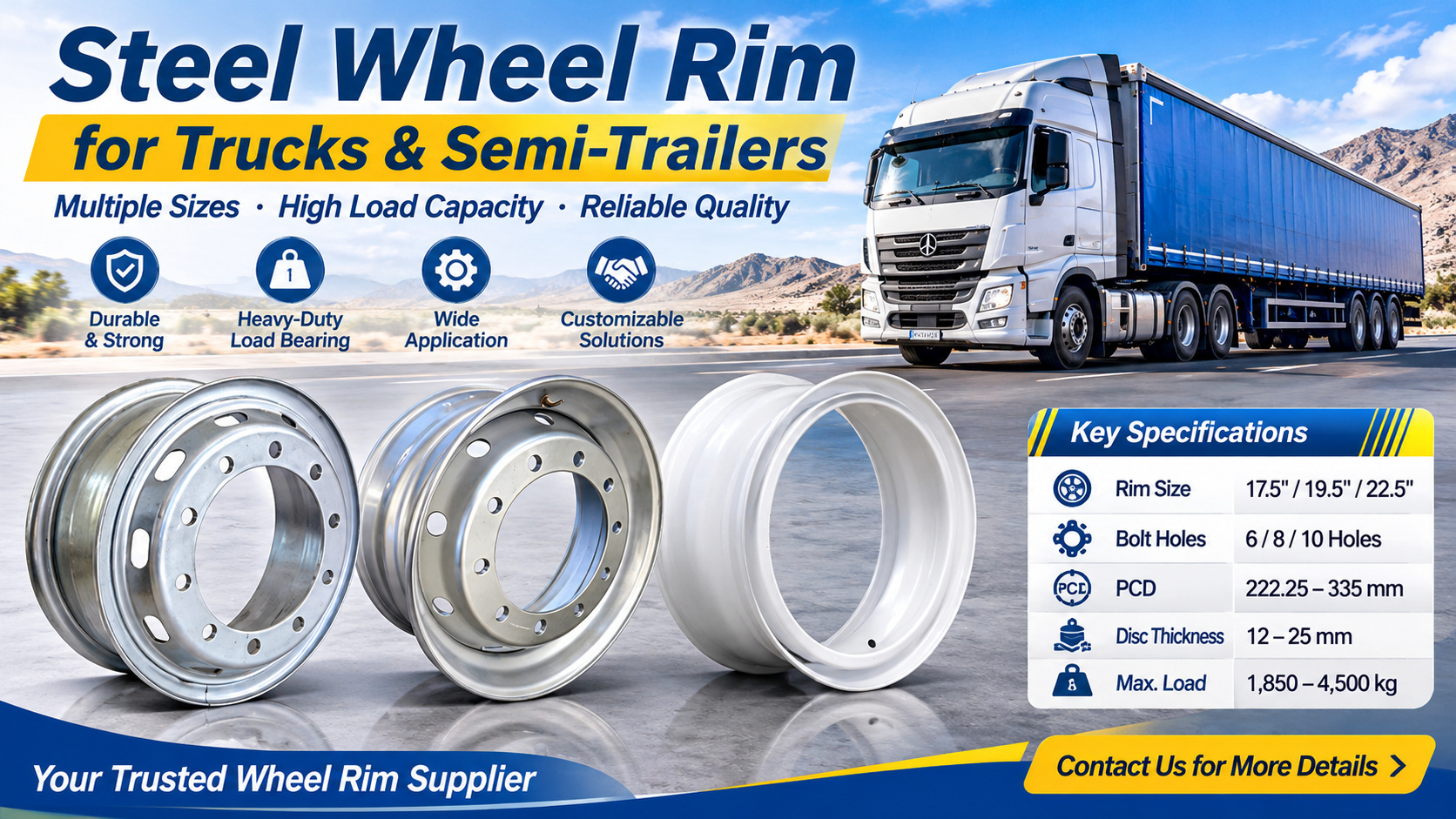
Steel wheel rims for trucks and semi-trailers with multiple sizes PCD patterns and load ratings
LUCKSUN steel wheel rims for commercial trucks and semi-trailers, available in multiple sizes and mounting configurations. Featuring different PCD patterns, bolt-hole arrangements, disc thicknesses and load ratings, these wheel rims are designed for a range of commercial vehicle and trailer applications.
LUCKSUN offers a range of steel wheel rim configurations for commercial vehicle and semi-trailer applications. The available reference catalog covers multiple wheel sizes, mounting patterns and load specifications, giving buyers more options when sourcing replacement rims or components for new trailer projects.
Whether you are a trailer parts distributor, fleet operator, importer or maintenance company, this guide explains the main specifications, how to identify a compatible wheel rim and what to check before ordering.
A wheel rim is the metal component that supports the tire and connects the tire assembly to the vehicle's wheel hub.
On a commercial truck or semi-trailer, the wheel rim must withstand the loads and forces associated with cargo weight, road conditions, braking and repeated operation.
Steel wheel rims for trucks and semi-trailers with multiple sizes PCD patterns and load ratings
A suitable rim needs to meet several requirements:
Correct wheel diameter and width
Compatible tire size
Matching bolt-hole arrangement
Correct Pitch Circle Diameter (PCD)
Suitable center bore or hub-pilot dimensions
Correct offset
Adequate rated load capacity
These dimensions work together. A rim with the correct diameter may still be unsuitable if its mounting pattern or center bore does not match the axle hub.
For buyers sourcing complete running-gear components, it is useful to review the LUCKSUN semi-trailer parts range alongside the wheel rim specifications.
The supplied reference catalog includes several wheel rim series for different commercial vehicle applications.
The 22.5-inch series includes:
22.5 × 7.50
22.5 × 8.25
22.5 × 9.00
22.5 × 11.75
These configurations are listed with different disc thicknesses, mounting patterns, offsets and maximum load values.
The reference tire sizes include 10R22.5, 11R22.5, 12R22.5 and 385/65R22.5.
The catalog also includes:
17.5 × 6.00
17.5 × 6.75
19.5 × 6.75
These options have different PCD and bolt-hole arrangements from the larger 22.5-inch series.
The reference list includes additional configurations:
6.5–16
6.5–20
7.0–20
7.5–20
8.0–20
8.5–20
These sizes have their own mounting dimensions and corresponding tire specifications.
The full model information is provided in the technical table below.
The following table is transcribed from the supplied LUCKSUN reference product chart.
| Item No. | Rim Size | Disc Thickness (mm) | Bolt Holes | P.C.D. (mm) | C.B.D. (mm) | Offset (mm) | Max. Load (kg) | Suitable Tires |
|---|---|---|---|---|---|---|---|---|
| 354001 | 22.5×8.25 | 14 | 10-Ø26 | 335 | 281 | 165 | 3600 | 11R22.5 |
| 354002 | 22.5×9.00 | 14 | 10-Ø26 | 335 | 281 | 161 | 4250 | 12R22.5 |
| 354003 | 22.5×9.00 | 14 | 10-Ø26 | 335 | 281 | 153 | 4250 | 12R22.5 |
| 354004 | 22.5×9.00 | 16 | 10-Ø26 | 335 | 281 | 175 | 4250 | 12R22.5 |
| 354005 | 22.5×11.75 | 14 | 10-Ø26 | 335 | 281 | 120 | 3750 | 385/65R22.5 |
| 354006 | 22.5×11.75 | 25 | 10-Ø26 | 335 | 281 | 120 | 4500 | 385/65R22.5 |
| 354007 | 22.5×11.75 | 25 | 8-Ø32.5 SR22 | 285 | 221 | 120 | 4500 | 385/65R22.5 |
| 354008 | 22.5×8.25 | 14 | 10-Ø26 | 335 | 281 | 100 | 3600 | 11R22.5 |
| 354009 | 17.5×6.00 | 12 | 6-Ø32.5 SR22 | 222.25 | 164 | 130 | 1850 | 8R17.5 |
| 354010 | 17.5×6.75 | 12 | 10-Ø26 | 225 | 176 | 140 | 2350 | 9R17.5 |
| 354011 | 19.5×6.75 | 12 | 8-Ø26 | 275 | 221 | 140 | 2350 | 9R19.5 |
| 354012 | 22.5×7.50 | 14 | 10-Ø26 | 335 | 281 | 110 | 3000 | 10R22.5 |
| 354013 | 22.5×7.50 | 14 | 10-Ø26 | 285.75 | 221 | 165 | 3000 | 10R22.5 |
| 354014 | 22.5×7.50 | 14 | 8-Ø32.5 SR22 | 285 | 221 | 165 | 3000 | 10R22.5 |
| 354015 | 22.5×7.50 | — | — | — | — | 110 | 3000 | 10R22.5 |
| 354016 | 22.5×8.25 | — | — | — | — | 120 | 3600 | 11R22.5 |
| 354017 | 22.5×9.00 | — | — | — | — | 130 | 4250 | 12R22.5 |
| 354018 | 6.5–16 | 12 | 6-Ø32.5 SR22 | 222.25 | 164 | 140 | 2000 | 8.25–16 |
| 354019 | 6.5–20 | 14 | 8-Ø26 | 275 | 221 | 145 | 2400 | 8.25–20 |
| 354020 | 7.0–20 | 14 | 10-Ø26 | 285.75 | 220 | 162 | 2800 | 9.00–20 |
| 354021 | 7.0–20 | 14 | 8-Ø32.5 SR22 | 285 | 221 | 162 | 2800 | 9.00–20 |
| 354022 | 7.5–20 | 14 | 10-Ø26 | 335 | 281 | 165 | 3200 | 10.00–20 |
| 354023 | 7.5–20 | 14 | 8-Ø32.5 SR22 | 285 | 221 | 165 | 3000 | 10.00–20 |
| 354024 | 8.0–20 | 14 | 10-Ø26 | 335 | 281 | 173 | 3350 | 11.00–20 |
| 354025 | 8.5–20 | 14 | 10-Ø26 | 335 | 281 | 175 | 3800 | 12.00–20 |
Important specification notes:
The table reproduces the values shown in the supplied product chart.
A dash indicates that the corresponding specification is not provided in the reference image.
The PCD value of 285 mm for certain models is retained as printed; it should not be automatically changed to 285.75 mm.
The listed maximum load is a reference value per wheel rim as presented in the catalog. It is not the axle capacity or the trailer payload.
Final specifications, fitment and rated load must be confirmed against the approved product drawing and manufacturer documentation before ordering.
When comparing commercial wheel rims, several technical terms appear repeatedly in product catalogs. Understanding them helps buyers avoid selecting an incompatible configuration.
Rim size describes the wheel diameter and width.
For example, 22.5 × 9.00 indicates a nominal 22.5-inch wheel diameter and 9.00-inch rim width.
Both dimensions need to be compatible with the intended tire.
Disc thickness refers to the thickness of the wheel disc that connects the rim section to the hub mounting area.
The supplied catalog includes disc thickness values of 12 mm, 14 mm, 16 mm and 25 mm.
Disc thickness should be considered together with the wheel's design and rated load. A thicker disc alone does not prove that one wheel is suitable for every heavy-duty application.
Bolt-hole specifications identify the number and diameter of the mounting holes.
Examples from the reference catalog include:
10-Ø26
8-Ø26
8-Ø32.5 SR22
6-Ø32.5 SR22
The number, diameter and seat type must match the wheel fastening arrangement.
PCD is the diameter of the imaginary circle passing through the centers of the wheel mounting holes.
The supplied catalog includes several PCD configurations, including 222.25 mm, 225 mm, 275 mm, 285 mm, 285.75 mm and 335 mm.
A wheel with the wrong PCD should not be installed simply because its overall diameter and width appear correct.
C.B.D. refers to the center bore dimension shown in the product chart.
It is an important mounting measurement, particularly for hub-piloted wheel arrangements.
The reference catalog lists different C.B.D. values, including 164 mm, 176 mm, 220 mm, 221 mm and 281 mm.
The actual hub interface and centering method must be confirmed before selecting a replacement.
Offset describes the position of the wheel mounting surface relative to the wheel centerline.
It affects how the wheel sits in relation to the hub, axle and adjacent wheel.
Different offsets can influence wheel clearance and the overall wheel position. Buyers should use the approved axle and wheel specifications rather than selecting an offset based only on appearance.
Wheel and tire compatibility is one of the most important considerations when purchasing commercial vehicle rims.
A tire must be suitable for the rim's diameter and width, while the complete wheel assembly must also meet the required load and operating specifications.
The supplied catalog provides several tire references:
| Wheel Rim Size | Suitable Tire Shown in Reference Chart |
|---|---|
| 22.5×7.50 | 10R22.5 |
| 22.5×8.25 | 11R22.5 |
| 22.5×9.00 | 12R22.5 |
| 22.5×11.75 | 385/65R22.5 |
| 17.5×6.00 | 8R17.5 |
| 17.5×6.75 | 9R17.5 |
| 19.5×6.75 | 9R19.5 |
| 6.5–16 | 8.25–16 |
| 6.5–20 | 8.25–20 |
| 7.0–20 | 9.00–20 |
| 7.5–20 | 10.00–20 |
| 8.0–20 | 11.00–20 |
| 8.5–20 | 12.00–20 |
These are reference pairings from the supplied product chart. The final tire selection should also follow the tire manufacturer's approved rim-width range, load index and speed requirements.
For more information about tire selection, see the LUCKSUN semi-trailer tire guide.
One common purchasing mistake is selecting a wheel rim by size alone.
For example, two 22.5 × 9.00 rims may have the same nominal diameter and width but different mounting details.
A complete comparison should include:
Rim diameter and width
PCD
Center bore diameter
Bolt-hole quantity and diameter
Nut-seat or bolt-seat design
Offset
Disc thickness
Maximum rated load
Tire compatibility
The mounting arrangement is especially important when replacing an existing wheel.
A wheel with a different center bore or bolt-seat design may not be compatible with the existing hub and fasteners, even if the PCD appears similar.
For buyers sourcing a complete trailer axle kit, wheel rim specifications should be confirmed together with the hub, bearings, axle and braking arrangement.
Commercial steel wheel rims are used across different vehicle and trailer applications. The correct configuration depends on the axle system, tire specification, load requirement and intended operation.
Flatbed trailers are commonly used to transport steel products, construction materials, machinery and general cargo.
Wheel rims should match the selected tire and axle configuration.
Explore the LUCKSUN flatbed semi-trailer range.
Container chassis trailers are designed for transporting shipping containers between ports, terminals, warehouses and distribution centers.
Wheel selection should consider the axle mounting arrangement, tire dimensions and operating load.
Dump trailers are used for sand, gravel, aggregates and other bulk materials.
Their wheel and tire specifications should be selected according to the approved axle configuration and operating requirements.
Lowbed trailers transport excavators, loaders and other heavy machinery.
For these applications, the wheel assembly must be suitable for the trailer's engineering design and rated operating conditions.
Different wheel sizes and mounting patterns are used across commercial vehicle platforms.
When sourcing replacement rims, fleet operators should identify the original wheel specifications and check compatibility before placing an order.
For additional running-gear components, review the LUCKSUN leaf spring range.
Before requesting a quotation, buyers should prepare the information needed to identify the correct wheel.
If the original rim is available, inspect its stamped markings.
These may identify the rim size, manufacturer, production information and other relevant specifications.
However, stamped markings should still be checked against the actual mounting requirements.
Confirm the PCD, bolt-hole quantity, bolt-hole diameter and center bore.
Do not estimate these measurements from a photograph.
Provide the exact tire size and confirm that the tire manufacturer approves the selected rim width.
The wheel's rated load must be suitable for the intended application.
The complete vehicle load distribution, axle capacity, tire rating and operating conditions must also be considered.
A wheel's maximum load value should never be treated as the trailer's allowable payload.
Confirm the axle manufacturer or model where available.
The hub-piloted or stud-piloted arrangement, fastening hardware and mounting geometry must be compatible.
For related wheel-end components, review the LUCKSUN SKF bearing range and trailer brake drum products.
Wheel rims are exposed to repeated loading, vibration, braking forces and road impacts.
Regular inspection is important for commercial vehicles and semi-trailers.
Recommended inspection points include:
Wheel disc and rim surface
Check for visible cracks or deformation.
Inspect for severe corrosion.
Look for impact damage around the rim flange.
Check for abnormal wear or damage near the mounting area.
Mounting holes and fastening points
Inspect bolt holes for elongation or damage.
Check wheel studs and nuts.
Confirm the correct fasteners and nut-seat arrangement.
Follow the manufacturer's tightening procedure and torque specifications.
Tire and wheel assembly
Check tire pressure according to the tire manufacturer's recommendations.
Inspect tire wear and sidewall condition.
Check for visible damage around the bead area.
Confirm that the tire and rim combination is approved for the application.
A damaged wheel rim should be assessed by a qualified technician. Cracked or structurally damaged wheels should not be returned to service without an approved repair or replacement decision.
For broader maintenance guidance, see the LUCKSUN semi-trailer components guide.
For international buyers, a suitable wheel rim supplier should be able to provide clear product information and support accurate specification matching.
LUCKSUN focuses on semi-trailers and related spare parts for international markets.
Our product range covers wheel rims and other running-gear components used in commercial trailer applications.
Multiple Reference Configurations
The available wheel rim catalog includes different sizes, PCD patterns, mounting arrangements, offsets and listed load ratings.
Application-Based Selection
Wheel rim requirements can be reviewed according to tire size, axle hub specifications and the intended trailer application.
Related Spare Parts
Buyers can also discuss related trailer components, including axles, bearings, brake parts and suspension products.
International B2B Supply
LUCKSUN welcomes inquiries from importers, distributors, fleet operators, maintenance companies and semi-trailer manufacturers.
You can explore our semi-trailer parts catalog for additional components and product categories.
For complete trailer projects, visit the LUCKSUN website to review available semi-trailer solutions.
The supplied reference catalog includes 17.5-inch, 19.5-inch and 22.5-inch wheel rim series, as well as selected 6.5–8.5-inch rim sizes for 16–20-inch applications.
It indicates a nominal 22.5-inch wheel diameter and an 8.25-inch rim width. The tire must be approved for this rim size.
They describe different bolt-circle diameters. The mounting holes are positioned on circles of different diameters, so the wheel must match the corresponding hub and fastening arrangement.
C.B.D. refers to the center bore diameter shown in the specification. It is an important measurement for confirming wheel-to-hub compatibility.
Offset describes the position of the wheel mounting surface relative to the wheel centerline. It affects the installed wheel position and clearance within the vehicle assembly.
Start by checking the tire manufacturer's approved rim-width range. Then confirm the PCD, center bore, bolt-hole arrangement, offset and rated load against the existing axle and hub specifications.
No. The rated load must match the actual vehicle and axle requirements. A wheel with a higher listed load rating is not automatically suitable if its mounting dimensions or tire compatibility are incorrect.
You can provide photographs, stamped markings, technical drawings or detailed measurements for preliminary identification. Final product selection should be confirmed against the approved dimensions and technical specifications.
LUCKSUN welcomes inquiries from importers, distributors, wholesalers and fleet operators. Please provide the required sizes, specifications, quantities and destination country for quotation.
Looking for steel wheel rims for commercial trucks or semi-trailers?
LUCKSUN welcomes inquiries for replacement wheel rims, trailer spare parts and related running-gear components.
To help identify the correct configuration, please provide:
Required rim size
PCD and center bore diameter
Bolt-hole quantity and diameter
Offset and disc thickness
Suitable tire size
Required load rating
Quantity and destination country
Existing product number or technical drawing, if available
Our team can review your requirements and discuss suitable product configurations and quotation details.
Contact LUCKSUN today for wheel rim specifications and a competitive quotation.
LUCKSUN – Semi-Trailers and Spare Parts for Global Markets.
Product Overview
LUCKSUN steel wheel rims are designed for commercial trucks, semi-trailers and other compatible heavy-duty vehicle applications.
The available reference range covers multiple wheel sizes, including 17.5-inch, 19.5-inch and 22.5-inch configurations, as well as selected 16-inch and 20-inch wheel series.
Different mounting specifications are available, including various PCD values, bolt-hole arrangements, center bore dimensions and offsets.
These options allow buyers to compare wheel rim configurations according to their existing axle, hub and tire requirements.
Technical Specifications
The reference product catalog includes 25 item numbers, from 354001 to 354025.
Key specifications include:
Wheel sizes: 17.5, 19.5 and 22.5 inches, plus 6.5–8.5-inch rim series for 16–20-inch applications
Disc thickness: 12–25 mm in the listed configurations
Bolt-hole arrangements: 6-hole, 8-hole and 10-hole
PCD options: 222.25, 225, 275, 285, 285.75 and 335 mm
C.B.D. options: 164, 176, 220, 221 and 281 mm
Offset options: 100–175 mm
Listed maximum load: 1,850–4,500 kg
Please refer to the product specification table for individual model details.
Applications & Customization
Suitable for consideration in commercial truck and semi-trailer wheel assemblies, replacement parts sourcing, fleet maintenance and trailer manufacturing projects.
Before ordering, buyers should confirm wheel size, bolt-hole pattern, PCD, center bore, offset, disc thickness, tire compatibility and required load rating.
LUCKSUN welcomes inquiries from trailer parts distributors, importers, wholesalers, fleet operators and vehicle manufacturers.
Send us your required item number, technical drawing or existing wheel rim specifications for product confirmation and quotation.