
Semi Trailer Components: A Complete Guide
A Complete Guide to Parts, Functions and Selection
A semi-trailer is more than a steel frame with wheels. It is an integrated transportation system made up of structural components, running gear, braking equipment, coupling devices, electrical systems and cargo-supporting structures.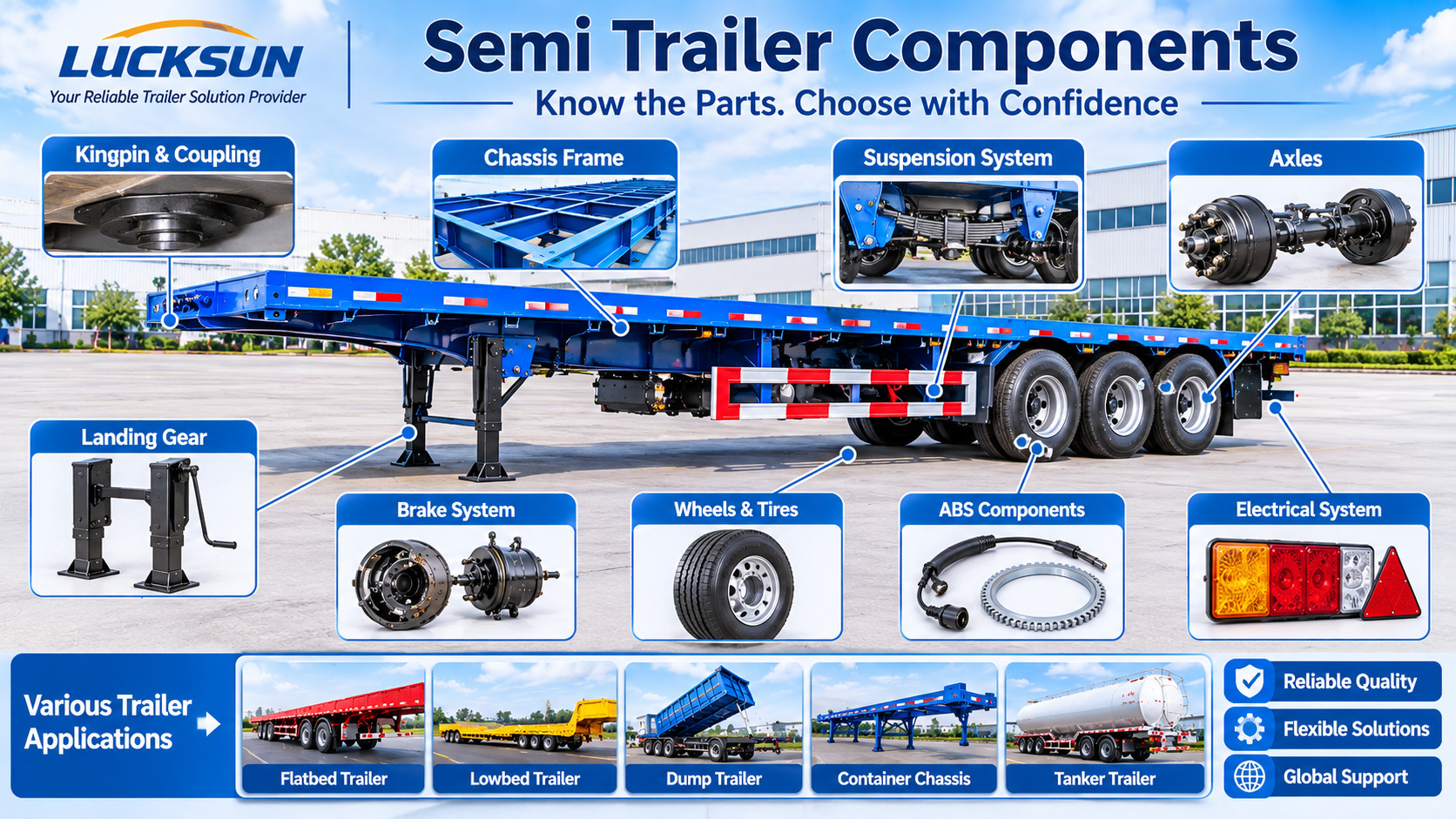
Explore the essential semi trailer components and their functions, from chassis and axles to braking, suspension and electrical systems
Every component has a specific function, and the compatibility between these components directly affects load distribution, road performance, operational safety and maintenance costs.
For fleet operators, trailer dealers, importers and transportation companies, understanding semi trailer components is essential when purchasing new trailers, sourcing replacement parts or planning long-term maintenance.
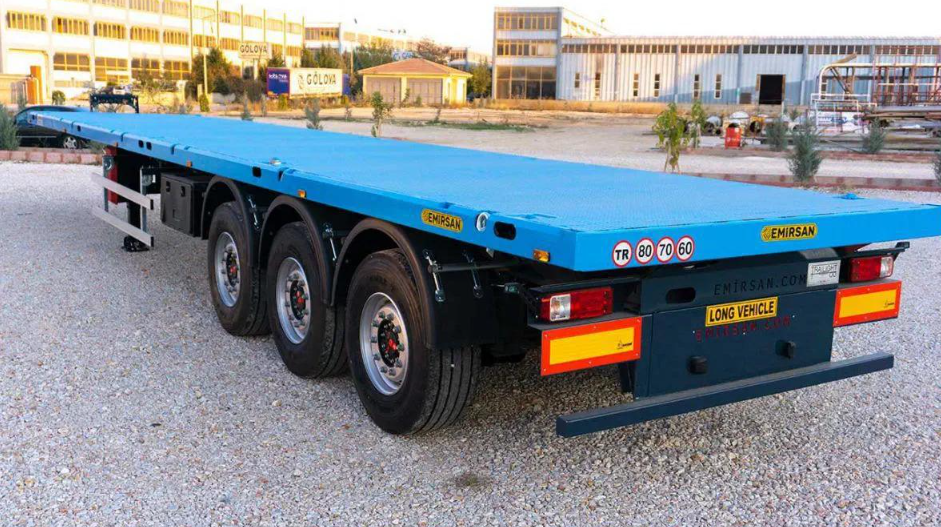
This guide explains the main components of a semi-trailer, how each system works, what buyers should check before purchasing, and how to select suitable trailer parts for different operating conditions.
1. What Are Semi Trailer Components?
Semi trailer components refer to the structural assemblies, mechanical systems and replacement parts used to manufacture, operate and maintain a semi-trailer.
Unlike a powered truck tractor, a conventional semi-trailer does not have its own engine or independent driving system. It connects to a tractor through a kingpin and fifth-wheel coupling arrangement and carries part of the combined vehicle load through its own axle group.
The main semi trailer components can be divided into several categories:
-
Chassis frame and structural components
-
Kingpin and coupling components
-
Landing gear and support systems
-
Trailer axles and suspension systems
-
Wheels, hubs and tires
-
Braking and ABS systems
-
Electrical wiring and lighting equipment
-
Cargo bodies and load-securing accessories
-
Hydraulic and specialized operating components
Although these systems have different functions, they must work together as a complete assembly.
For example, selecting a different axle configuration may affect suspension positioning, brake compatibility, tire selection and overall load distribution.
This is why professional trailer parts purchasing should consider the complete application rather than focusing on individual components alone.
2. Main Structural Components of a Semi-Trailer
The chassis is the foundation of a semi-trailer. It supports the cargo-carrying structure and provides mounting locations for important mechanical assemblies.
2.1 Main Frame and Crossmembers
The main frame generally consists of two longitudinal beams connected by multiple crossmembers and supporting structural members.
Its primary functions include:
-
Supporting the trailer's structural loads
-
Distributing cargo weight across the chassis
-
Providing mounting points for axles and suspension
-
Supporting the landing gear and coupling area
-
Maintaining structural stability during transportation
The frame design varies according to trailer type and operating requirements.
A flatbed trailer, for example, requires an open cargo platform, while a lowbed trailer needs a lower loading deck to accommodate construction machinery and oversized equipment.
When evaluating a trailer frame, buyers should consider material specifications, beam dimensions, crossmember arrangement, welding quality, reinforcement design and corrosion protection.
A heavier frame does not automatically mean a better trailer. The complete structural design must match the intended load and operating conditions.
2.2 Kingpin and Coupling Plate
The kingpin is one of the most important semi trailer components because it connects the trailer to the towing tractor.
It is normally installed underneath the front coupling area of the trailer.
When the tractor's fifth wheel locks onto the kingpin, the connection allows the tractor and trailer to articulate while transmitting towing and braking forces.
The coupling assembly generally involves:
-
Kingpin
-
Upper coupling plate or skid plate
-
Mounting structure
-
Fifth-wheel interface
The fifth wheel belongs to the tractor, while the kingpin and trailer-side coupling plate belong to the semi-trailer.
Buyers should confirm the required kingpin standard, dimensions, mounting arrangement and compatibility with the tractor's fifth wheel.
Incorrect specifications may cause coupling difficulties and operational risks.
2.3 Landing Gear
Landing gear supports the front portion of a semi-trailer when it is disconnected from the tractor.
It allows the trailer to remain standing independently during loading, unloading, parking and coupling operations.
A typical landing gear assembly includes:
-
Inner and outer support legs
-
Gearbox
-
Operating crank handle
-
Cross shaft
-
Mounting brackets
-
Foot pads or support plates
Mechanical landing gear is commonly used on flatbed trailers, container chassis, dump trailers and other conventional semi-trailers.
The selection of landing gear should consider static support capacity, lifting range, mounting height, ground conditions and operating frequency.
For heavy-duty applications, the mounting structure and synchronized operation of both legs deserve particular attention.
3. Trailer Axle and Suspension Components
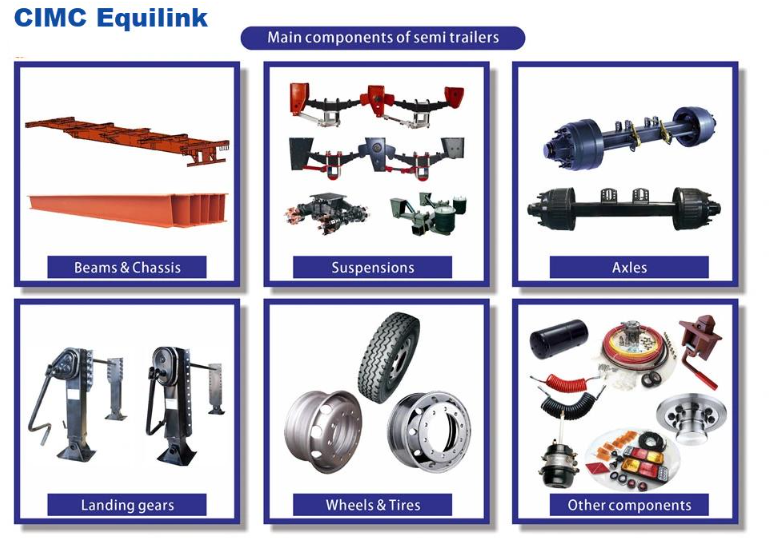
The axle and suspension system is one of the most important assemblies of a semi-trailer.
It supports the trailer's running load, maintains wheel alignment and helps control movement when traveling over different road surfaces.
3.1 Trailer Axle Assembly
A trailer axle transfers forces between the wheel ends and suspension system.
Depending on the application, axle assemblies may be supplied in different load ratings, track widths, brake configurations and mounting arrangements.
Common axle components include:
-
Axle beam
-
Spindles
-
Wheel hubs
-
Bearings
-
Brake assemblies
-
Oil seals
-
ABS sensor components
The axle configuration may include two, three or more axles depending on trailer design, payload requirements and local regulations.
When purchasing trailer axles, buyers should confirm axle load rating, track width, suspension mounting dimensions, brake type, hub specifications and wheel compatibility.
3.2 Trailer Suspension System
The suspension system connects the axle assembly to the trailer frame.
Its main functions are to support the load, absorb road impacts, maintain wheel contact and help control trailer movement.
Two common suspension configurations are mechanical suspension and air suspension.
Mechanical Suspension
Mechanical suspension commonly uses leaf springs, brackets, equalizers, U-bolts and related mounting hardware.
It is widely used in heavy-duty trailers, particularly in markets where straightforward maintenance and durable construction are important.
Air Suspension
Air suspension uses air springs and associated control components to support the trailer and help maintain its designed ride height.
Depending on the configuration, it may provide improved ride characteristics and adjustable suspension height.
Before purchasing suspension components, check axle spacing, spring centers, mounting dimensions, ride height, load rating and compatibility with the existing chassis.
3.3 Wheels, Hubs and Tires
Wheels, hubs and tires form the trailer's wheel-end and road-contact system.
The hub connects the wheel to the axle spindle, while bearings allow the wheel to rotate under load.
Tires provide traction and support the trailer during transportation.
Common purchasing considerations include:
-
Tire size and load index
-
Wheel rim dimensions
-
Bolt pattern
-
Hub configuration
-
Bearing specifications
-
Wheel offset and mounting compatibility
For international orders, buyers should confirm the tire and wheel standards required in the destination market.
A tire with the correct physical dimensions may still be unsuitable if its load rating or application requirements are incorrect.
4. Trailer Braking and ABS Components
The braking system is essential for controlling the movement of a loaded semi-trailer.
It must be properly matched to the trailer's axle configuration, operating weight and applicable vehicle regulations.
4.1 Air Brake System
Many heavy-duty semi-trailers use pneumatic braking systems.
A typical air brake arrangement may include:
-
Air reservoirs
-
Brake chambers
-
Brake valves
-
Air hoses and pipelines
-
Slack adjusters
-
Brake drums or discs
-
Brake shoes and related hardware
When braking is activated, compressed air operates the brake mechanism and generates the force required to slow down the trailer.
The specific configuration varies according to the braking design and vehicle application.
4.2 Drum Brakes and Air Disc Brakes
Drum brakes and air disc brakes are two common braking configurations.
Drum brakes use brake shoes that press against the internal surface of a rotating brake drum.
Air disc brakes use a caliper to apply pressure to brake pads against a rotating disc.
The appropriate system depends on the intended application, operating environment, maintenance arrangements, vehicle specifications and local requirements.
4.3 ABS Components
The Anti-lock Braking System (ABS) helps prevent wheel lock-up during braking under applicable operating conditions.
Typical trailer ABS components include:
-
Electronic control unit
-
Wheel-speed sensors
-
Tone rings
-
Electrical connections
-
Sensor mounting brackets
Correct installation and compatibility between the ABS equipment and braking system are essential.
When replacing ABS parts, buyers should confirm the existing system configuration, sensor type, connector arrangement and relevant part numbers.
5. Electrical System and Lighting Components
The electrical system provides power and signal connections between the tractor and semi-trailer.
It supports lighting, braking signals and other electrical functions depending on the trailer configuration.
Common electrical components include:
-
Main electrical harness
-
Electrical connectors
-
Side marker lights
-
Tail lights
-
Brake lights
-
Turn signal lights
-
Reflective safety markings
-
Junction boxes and wiring accessories
Proper wiring protection is important because trailer electrical components are exposed to vibration, moisture, dust and changing operating conditions.
For replacement purchases, confirm the operating voltage, connector type, wiring arrangement, lamp specifications and destination-market requirements.
6. Cargo Body and Specialized Trailer Components
Different semi-trailer types require different body structures and specialized accessories.
The chassis and running gear may share similar basic principles, but the cargo-carrying structure and operating equipment can vary considerably.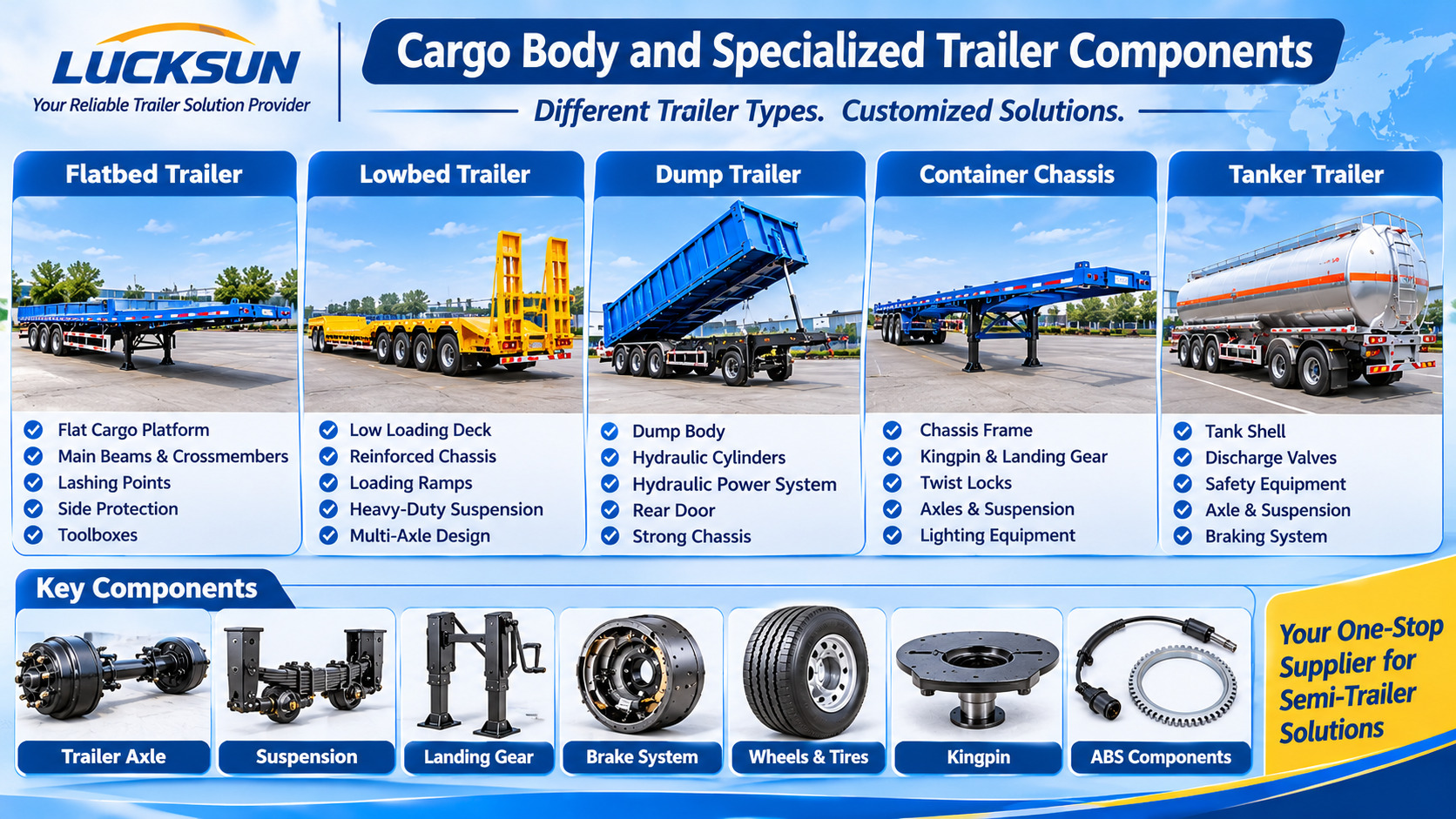
Explore the specialized components of different semi-trailer types, including cargo bodies, hydraulic systems, axles, suspension and load-securing equipment
6.1 Flatbed Trailer Components
Flatbed trailers are designed for transporting containers, steel products, construction materials and other general cargo.
Important components include:
-
Flat cargo platform
-
Main beams and crossmembers
-
Container twist locks, where applicable
-
Side protection structures
-
Cargo lashing points
-
Toolboxes and accessories
Buyers should pay attention to platform dimensions, deck structure, cargo-securing arrangements and axle configuration.
6.2 Lowbed Trailer Components
Lowbed trailers are designed for transporting heavy machinery, construction equipment and oversized loads.
Their specialized components may include:
-
Low loading deck
-
Reinforced chassis
-
Detachable or fixed gooseneck, depending on design
-
Loading ramps
-
Hydraulic or spring-assisted ramp mechanisms
-
Multiple axle configurations
-
Heavy-duty suspension
The loading height, deck width, ramp capacity, ground clearance and axle-load distribution should be evaluated according to the machinery being transported.
6.3 Dump Trailer Components
Dump trailers are commonly used for transporting sand, gravel, aggregates and other bulk materials.
Their main specialized components may include:
-
Dump body
-
Hydraulic cylinders
-
Hydraulic power system
-
Hydraulic hoses and connections
-
Rear door and locking mechanism
-
Reinforced chassis
-
Axle and suspension assembly
The hydraulic system must be matched to the body dimensions, lifting geometry and intended cargo application.
6.4 Container Chassis Components
Container chassis are designed to transport shipping containers.
Important components include:
-
Chassis frame
-
Kingpin
-
Landing gear
-
Axles and suspension
-
Twist locks
-
Brake system
-
Wheels and tires
-
Lighting equipment
The number and position of twist locks must match the intended container dimensions and chassis design.
6.5 Tanker Trailer Components
Tanker trailers are specialized vehicles for transporting liquid products.
Depending on the design and cargo, their components may include:
-
Tank shell
-
Tank supports
-
Manholes
-
Discharge valves
-
Pipelines and fittings
-
Safety equipment
-
Axle and suspension assemblies
-
Braking and electrical systems
Material selection, tank design, pressure requirements and applicable transport regulations must be confirmed for the intended cargo.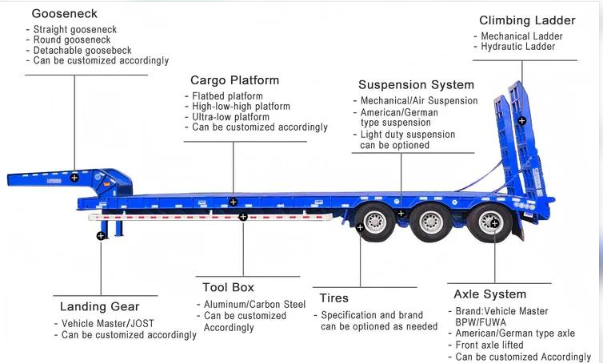
Explore the specialized components of different semi-trailer types, including cargo bodies, hydraulic systems, axles, suspension and load-securing equipment
7. Semi Trailer Components: Functions and Purchasing Checklist
The following table provides a practical reference for buyers comparing semi-trailer components and preparing spare-parts inquiries.
| Component | Main Function | Key Purchasing Considerations |
|---|---|---|
| Chassis frame | Supports the trailer structure and cargo | Material, dimensions, structural design |
| Kingpin | Connects trailer to tractor | Standard, diameter, mounting |
| Landing gear | Supports uncoupled trailer | Static capacity, height, gearbox |
| Trailer axle | Supports running load | Load rating, track width, brake type |
| Suspension | Connects axle to chassis | Type, spacing, mounting dimensions |
| Wheel hub | Connects wheel to axle | Hub type, bearings, bolt pattern |
| Tires and rims | Provide road contact | Size, load index, compatibility |
| Brake system | Controls trailer speed | Brake type, capacity, configuration |
| ABS components | Helps prevent wheel lock-up | Sensor, tone ring, control compatibility |
| Electrical system | Powers lights and signals | Voltage, connectors, wiring |
| Twist locks | Secure shipping containers | Container compatibility, locking arrangement |
| Hydraulic system | Operates specialized mechanisms | Pressure, cylinder dimensions, capacity |
A reliable quotation should identify the exact product specification rather than relying only on a general component name.
8. How to Choose the Right Semi Trailer Spare Parts
Selecting the correct semi trailer spare parts requires more than checking appearance or price.
The following steps can help reduce purchasing errors.
Step 1: Identify the Trailer Type
First, identify whether the parts are intended for a flatbed, lowbed, dump trailer, container chassis, tanker or another trailer configuration.
Different trailer applications require different structural and mechanical arrangements.
Step 2: Confirm Technical Specifications
Provide the relevant dimensions, model numbers, load ratings and mounting information.
For axle and suspension components, important details may include axle track, brake configuration, spring centers and mounting dimensions.
Step 3: Check Component Compatibility
A replacement component must be compatible with the existing assembly.
For example, an axle should be checked against the suspension, brake system, wheel hubs and tires.
Similarly, a landing gear replacement must match the mounting arrangement and required operating height.
Step 4: Consider the Operating Environment
Road conditions, cargo type, loading frequency, climate and maintenance availability can all influence component selection.
A trailer operating on demanding construction routes may require different specifications from one primarily used for highway transportation.
Step 5: Confirm Destination-Market Requirements
Export buyers should check the applicable technical and regulatory requirements in the destination country.
Brake equipment, lighting, axle loading, dimensions and other safety-related specifications may differ between markets.
The supplier should receive the destination market and intended application before the final configuration is confirmed.
9. Common Signs That Semi Trailer Components Need Inspection or Replacement
Regular inspection helps identify component problems before they develop into more serious operational issues.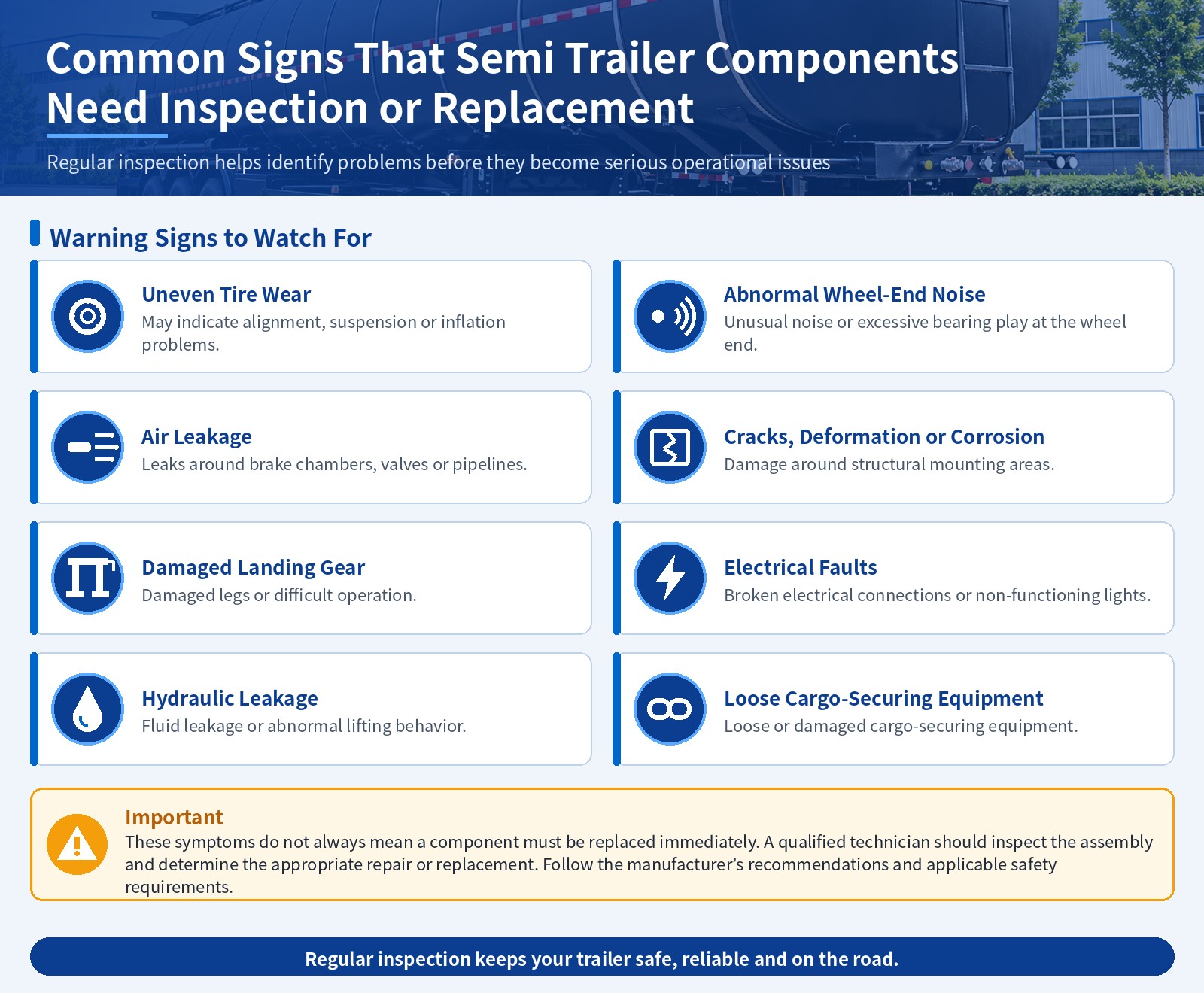
Some common warning signs include:
-
Uneven tire wear, which may indicate alignment, suspension or inflation problems.
-
Abnormal wheel-end noise or excessive bearing play.
-
Air leakage around brake chambers, valves or pipelines.
-
Cracks, deformation or corrosion around structural mounting areas.
-
Damaged landing gear legs or difficult operation.
-
Broken electrical connections or non-functioning lights.
-
Hydraulic leakage or abnormal lifting behavior.
-
Loose or damaged cargo-securing equipment.
These symptoms do not always indicate that a component must be replaced immediately. A qualified technician should inspect the assembly and determine the appropriate repair or replacement procedure.
Maintenance should follow the trailer manufacturer's recommendations and applicable safety requirements.
10. Why Choose LUCKSUN for Semi Trailer Components and Spare Parts?
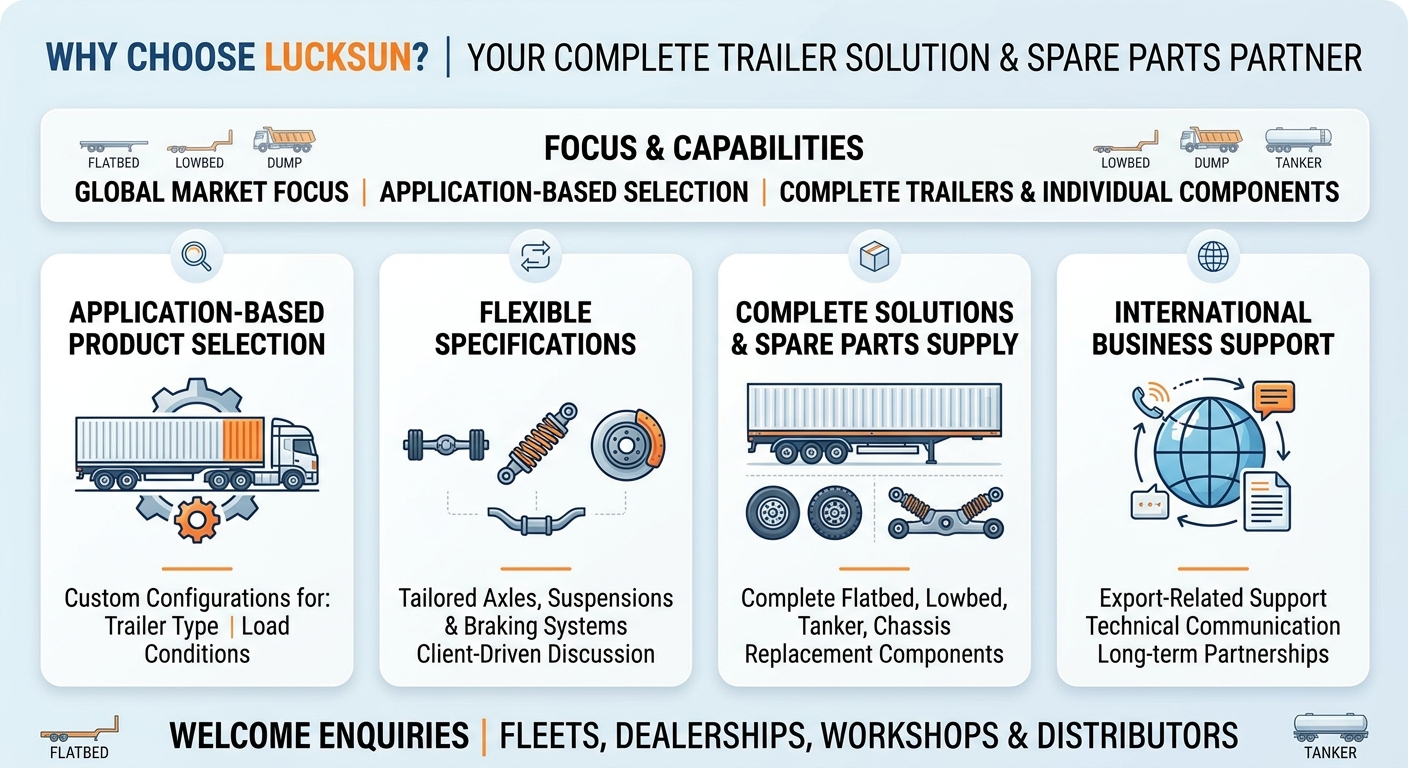
A real-world view of our manufacturing and assembly facilities, showcasing complete semi-trailers, axle assemblies, suspension systems, and packaged spare parts prepared for international dispatch.
At LUCKSUN, we understand that semi-trailer performance depends on the compatibility of the complete vehicle system.
We focus on semi-trailers and related components for international markets, supporting buyers who need complete trailer solutions as well as individual spare parts.
Our product supply covers different trailer applications, including:
-
Flatbed semi-trailers and axle assemblies
-
Lowbed trailers and heavy-duty components
-
Dump trailers and hydraulic-related parts
-
Container chassis and supporting components
-
Tanker trailers and related accessories
-
Trailer axles, suspension systems and landing gear
-
Wheels, hubs, braking equipment and other spare parts
Application-Based Product Selection
We help customers identify suitable product configurations according to trailer type, load requirements and operating conditions.
Flexible Specifications
Different axle specifications, suspension arrangements, braking systems and related components can be discussed according to customer requirements.
Complete Trailer and Spare Parts Supply
Whether you need a complete semi-trailer or individual replacement components, we can discuss suitable supply solutions based on your purchasing requirements.
International Business Support
We provide product information, technical communication, quotation coordination and export-related support for overseas customers.
Our goal is to establish long-term business relationships through practical product solutions, clear communication and dependable supply arrangements.
If you are sourcing semi trailer components for your fleet, dealership, workshop or distribution business, LUCKSUN welcomes your inquiry.
11. Frequently Asked Questions About Semi Trailer Components
Q1. What are the main components of a semi-trailer?
The main components include the chassis frame, kingpin, landing gear, axles, suspension, wheels, tires, braking system, electrical equipment and cargo body. Specialized trailers may also include hydraulic systems, tank equipment, container twist locks and other application-specific parts.
Q2. What are the most commonly replaced semi trailer parts?
Common replacement items include brake pads or shoes, brake drums, wheel bearings, oil seals, tires, air hoses, electrical lights, suspension components and other wear-related parts.
The replacement schedule depends on operating conditions, component specifications and inspection results.
Q3. Are trailer axles interchangeable between different semi-trailers?
Not necessarily. Axle compatibility depends on load rating, track width, brake configuration, suspension mounting dimensions, hub specifications and other installation requirements.
Always confirm the complete specification before ordering a replacement axle.
Q4. What is the difference between mechanical and air suspension?
Mechanical suspension commonly uses leaf springs and related mounting hardware to support the trailer axle.
Air suspension uses air springs and pneumatic control components to support the load and maintain the designed ride height.
The choice depends on trailer application, operating conditions, maintenance preferences and technical requirements.
Q5. Can I purchase semi trailer components separately?
Yes. Buyers can source individual components such as axles, suspension systems, landing gear, kingpins, brake parts, wheel hubs, tires, lighting equipment and other replacement parts.
The required dimensions, specifications and compatibility should be confirmed before ordering.
Q6. What information should I provide when requesting a semi trailer parts quotation?
It is helpful to provide:
-
Trailer type and application
-
Component name and required quantity
-
Existing part number or product model
-
Technical drawings or dimensions
-
Product photos, if available
-
Required specifications and destination country
These details help suppliers identify suitable products and prepare more accurate quotations.
Q7. Does LUCKSUN supply complete semi-trailers as well as spare parts?
Yes. LUCKSUN focuses on semi-trailers and related components, including flatbed, lowbed, dump and container chassis trailers, as well as trailer axles, suspension, landing gear and other spare parts.
A Few Thoughts on Semi Trailer Components
After working with semi-trailers and their components, I have come to realize that a reliable trailer is never defined by just one part. Every component, from the chassis and axles to the suspension and braking system, has its own responsibility. Sometimes, a small component can make a big difference to the performance of the entire vehicle.
I believe choosing trailer parts should never be only about finding the lowest price. What really matters is whether the components are suitable for the application, compatible with the complete trailer and dependable in everyday operation. For buyers, a good purchasing decision today can mean fewer problems and better value over the years.
At LUCKSUN, we believe that understanding our customers' needs is just as important as supplying products. We hope to provide practical solutions, honest communication and lasting cooperation with every customer we work with.
12. Contact LUCKSUN for Semi Trailer Components
Finding the right semi trailer components is an important step toward maintaining reliable transportation operations and controlling long-term maintenance costs.
Whether you are purchasing trailer axles, suspension systems, landing gear, braking equipment or complete semi-trailers, the right specifications and component compatibility should always come first.
Looking for a reliable semi trailer parts supplier in China?
Contact LUCKSUN with your product requirements, technical specifications or drawings.
Our team will be pleased to discuss suitable products and quotation options for your market.
LUCKSUN – Your Reliable Trailer Solution Provider.