


A reliable braking system starts with correctly matched components. For commercial semi-trailers, the brake drum and wheel hub are two important parts of the wheel-end assembly. Their dimensions, mounting positions and compatibility with the axle system directly influence installation accuracy and maintenance requirements.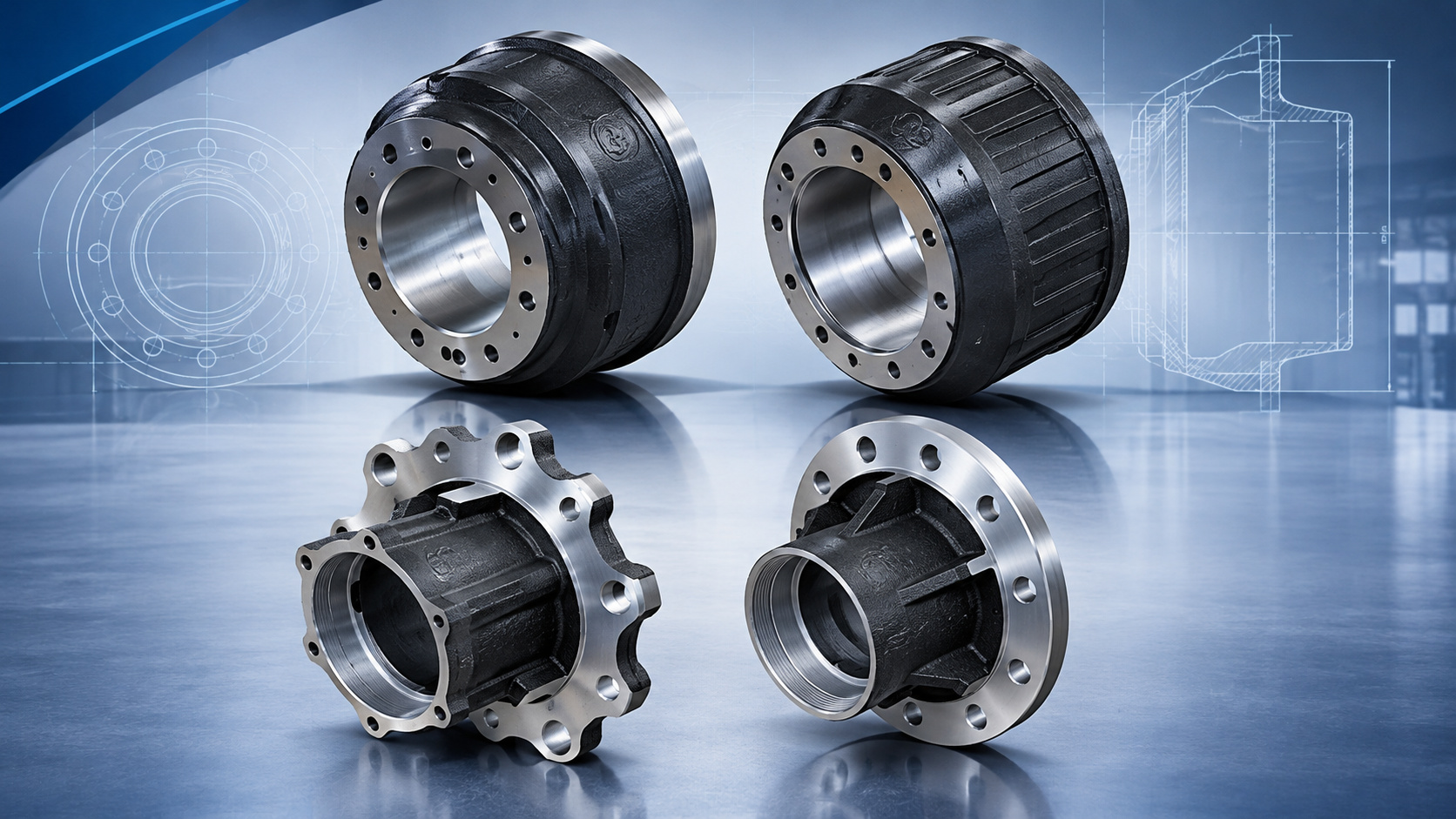
Brake Drum & Hub for Semi-Trailers
LUCKSUN provides brake drum and wheel hub solutions with multiple PCD and mounting dimension configurations for semi-trailer applications. Available reference specifications include 225 mm, 285.75 mm and 335 mm PCD options, covering different mounting arrangements.
Whether you are sourcing replacement parts for an existing trailer, purchasing components for axle assembly production or managing spare parts inventory, checking the complete dimensions is essential before ordering.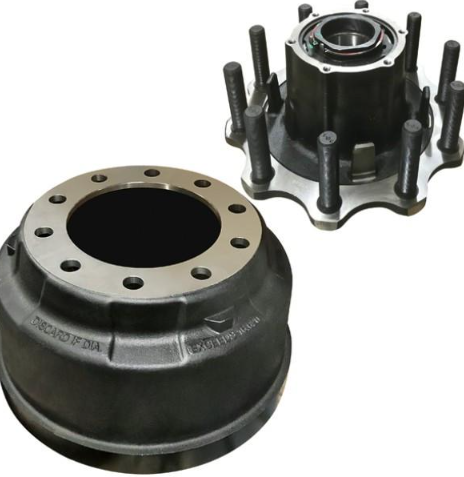
Semi trailer brake drum and wheel hub with multiple PCD mounting configurations
Brake drums and wheel hubs work together in a conventional drum-brake wheel-end system, but they perform different functions.
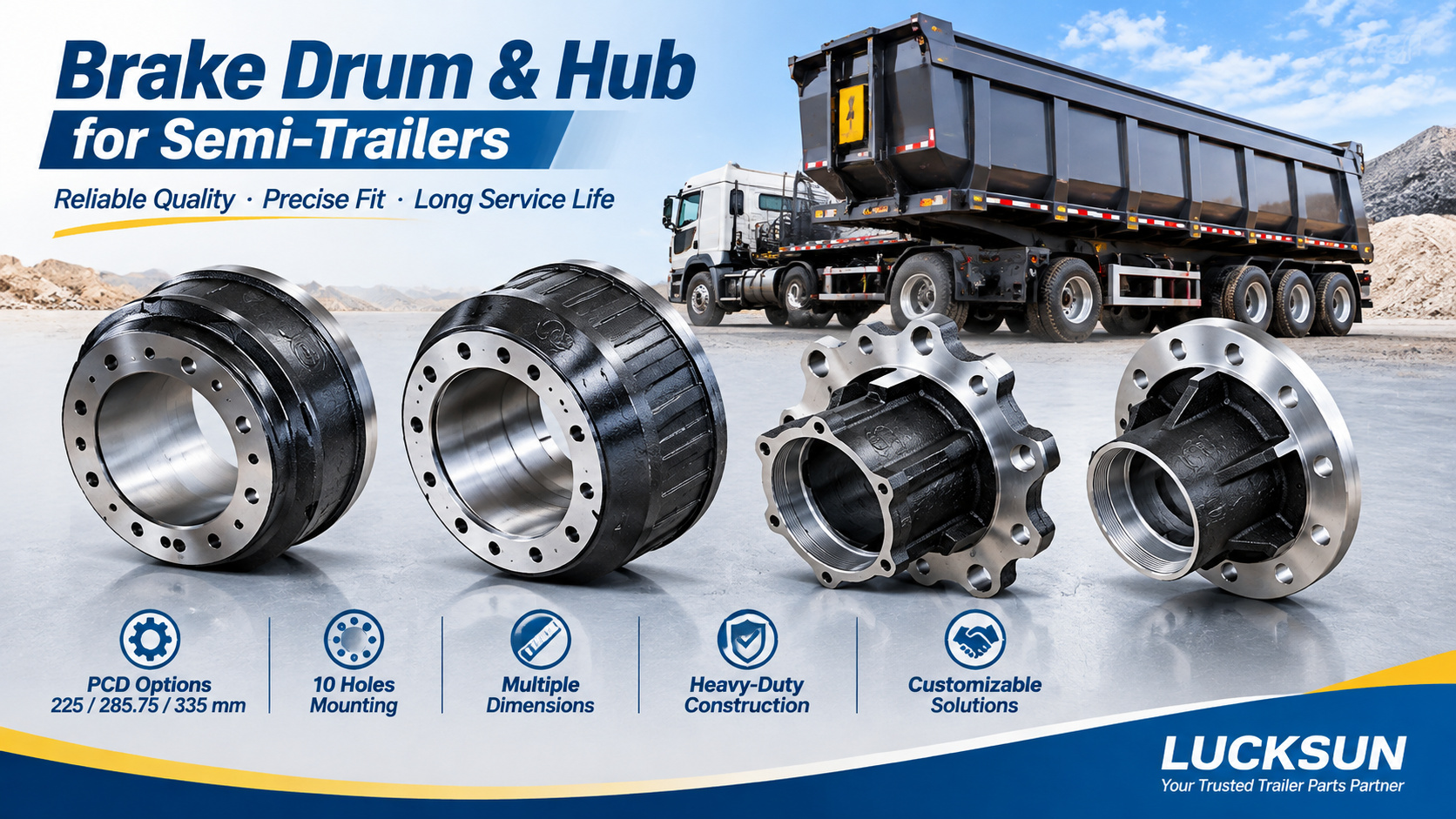
A brake drum is a rotating component connected to the wheel-end assembly. During braking, the brake shoes expand against the drum's internal friction surface, generating friction to slow down the wheel.
A suitable brake drum needs to match the brake shoe dimensions, mounting arrangement and axle configuration.
Important dimensions include:
Pitch Circle Diameter (PCD)
Mounting hole quantity
Mounting hole diameter
Pilot or locating dimensions
Internal braking surface dimensions
Overall depth and height
The wheel hub connects the wheel to the axle spindle and provides the mounting structure for the wheel-end assembly.
Depending on the design, the hub works with bearings, bearing seats, seals, wheel studs and related fastening components.
When purchasing a replacement hub, buyers should check:
Hub mounting dimensions
Bearing seat and spindle compatibility
Wheel bolt pattern
Thread specifications
Overall hub dimensions
Compatibility with the brake drum
For buyers sourcing a complete trailer axle kit, these components should be evaluated as part of the complete axle and braking arrangement rather than as isolated parts.
The product reference drawing shows several brake drum configurations with different PCD values and mounting dimensions.
The following table reproduces the available dimensional data.
| P.C.D. (mm) | A (mm) | B (mm) | C | D (mm) | E (mm) |
|---|---|---|---|---|---|
| 225 | Ø183 | Ø311 | 10-Ø24.3 | 206 | 266 |
| 285.75 | Ø223 | Ø419 | 10-Ø25.4 | 193 | 269 |
| 335 | Ø285.8 | Ø419 | 10-Ø25.4 | 193 | 269 |
| 335 | Ø282 | Ø419 | 10-Ø23.5 | 192 | 246.5 |
| 335 | Ø298 | Ø419 | 10-Ø23.5 | 213 | 285 |
| 335 | Ø290 | Ø420 | 10-Ø23 | 200 | 252 |
| 335 | Ø290 | Ø420 | 10-Ø23 | 225 | 298 |
Note: A, B, C, D and E follow the dimension labels in the supplied product drawing. The C column records the hole quantity and diameter. Other dimension labels should be checked against the original engineering drawing before production or replacement.
PCD stands for Pitch Circle Diameter. It refers to the diameter of the imaginary circle passing through the centers of the mounting holes.
For example:
225 mm PCD
285.75 mm PCD
335 mm PCD
These values describe different mounting patterns. A brake drum with the wrong PCD may not fit the intended hub or wheel-end assembly.
However, PCD alone is not enough to confirm compatibility. The mounting hole diameter, pilot dimensions, braking surface and overall geometry must also match.
Explore the LUCKSUN brake drum product category for related semi-trailer braking components.
The supplied hub drawing includes seven configurations. These options have different PCD values, dimensions and connection details.
| P.C.D. (mm) | A (mm) | B (mm) | C | D | E (mm) |
|---|---|---|---|---|---|
| 225 | Ø152.4 | Ø152.4 | 6.25"-8UNC | 10-Ø24 | 202 |
| 285.75 | Ø152.4 | Ø152.4 | Ø171.45-6xM8 | 10-Ø25 | 205 |
| 285.75 | Ø122 | Ø147 | Ø39.7-6xM8 | 10-Ø25 | 180 |
| 335 | Ø152.4 | Ø152.4 | 6.25"-8UNC | 10-Ø22 | 230 |
| 335 | Ø160 | Ø160 | Ø184-6xM8 | 10-Ø22 | 225 |
| 335 | Ø120 | Ø150 | M135x2 | 10-Ø22 | 205 |
| 335 | Ø150 | Ø200 | M155x3 | 10-Ø22 | 286 |
Note: Dimensions and thread designations are reproduced from the supplied reference drawing. A, B and E are drawing-defined dimensions. The C column contains the connection or thread notation shown in the drawing. Please confirm the original drawing and thread details before placing an order.
Two hubs may have the same PCD but still have different internal dimensions, mounting structures or thread arrangements.
For example, the supplied drawing shows multiple 335 mm PCD hub configurations. Their A and B dimensions, C connection details and E dimensions are not identical.
This means that selecting a hub based only on its PCD may result in an incorrect replacement.
Buyers should also verify the axle spindle, bearing arrangement and wheel mounting interface. If you are sourcing related SKF bearings for trailer wheel ends, confirm bearing dimensions and compatibility with the selected hub.
Choosing the correct wheel-end components requires more than comparing product photographs.
The following checks can help reduce ordering and installation errors.
Measure or identify the original PCD before selecting a replacement.
Common configurations in the supplied drawing include 225 mm, 285.75 mm and 335 mm.
Do not assume that components with similar external appearances share the same mounting pattern.
Confirm the number of holes and their diameters.
The brake drum reference table lists 10 mounting holes for all seven configurations, but the hole diameters differ.
The hub table also shows different hole dimensions across its configurations.
The hub must match the axle spindle and bearing arrangement.
Check the relevant bearing seats, internal dimensions, thread details and mounting position.
If you are replacing a complete axle assembly, review the trailer axle selection guide before confirming the wheel-end components.
The brake drum must be suitable for the existing brake shoe and braking arrangement.
Confirm the internal braking surface dimensions, drum width, mounting geometry and maximum permitted wear dimensions using the relevant technical documentation.
A wheel-end system includes more than the drum and hub.
Depending on the design, the related components may include:
Wheel bearings
Oil seals
Wheel studs and nuts
Hub caps
Brake shoes
Brake chambers
Slack adjusters
For additional information about the relationship between these components, read the LUCKSUN semi-trailer components guide.
Brake drums and wheel hubs are used in many commercial trailer applications equipped with compatible drum-brake axle systems.
Flatbed trailers transport steel products, machinery, construction materials and general cargo.
Their wheel-end components must match the axle design, wheel specifications and operating requirements.
Container chassis trailers are used for transporting standard shipping containers between ports, terminals, warehouses and distribution facilities.
Correct hub and brake drum dimensions are important when replacing wheel-end components.
Dump trailers often operate in construction, mining and aggregate transportation environments.
Their wheel-end components should be selected according to the original axle and braking configuration.
Lowbed trailers transport excavators, loaders and other heavy equipment.
The complete axle and braking arrangement must be matched to the trailer's approved engineering design and operating requirements.
For these applications, buyers should also consider the associated trailer wheel rim specifications and axle configuration.
Regular inspection helps identify wheel-end problems before they lead to more serious failures.
Check the drum for:
Visible cracks
Heat checking or excessive heat damage
Deep scoring or grooves
Abnormal wear
Distortion or out-of-round conditions
Damaged or elongated mounting holes
The brake surface diameter should be checked against the maximum service limit specified by the component manufacturer.
A damaged or excessively worn drum should be evaluated and replaced according to the relevant axle and brake manufacturer's service instructions.
Inspect the hub and related wheel-end components for:
Bearing noise or abnormal movement
Oil or grease leakage
Damaged bearing seats
Worn wheel studs
Damaged threads
Loose or damaged mounting surfaces
When the brake drum is removed, inspect the mating surfaces and locating features before reassembly.
Follow the manufacturer's procedures for bearing lubrication, adjustment, fastening torque and wheel-end installation.
For suspension-related maintenance, you can also review LUCKSUN trailer leaf springs and other running-gear components.
If the trailer is equipped with ABS or EBS, ensure that the related braking and electronic components remain compatible. See the trailer ABS product category for related parts.
For international buyers, accurate technical information makes the quotation and supply process more efficient.
Before requesting a price, prepare the following information:
| Information | What to Provide |
|---|---|
| Product | Brake drum, wheel hub or matched components |
| PCD | 225 / 285.75 / 335 mm or other required size |
| Hole Quantity | Number of mounting holes |
| Hole Diameter | Actual mounting hole diameter |
| Dimensions | Relevant A, B, C, D and E drawing dimensions |
| Axle Brand | Axle manufacturer or axle model |
| Bearing Details | Bearing number or dimensions, where applicable |
| Thread Details | Required thread specification |
| Quantity | Required order quantity |
| Destination | Country or delivery port |
| Reference | Original part number, drawing or product photographs |
If you do not have a complete technical drawing, clear photographs of the old components and their markings can help with preliminary identification.
However, photographs alone should not replace dimensional verification.
Selecting a supplier involves more than comparing unit prices.
For international distributors, fleet operators and trailer manufacturers, dimensional consistency, clear technical communication and reliable supply coordination are important purchasing considerations.
LUCKSUN focuses on semi-trailers and related spare parts for international markets.
Our product range covers different trailer components and running-gear requirements, including:
Trailer axle assemblies
Brake drums and related brake components
Wheel hubs and wheel-end parts
Suspension components
Wheel rims
ABS-related parts
Other semi-trailer accessories
For buyers who need more than one component, related products can be reviewed together to help confirm the intended axle and wheel-end configuration.
Learn more about LUCKSUN and its semi-trailer business.
A brake drum provides the friction surface used by the brake shoes to slow the wheel. A wheel hub connects the wheel to the axle spindle and supports the bearing arrangement. They work together but are separate components.
The supplied reference drawing includes 225 mm, 285.75 mm and 335 mm PCD configurations for brake drums and wheel hubs.
No. The drawing shows several 335 mm PCD brake drums with different mounting dimensions and overall dimensions. Buyers should verify the complete specification before ordering.
This depends on the existing wheel-end design and the condition of the components. The replacement drum must match the hub mounting arrangement and the complete brake assembly. The hub should also be inspected before reassembly.
Useful information includes PCD, mounting hole dimensions, hub dimensions, bearing details, spindle specifications, thread information and the original part number.
Please contact LUCKSUN with the required configuration and order quantity to discuss product availability and quotation arrangements.
Send your technical drawing, original sample details or dimensional requirements. The requested configuration can then be reviewed for technical compatibility and supply feasibility.
Looking for semi-trailer brake drums, wheel hubs or related axle components?
LUCKSUN welcomes inquiries from trailer parts distributors, wholesalers, fleet maintenance companies, repair businesses and semi-trailer manufacturers.
To help us identify the correct product, please provide:
Required PCD and mounting dimensions
Product photographs or technical drawings
Axle brand or model, if available
Required quantity
Destination country
Our team can review your requirements and discuss suitable product configurations and quotation details.
Contact LUCKSUN today to discuss your brake drum and wheel hub requirements.
Website: https://www.lucksunvehicle.com/
Product Overview
Brake drums and wheel hubs are essential components of commercial semi-trailer wheel-end and drum braking systems. The brake drum provides the internal friction surface for the brake shoes, while the wheel hub supports the wheel mounting and bearing arrangement.
LUCKSUN offers different brake drum and hub dimension configurations for buyers who need replacement components, trailer maintenance parts or matched wheel-end solutions.
Available reference configurations include 225 mm, 285.75 mm and 335 mm PCD options. Buyers can select the appropriate dimensions according to their existing axle and wheel-end specifications.
Technical Specifications
The available reference drawing includes seven brake drum configurations and seven wheel hub configurations.
Key specification details include:
PCD: 225 / 285.75 / 335 mm
Brake drum mounting hole arrangement: 10 holes
Different mounting and pilot dimensions
Multiple hub interface and thread configurations
Different overall dimension combinations
Please refer to the detailed specification tables below. Final compatibility must be confirmed using the original part number and engineering drawing.
Applications & Purchasing Support
Suitable for consideration in commercial trailer maintenance, axle assembly replacement, spare parts distribution and semi-trailer manufacturing projects.
Before ordering, buyers should confirm the PCD, mounting hole diameter, hub dimensions, bearing arrangement, axle spindle and brake assembly requirements.
LUCKSUN supports product inquiries for individual components and related semi-trailer spare parts. Send your technical drawing, existing part photographs or required dimensions to request a suitable configuration and quotation.
