
Trailer Axles Explained: Types, Components, Capacity and How to Choose
A reliable trailer axle is one of the most important components of any semi-trailer. It supports the vehicle's weight, transfers loads to the road, and works together with the suspension, wheels, tires, and braking system to maintain stable transportation performance.
Whether you operate a flatbed trailer, lowbed trailer, skeletal container chassis, dump trailer, or tanker semi-trailer, selecting the right trailer axles directly affects load distribution, road performance, maintenance costs, and vehicle service life.
However, not all trailer axles are the same. Different applications require different axle capacities, beam designs, braking systems, mounting dimensions, and suspension configurations.
In this guide, LUCKSUN explains trailer axle types, major components, load ratings, maintenance requirements, and important purchasing considerations to help international buyers make informed decisions.
1. What Is a Trailer Axle?
A trailer axle is a structural assembly that connects the wheels on both sides of a trailer and supports the load transferred through the suspension system.
Unlike a powered truck axle, a conventional semi-trailer axle is generally a non-driven axle. Its primary functions are to support vertical loads, maintain wheel alignment, and provide mounting points for the braking and wheel-end systems.
A complete trailer axle assembly may include:
-
Axle beam
-
Spindles
-
Wheel hubs
-
Wheel bearings
-
Oil seals
-
Brake drums or brake discs
-
Brake chambers and related components
-
ABS sensor mounting components
The exact configuration depends on the axle design and the trailer manufacturer's specifications.
Trailer axles are commonly used in flatbed trailers, lowbed trailers, dump trailers, container chassis, curtain-side trailers, and tanker semi-trailers.
For commercial transportation, the axle must be selected according to the vehicle's gross weight, axle-load distribution, suspension design, braking requirements, and local transportation regulations.
2. Main Components of a Trailer Axle
Understanding the structure of a trailer axle helps buyers evaluate product quality and identify the correct replacement parts.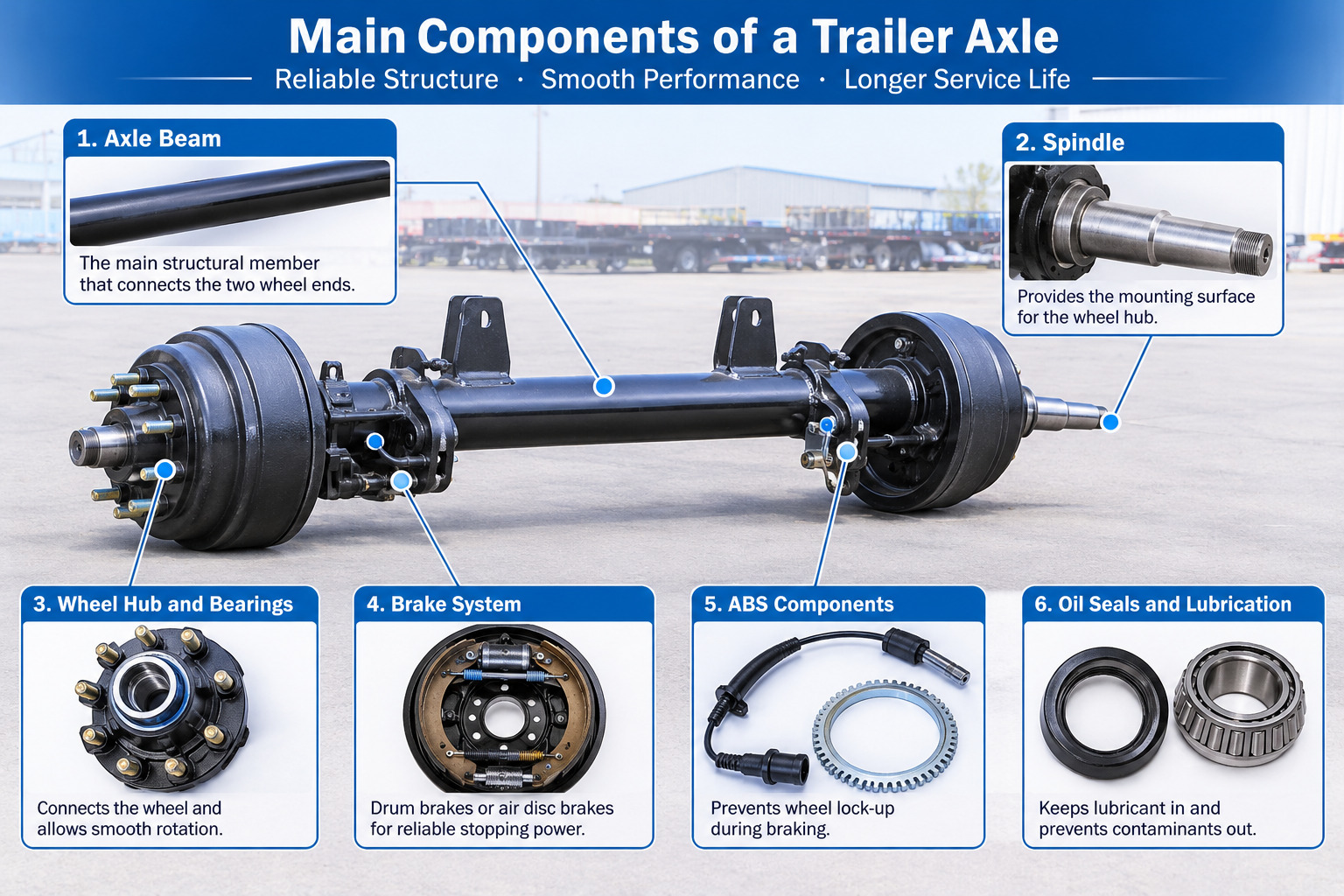
Main components of a trailer axle including axle beam, spindle, wheel hub, bearings, brake system and ABS components.
2.1 Axle Beam
The axle beam is the main structural member connecting the two wheel ends.
It transfers vertical and lateral forces from the wheels to the suspension system and supports the loads generated during transportation.
Common axle beam configurations include straight beams and cambered beams.
The beam material, wall thickness, cross-sectional design, track width, and suspension mounting dimensions all influence its suitability for a particular application.
2.2 Spindle
The spindle is located at each end of the axle beam and provides the mounting surface for the wheel hub and bearing assembly.
Spindle dimensions must match the selected bearings, hubs, seals, and other wheel-end components.
Incorrect spindle dimensions can lead to assembly problems and premature component wear.
2.3 Wheel Hub and Bearings
The wheel hub connects the wheel to the axle spindle.
Wheel bearings allow the hub and wheel to rotate smoothly while supporting the applied loads.
Proper bearing selection, lubrication, installation, and adjustment are essential for reliable wheel-end operation.
2.4 Brake System
Trailer axles can be configured with drum brakes or air disc brakes.
Drum brake systems generally consist of brake drums, shoes, brake chambers, slack adjusters, and related operating components.
Air disc brake systems use brake discs and calipers to generate braking force.
The appropriate braking system depends on the trailer application, vehicle regulations, maintenance preferences, and braking performance requirements.
2.5 ABS Components
The Anti-lock Braking System (ABS) helps prevent wheel lock-up during braking under applicable operating conditions.
Depending on the design, an ABS-equipped trailer axle may include a tone ring, wheel-speed sensor, and associated mounting brackets.
Correct sensor positioning and compatibility with the trailer's electrical and braking systems are important during installation.
2.6 Oil Seals and Lubrication Components
Oil seals help retain lubricant inside the wheel-end assembly and prevent external contaminants from entering.
Proper lubrication protects bearings from excessive friction and helps reduce premature wear.
Regular inspection is necessary to identify lubricant leakage, abnormal noise, and other signs of wheel-end problems.
3. Different Types of Trailer Axles
Trailer axles can be classified according to their structural design, braking configuration, and intended application.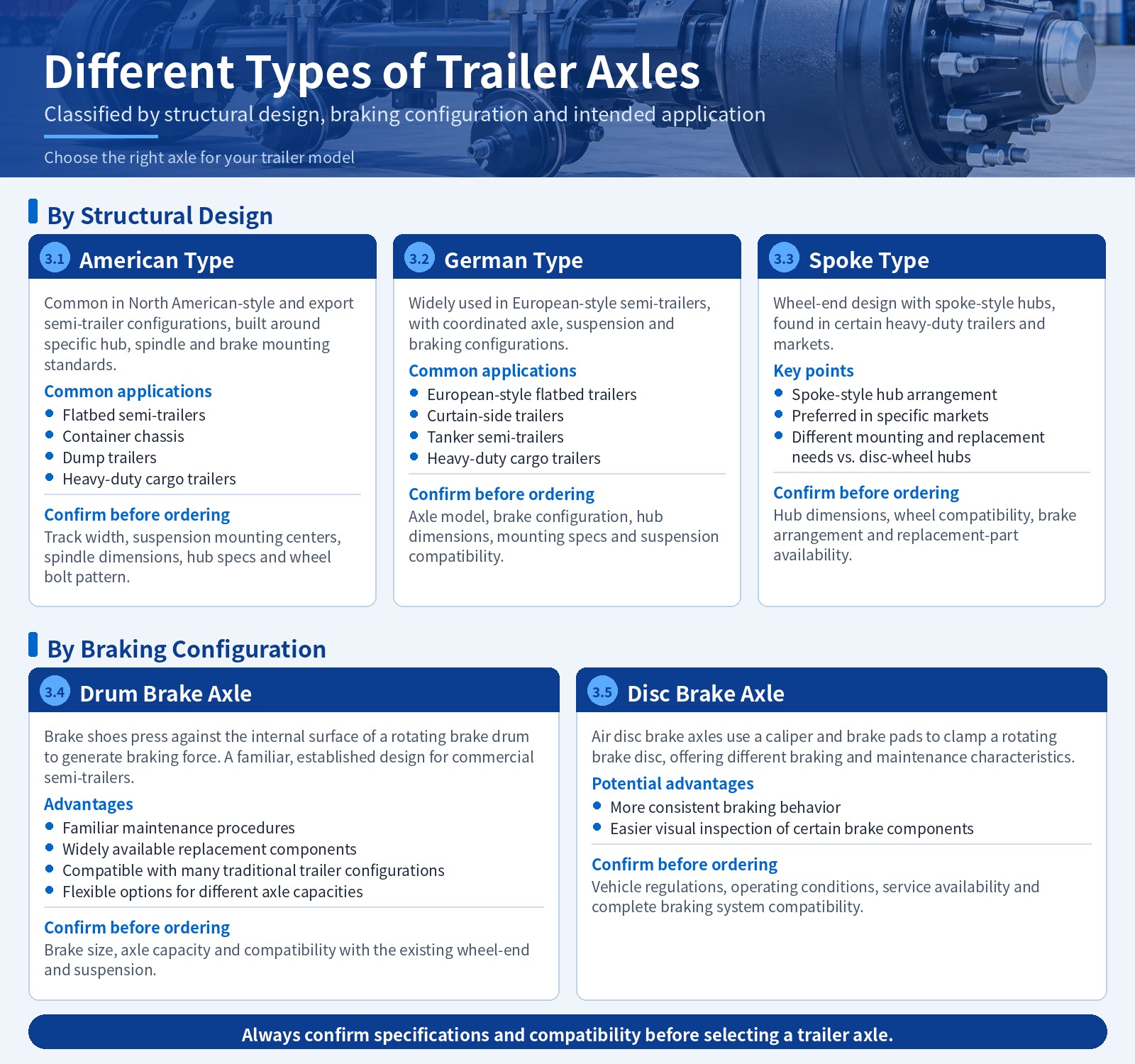
Understanding these differences helps buyers choose suitable products for different trailer models.
3.1 American Type Trailer Axle
American-type trailer axles are commonly used in North American-style trailer configurations and various export semi-trailer applications.
They typically feature an axle beam and wheel-end arrangement designed around specific hub, spindle, and brake mounting standards.
Depending on the model, they can be equipped with drum brakes or compatible disc brake systems.
Common applications:
-
Flatbed semi-trailers
-
Container chassis
-
Dump trailers
-
Heavy-duty cargo trailers
When purchasing an American-type axle, buyers should confirm track width, suspension mounting centers, spindle dimensions, hub specifications, and wheel bolt patterns.
3.2 German Type Trailer Axle
German-type trailer axles are widely used in European-style semi-trailer configurations.
They are available in different beam structures and wheel-end arrangements, with compatibility depending on the manufacturer and model.
These axles are commonly selected for commercial trailers requiring coordinated axle, suspension, and braking configurations.
Common applications:
-
European-style flatbed trailers
-
Curtain-side trailers
-
Tanker semi-trailers
-
Heavy-duty cargo trailers
Before ordering, confirm the axle model, brake configuration, hub dimensions, mounting specifications, and compatibility with the existing suspension system.
3.3 Spoke Type Trailer Axle
Spoke-type trailer axles use a wheel-end design with spoke-style hubs.
They can be found in certain heavy-duty trailer configurations and markets where this wheel-end arrangement is preferred.
Compared with conventional disc-wheel hub designs, spoke-type assemblies have different mounting and replacement requirements.
Buyers should confirm hub dimensions, wheel compatibility, brake arrangements, and replacement-part availability before selecting this type.
3.4 Drum Brake Trailer Axle
Drum brake axles use brake shoes that press against the internal surface of a rotating brake drum to generate braking force.
They remain a common option for commercial semi-trailers because of their established design and service familiarity.
Advantages include:
-
Familiar maintenance procedures
-
Widely available replacement components
-
Compatibility with many traditional trailer configurations
-
Flexible options for different axle capacities
3.5 Disc Brake Trailer Axle
Air disc brake axles use a caliper and brake pads to clamp a rotating brake disc.
They offer different braking and maintenance characteristics compared with conventional drum brake systems.
Depending on the application, advantages may include more consistent braking behavior and easier visual inspection of certain brake components.
The final selection should consider vehicle regulations, operating conditions, service availability, and the compatibility of the complete braking system.
4. Trailer Axle Load Capacity: What Should Buyers Know?
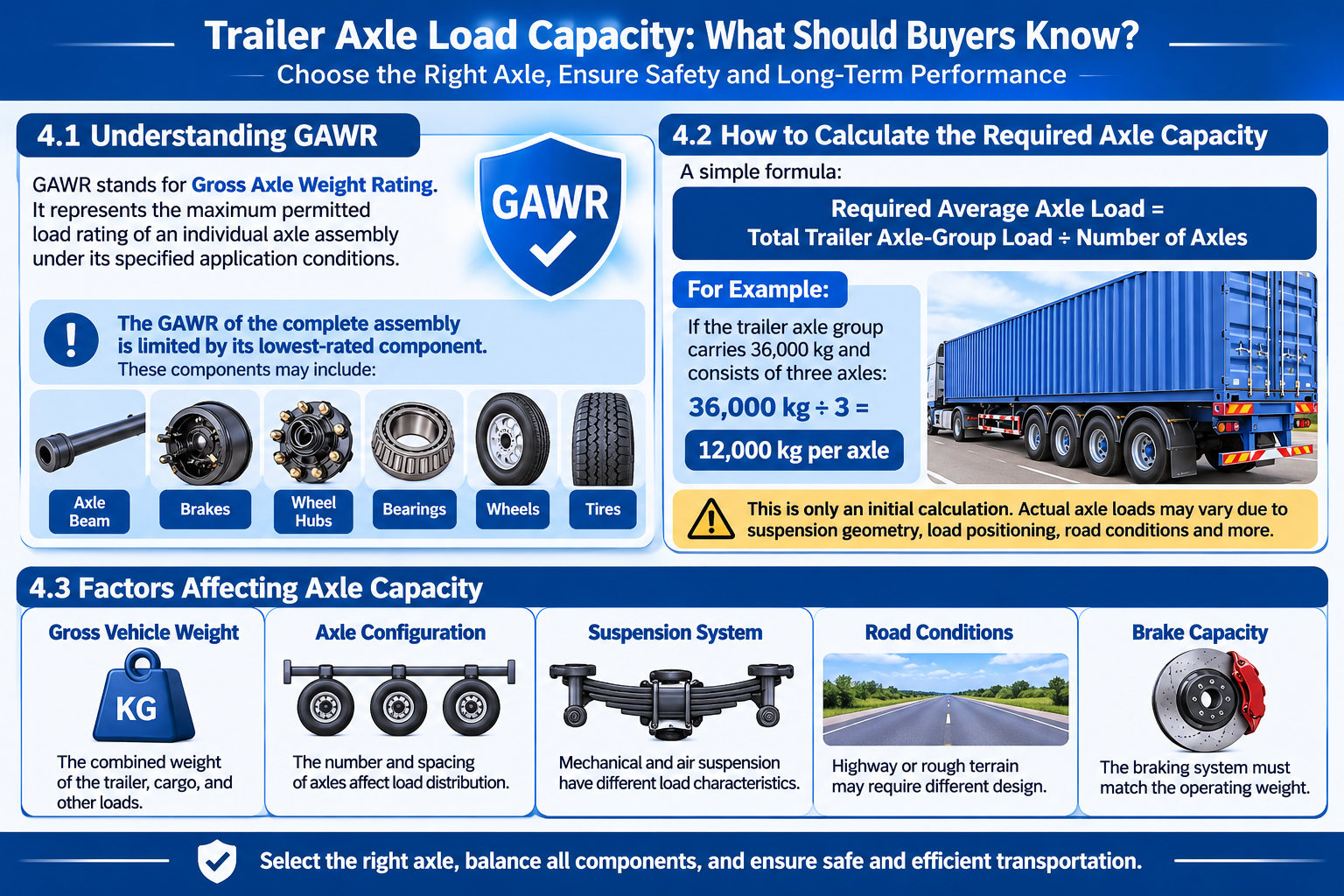
Understanding trailer axle load capacity helps buyers select the right axle configuration for safe and reliable transportation
Axle load capacity is one of the most important factors when selecting a trailer axle.
Choosing an axle with insufficient capacity may result in excessive stress, premature wear, and potential structural failure.
However, simply selecting the axle with the largest advertised capacity is not necessarily the right solution.
The complete axle assembly must be evaluated.
4.1 Understanding GAWR
GAWR stands for Gross Axle Weight Rating.
It represents the maximum permitted load rating of an individual axle assembly under its specified application conditions.
An important engineering principle is that the GAWR of the complete assembly is limited by its lowest-rated weight-bearing component.
These components may include:
-
Axle beam
-
Brakes
-
Wheel hubs
-
Bearings
-
Wheels
-
Tires
For example, a high-rated axle beam does not automatically make the complete axle assembly suitable for the same load if the brakes, hubs, or tires have lower ratings.
4.2 How to Calculate the Required Axle Capacity
The preliminary load calculation should consider the total weight carried by the trailer axle group.
A simplified calculation is:
Required Average Axle Load = Total Trailer Axle-Group Load ÷ Number of Axles
For example:
If the trailer axle group carries 36,000 kg and consists of three axles:
36,000 kg ÷ 3 = 12,000 kg per axle.
This is only an initial average-load calculation, not a final axle selection.
Actual axle loads may differ because of suspension geometry, load positioning, uneven road surfaces, dynamic forces, and braking conditions.
The final design must also account for axle spacing, suspension load distribution, applicable regulations, and the ratings of all related components.
4.3 Factors Affecting Axle Capacity
Several factors influence the required axle specification:
Gross Vehicle Weight: The combined weight of the trailer, cargo, and other applicable loads.
Axle Configuration: The number and spacing of axles affect load distribution.
Suspension System: Mechanical and air suspension systems have different structural and load-distribution characteristics.
Road Conditions: Highway operation and demanding construction-site conditions may require different design considerations.
Brake Capacity: The braking system must be appropriately matched to the vehicle's operating weight and legal requirements.
5. How to Choose the Right Trailer Axle?
Selecting the right trailer axle requires more than checking the advertised load rating.
The following factors should be evaluated before purchasing.
5.1 Confirm the Trailer Application
Different trailers have different operating requirements.
| Trailer Type | Main Axle Selection Considerations |
|---|---|
| Flatbed Trailer | Load rating, suspension, wheel-end compatibility |
| Lowbed Trailer | Heavy-duty capacity, axle configuration, braking |
| Dump Trailer | Load distribution, operating environment, durability |
| Container Chassis | Axle rating, suspension, tire compatibility |
| Tanker Trailer | Loaded weight, axle spacing, braking requirements |
| Curtain-Side Trailer | Axle capacity, road performance, maintenance |
The axle should always be selected according to the trailer's engineering design.
5.2 Check Axle Dimensions
Dimensions are especially important when replacing an existing axle.
Before ordering, confirm:
-
Track width
-
Spring center or suspension mounting center
-
Hub-face-to-hub-face dimension
-
Spindle specifications
-
Brake flange dimensions
-
Wheel bolt pattern
These measurements help prevent compatibility problems during installation.
5.3 Select the Correct Brake System
The brake system should match the trailer's original design and destination-market requirements.
Buyers should confirm whether the axle uses drum brakes or disc brakes and whether ABS or EBS integration is required.
Brake compatibility is essential for safe operation.
5.4 Consider Maintenance and Spare Parts
Axle purchasing should also consider the availability of replacement bearings, seals, brake shoes, drums, hubs, and other service components.
For fleet operators and distributors, a consistent supply of compatible spare parts can help reduce vehicle downtime.
5.5 Evaluate the Operating Environment
Trailers operating in demanding environments may require additional attention to corrosion protection, component quality, lubrication, and maintenance accessibility.
The correct configuration should reflect actual working conditions rather than relying on a standard specification alone.
6. Trailer Axle Maintenance: How to Extend Service Life
Regular inspection and maintenance help maintain trailer safety and reduce unexpected operating interruptions.
Although maintenance intervals vary by manufacturer and application, the following items deserve attention.
6.1 Inspect Bearings and Wheel Hubs
Check for abnormal noise, excessive heat, lubricant leakage, and signs of bearing damage.
Incorrect bearing adjustment or inadequate lubrication can lead to serious wheel-end problems.
6.2 Check Brake Components
Inspect brake linings, drums, discs, calipers, brake chambers, and adjustment mechanisms according to the manufacturer's maintenance instructions.
Worn or damaged components should be replaced with compatible parts.
6.3 Inspect the Axle Beam
Check the beam and mounting areas for visible cracks, deformation, corrosion, or other structural damage.
Any suspected structural defect should be assessed by qualified personnel.
6.4 Check Wheel Nuts and Tires
Loose wheel fasteners and incorrect tire pressure can create serious safety risks.
Follow the trailer and wheel manufacturers' specified tightening torque and inspection procedures.
6.5 Check ABS Sensors and Wiring
Inspect sensor mounting, wiring connections, and related components for damage or contamination.
A warning light or diagnostic fault should be investigated rather than ignored.
Maintenance reminder: Always follow the original axle manufacturer's service manual for inspection intervals, torque values, lubrication specifications, and replacement procedures. SAF-HOLLAND and other major axle manufacturers provide model-specific maintenance guidance.
7. Common Trailer Axle Problems and Their Possible Causes
Understanding common axle problems helps fleet managers and maintenance teams identify issues before they become more serious.
| Common Problem | Possible Cause | Recommended Action |
|---|---|---|
| Abnormal Bearing Noise | Bearing wear or improper adjustment | Inspect and replace as required |
| Lubricant Leakage | Damaged oil seal | Inspect seal and wheel-end assembly |
| Uneven Tire Wear | Alignment or load distribution problems | Inspect suspension and axle alignment |
| Brake Overheating | Brake adjustment or component problems | Inspect the complete brake system |
| ABS Warning | Sensor, wiring, or system fault | Perform diagnostic inspection |
| Axle Beam Deformation | Overloading or impact damage | Arrange professional structural inspection |
The actual cause should always be confirmed through proper inspection rather than replacing parts based on symptoms alone.
8. Trailer Axle for Sale: What to Check Before Buying?
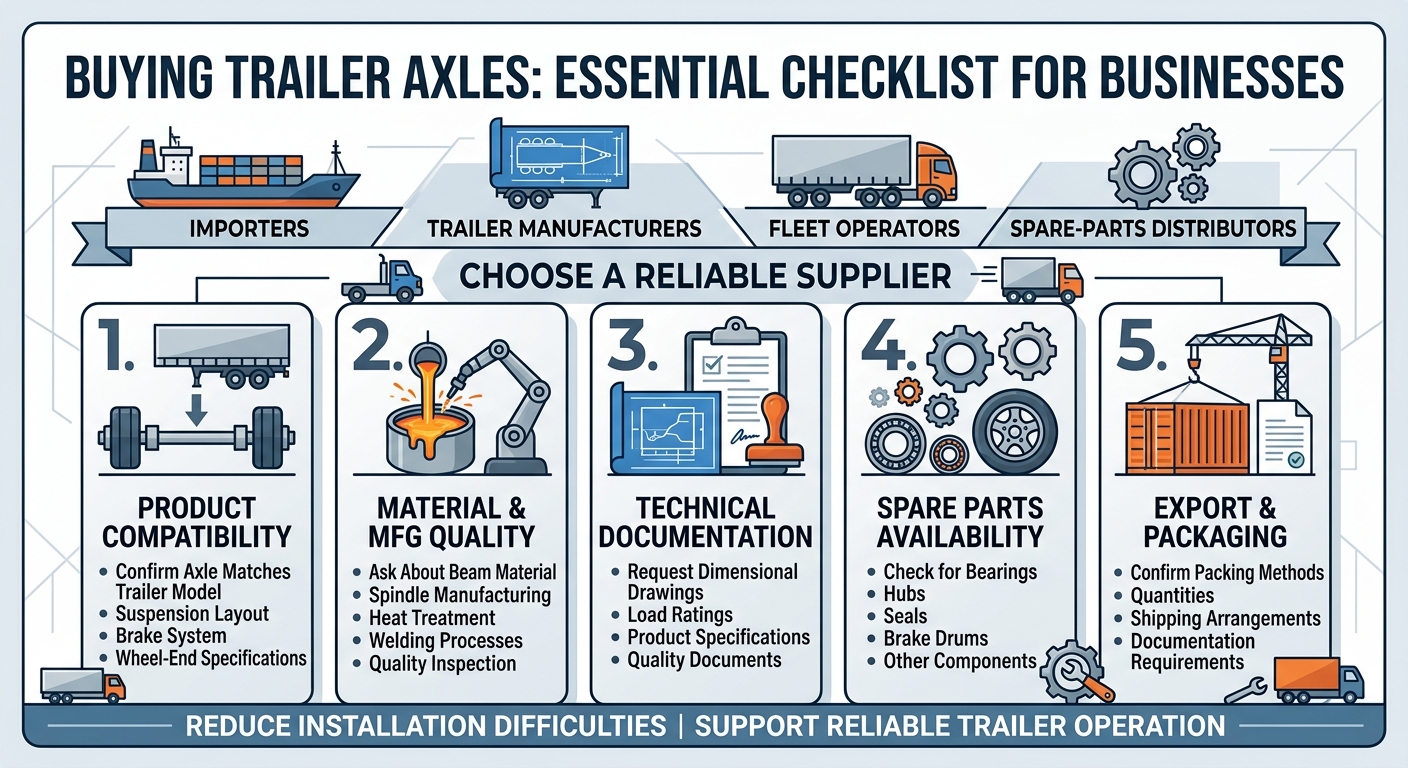
For importers, trailer manufacturers, fleet operators, and spare-parts distributors, choosing a reliable trailer axle supplier is an important purchasing decision.
A competitive price is valuable, but product compatibility and technical support are equally important.
Before placing an order, consider the following:
1. Product Compatibility
Confirm that the axle matches your trailer model, suspension arrangement, brake system, and wheel-end specifications.
2. Material and Manufacturing Quality
Ask about axle beam material, spindle manufacturing, heat treatment, welding processes where applicable, and quality inspection procedures.
3. Technical Documentation
Request dimensional drawings, load ratings, product specifications, and relevant quality documents.
4. Spare Parts Availability
Check whether matching bearings, hubs, seals, brake drums, and other replacement components can be supplied.
5. Export and Packaging Requirements
For international orders, confirm packing methods, quantities, shipping arrangements, and documentation requirements.
A properly matched axle assembly helps reduce installation difficulties and supports more reliable trailer operation.
9. Why Choose LUCKSUN for Trailer Axles and Spare Parts?
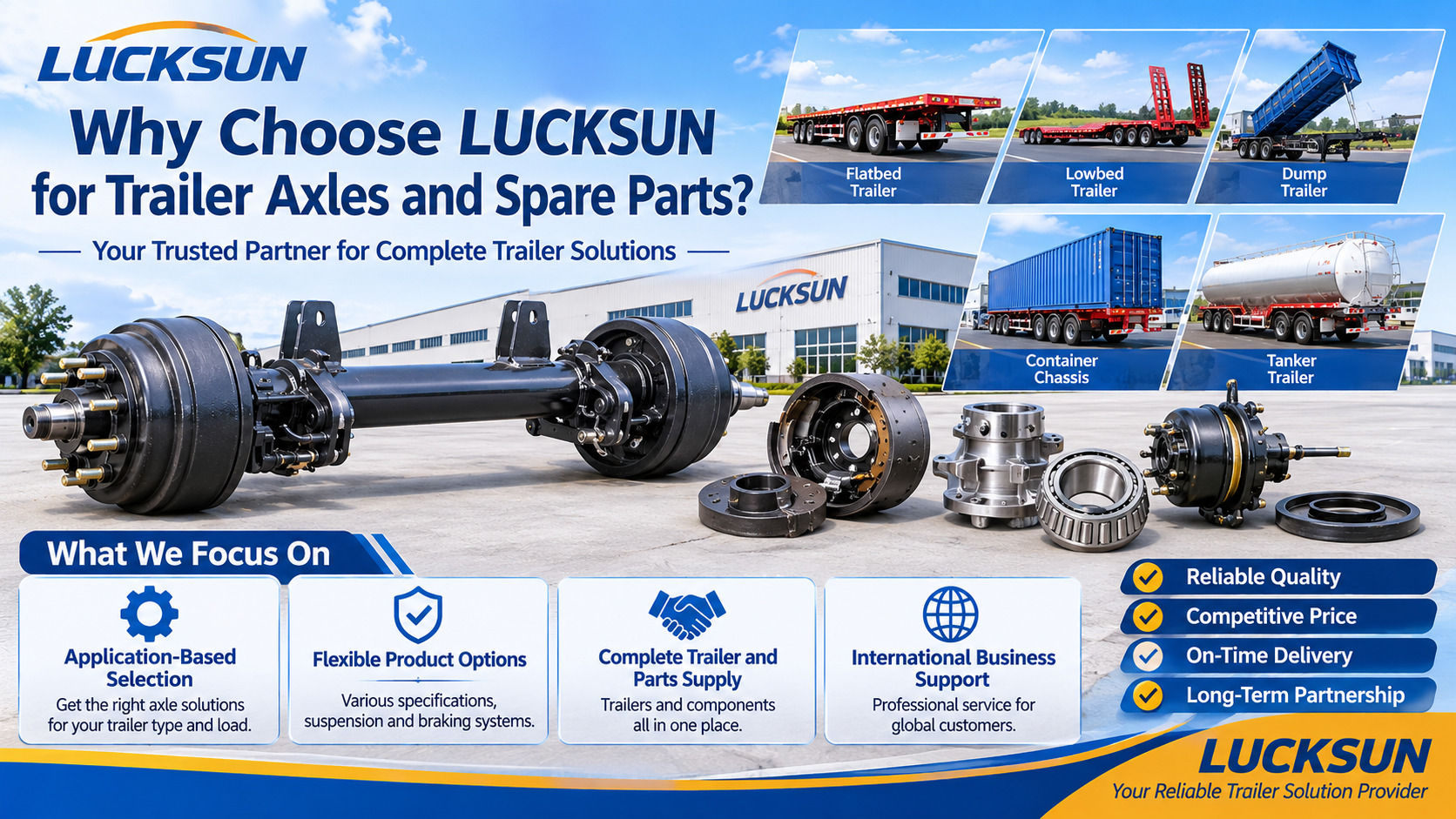
LUCKSUN provides application-based trailer axle solutions, flexible component options and complete semi-trailer spare parts supply for international buyers.
At LUCKSUN, we understand that trailer axles are not isolated components. Their performance depends on compatibility with the complete trailer structure, suspension, braking system, and wheel-end assembly.
We focus on semi-trailers and related components for international markets, supporting customers who need complete trailer solutions as well as individual replacement parts.
Our product supply covers different trailer applications, including:
-
Flatbed trailer axles
-
Lowbed trailer axles
-
Dump trailer axles
-
Container chassis axles
-
Tanker trailer axles
-
Trailer axle spare parts and related components
What We Focus On
Application-Based Selection
We help customers identify suitable axle configurations according to trailer type, load requirements, and operating conditions.
Flexible Product Options
Different axle specifications, suspension arrangements, braking systems, and related components can be discussed according to customer requirements.
Complete Trailer and Parts Supply
In addition to trailer axles, we supply semi-trailers and related components to support different purchasing needs.
International Business Support
We provide product information, technical communication, quotation coordination, and export-related support for overseas customers.
Our goal is to build long-term cooperation through practical product solutions, clear communication, and reliable supply arrangements.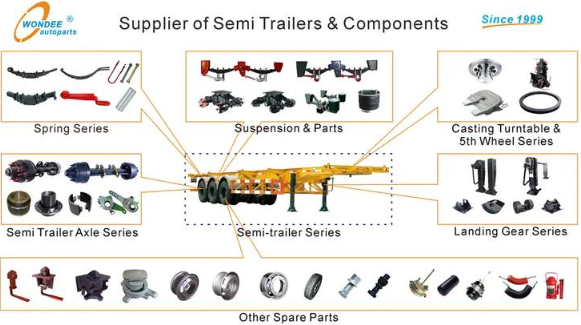
LUCKSUN provides application-based trailer axle solutions, flexible component options and complete semi-trailer spare parts supply for international buyers.
10. Frequently Asked Questions About Trailer Axles
Q1: What are the main types of trailer axles?
Trailer axles can be classified by structural design, braking configuration, and application. Common options include American-type, German-type, and spoke-type designs, as well as drum brake and disc brake configurations.
Q2: What is the difference between a trailer axle and a truck axle?
A conventional trailer axle is generally non-driven and supports the trailer's weight. A truck drive axle transfers engine torque to the wheels and also supports vehicle loads.
Q3: How many axles does a semi-trailer usually have?
Many conventional semi-trailers use two or three axles. Heavy-duty and specialized trailers may use additional axles depending on cargo weight, vehicle design, and local regulations.
Q4: How do I know what axle capacity I need?
Calculate the expected axle-group load and evaluate the individual axle ratings, suspension, brakes, wheels, and tires. The final selection must follow engineering calculations and applicable vehicle regulations.
Q5: Are trailer axles available with ABS?
Yes. Many trailer axle configurations can be equipped with ABS-compatible components, including tone rings and wheel-speed sensors. Compatibility with the complete trailer braking system must be confirmed.
Q6: Can I replace only one trailer axle?
Replacement is possible when the new axle matches the original specifications and the trailer manufacturer's requirements. Track width, suspension mounting, spindle, hub, brake, and load ratings must be checked carefully.
Q7: What information is required to order a trailer axle?
Buyers should provide the trailer type, axle capacity, axle dimensions, brake type, suspension configuration, hub specifications, wheel bolt pattern, and quantity.
If replacing an existing axle, clear photos and dimensional drawings are particularly useful.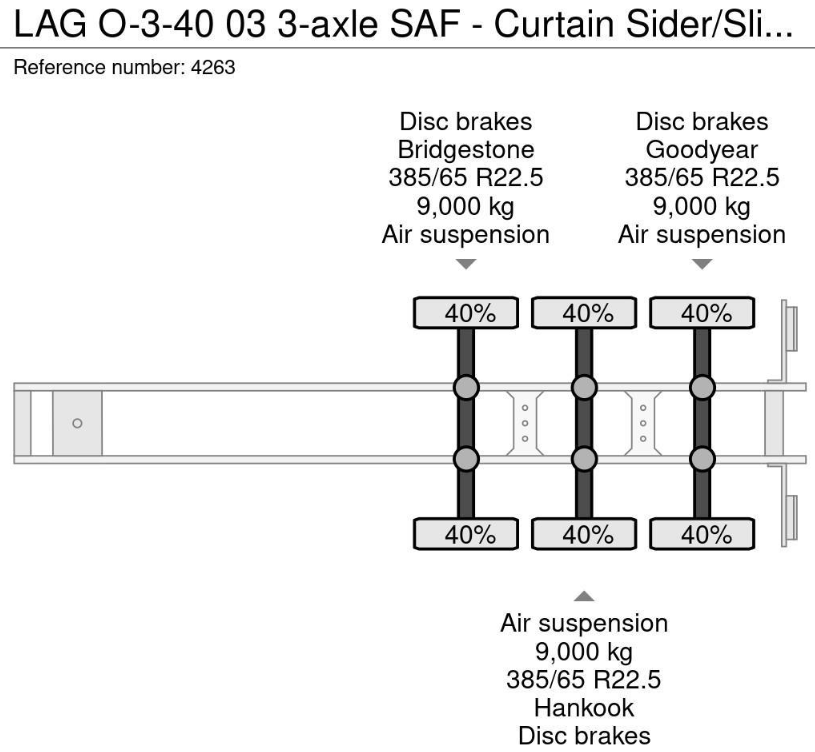
Understanding trailer axle load capacity helps buyers select the right axle configuration for safe and reliable transportation
11. Contact LUCKSUN for Trailer Axle Solutions
Looking for trailer axles for sale or a reliable supplier of semi-trailer axle assemblies and spare parts?
LUCKSUN welcomes inquiries from international importers, trailer manufacturers, fleet operators, engineering companies, and spare-parts distributors.
Whether you need individual trailer axles, complete axle assemblies, or related semi-trailer components, we can discuss suitable configurations according to your requirements.
Send us your trailer model, axle specifications, required quantity, and destination country.
Contact LUCKSUN today to request a quotation and discuss your trailer axle requirements.