


A reliable suspension system is essential to the performance of a commercial semi-trailer. It supports the trailer structure, manages road impacts, helps maintain axle positioning, and contributes to stable transportation under different loading conditions.
LUCKSUN supplies air suspension systems designed for commercial semi-trailer applications, including European-style and USA-style configurations. With both over slung and under slung arrangements available, buyers can select a suitable design according to trailer frame geometry, axle positioning, ride height, and operating requirements.
Whether you are a trailer manufacturer, importer, fleet operator, or spare parts distributor, choosing the right air suspension system requires more than comparing product prices. Structural compatibility, component specifications, installation dimensions, and long-term maintenance should all be considered.
Explore our semi-trailer parts and components to understand how suspension works together with the axle, braking, and chassis systems.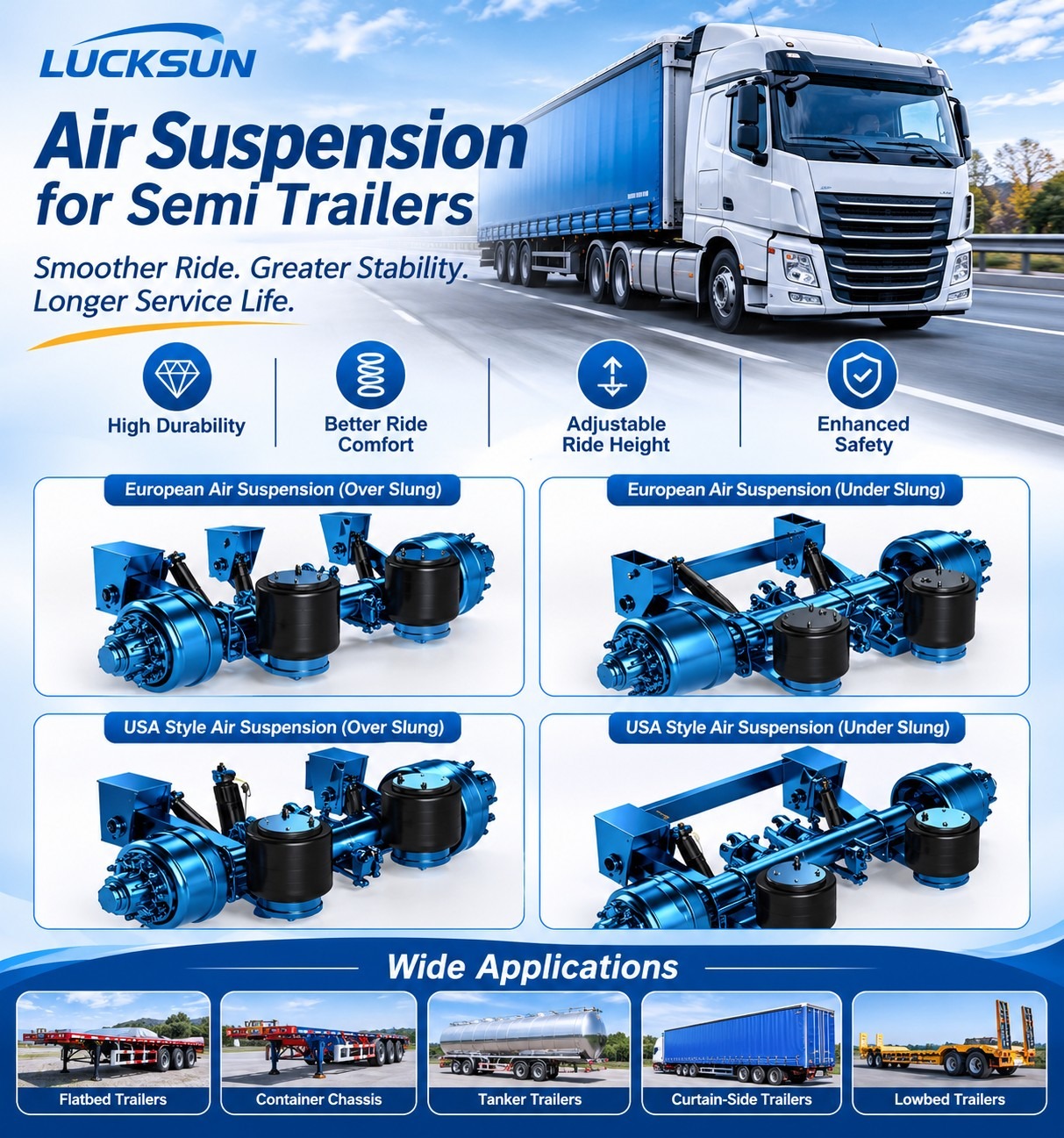
LUCKSUN air suspension systems feature European and USA-style designs, including over slung and under slung configurations. Designed for different semi-trailer applications, they provide reliable load support, improved ride comfort, and flexible installation options.
An air suspension system is a pneumatic suspension assembly that uses compressed air within flexible air springs to support the vehicle's load and absorb road movement.
Unlike conventional mechanical leaf spring suspension, an air suspension system uses air pressure to provide its springing function. Depending on the design, a height control valve regulates the air supply to maintain the intended suspension ride height as the load changes.
A typical trailer air suspension assembly may include:
Air springs (air bags)
Suspension beams or trailing arms
Shock absorbers
Height control valves
Air supply lines and fittings
Mounting brackets and connection hardware
Axle locating and supporting components
The exact component arrangement depends on the suspension design and trailer application.
The air spring is responsible for supporting the load through compressed air, while the shock absorber helps control suspension movement. The control valve manages air pressure to maintain the designed ride height.
These components must work together as a complete system. Selecting an air spring independently without checking the suspension geometry may lead to installation or operating problems.
For a more detailed explanation of the complete running gear, see our trailer axle selection and technical guide.
Air suspension is widely considered for commercial trailers where ride quality, load management, and suspension height control are important.
Air springs provide a flexible support medium that helps isolate the trailer structure from road impacts.
Compared with a conventional steel leaf spring arrangement, a properly designed air suspension system can reduce the transmission of certain road shocks and vibrations to the trailer structure.
This can be particularly valuable when transporting sensitive or high-value cargo.
One of the practical advantages of trailer air suspension is its ability to maintain or adjust the designed ride height through pneumatic controls, depending on the system configuration.
This function can help support loading and unloading operations and maintain the intended trailer height under changing load conditions.
However, the operating height must remain within the suspension manufacturer's specified range.
Air springs work together with shock absorbers and suspension locating components to control vertical movement.
A correctly matched system helps maintain appropriate suspension geometry and wheel contact during normal road operation.
The final performance depends on the complete design, including air spring characteristics, shock absorber selection, axle location, and frame mounting.
Air suspension can be designed for different commercial trailer structures.
Depending on the application and engineering requirements, it may be used on:
Flatbed semi-trailers
Skeletal container chassis
Tanker semi-trailers
Curtain-side trailers
Selected lowbed trailers
Specialized commercial trailers
The suspension must always be selected according to the approved trailer design, axle loading, and destination-market requirements.
For customers comparing different suspension technologies, our guide to mechanical suspension types for semi-trailers provides additional background.
The product range shown in our air suspension series includes four main configurations.
The key differences are the design style and the axle-to-suspension mounting arrangement.
The European-style over slung air suspension is designed around an over slung mounting arrangement.
Its configuration should be matched to the trailer frame, axle position, mounting brackets, and required ride height.
This design may be considered for European-style commercial trailer structures where the corresponding mounting geometry is required.
Before ordering, buyers should confirm the axle mounting position, suspension beam dimensions, and frame clearance.
The European-style under slung configuration uses a different axle and suspension mounting arrangement from the over slung version.
This configuration may be suitable where the trailer's chassis design requires an under slung layout.
The selection should take into account axle positioning, available installation space, ride height, and suspension travel.
The correct configuration should be confirmed using the trailer's technical drawing rather than appearance alone.
The USA-style over slung air suspension is another configuration available in the LUCKSUN product series.
It is intended for trailer structures designed around the corresponding American-style suspension geometry.
When selecting this arrangement, buyers should pay attention to frame bracket positions, axle connection dimensions, air spring locations, and shock absorber mounting points.
The USA-style under slung air suspension offers an alternative mounting arrangement for compatible trailer structures.
It should be selected according to the chassis layout, axle position, required ride height, and available mounting clearance.
For replacement projects, the original suspension model and installation dimensions should be checked before ordering.
| Configuration | Design Style | Mounting Arrangement |
|---|---|---|
| European Over Slung | European | Over Slung |
| European Under Slung | European | Under Slung |
| USA Over Slung | USA Style | Over Slung |
| USA Under Slung | USA Style | Under Slung |
The terms European and USA Style identify the product configurations shown in this series. They should not be treated as automatic proof of compliance with any particular national or regional standard.
Likewise, over slung and under slung describe mounting arrangements, not load capacity.
For a suitable selection, confirm the complete assembly drawing and technical specifications.
A trailer air suspension system operates through the controlled supply and release of compressed air.
Its working process can be understood in four stages.
Stage 1: Air Supply
Compressed air is supplied from the trailer's pneumatic system to the suspension circuit.
Stage 2: Load Support
Air enters the air springs, creating the pressure needed to support the trailer load.
As the load changes, the required air spring pressure also changes.
Stage 3: Ride Height Control
When the trailer moves away from its designed ride height, the height control valve can add or release air, depending on the system arrangement.
This helps maintain the intended operating height.
Stage 4: Shock Absorption and Movement Control
During road operation, the air springs respond to vertical wheel movement while the shock absorbers help control oscillation.
The suspension beam and locating components maintain the intended relationship between the axle and trailer frame.
Proper adjustment is important. An incorrect ride height may affect load distribution, suspension travel, tire wear, and component service life.
Choosing between air suspension and mechanical suspension depends on the trailer's working environment, budget, maintenance resources, and cargo requirements.
| Comparison | Air Suspension | Mechanical Suspension |
|---|---|---|
| Spring Medium | Compressed Air | Steel Leaf Springs |
| Ride Height | Adjustable on suitable designs | Generally fixed |
| Ride Characteristics | Designed to isolate road impacts | Depends on leaf spring design |
| Main Components | Air Springs, Valves, Shocks, Beams | Leaf Springs, Hangers, Equalizers |
| Maintenance | Requires pneumatic system inspection | Requires mechanical inspection |
| System Complexity | More pneumatic components | Relatively straightforward structure |
| Initial Cost | Configuration dependent | Often lower |
| Typical Considerations | Ride quality and height control | Simplicity and service accessibility |
Neither system is automatically the best choice for every trailer.
Air suspension may be worth considering for highway fleets, cargo requiring better ride isolation, and applications where ride height control is useful.
Mechanical suspension may be more appropriate where a simpler structure, straightforward maintenance, and lower initial system cost are priorities.
The final decision should be based on operating conditions and the complete trailer design.
For international buyers, selecting the correct air suspension requires checking several technical details before placing an order.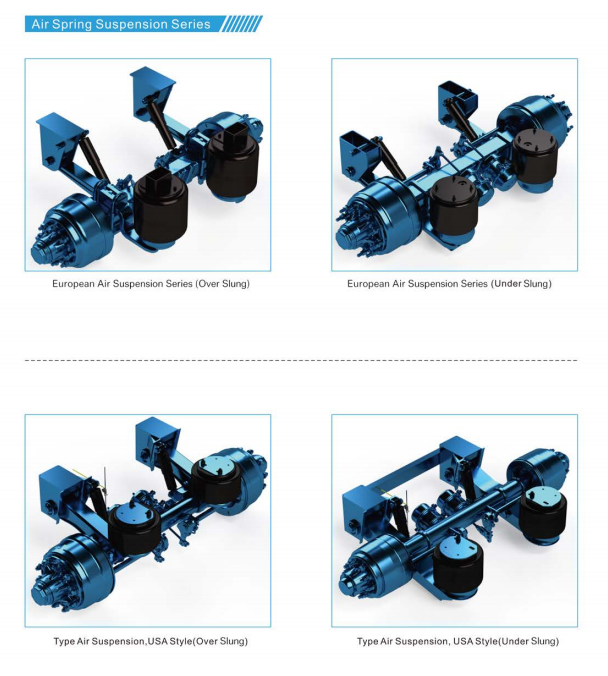
Engineered for smoother rides and steadier load handling, our trailer air suspension range combines air-spring cushioning with robust axle and hanger construction. Choose from European-type and USA-style designs, each available in over-slung and under-slung configurations, to fit flatbed, container chassis, tanker, curtain-side and lowbed semi trailers. Reduced road shock helps protect cargo and trailer structure, while consistent ride height supports safer, more stable transport.
First, identify whether your trailer requires a European-style or USA-style configuration.
Do not select a product based only on its appearance. Different suspension designs may have different mounting dimensions and axle connections.
Check the original axle and suspension arrangement.
The mounting position affects the relationship between the axle, suspension beam, and trailer frame.
A mismatch can create installation difficulties and may affect the intended ride height.
The suspension must match the axle design.
Important details include:
Axle model and rated capacity
Axle diameter and connection design
Axle spacing
Suspension mounting center
Brake configuration
Axle positioning
Our trailer axle kit guide explains the main components buyers should consider when sourcing a complete axle package.
Ride height is an essential selection parameter.
Buyers should provide the required ride height and relevant measurements between the frame, axle centerline, and suspension mounting points.
Frame clearance must also be checked to avoid interference during suspension movement.
A trailer operating mainly on highways may have different suspension requirements from one working on uneven roads, construction sites, or demanding regional routes.
Consider:
Typical cargo weight
Road surface conditions
Operating speed
Loading and unloading frequency
Maintenance resources
Local spare parts availability
The correct configuration should reflect actual working conditions rather than relying on a generic product description.
Air suspension systems can be considered for various commercial trailer applications when the engineering configuration is suitable.
Flatbed trailers transport steel products, machinery, building materials, and other general cargo.
Air suspension may be selected where ride characteristics and suspension height control are important.
Container chassis are designed to transport shipping containers between ports, terminals, and inland destinations.
Suspension selection should consider axle loading, frame geometry, operating conditions, and local regulations.
Explore our semi-trailer product range to compare different trailer configurations.
Tanker trailers transport liquid cargo and require careful consideration of vehicle stability, axle loads, braking, and suspension geometry.
The suspension configuration must be matched to the tanker's approved engineering design and operating conditions.
These trailers are commonly used for general freight transportation.
An appropriately selected air suspension system may support cargo protection by reducing certain road-induced impacts.
For customized trailers, suspension selection should begin with the overall vehicle design.
Axle arrangement, frame height, mounting position, cargo requirements, and local regulations should be evaluated together.
Even a suitable air suspension system requires correct installation and routine maintenance.
Before installation, inspect the suspension brackets, mounting surfaces, axle connection points, and frame structure.
All mounting dimensions should be checked against the technical drawing.
During operation, maintenance personnel should regularly inspect:
Air springs for cracks, abrasion, and air leakage
Air lines and fittings for damage or loose connections
Shock absorbers for leakage or abnormal wear
Height control valves for proper operation
Suspension brackets and fasteners for damage or looseness
Axle alignment and tire wear patterns
Any abnormal ride height, uneven tire wear, or air leakage should be investigated promptly.
For the pneumatic side of the system, our article on semi-trailer air suspension components provides further information about the main components.
Maintenance intervals and replacement criteria should follow the relevant component manufacturer's instructions.
When purchasing trailer suspension systems, buyers need more than a product photograph and a quotation.
They need a supplier who understands the relationship between suspension design, axle configuration, trailer structure, and actual operating requirements.
LUCKSUN focuses on semi-trailers and related components for international markets.
Our product sourcing and configuration discussions can cover:
Multiple Configuration Options
European-style and USA-style air suspension configurations, including over slung and under slung arrangements.
Application-Based Selection
Suspension recommendations based on trailer type, axle configuration, mounting dimensions, and operating conditions.
Technical Communication
Buyers can provide drawings, product photographs, existing model information, and installation measurements for configuration review.
OEM and Customized Requirements
Suspension specifications can be discussed according to the project requirements and available product configurations.
Complete Trailer Parts Supply
In addition to suspension systems, LUCKSUN supports sourcing discussions for related components such as trailer axles, landing gear, braking components, and other semi-trailer parts.
Learn more about our company background and manufacturing capabilities.
For buyers developing a complete trailer project, the suspension should be evaluated together with the chassis, axles, and braking system rather than purchased as an isolated component.
Before requesting a quotation, prepare the following information to help identify a suitable configuration.
| Information Required | What to Provide |
|---|---|
| Trailer Type | Flatbed, Tanker, Chassis, Lowbed, etc. |
| Suspension Style | European or USA Style |
| Mounting Type | Over Slung or Under Slung |
| Axle Quantity | Single, Tandem, Tridem, etc. |
| Axle Model | Existing or required model |
| Axle Capacity | Rated capacity per axle |
| Ride Height | Required installation height |
| Axle Spacing | Center-to-center distance |
| Mounting Dimensions | Bracket and connection measurements |
| Quantity | Required units |
| Destination Market | Country of use |
| Drawings | Technical drawing or clear product photos |
If you are replacing an existing suspension, photographs of the complete assembly and its mounting points can also help with initial identification.
Providing accurate information at the quotation stage helps reduce specification misunderstandings and unnecessary installation adjustments.
It supports the trailer load through compressed air in the air springs, absorbs road movement, and helps maintain the designed ride height when equipped with the appropriate control system.
They refer to different axle-to-suspension mounting arrangements. The correct choice depends on the trailer frame design, axle position, mounting geometry, and required ride height.
These are different design configurations in the product range. Their actual differences should be confirmed through mounting dimensions, component design, axle connections, and technical drawings rather than assuming that the names alone define a specific standard.
Potentially, yes. However, the existing frame, axle, mounting brackets, available clearance, ride height, and pneumatic system must be checked before confirming compatibility.
Yes. Air springs, air lines, valves, shock absorbers, brackets, and fasteners should be inspected periodically according to the manufacturer's maintenance recommendations.
Configuration requirements can be discussed according to the trailer application, axle specifications, installation dimensions, and available product options.
Provide the trailer type, suspension style, mounting arrangement, axle specifications, required quantity, and technical drawings or photographs whenever available.
Looking for an air suspension system for a new semi-trailer project or replacement application?
LUCKSUN can help you review the required suspension configuration according to your trailer design and purchasing requirements.
Send us your:
Trailer model and application
European or USA-style preference
Over slung or under slung configuration
Axle specifications
Required quantity
Technical drawings or product photographs
Our team can review the information and discuss a suitable configuration for your project.
LUCKSUN – Semi-Trailers and Parts for Global Markets.
Contact our team through the LUCKSUN inquiry page to discuss your air suspension requirements and request a quotation.
LUCKSUN Air Suspension Systems are designed for commercial semi-trailer applications, providing pneumatic support and controlled suspension movement for different trailer configurations.
The system uses air springs to support the trailer load and help absorb road impacts. Combined with suspension beams, shock absorbers, and pneumatic control components, it forms an integrated suspension assembly.
Air Spring Design: Uses compressed air to support the trailer load and provide flexible suspension performance.
Ride Height Control: Supports ride height adjustment through a compatible pneumatic control system.
Stable Suspension Structure: Designed to work with suitable axle and trailer frame configurations.
Multiple Design Options: Available in European-style and USA-style configurations.
Flexible Installation Arrangements: Over slung and under slung designs are available.
Project-Based Customization: Specifications can be discussed according to trailer drawings and technical requirements.
A typical trailer air suspension assembly may include:
Air springs
Suspension beams
Shock absorbers
Height control valves
Mounting brackets
Pneumatic connections and fittings
The actual component configuration depends on the selected model.
LUCKSUN air suspension systems can be considered for compatible flatbed trailers, container chassis, tanker trailers, curtain-side trailers, and other commercial semi-trailer projects.
For accurate product selection, buyers should confirm axle specifications, mounting dimensions, required ride height, and trailer frame compatibility before ordering.
LUCKSUN offers different air suspension configurations to meet the structural requirements of various semi-trailer designs.
The product range includes European-style and USA-style air suspension systems, each available in over slung and under slung arrangements.
The European over slung configuration is designed for compatible trailer structures using an over slung axle mounting arrangement.
It is suitable for projects requiring this specific suspension geometry. Frame clearance, axle positioning, and mounting dimensions should be checked before installation.
The European under slung configuration features an alternative axle mounting arrangement.
It can be considered for trailer chassis designed around an under slung suspension layout. Buyers should confirm the required installation height and axle connection dimensions.
This configuration is designed for compatible trailer structures using USA-style suspension geometry with an over slung arrangement.
Important selection points include axle mounting positions, suspension beam dimensions, air spring locations, and shock absorber connections.
The USA-style under slung configuration provides another mounting option for compatible trailer chassis.
Its selection should be based on the original suspension design, frame structure, axle specifications, and required ride height.
| Product Type | Design Style | Mounting Arrangement |
|---|---|---|
| European Over Slung | European | Over Slung |
| European Under Slung | European | Under Slung |
| USA Over Slung | USA Style | Over Slung |
| USA Under Slung | USA Style | Under Slung |
Before purchasing, please confirm:
European-style or USA-style design
Over slung or under slung arrangement
Axle model and specifications
Suspension mounting dimensions
Required ride height
Trailer frame clearance
Providing technical drawings or clear photographs of the existing suspension assembly will help identify a suitable configuration.
Note: These product names describe the configurations offered in this series. Final compatibility should be verified against the actual engineering drawings and technical specifications.
Air suspension systems are used in different commercial trailer applications where pneumatic load support, ride characteristics, and suspension height control are important.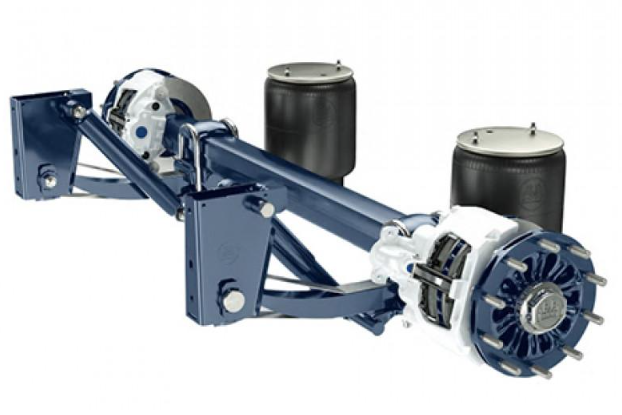
LUCKSUN provides air suspension configuration options for different trailer projects. The correct system should be selected according to vehicle structure, axle arrangement, cargo requirements, and operating conditions.
Flatbed trailers are commonly used to transport steel products, construction materials, machinery, and general cargo.
A suitable air suspension configuration can help manage road impacts and support the designed trailer ride height.
Container chassis are used for transporting shipping containers between ports, terminals, and inland destinations.
Suspension selection should consider axle loading, chassis dimensions, mounting geometry, and local operating requirements.
Tanker trailers require careful consideration of axle loads, vehicle stability, braking performance, and suspension geometry.
The suspension system must match the complete trailer engineering design and intended operating conditions.
These trailers are widely used for general freight transportation.
An appropriately selected air suspension system can help reduce certain road-induced impacts and support stable trailer operation.
For specialized trailer projects, suspension specifications should be confirmed together with the chassis design, axle configuration, installation space, and operating requirements.
To help identify the correct product, buyers are encouraged to provide the following information:
| Required Information | Details |
|---|---|
| Trailer Type | Flatbed, Tanker, Chassis, Lowbed, etc. |
| Suspension Design | European Style / USA Style |
| Mounting Arrangement | Over Slung / Under Slung |
| Axle Quantity | Single / Tandem / Tridem |
| Axle Capacity | Rated capacity per axle |
| Axle Spacing | Center-to-center distance |
| Ride Height | Required installation height |
| Mounting Dimensions | Bracket and connection measurements |
| Order Quantity | Required units |
| Destination Market | Country of application |
LUCKSUN focuses on semi-trailers and related components for international markets.
We support product selection discussions based on trailer applications, axle specifications, mounting dimensions, and customer requirements.
Whether you need air suspension systems for a new trailer project or replacement components for an existing fleet, our team can help review your requirements and discuss suitable product configurations.
Contact LUCKSUN today to discuss your air suspension requirements and request a quotation.
