
Trailer Axle Kit: A Complete Guide to Components, Specifications and Selection
A reliable trailer axle system is essential for safe load transportation, stable road performance, and long-term operating efficiency. Whether you are manufacturing new semi-trailers, replacing worn axle components, or purchasing trailer parts for fleet maintenance, selecting the right trailer axle kit is an important decision.
A trailer axle kit is more than an individual axle beam. Depending on the configuration, it can include an axle assembly, wheel hubs, brake components, suspension parts, and related mounting hardware. Purchasing compatible components as a matched system can simplify procurement, reduce installation complications, and improve maintenance efficiency.
For commercial transportation businesses, the correct axle configuration must match the trailer's load requirements, suspension design, braking system, wheel specifications, and operating environment.
This guide explains what a trailer axle kit includes, how its components work together, the main types available, and what buyers should consider before placing an order.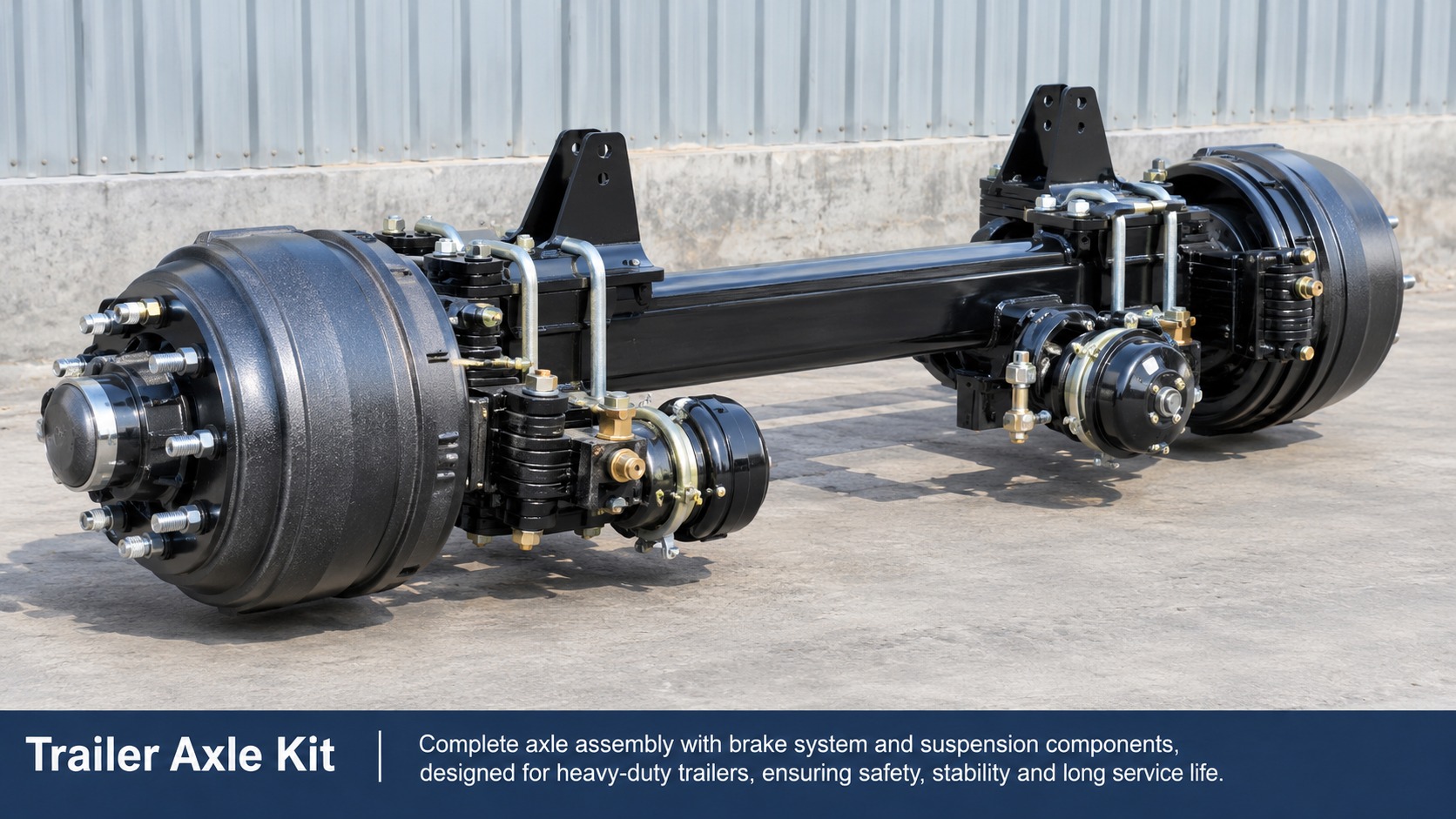
Trailer Axle Kit – Complete Heavy-Duty Axle Assembly
A complete trailer axle assembly featuring integrated wheel hubs, drum brake components, and suspension mounting structures. Designed for commercial semi-trailers, it supports reliable load distribution, stable braking performance, and long-term operation across demanding transportation conditions.
1. What Is a Trailer Axle Kit?
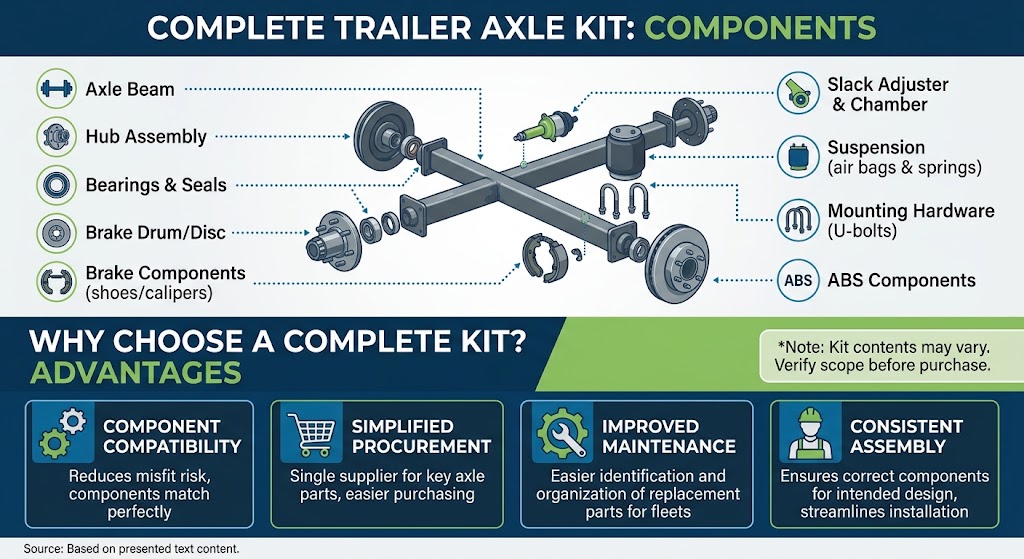
This detailed infographic illustrates the core components of a complete trailer axle kit—from the axle beam and wheel ends to suspension and braking systems—and highlights the key practical advantages of purchasing matched kits, including enhanced component compatibility, simplified procurement, improved maintenance planning, and consistent assembly
A trailer axle kit is a collection of components designed to support the trailer's wheel-end, suspension, and braking functions.
In light-duty trailer applications, a complete kit may include the axle beam, hubs, bearings, seals, and brake assemblies.
For heavy-duty commercial semi-trailers, buyers may use the term more broadly to describe an axle assembly package or a matched axle-and-suspension system.
Depending on the supplier and purchasing requirements, a commercial trailer axle kit may contain:
-
Trailer axle beam
-
Wheel hub assemblies
-
Wheel bearings and oil seals
-
Brake drums or brake discs
-
Brake shoes or disc brake components
-
Slack adjusters and brake chambers, where applicable
-
Leaf spring suspension or air suspension components
-
U-bolts, spring seats, and mounting hardware
-
ABS-related mounting components, where specified
Not every kit includes all these parts. Buyers should always confirm the actual supply scope before requesting a quotation.
Why Is a Complete Trailer Axle Kit Important?
Purchasing a matched component package offers several practical advantages.
Better Component Compatibility
Axle beams, hubs, bearings, brakes, and suspension components need to work together. Specifying the complete configuration helps reduce the risk of dimensional or functional mismatches.
Simplified Procurement
Instead of sourcing multiple components from different suppliers, buyers can consolidate important axle-related parts into one purchasing requirement.
Improved Maintenance Planning
Fleet operators and trailer repair businesses can organize replacement parts more efficiently by identifying the required axle assembly and component specifications.
More Consistent Assembly
A properly specified axle package helps ensure that the components are suitable for the intended trailer design and installation requirements.
2. Main Components of a Trailer Axle Kit
Understanding each component helps buyers select a suitable axle package and communicate technical requirements more accurately.
A complete trailer axle kit integrates the axle beam, wheel hub and bearing assembly, braking system, suspension system, and mounting components. Each part plays an essential role in load support, braking performance, and driving stability, providing a reliable solution for heavy-duty commercial semi-trailers.
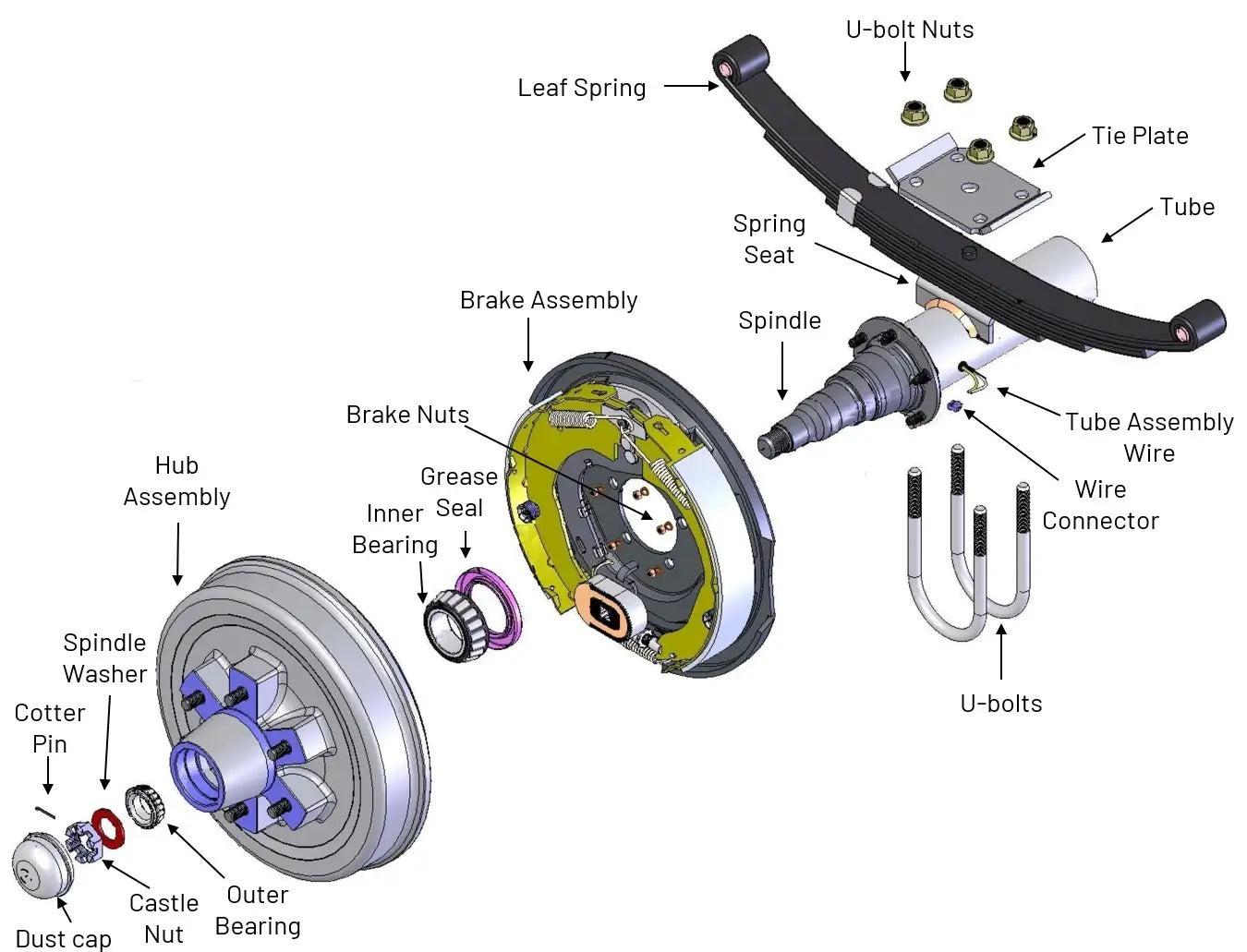
2.1 Trailer Axle Beam
The axle beam is the main structural member connecting the two wheel ends.
It transfers vertical loads from the trailer structure to the wheels and works together with the suspension system to maintain the required axle position.
Important specifications include:
-
Rated axle capacity
-
Axle tube diameter and wall thickness
-
Overall axle dimensions
-
Track width
-
Spring center distance
-
Spindle configuration
-
Axle camber and geometry
For commercial semi-trailers, axle capacity and beam design should be selected according to the vehicle's approved design and intended operating conditions.
2.2 Wheel Hub and Bearing Assembly
The wheel hub connects the wheel to the axle spindle and provides the mounting interface for the wheel and braking components.
Typical components include:
-
Wheel hub
-
Inner and outer bearings
-
Bearing races
-
Oil seals
-
Wheel studs and nuts
-
Hub cap
Correct bearing selection, lubrication, installation, and adjustment are important for reducing friction and preventing premature wheel-end wear.
Buyers should verify bearing dimensions, hub specifications, wheel bolt patterns, and spindle compatibility before ordering replacements.
2.3 Brake System
The braking system is one of the most important parts of a commercial trailer axle package.
Depending on the trailer design and market requirements, common configurations include:
Drum Brake System
A drum brake system generally includes a brake drum, brake shoes, brake camshaft, slack adjuster, and brake chamber.
It is widely used in commercial semi-trailer applications because of its established design and maintenance familiarity.
Air Disc Brake System
An air disc brake system uses brake discs, calipers, pads, and associated air-operated components.
It can offer different braking and maintenance characteristics compared with drum brakes. The final choice should consider operating conditions, vehicle specifications, maintenance resources, and local regulations.
ABS Compatibility
For commercial trailers, the braking package may also require ABS-compatible components, including sensor mounting arrangements and tone rings where specified.
The brake system must be compatible with the tractor, trailer configuration, and applicable road regulations.
2.4 Trailer Suspension System
The suspension system connects the axle assembly to the trailer frame.
Its main functions include supporting the trailer load, absorbing road impacts, maintaining axle positioning, and contributing to vehicle stability.
Two common commercial semi-trailer suspension configurations are:
Mechanical Leaf Spring Suspension
Leaf spring suspension uses steel spring packs and related mounting components to support the axle.
Typical components include:
-
Leaf springs
-
Spring seats
-
Spring hangers
-
Equalizers, where applicable
-
U-bolts
-
Shackle assemblies
-
Mounting bolts and nuts
Mechanical suspension is commonly selected for cargo trailers operating in environments where a straightforward mechanical structure and accessible maintenance are important.
Air Suspension System
Air suspension uses air springs, control valves, shock absorbers, and associated mounting components.
Depending on the design, it can provide adjustable ride height and improved isolation from road impacts.
It is frequently considered for highway transportation, modern commercial fleets, and applications where ride quality and vehicle operating requirements are important.
2.5 Related Mounting and Connection Parts
A complete axle installation also requires suitable connection and fastening components.
These may include:
-
U-bolts and tie plates
-
Spring hangers
-
Mounting brackets
-
Shock absorbers
-
Fasteners
-
ABS sensor brackets
The required hardware depends on the axle and suspension design.
Using suitable mounting components is important for maintaining correct positioning and preventing looseness during operation.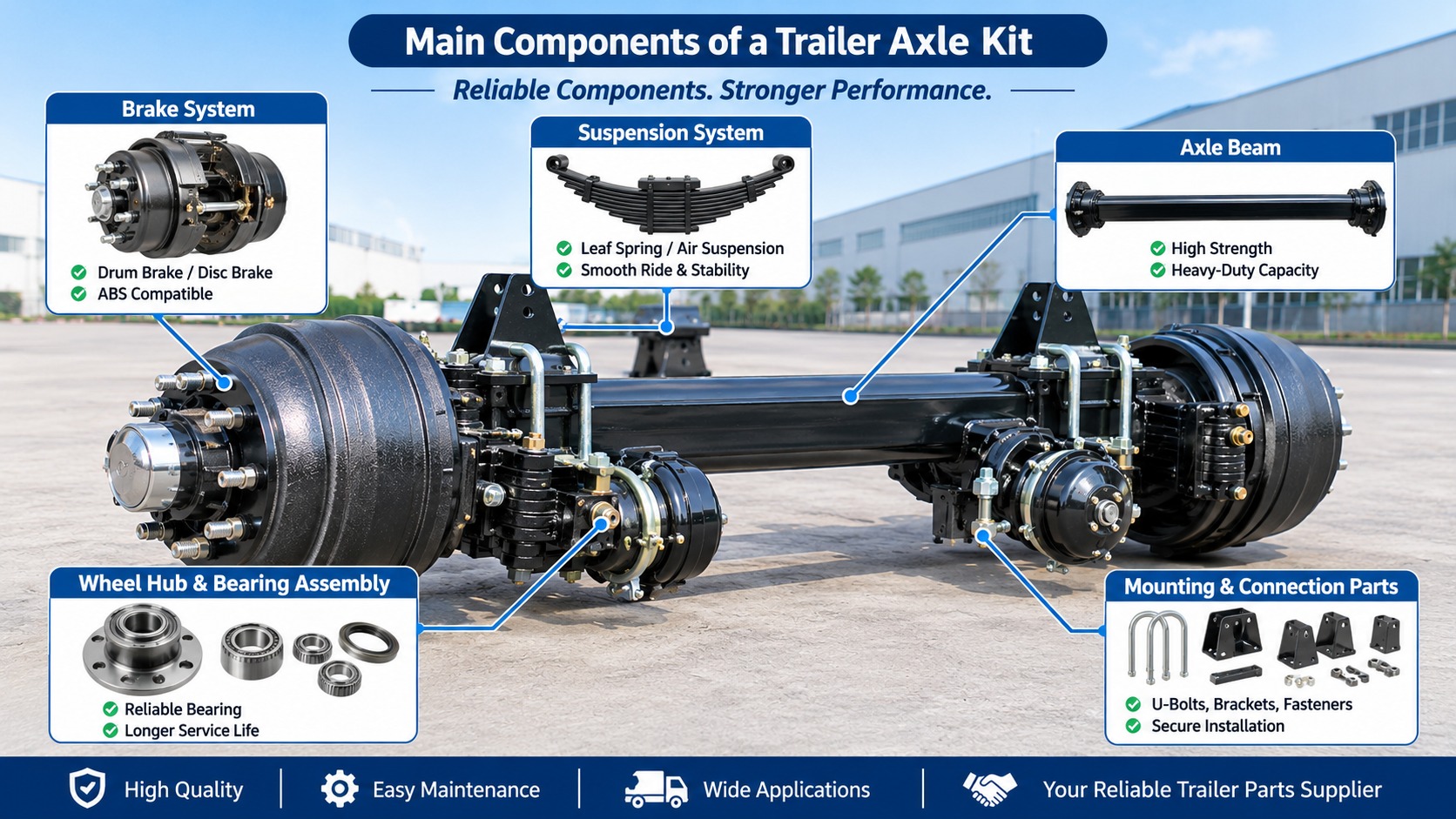
Main Components of a Trailer Axle Kit
A complete trailer axle kit integrates the axle beam, wheel hub and bearing assembly, braking system, suspension system, and mounting components. Each part plays an essential role in load support, braking performance, and driving stability, providing a reliable solution for heavy-duty commercial semi-trailers.
3. Different Types of Trailer Axle Kits
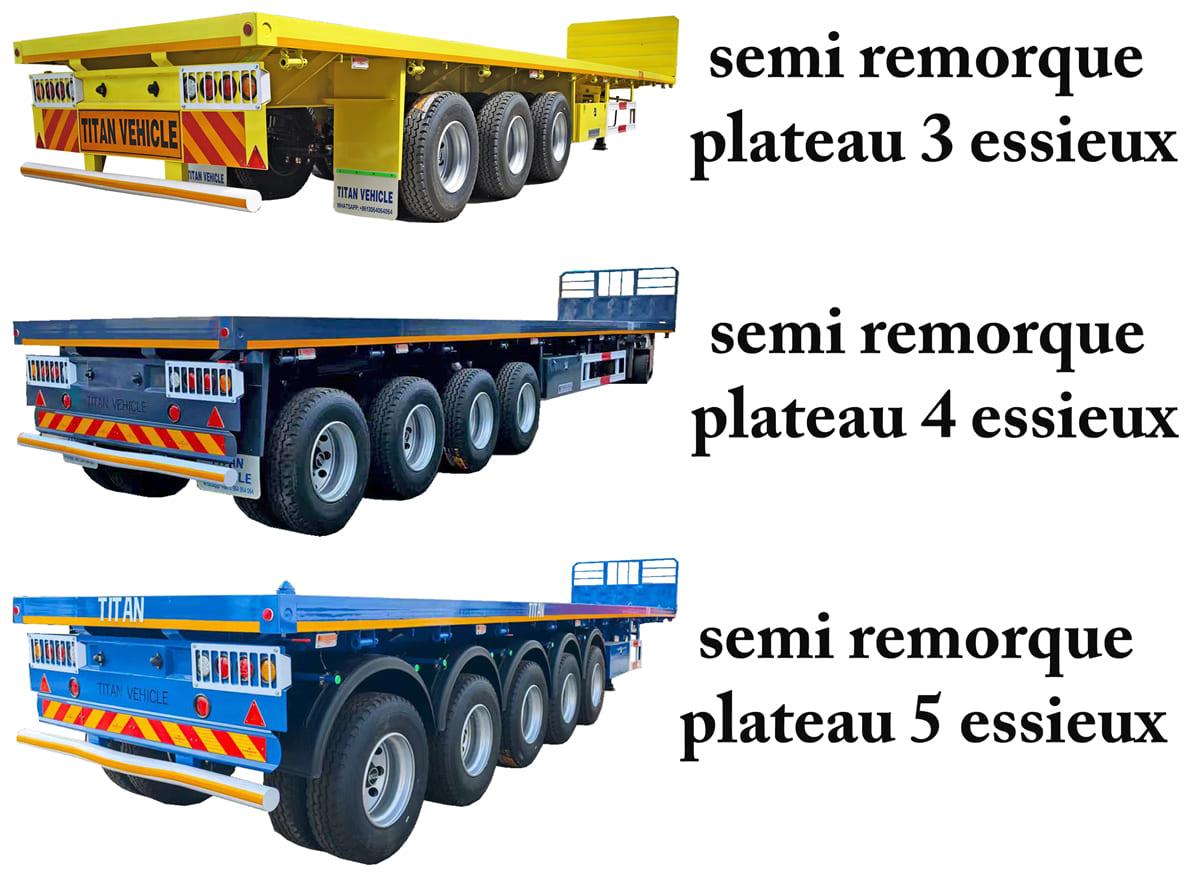
Trailer axle kits are available in different configurations to suit various trailer designs, loading requirements, and transportation environments.
Different Types of Trailer Axle Kits
Trailer axle kits are available in single, tandem, tri-axle, and multi-axle configurations to meet different load requirements and trailer applications. From general cargo transportation to heavy-duty equipment hauling, the right axle arrangement helps achieve proper load distribution, reliable performance, and operational stability.
3.1 Single Axle Kit
A single axle configuration uses one axle assembly.
It is commonly associated with light-duty and specialized trailer applications where the load requirements are within the capacity of the complete running gear system.
For heavy commercial applications, the vehicle manufacturer must verify the suitability of the axle configuration against the trailer's approved design.
3.2 Tandem Axle Kit
A tandem axle system uses two axles installed in the same trailer running gear group.
It can distribute the trailer load across two axle positions and provide a suitable configuration for many commercial transportation applications.
Tandem axle systems are commonly used in cargo trailers, flatbed trailers, and other commercial trailer designs.
3.3 Tri-Axle Kit
A tri-axle configuration uses three axles and is widely considered for commercial semi-trailers requiring higher overall axle-group capacity.
Typical applications include:
-
Flatbed semi-trailers
-
Side wall semi-trailers
-
Curtain side trailers
-
Container chassis
-
Dump semi-trailers
-
Some specialized equipment trailers
The actual load capacity is determined by the rated capacity of each axle, suspension, tires, wheels, braking components, frame design, and applicable regulations.
3.4 Four-Axle and Multi-Axle Systems
Four-axle and multi-axle configurations are used in certain heavy-duty and specialized transportation applications.
They may be considered for lowbed trailers, heavy equipment transportation, and other operations requiring a specific load distribution arrangement.
Axle spacing, suspension geometry, steering requirements, and road regulations must be evaluated during the design process.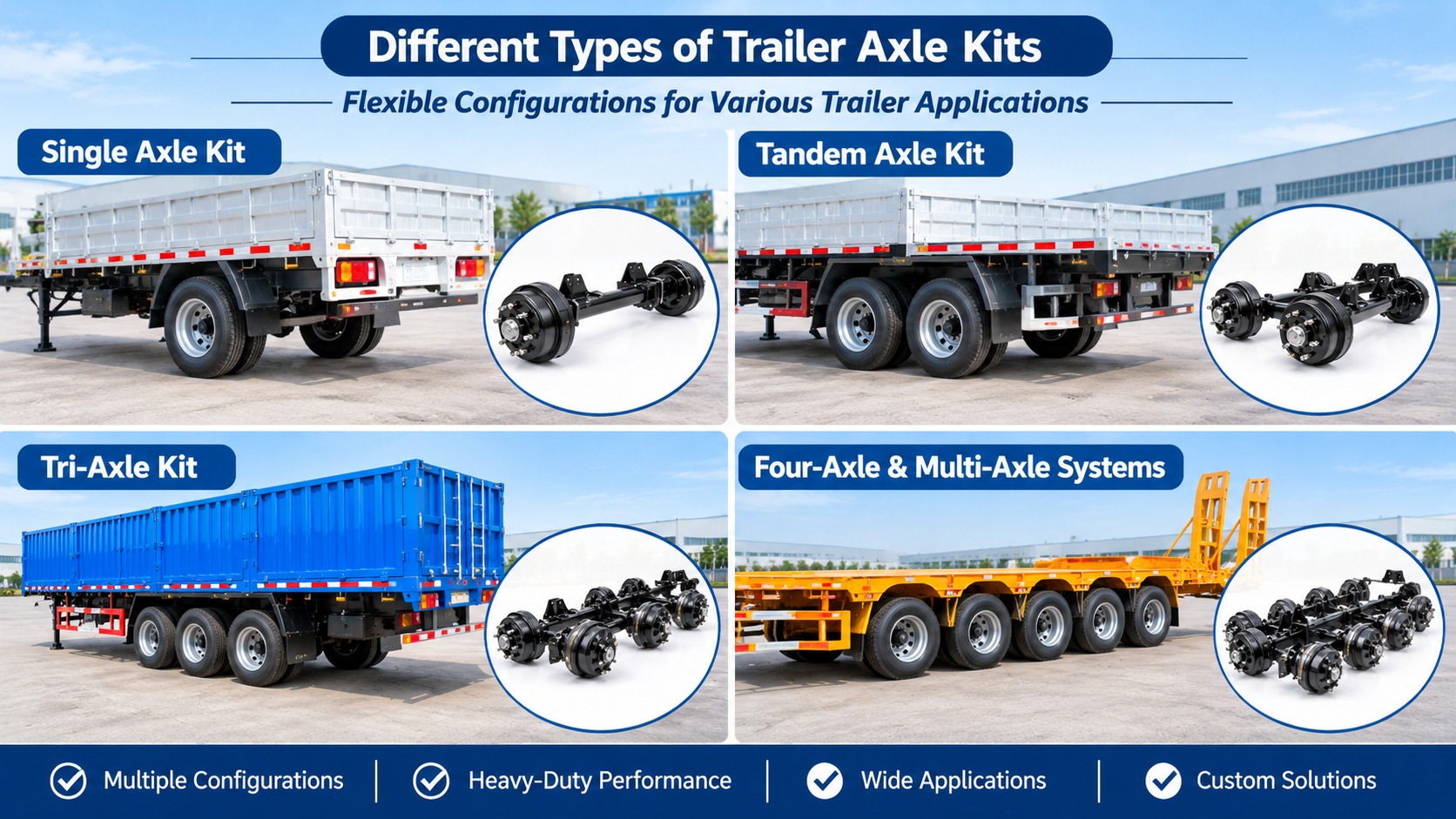
Trailer axle kits are available in single, tandem, tri-axle, and multi-axle configurations to meet different load requirements and trailer applications. From general cargo transportation to heavy-duty equipment hauling, the right axle arrangement helps achieve proper load distribution, reliable performance, and operational stability.
4. Trailer Axle Kit Specifications: What Should Buyers Check?
Technical compatibility is one of the most important considerations when purchasing a trailer axle kit.
A product that looks similar to the existing assembly may still have different mounting dimensions, wheel-end specifications, or braking arrangements.
The following table outlines the main specifications buyers should confirm.
| Specification | What It Means | Why It Matters |
|---|---|---|
| Axle Capacity | Rated load capacity of each axle | Determines load suitability |
| Track Width | Distance between the wheel centerlines | Affects wheel positioning |
| Spring Center | Distance between suspension spring mounting centers | Ensures suspension compatibility |
| Axle Tube | Beam diameter and wall thickness | Relates to structural design |
| Brake Type | Drum brake or disc brake | Determines braking compatibility |
| Brake Size | Dimensions of the braking assembly | Ensures component matching |
| Hub Specification | Hub dimensions and wheel mounting pattern | Ensures wheel compatibility |
| Suspension Type | Mechanical or air suspension | Determines mounting arrangement |
| Tire Configuration | Tire size and wheel specifications | Ensures running gear compatibility |
| ABS Configuration | Sensor and related mounting requirements | Supports braking system integration |
Common Commercial Axle Configurations
The following examples illustrate specifications found in commercial trailer axle product ranges. They are reference configurations, not universal standards or a fixed LUCKSUN product specification.
| Item | Example Configuration A | Example Configuration B |
|---|---|---|
| Axle Load | 12,000 kg | 13,000 kg |
| Brake Type | Drum Brake | Disc Brake |
| Suspension | Mechanical | Air Suspension |
| Tire Application | Dual Tire | Dual Tire |
| Axle Arrangement | Tandem / Tri-Axle | Tandem / Tri-Axle |
| Application | General Cargo | Highway Transportation |
Final specifications must be confirmed against the axle manufacturer's technical documentation and the complete trailer design.
5. How to Choose the Right Trailer Axle Kit
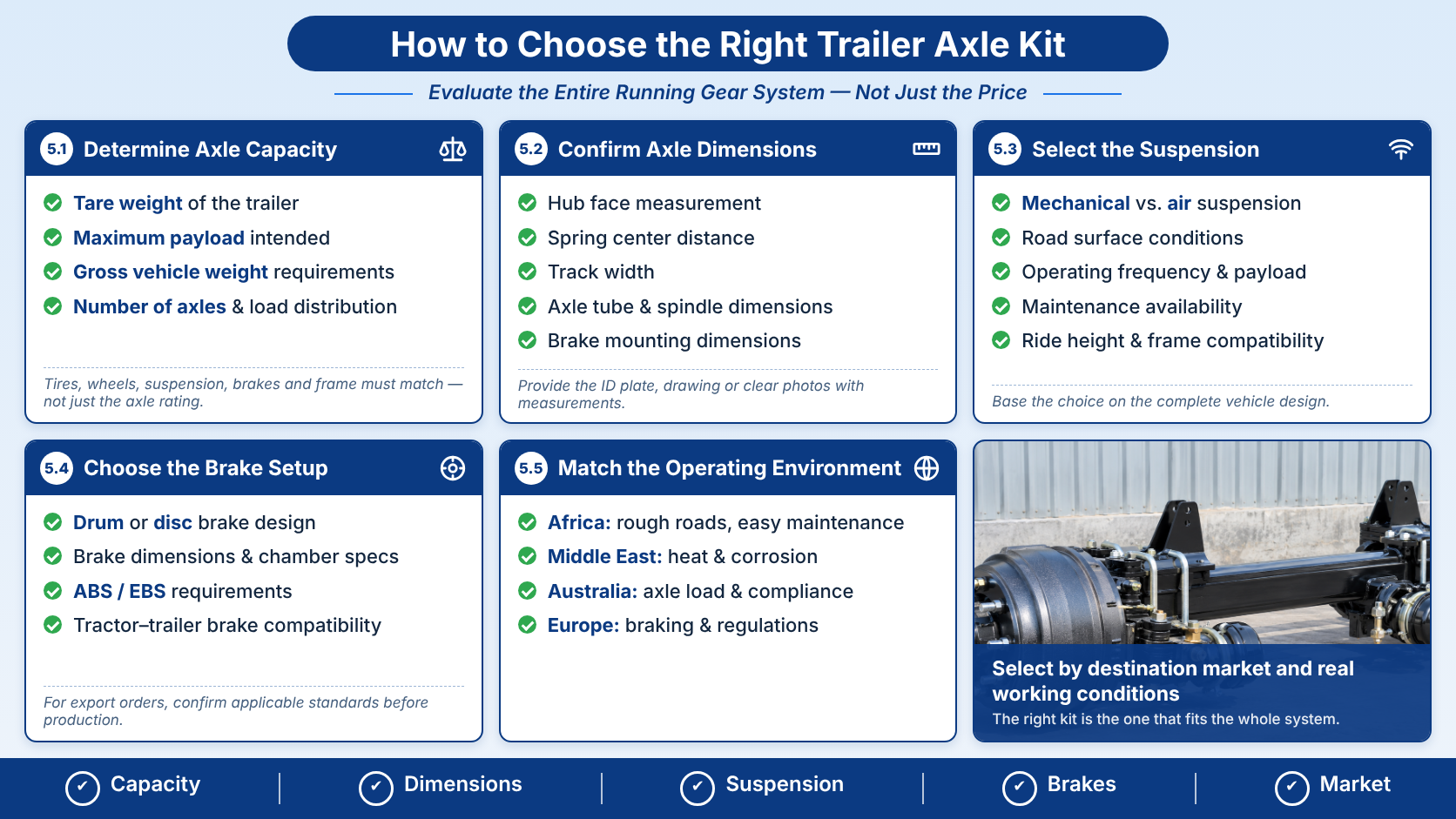
Choosing a trailer axle kit takes more than comparing price or rated capacity. Evaluate the whole running gear system: confirm load requirements and mounting dimensions, match the suspension and brake setup to the application, and verify that the kit suits the road conditions and regulations of your destination market.
Selecting an appropriate trailer axle kit requires more than comparing prices.
Buyers should evaluate the entire trailer running gear system.
5.1 Determine the Required Axle Capacity
Start by identifying:
-
Trailer tare weight
-
Maximum intended payload
-
Gross vehicle weight requirements
-
Number of axles
-
Expected load distribution
The load must be distributed appropriately across the complete running gear system.
Do not select an axle based only on its advertised maximum capacity. The tires, wheels, suspension, brakes, frame, and other components must also be suitable for the intended application.
5.2 Confirm Axle Dimensions
For replacement projects, accurate measurements are essential.
Important dimensions may include:
-
Hub face measurement
-
Spring center distance
-
Track width
-
Axle tube dimensions
-
Spindle dimensions
-
Brake mounting dimensions
Where possible, provide the existing axle identification plate, technical drawing, or clear photographs with measurements.
5.3 Select the Appropriate Suspension
Mechanical suspension and air suspension have different structural characteristics and maintenance requirements.
Consider:
-
Road surface conditions
-
Trailer operating frequency
-
Payload requirements
-
Maintenance availability
-
Required ride height
-
Compatibility with the trailer frame
For rough-road transportation and heavy-duty applications, suspension selection should be based on the complete vehicle design rather than price alone.
5.4 Choose the Correct Brake Configuration
The brake system must meet the intended vehicle application and local regulatory requirements.
Confirm:
-
Drum or disc brake design
-
Brake dimensions
-
Brake chamber specifications
-
ABS or EBS requirements
-
Tractor and trailer brake compatibility
For international orders, buyers should confirm applicable standards before production.
5.5 Consider the Operating Environment
Different markets have different road conditions, climates, maintenance resources, and vehicle regulations.
For example:
-
African transportation operations may require consideration of rough-road conditions, maintenance accessibility, and heavy cargo applications.
-
Middle Eastern fleets may need to evaluate high-temperature operating environments and corrosion protection.
-
Australian commercial applications require careful verification of applicable vehicle dimensions, axle loading, and compliance requirements.
-
European highway fleets may prioritize braking compatibility, suspension performance, and relevant regulatory requirements.
The right axle kit should be selected according to the destination market and actual operating conditions.
6. Trailer Axle Kit Applications
Commercial trailer axle assemblies are used across a wide range of transportation and industrial applications.
Flatbed Semi-Trailers
Flatbed trailers transport steel products, construction materials, machinery, containers, and other general cargo.
Their axle configurations should be matched to the trailer's rated payload, deck design, and transportation requirements.
Lowbed Semi-Trailers
Lowbed trailers are designed for transporting heavy construction equipment and machinery.
Depending on the model, they may use three, four, or more axles to achieve the required load distribution and overall vehicle configuration.
Dump Semi-Trailers
Dump trailers are used to transport sand, gravel, aggregates, and other bulk materials.
Their axle and suspension systems must accommodate the intended payload and the additional operational conditions associated with loading and unloading.
Container Chassis
Container chassis are designed to carry shipping containers in standard configurations.
Axle selection must consider the chassis structure, container load distribution, suspension arrangement, and applicable road regulations.
Side Wall and Curtain Side Trailers
These trailers are commonly used for general cargo transportation and logistics operations.
The axle package should be matched to the trailer dimensions, gross vehicle weight, and intended fleet application.
7. Trailer Axle Kit vs. Individual Axle Parts: Which Is Better?
When purchasing trailer replacement components, buyers generally have two options: ordering a complete kit or sourcing individual parts.
| Comparison | Complete Axle Kit | Individual Axle Parts |
|---|---|---|
| Procurement | Consolidated purchasing | Multiple purchasing items |
| Compatibility | Can be specified as a matched package | Requires individual verification |
| Installation Planning | Easier to define the complete scope | Requires more coordination |
| Customization | Depends on supplier capability | Flexible part-by-part selection |
| Inventory Management | Suitable for planned replacement packages | Useful for specific component replacement |
| Initial Cost | Depends on package configuration | Depends on the number of parts required |
Which Option Should You Choose?
A complete trailer axle kit is worth considering when replacing a complete axle system or preparing new trailer production.
Individual parts may be more suitable when only a specific component needs replacement and the remaining assembly is in good condition.
For fleet operators and trailer manufacturers, the most practical solution depends on procurement volume, maintenance requirements, and component compatibility.
8. What Affects Trailer Axle Kit Prices?
Trailer axle kit prices vary according to technical specifications, component brands, materials, production requirements, and order quantities.
There is no single price suitable for every trailer axle configuration.
The main cost factors include:
1. Axle Load Rating
Different axle capacities require different structural designs and component specifications.
2. Brake Configuration
Drum brake and air disc brake packages have different component structures and costs.
3. Suspension Type
Mechanical leaf spring and air suspension configurations have different component requirements.
4. Component Brands
Axle, brake, bearing, suspension, and other component brands can influence the overall quotation.
5. Custom Dimensions
Non-standard track widths, spring centers, wheel-end configurations, and mounting dimensions may require customized production.
6. Order Quantity
Bulk purchasing may provide better procurement efficiency and more competitive commercial terms.
7. Destination and Shipping Requirements
Packaging, transportation arrangements, export documentation, and delivery terms can affect the final landed cost.
How to Get an Accurate Trailer Axle Kit Quotation
To receive a suitable quotation, buyers should prepare the following information:
-
Required quantity
-
Axle load capacity
-
Axle dimensions or technical drawing
-
Brake type and specifications
-
Suspension type
-
Hub and wheel specifications
-
Preferred component brands
-
Destination country and delivery requirements
If you do not have a complete technical drawing, photographs of the existing axle assembly and its identification plate can help with the initial assessment.
9. Quality Inspection and Maintenance of Trailer Axle Kits
A suitable axle configuration must also be supported by proper manufacturing inspection and regular maintenance.
Quality Inspection Before Delivery
Buyers should consider checking the following:
Axle Structure
Inspect the axle beam for visible deformation, cracks, and manufacturing defects.
Welding Quality
Check relevant welded joints and mounting areas according to the applicable inspection requirements.
Wheel-End Components
Verify hub dimensions, bearing specifications, seals, and installation quality.
Brake Components
Check brake assembly specifications and the condition of relevant components.
Suspension Components
Confirm the correct mounting dimensions, component arrangement, and fastening hardware.
Documentation
Request applicable product specifications, inspection records, and technical documents according to the purchasing agreement.
Routine Maintenance Recommendations
Regular maintenance helps identify potential problems before they develop into more serious failures.
Recommended inspection items include:
-
Checking wheel-bearing condition and lubrication
-
Inspecting brake linings, drums, discs, and related components
-
Checking suspension bushings and mounting points
-
Inspecting U-bolts and fasteners according to the manufacturer's procedures
-
Checking axle alignment and abnormal tire wear
-
Inspecting air suspension components for leaks or damage
Maintenance intervals should follow the axle and suspension manufacturer's instructions, taking operating conditions and actual vehicle usage into account.
10. Why Choose LUCKSUN for Trailer Axle and Semi-Trailer Parts Supply?
Selecting a suitable supplier is an important part of managing commercial trailer procurement.
LUCKSUN focuses on semi-trailer and related component supply for international customers.
For buyers sourcing trailer axle kits and other semi-trailer parts, the purchasing process should begin with a clear understanding of the intended application and technical requirements.
LUCKSUN can support customer enquiries involving:
-
Trailer axle assemblies
-
Mechanical suspension components
-
Air suspension systems
-
Brake-related components
-
Landing legs
-
Trailer structural parts
-
Other semi-trailer accessories
Different projects may require different axle capacities, dimensions, braking systems, and suspension configurations.
Rather than selecting a package based only on a product photograph, buyers should confirm the complete technical specifications before placing an order.
Whether you are a trailer manufacturer, parts distributor, fleet operator, or commercial vehicle importer, providing your required specifications helps identify a more suitable supply solution.
Contact LUCKSUN to discuss your trailer axle kit requirements and request a quotation.
11. Frequently Asked Questions About Trailer Axle Kits
Q1: What is included in a complete trailer axle kit?
A complete kit may include the axle beam, hubs, bearings, seals, brake assemblies, and related mounting hardware. Some commercial packages also include suspension components. The exact contents depend on the supplier and configuration.
Q2: What is the difference between a trailer axle and a trailer axle kit?
A trailer axle generally refers to the axle beam or axle assembly itself. A trailer axle kit is a broader package that may include hubs, bearings, brakes, suspension components, and mounting hardware.
Q3: Can I purchase semi-trailer axle kits in bulk?
Yes. Commercial trailer axle assemblies and related components can be sourced for bulk purchasing, depending on supplier capability, specifications, and production arrangements.
Q4: How do I know which axle capacity I need?
Start with the trailer's approved gross weight, axle arrangement, expected load distribution, and component ratings. The complete running gear system must be designed to meet the intended operating requirements and applicable regulations.
Q5: Are trailer axle kits available with drum brakes and disc brakes?
Yes. Both drum brake and air disc brake configurations are available in commercial trailer applications. Selection depends on vehicle design, braking requirements, maintenance considerations, and local regulations.
Q6: Can a trailer axle kit be customized?
Depending on the supplier's manufacturing capabilities, customization may include axle capacity, track width, spring center distance, brake configuration, wheel-end specifications, and suspension arrangements.
Q7: What information is required to order a replacement trailer axle kit?
Buyers should provide the existing axle specifications, measurements, photographs, identification plate, brake configuration, suspension type, and required quantity. A technical drawing is helpful when available.
Q8: How often should trailer axle components be inspected?
Inspection frequency depends on the manufacturer's recommendations, operating conditions, mileage, loading conditions, and local maintenance requirements. Bearings, brakes, suspension connections, and tire wear should be checked regularly.
Q9: Can I order trailer axle kits together with other semi-trailer parts?
Yes. Depending on supply arrangements, buyers can enquire about axle assemblies, suspension components, brake parts, landing legs, and other semi-trailer accessories together.
Q10: How can I get a quotation from LUCKSUN?
Send your required quantity, axle capacity, technical specifications, brake type, suspension configuration, and destination country. If available, include photographs or technical drawings to help confirm the correct configuration.
Final Thoughts
A trailer axle kit is an important part of the complete semi-trailer running gear system. Choosing the right package requires careful consideration of axle capacity, dimensions, suspension, braking components, wheel-end compatibility, and operating conditions.
For trailer manufacturers, distributors, and fleet operators, a properly specified axle package can simplify procurement and support more efficient maintenance planning.
Looking for a trailer axle kit supplier? Contact LUCKSUN with your requirements to discuss suitable configurations and request a competitive quotation.