
24m³ Rear-Tipping Semi-Trailer for Saudi Arabia
A reliable dump trailer is more than a vehicle for transporting sand and gravel. For construction companies, material suppliers and fleet operators in Saudi Arabia, it is an important part of daily transportation efficiency.
The 24-cubic-meter rear-tipping semi-trailer (Saudi-style) is designed for bulk material transportation and hydraulic rear unloading. Its practical capacity makes it a suitable configuration to consider for operations involving sand, aggregates, crushed stone, soil and other compatible construction materials.
Watch the 24m³ Rear-Tipping Semi-Trailer in Detail
However, choosing the right trailer requires more than looking at the cubic-meter rating. The body structure, chassis strength, hydraulic lifting system, axle configuration, suspension and braking components all influence its performance during daily operation.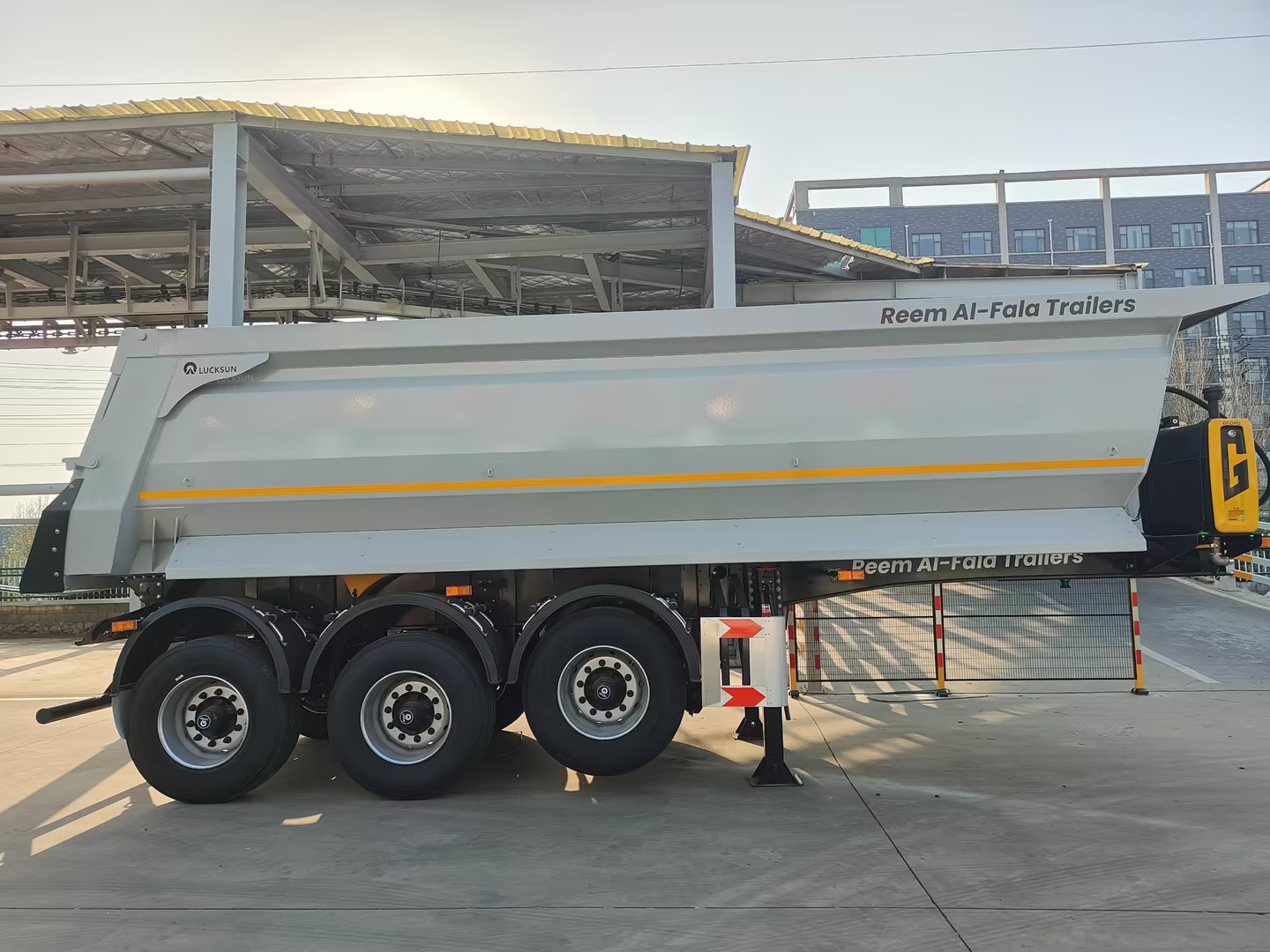
A 24m³ heavy-duty rear-tipping semi-trailer featuring a reinforced steel cargo body, hydraulic lifting system and three-axle configuration, designed for sand, gravel and construction material transportation in Saudi Arabia.
At LUCKSUN, we focus on semi-trailers and related components for international buyers. This guide explains the important design considerations, configuration options and purchasing factors for a 24m³ rear-tipping semi-trailer intended for the Saudi Arabian market.
1. What Is a 24-Cubic-Meter Rear-Tipping Semi-Trailer?
A 24m³ rear-tipping semi-trailer is a heavy-duty trailer equipped with a cargo body and hydraulic lifting mechanism. During unloading, the hydraulic cylinder raises the front section of the body, allowing bulk materials to discharge through the rear opening.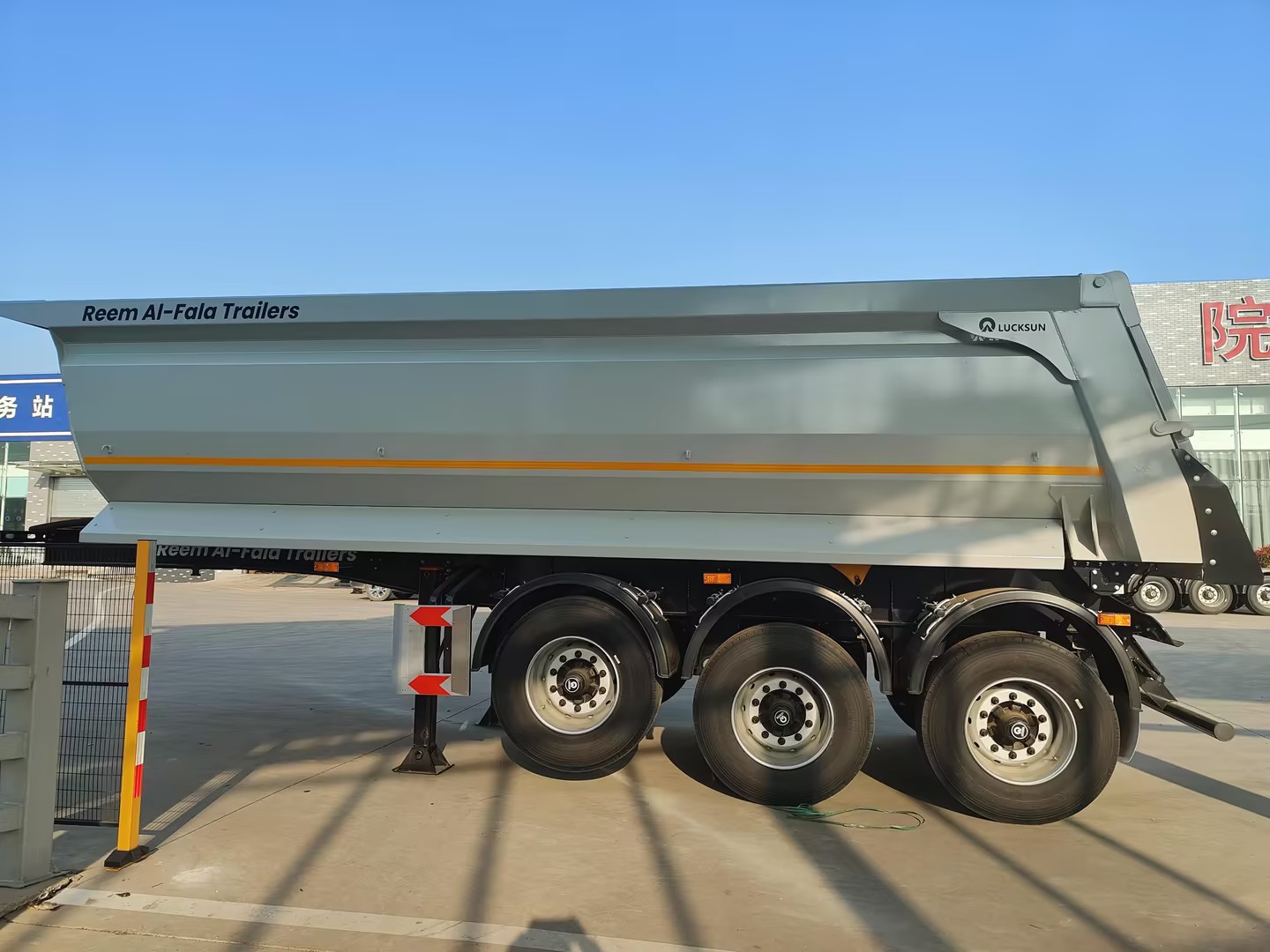
24m3 rear tipping semi-trailer for Saudi Arabia
Unlike a conventional flatbed trailer, a rear tipper is designed to transport loose materials and unload them without requiring a separate unloading machine for every discharge operation.
A typical configuration may include:
-
A reinforced steel chassis.
-
A 24m³ cargo body.
-
A front-mounted hydraulic telescopic cylinder.
-
A three-axle running gear.
-
Mechanical or air suspension.
-
Pneumatic braking equipment.
-
Rear discharge doors.
-
Heavy-duty landing legs and kingpin.
-
Lighting, electrical wiring and safety accessories.
The exact design depends on the intended cargo, tractor specifications, road conditions and local transportation requirements.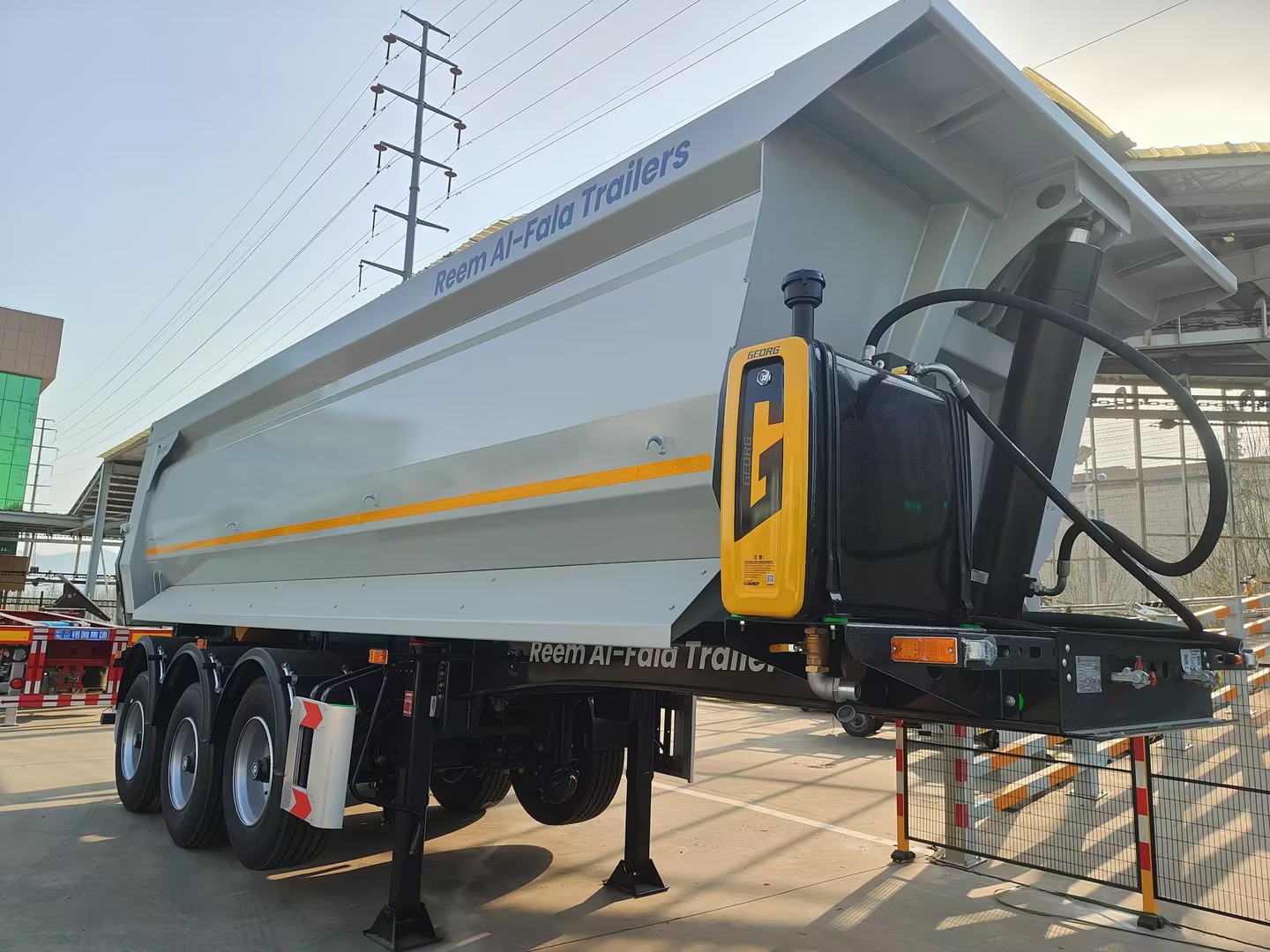
For buyers comparing different dump semi-trailer configurations, the most important consideration is whether the complete vehicle matches the actual operating conditions.
2. Why Choose a 24m³ Tipper Trailer for Saudi Arabia?
Saudi Arabia has extensive construction, infrastructure, mining and industrial transportation activities. Bulk materials need to move between quarries, material yards, construction sites and project locations.
A 24m³ trailer offers a practical balance between cargo volume, vehicle dimensions and operating requirements for many medium-volume bulk transportation applications.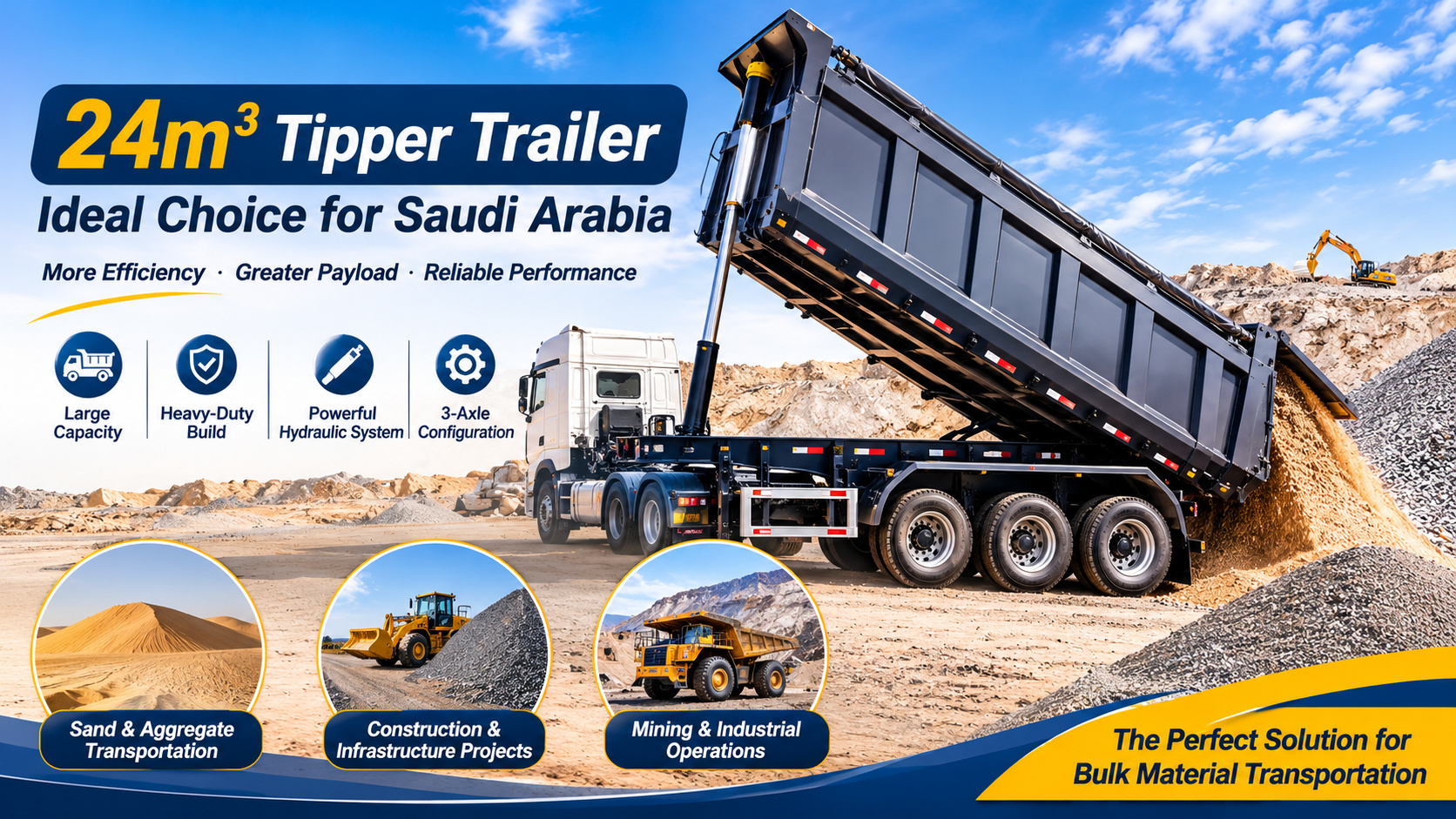
A heavy-duty 24m³ rear-tipping semi-trailer unloading sand and aggregates at a quarry in Saudi Arabia. Designed for bulk material transportation, this configuration supports construction, infrastructure, mining and industrial operations, with a robust cargo body, hydraulic tipping system and three-axle layout.
Sand and Aggregate Transportation
Sand, gravel and crushed stone are commonly transported to construction sites and material processing facilities.
A rear-tipping structure allows the operator to discharge materials at designated unloading areas. The rear-opening design is particularly useful where a controlled discharge direction is preferred.
Construction and Infrastructure Projects
Road construction, earthmoving and general infrastructure projects require regular transportation of soil, aggregates and other bulk materials.
A suitable rear tipper can help reduce manual unloading work and support repeated loading and unloading cycles.
Mining and Industrial Operations
For selected mining and industrial applications, a 24m³ configuration can be considered when the material density and legal payload limits are compatible with the vehicle design.
It is important to remember that a larger cargo volume does not automatically mean a higher legal payload.
For example, 24m³ of lightweight material and 24m³ of dense crushed stone can produce very different cargo weights.
The correct selection must consider material density, trailer tare weight, axle ratings, tractor capacity and permitted gross combination weight.
3. Cargo Body Design: U-Shape or Box-Type?
The cargo body is one of the most important parts of a rear-tipping semi-trailer.
For Saudi-style tipper applications, buyers commonly compare curved U-shaped bodies with rectangular box-type bodies.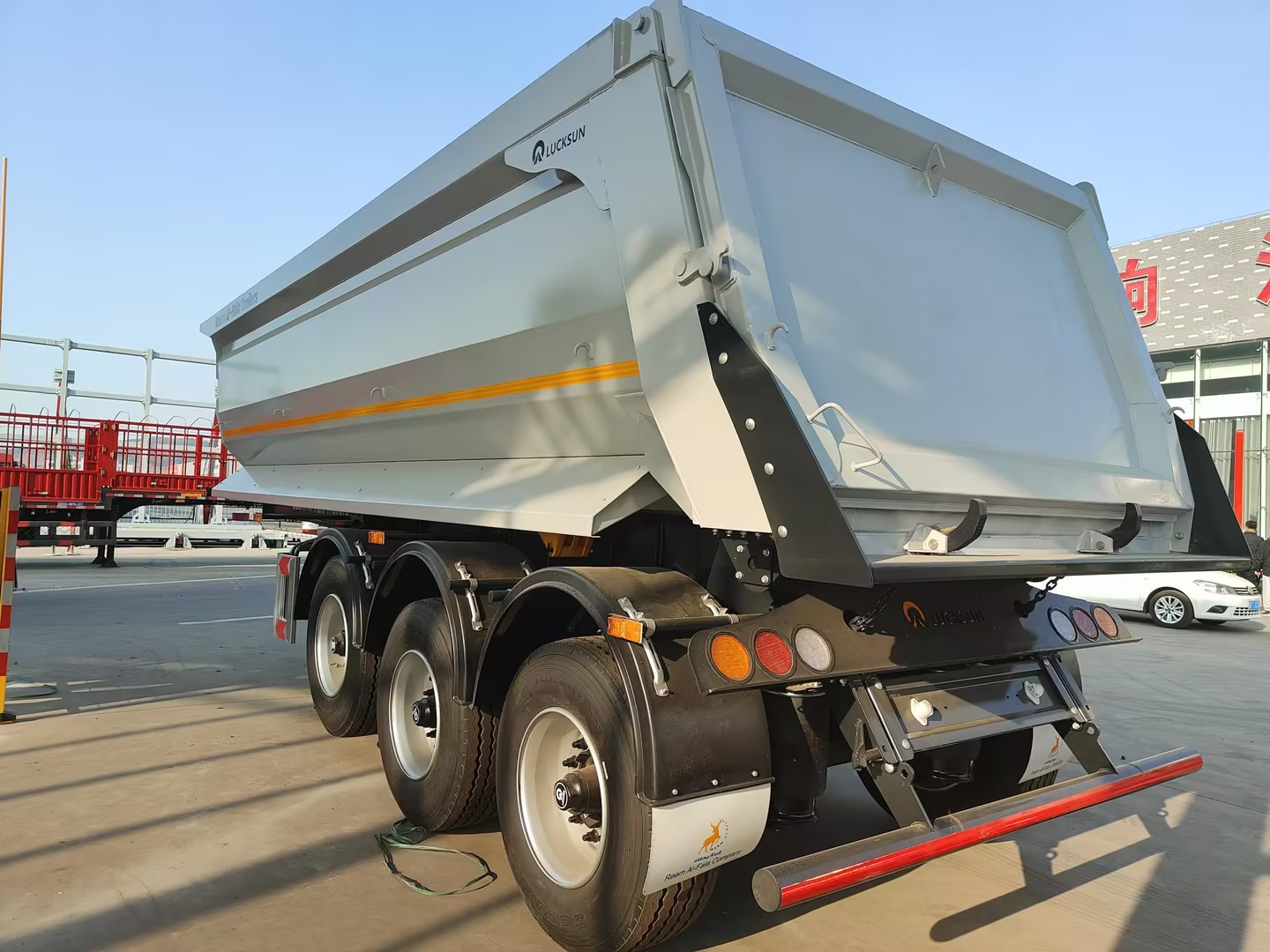
rear-tipping-semi-trailer-air-suspension-brake-chamber-axle-beam
The two designs have different structural characteristics and should be selected according to the transported material.
U-Shape Half-Pipe Cargo Body
A U-shaped cargo body features a curved internal surface without the sharp lower corners found in conventional rectangular bodies.
Its main advantages include:
-
Smoother material movement during unloading.
-
Reduced material accumulation in lower corners.
-
Easier cleaning after unloading.
-
A curved structure that can distribute certain loads more evenly.
This design may be particularly useful for wet sand, clay and other materials that tend to stick to internal surfaces.
However, the actual performance depends on body geometry, steel selection, surface condition and unloading angle.
Rectangular Box-Type Cargo Body
A box-type body uses relatively flat side walls and a flat floor.
It offers a straightforward structure and can be suitable for transporting dry sand, gravel, soil and other compatible bulk materials.
Its advantages include:
-
Practical cargo volume utilization.
-
Straightforward body fabrication.
-
Flexible reinforcement arrangements.
-
Convenient inspection of internal surfaces.
For buyers who frequently transport abrasive materials, additional floor protection and wear-resistant steel options should be evaluated.
U-Shape vs. Box-Type: Which Is Better?
| Comparison | U-Shape Body | Box-Type Body |
|---|---|---|
| Internal structure | Curved half-pipe | Rectangular |
| Material discharge | Designed for smoother material flow | Depends on floor and wall geometry |
| Material residue | Can reduce corner accumulation | May retain material in corners |
| Suitable cargo | Sand, wet materials, aggregates | Dry sand, gravel, soil |
| Structural considerations | Curved body strength and wear | Floor reinforcement and corner joints |
| Customization | Available according to design | Available according to design |
There is no universal winner. Buyers should consider cargo characteristics, material abrasiveness, maintenance requirements and expected operating conditions before making a decision.
4. Chassis Structure and Frame Reinforcement
A rear-tipping semi-trailer experiences different forces during transportation and unloading.
During road operation, the chassis supports the trailer's own weight and cargo load. During tipping, the lifting system introduces additional forces into the frame and supporting structures.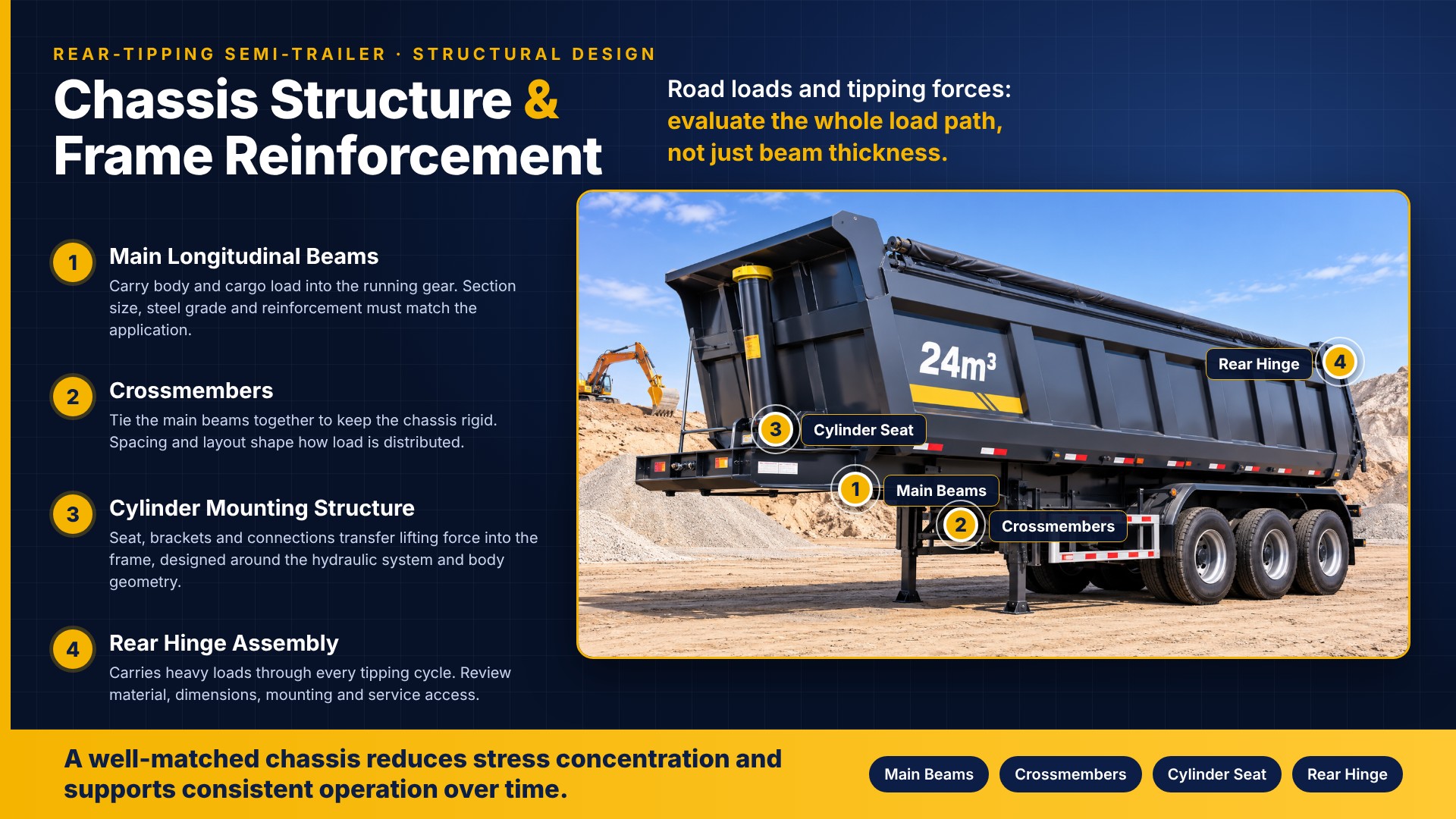
Rear-tipping semi-trailer chassis structure diagram showing main beams, crossmembers, cylinder seat and rear hinge reinforcement
For this reason, chassis design should not be evaluated only by the thickness of the main beams.
Important structural areas include:
Main longitudinal beams
The main beams support the vehicle structure and transmit loads through the running gear. Their section dimensions, material grade and reinforcement design should be matched to the intended application.
Crossmembers
Crossmembers connect the main beams and help maintain chassis rigidity. Their spacing and structural arrangement influence load distribution.
Cylinder mounting structure
The hydraulic cylinder mounting area requires particular attention because it transfers lifting forces into the chassis.
The cylinder seat, supporting brackets and associated connections should be designed according to the hydraulic system and body geometry.
Rear hinge structure
The rear hinge assembly carries significant loads during the tipping cycle. Its material, dimensions, mounting arrangement and maintenance accessibility should be considered during specification approval.
A well-matched chassis structure helps reduce unnecessary stress concentration and supports more consistent operation over time.
5. Hydraulic Lifting System: The Core of Rear-Tipping Performance
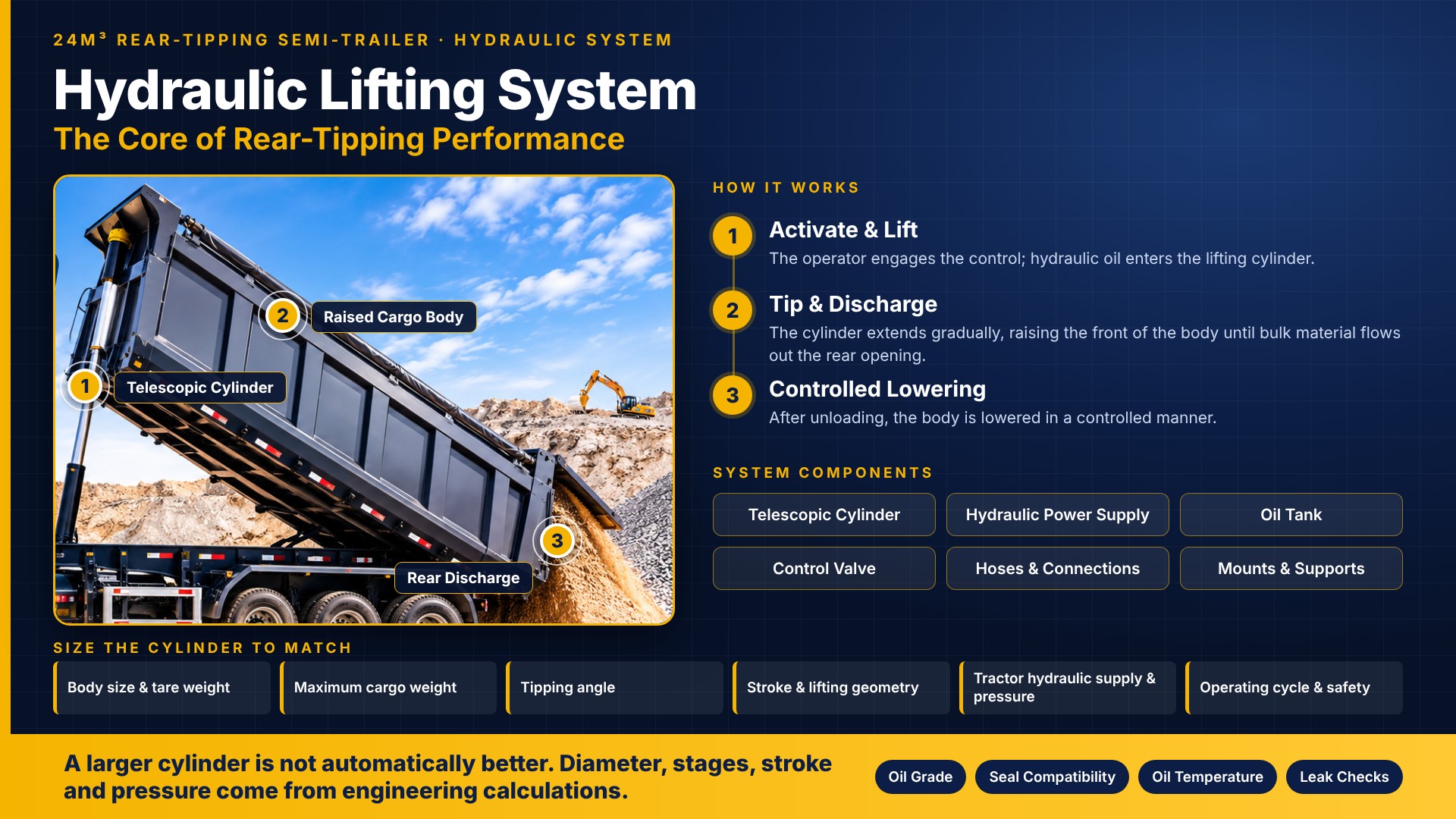
24m³ rear-tipping semi-trailer hydraulic lifting system with telescopic cylinder raising the cargo body to discharge bulk material
The hydraulic lifting system is responsible for raising the cargo body and controlling the unloading process.
For a 24m³ rear-tipping semi-trailer, the system normally includes:
-
Telescopic hydraulic cylinder.
-
Hydraulic power supply.
-
Hydraulic oil tank.
-
Control valve.
-
Hydraulic hoses and connections.
-
Associated mounting and support components.
How Does the Hydraulic System Work?
When the operator activates the hydraulic control system, hydraulic oil enters the lifting cylinder.
The cylinder extends gradually, raising the front section of the cargo body. As the body reaches its designed tipping position, the bulk material moves toward the rear discharge opening.
After unloading, the body is lowered in a controlled manner.
The lifting cylinder must be matched to several engineering factors:
-
Cargo body dimensions and tare weight.
-
Maximum intended cargo weight.
-
Tipping angle requirements.
-
Cylinder stroke and lifting geometry.
-
Tractor hydraulic supply and operating pressure.
-
Required operating cycle and safety arrangements.
Important Hydraulic Purchasing Considerations
A larger cylinder is not automatically a better solution.
The cylinder diameter, number of stages, stroke and operating pressure should be determined through engineering calculations.
Buyers should also confirm hose routing, connection quality, maintenance accessibility and compatibility with the tractor's hydraulic system.
For fleets operating in hot environments, hydraulic oil selection, seal compatibility, oil temperature management and regular leakage inspections are particularly important.
6. Axle and Suspension Configuration
The axle and suspension systems determine how the trailer transfers its load to the road.
For a 24m³ rear-tipping semi-trailer, a three-axle configuration is a common option to evaluate, subject to the intended gross weight and local regulations.
Three-Axle Configuration
A three-axle running gear provides multiple wheel contact points and allows the vehicle's load to be distributed across an axle group.
The final axle arrangement must be determined according to:
-
Permitted axle loads.
-
Trailer tare weight.
-
Cargo weight and distribution.
-
Axle spacing.
-
Tire load ratings.
-
Applicable road regulations.
FUWA, BPW and other suitable axle brands can be considered according to buyer requirements, availability and budget.
For additional technical information, explore our trailer axle kit solutions.
Mechanical Suspension
Mechanical leaf spring suspension is a practical choice for many heavy-duty trailer applications.
Its advantages include a relatively straightforward structure, familiar maintenance procedures and suitability for selected rough-road operating conditions.
However, spring capacity, equalizer design, mounting brackets and axle compatibility must be confirmed as a complete system.
Air Suspension
Air suspension uses air springs and pneumatic control components to support the trailer.
Depending on the design, it can provide different ride characteristics and ride-height control.
It may be suitable for applications where operating comfort, load characteristics and vehicle requirements justify the additional system complexity.
Suspension Comparison
| Item | Mechanical Suspension | Air Suspension |
|---|---|---|
| Main components | Leaf springs and mechanical linkages | Air springs, valves and air lines |
| Structure | Relatively straightforward | More complex |
| Maintenance | Mechanical inspection and replacement | Pneumatic system inspection |
| Ride characteristics | Dependent on spring design | Adjustable in compatible systems |
| Application | Heavy-duty commercial use | Selected transport applications |
The best choice depends on road conditions, cargo requirements, maintenance resources and total operating cost.
7. Braking System and Road Safety
The braking system is a critical part of any heavy-duty semi-trailer.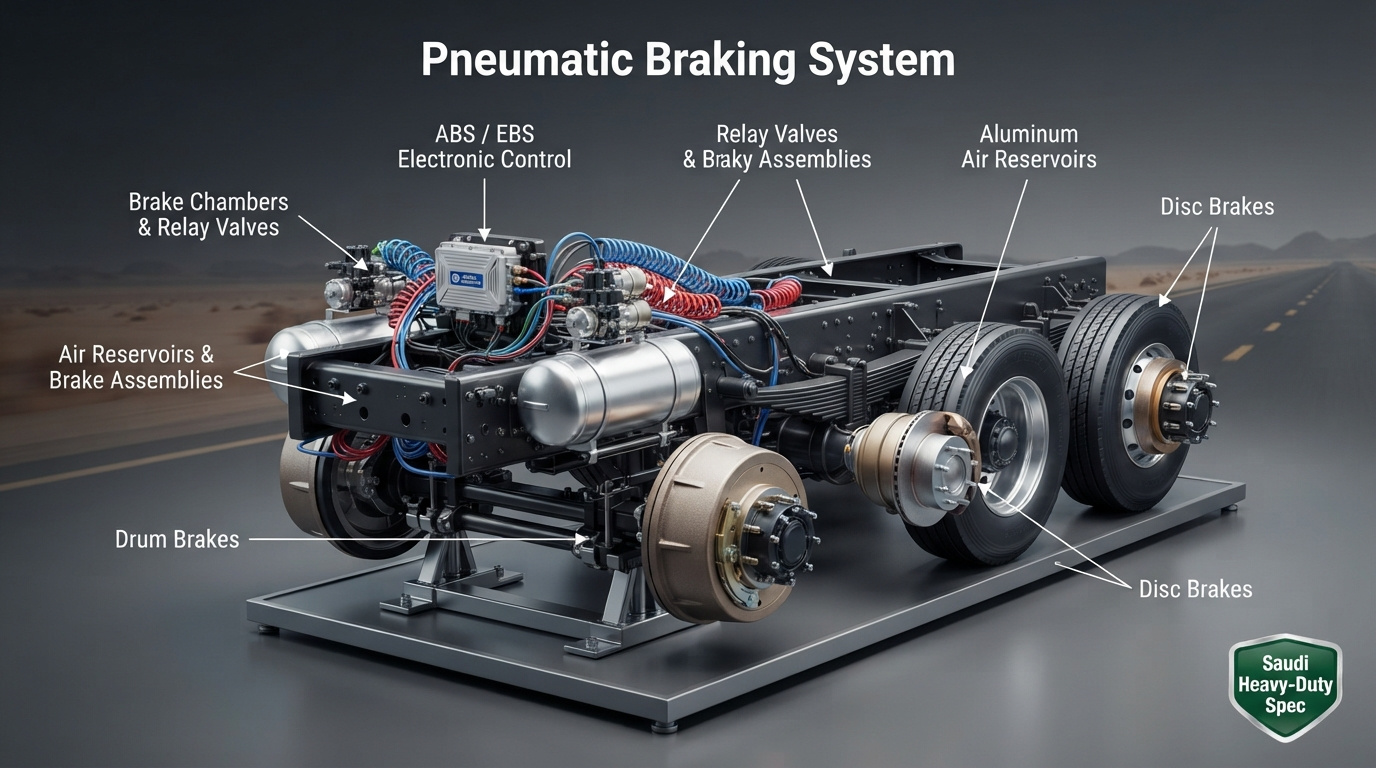
Heavy-Duty Semi-Trailer Braking System & ABS/EBS Road Safety Configuration (Saudi Market Spec)
Precision-engineered heavy-duty semi-trailer braking system showcasing a pneumatic braking architecture equipped with ABS or EBS electronic control options, heavy-duty brake chambers, fast-response relay valves, air reservoirs, emergency and parking brake mechanisms, and rugged drum or disc brake assemblies. Designed to support road safety, wheel-lock prevention under applicable operating conditions, and full compatibility across axle configurations, brake chambers, and tractor pneumatic systems—including configurations aligned with LUCKSUN trailer ABS options for demanding Saudi operating environments.
For a Saudi-market configuration, buyers should confirm the braking system according to the vehicle's axle arrangement, tractor compatibility and applicable technical requirements.
Possible components include:
-
Pneumatic braking system.
-
ABS or EBS, where specified.
-
Brake chambers.
-
Relay valves.
-
Brake drums or disc brakes.
-
Air reservoirs.
-
Emergency and parking brake arrangements.
ABS helps reduce wheel-locking risk during braking under applicable operating conditions.
EBS provides electronic control of braking functions on compatible vehicle systems. The exact system configuration should be confirmed with the supplier.
Buyers can also review LUCKSUN's trailer ABS product range when specifying braking components.
Do not select braking equipment based only on brand preference. The complete system must be compatible with the tractor, axles, brake chambers and applicable vehicle requirements.
8. Key Specifications of a 24m³ Rear-Tipping Semi-Trailer
The following table provides a reference configuration for product evaluation and quotation discussions.
Actual specifications should be confirmed against the approved technical drawing and customer requirements.
| Specification | Reference Configuration |
|---|---|
| Product Name | Rear-Tipping Semi-Trailer |
| Market Application | Saudi Arabia |
| Cargo Body Capacity | 24 m³ |
| Discharge Method | Rear Tipping |
| Body Design | U-Shape or Box-Type |
| Axle Configuration | 3 Axles |
| Axle Brand | FUWA / BPW / Optional |
| Suspension | Mechanical or Air Suspension |
| Hydraulic System | Front-Mounted Telescopic Cylinder |
| Chassis | Reinforced Heavy-Duty Steel Structure |
| Cargo Body Material | High-Strength Steel / Optional Wear-Resistant Steel |
| Braking System | Pneumatic Brake / ABS / EBS Options |
| Tires | Size and Brand to Be Confirmed |
| Landing Gear | Heavy-Duty Mechanical Landing Gear |
| Kingpin | Specification to Match Tractor |
| Electrical System | 24V |
| Lighting | LED Lighting |
| Surface Treatment | Protective Painting |
| Color | Customizable |
| Export Configuration | Subject to Saudi Market Requirements |
Important: This is a reference configuration, not a declaration of certified dimensions, payload or road approval. The final design must be confirmed through engineering review.
9. How to Select the Right Steel for Saudi Operating Conditions
Material selection has a direct influence on trailer durability and maintenance costs.
For rear-tipping trailers, the cargo floor and lower body sections can experience repeated abrasion from sand, gravel and crushed stone.
The appropriate material should be selected according to cargo characteristics and expected operating intensity.
High-Strength Structural Steel
High-strength structural steel can be used in selected chassis and body components to meet specified strength and weight requirements.
Its suitability depends on the material grade, design stress, welding procedure and fabrication quality.
Wear-Resistant Steel
For applications involving abrasive aggregates or frequent transportation of crushed stone, wear-resistant steel may be considered for the cargo floor and other high-wear areas.
It can help improve abrasion resistance when correctly specified and fabricated.
However, using thicker or harder steel everywhere may increase tare weight and reduce available payload.
Reinforcement Where It Matters
A more practical approach is to identify the areas exposed to the highest wear and stress.
For example:
-
Cargo floor: consider abrasion resistance.
-
Rear body section: evaluate repeated material impact.
-
Main frame: prioritize structural strength.
-
Cylinder mounting area: consider lifting-force transmission.
-
Rear hinge: ensure suitable structural design.
Material selection should balance strength, weight, durability and manufacturing requirements rather than simply maximizing steel thickness.
10. Operating in Saudi Arabia: What Should Buyers Consider?
Saudi Arabia's operating environment creates several important requirements for commercial trailers.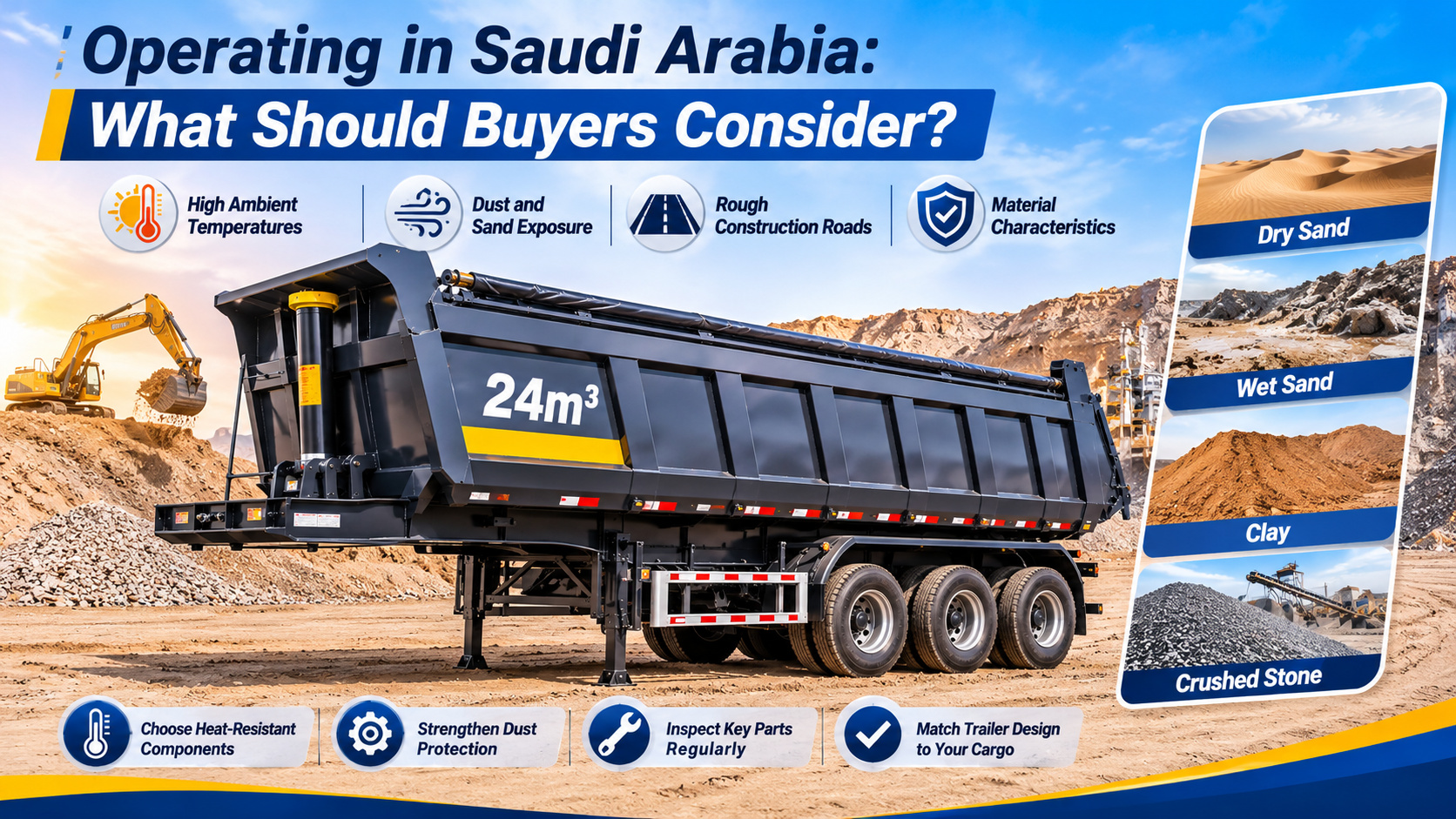
24m3 tipper trailer operating conditions in Saudi Arabia with heat dust and rough road considerations
This 24m³ rear-tipping semi-trailer is presented in a Saudi Arabian construction and quarry environment, where high temperatures, dust exposure and rough operating roads place additional demands on trailer components. From hydraulic systems and sealing materials to suspension, tires and braking connections, proper component selection and regular maintenance are essential. Matching the trailer body design to the characteristics of dry sand, wet sand, clay or crushed stone also helps support reliable bulk material transportation.
High Ambient Temperatures
High temperatures can influence hydraulic oil performance, seals, hoses, tires and other components.
Buyers should confirm that hydraulic components and sealing materials are suitable for the expected operating temperature.
Regular inspection of hydraulic oil condition and leakage points is also recommended.
Dust and Sand Exposure
Dust can affect moving components, electrical connections, braking equipment and hydraulic seals.
Suitable component protection, routine cleaning and preventive inspections can help reduce unnecessary maintenance.
Rough Construction Roads
Trailers operating on construction and quarry roads may encounter uneven surfaces, repeated vibration and impact loads.
Particular attention should be given to:
-
Chassis connections.
-
Suspension brackets.
-
Axle mounting points.
-
Tire condition.
-
Brake chambers and air lines.
-
Rear hinge and cylinder mounting areas.
Material Characteristics
Not all bulk materials behave in the same way during unloading.
Dry sand, wet sand, clay and crushed stone have different densities, flow characteristics and abrasion levels.
The trailer body design should reflect the material that will actually be transported.
A configuration suitable for dry sand may require different internal geometry or wear protection when used for sticky or highly abrasive materials.
11. Saudi Arabia Compliance: What Should Be Checked Before Ordering?
For overseas trailer buyers, compliance should be discussed before production and shipment.
Saudi Arabia has technical regulations covering trailers and semi-trailers. Requirements may involve vehicle dimensions, weights, tire conformity, chassis identification and other technical conditions.
Before confirming an order, importers should verify:
-
Applicable Saudi technical regulations and standards.
-
Required conformity assessment and certification.
-
Permitted vehicle dimensions and gross combination weight.
-
Axle load and tire specifications.
-
Chassis number and identification requirements.
-
Lighting, braking and safety equipment.
-
Importer-specific documentation and customs requirements.
The applicable requirements should be checked against the exact trailer model, intended registration and current regulatory procedures.
A supplier's general statement that a trailer is suitable for Saudi Arabia should not replace the buyer's verification of the required conformity documents.
12. Maintenance Tips for a Rear-Tipping Semi-Trailer
Regular maintenance is essential for keeping a tipper trailer in reliable working condition.
A practical maintenance plan should cover the following areas.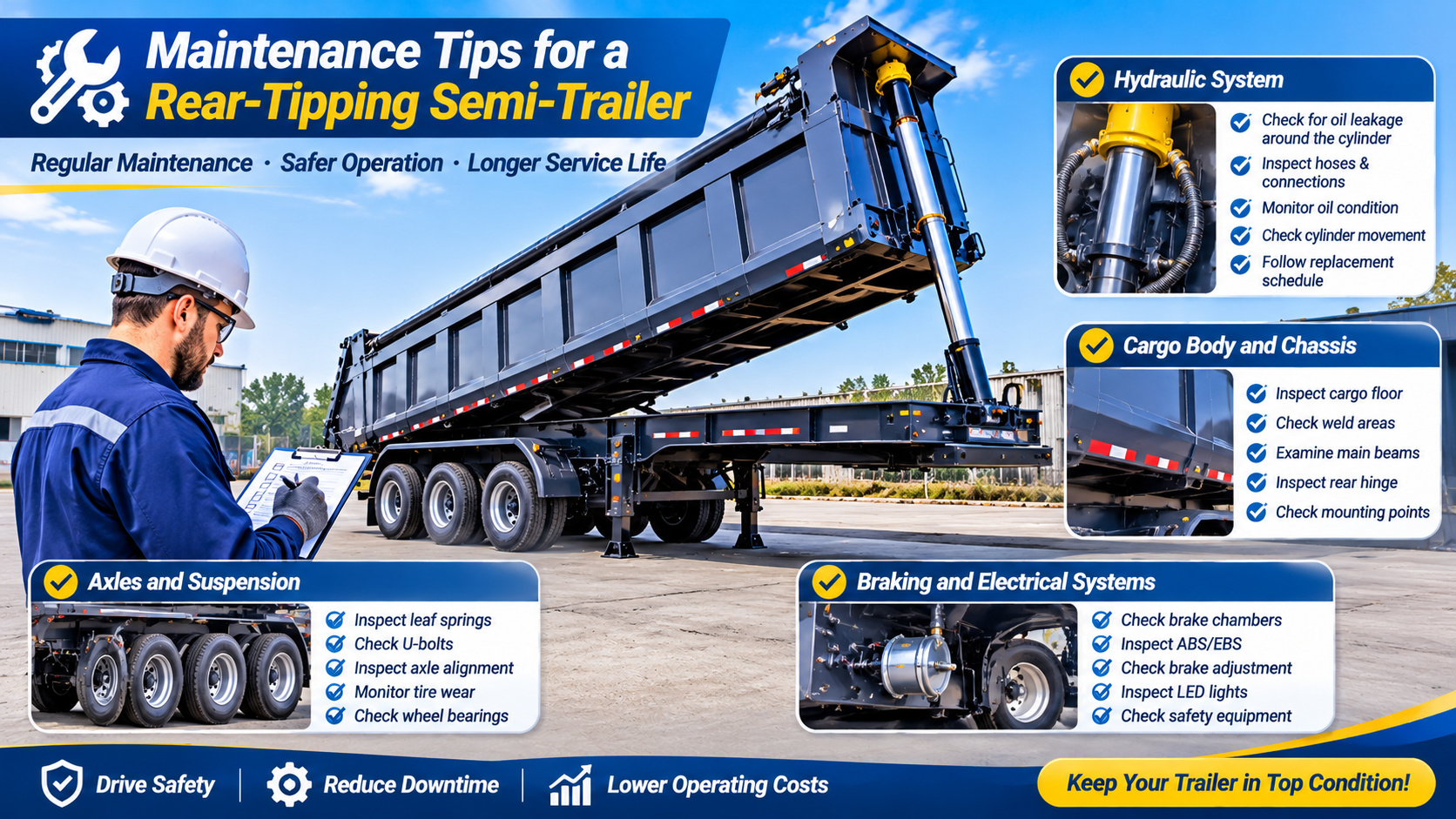
Rear tipping semi-trailer maintenance checklist covering hydraulic system chassis axles suspension and brakes
Regular maintenance is essential for keeping a rear-tipping semi-trailer safe, reliable and ready for demanding operations. Key inspection areas include the hydraulic lifting system, cargo body, chassis, axles, suspension, braking components and electrical connections. Routine checks can help identify wear, leakage or damage early, reduce unexpected downtime and support longer service life.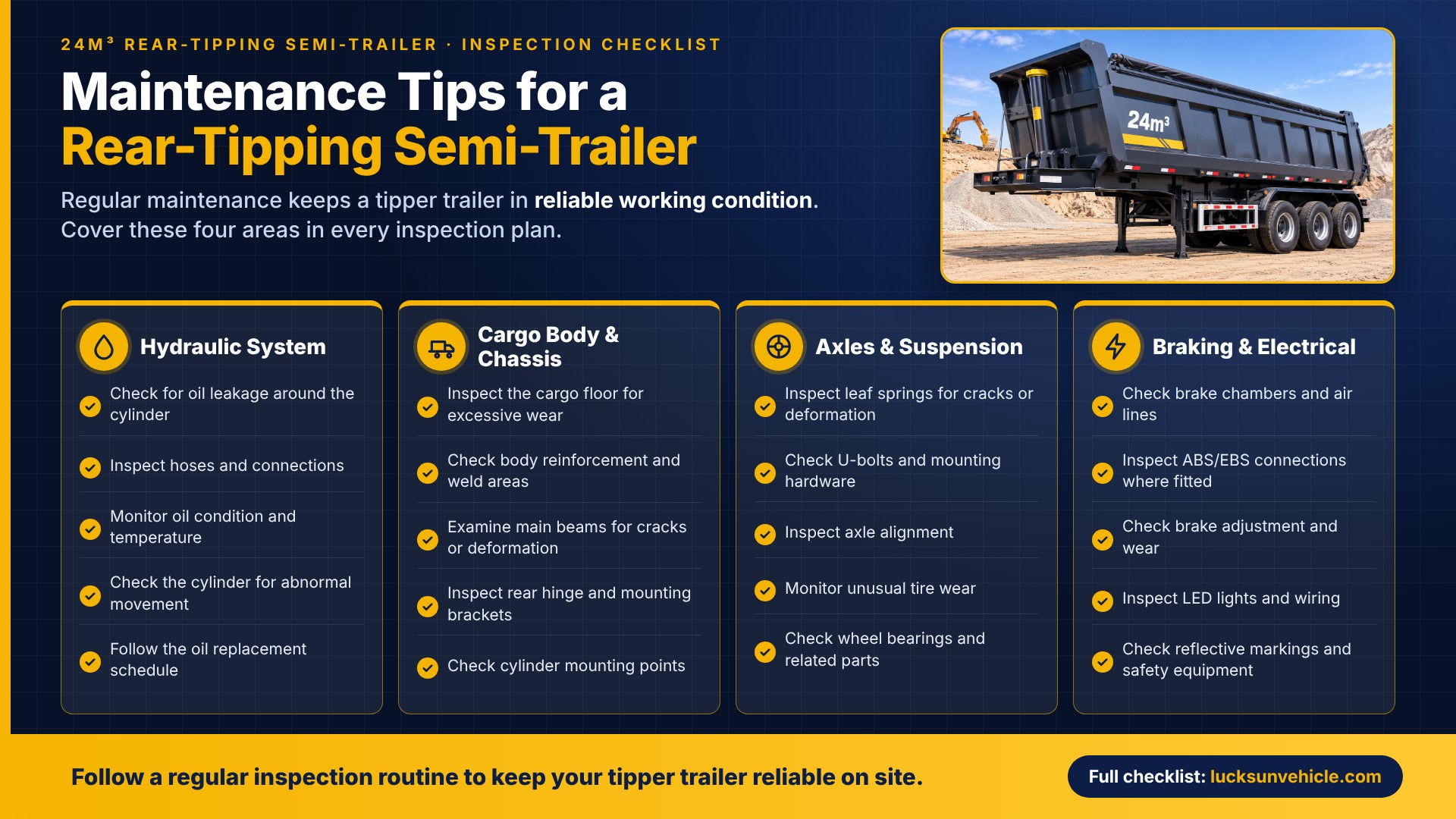
Hydraulic System
-
Check for oil leakage around the cylinder.
-
Inspect hydraulic hoses and connections.
-
Monitor oil condition and operating temperature.
-
Check the cylinder for abnormal movement.
-
Follow the recommended hydraulic oil replacement schedule.
Cargo Body and Chassis
-
Inspect the cargo floor for excessive wear.
-
Check the body reinforcement and weld areas.
-
Examine the main beams for cracks or deformation.
-
Inspect the rear hinge and mounting brackets.
-
Check cylinder mounting points.
Axles and Suspension
-
Inspect leaf springs for cracks or deformation.
-
Check U-bolts and mounting hardware.
-
Inspect axle alignment.
-
Monitor unusual tire wear.
-
Check wheel bearings and related components.
Braking and Electrical Systems
-
Check brake chambers and air lines.
-
Inspect ABS/EBS connections where fitted.
-
Check brake adjustment and wear.
-
Inspect LED lights and electrical wiring.
-
Check reflective markings and safety equipment.
For a more complete inspection routine, read our semi-trailer maintenance guide.
13. How to Choose a Reliable 24m³ Tipper Trailer Supplier
For importers, distributors and fleet operators, choosing a supplier is not simply about comparing the lowest quotation.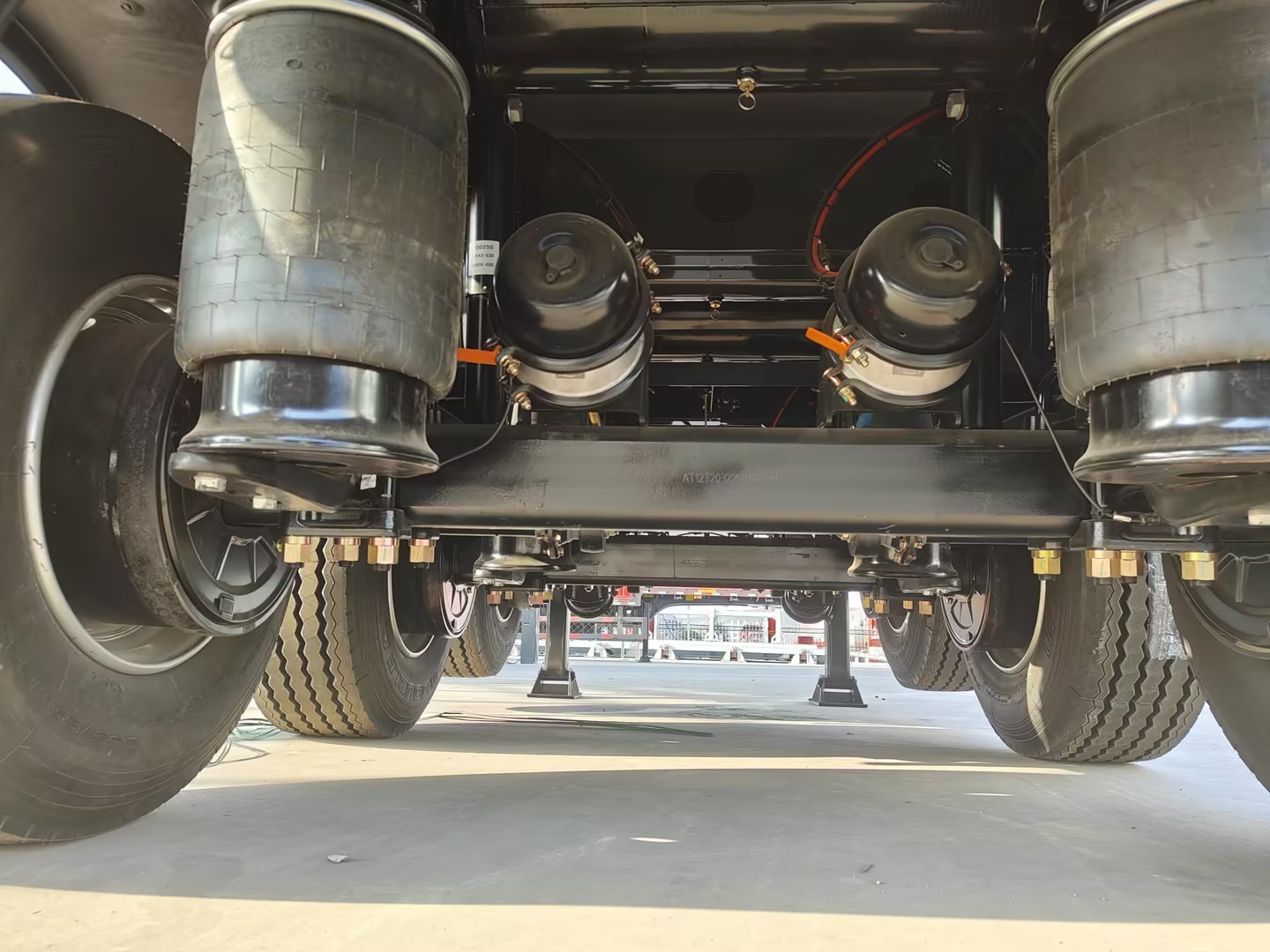
Underside view of a 24m³ rear-tipping semi-trailer showing air suspension bellows, brake chambers and axle beam
The quality of the technical communication, configuration matching, component selection and export coordination can influence the long-term value of the purchase.
Before placing an order, consider the following points.
Confirm the Technical Drawing
Request a detailed drawing showing the overall dimensions, cargo body structure, axle spacing, kingpin position and main chassis arrangement.
Check the Component Brands
Confirm the proposed axle, suspension, hydraulic cylinder, braking equipment, tires and landing gear.
Brand options should be specified clearly in the quotation rather than described only as international brands.
Review Manufacturing and Quality Control
Ask about the chassis fabrication process, welding inspection, surface preparation, painting and final assembly checks.
Confirm Spare Parts Support
For fleet operators, access to compatible spare parts is an important part of long-term vehicle management.
Related products may include axles, suspension components, brake parts, ABS equipment, tires and hydraulic components.
Explore our semi-trailer spare parts range for additional product information.
14. Why Consider LUCKSUN for Your Rear-Tipping Semi-Trailer Project?
LUCKSUN focuses on semi-trailers and related components for international markets.
Our product range includes dump semi-trailers, flatbed trailers, skeletal container chassis, lowbed trailers and various semi-trailer spare parts.
Through our cooperation with Luoxiang Group, we can coordinate product configurations according to different customer requirements.
Our business approach focuses on several practical points:
-
Product configurations based on actual transportation requirements.
-
Axle, suspension and braking component options.
-
Cargo body and chassis customization.
-
Technical specification communication before ordering.
-
Export-oriented product and quotation coordination.
-
Related trailer components and spare parts supply.
You can learn more about our company through the LUCKSUN company profile.
For customers comparing different trailer types, we also provide information about 40ft flatbed semi-trailers and 40ft skeletal container chassis trailers.
The right trailer is not necessarily the one with the largest specifications or the lowest purchase price. It is the one that matches the cargo, tractor, operating environment and legal requirements of the destination market.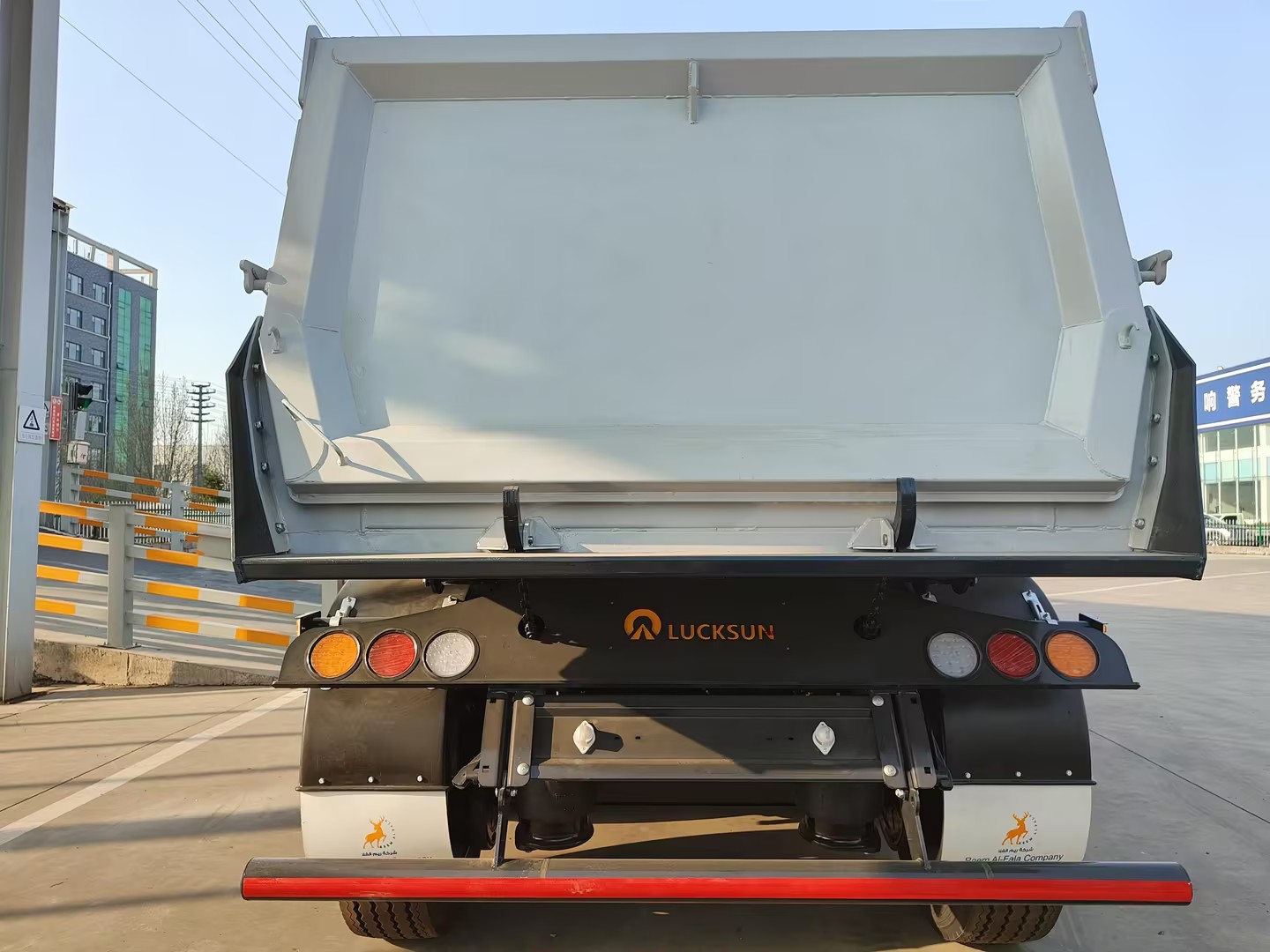
Air suspension, brake chambers and reinforced axle beam on a 24m³ rear-tipping semi-trailer, built for heavy-duty hauling.
15. Frequently Asked Questions
Q1. What is a 24m³ rear-tipping semi-trailer used for?
It is mainly used for transporting and unloading bulk materials such as sand, gravel, crushed stone, soil and other compatible construction materials.
Q2. Does a 24m³ trailer mean it can carry 24 tons?
No. Cubic meters measure cargo volume, while tons measure weight.
The actual payload depends on cargo density, trailer tare weight, axle ratings, tire capacity, tractor specifications and applicable legal limits.
Q3. Is a U-shape or box-type body better for Saudi Arabia?
Both designs can be suitable.
U-shaped bodies may help reduce material accumulation in corners, especially with certain wet or sticky materials. Box-type bodies provide a conventional rectangular cargo space and can be practical for dry bulk materials.
The selection should depend on cargo characteristics and maintenance requirements.
Q4. How many axles does a 24m³ rear tipper need?
A three-axle configuration is a common option, but the final axle arrangement should be determined by gross vehicle weight, permitted axle loads, cargo distribution and local road regulations.
Q5. Can the hydraulic system be customized?
Yes. The cylinder, hydraulic connections, lifting geometry and related components can be specified according to the cargo body design, tractor hydraulic system and operating requirements.
Q6. Which suspension is better for rough roads?
Mechanical leaf spring suspension is a practical option for many heavy-duty applications. Air suspension may also be suitable depending on the vehicle design and operating conditions.
Neither option should be selected without checking the complete suspension and axle configuration.
Q7. Can the trailer be customized for Saudi Arabia?
The cargo body, steel material, axle brand, suspension, braking equipment, hydraulic system, tires, lighting and other components can be discussed according to the customer's requirements.
Final specifications must be checked against applicable Saudi technical and registration requirements.
Q8. What information should I provide when requesting a quotation?
To receive a more accurate quotation, buyers should provide:
-
Required quantity.
-
Cargo type and material density.
-
Preferred cargo body design.
-
Axle and suspension requirements.
-
Tractor model and hydraulic system details.
-
Destination country and applicable regulations.
-
Required delivery schedule.
Get a Quotation for Your 24m³ Rear-Tipping Semi-Trailer
Looking for a 24-cubic-meter rear-tipping semi-trailer for your Saudi Arabian transportation business?
LUCKSUN can help coordinate a suitable trailer configuration based on your cargo, tractor specifications and operating requirements.
Send us your preferred body design, axle configuration, suspension requirements and destination details.
Our team will review your requirements and provide product information and a quotation accordingly.
LUCKSUN – Semi-Trailers and Spare Parts for Global Markets.