
What Is the Front Wheel Support on a Semi-Trailer Called
If you have ever looked at the front of a semi-trailer and wondered what the two metal support legs are called, the correct technical term is landing gear.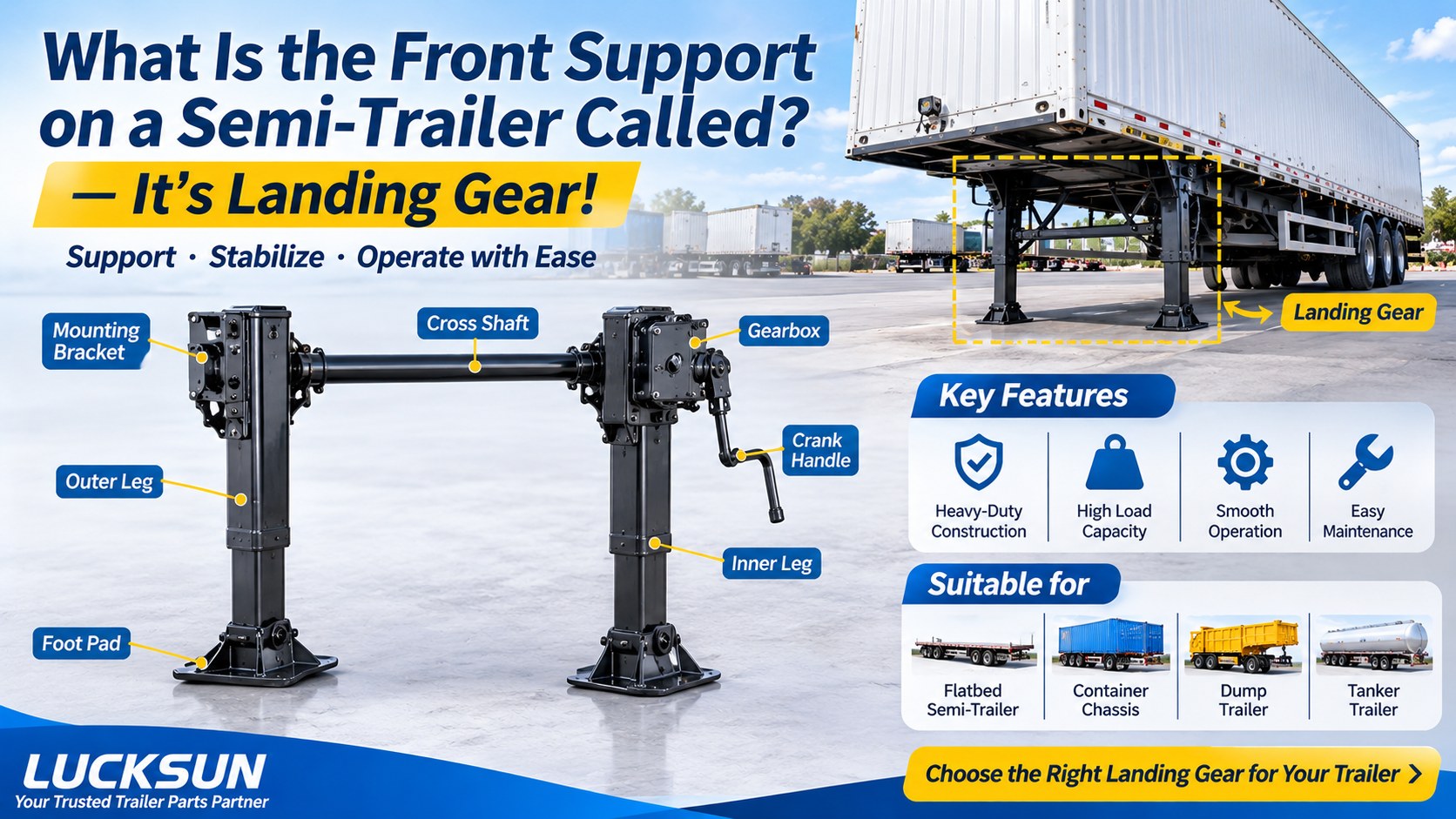
Semi-trailer landing gear with twin support legs gearbox cross shaft and foot padsA detailed overview of semi-trailer landing gear, showing the twin support legs, gearbox, cross shaft, crank handle, mounting brackets and foot pads. Designed to illustrate how landing gear supports a semi-trailer when disconnected from the tractor.
Also known as trailer landing legs, support legs or trailer jacks, landing gear is installed near the front of a semi-trailer. Its main purpose is to support the front section of the trailer when it is disconnected from the tractor unit.
Unlike a conventional full trailer, a semi-trailer does not have a front axle with wheels. When the tractor is disconnected, the landing gear provides the necessary front support to keep the trailer standing independently.
For trailer importers, fleet operators, spare parts distributors and maintenance companies, understanding landing gear is important when selecting a new trailer or sourcing replacement components.
This guide explains what semi-trailer landing gear is, how it works, its main components, available types, important technical specifications and what buyers should check before ordering.
1. What Is the Front Support on a Semi-Trailer Called?
The front support on a semi-trailer is called landing gear.
A typical mechanical landing gear assembly consists of two vertical support legs mounted underneath the front section of the trailer chassis.
When the trailer is disconnected from the tractor, the driver lowers both legs until their footplates contact the ground. This allows the trailer to remain supported without the tractor attached.
When the trailer is connected to the tractor again, the landing gear is raised into its travel position to provide sufficient ground clearance.
Although some people refer to these components as front trailer wheels, this is technically incorrect. Standard landing gear uses support feet or shoes rather than road wheels.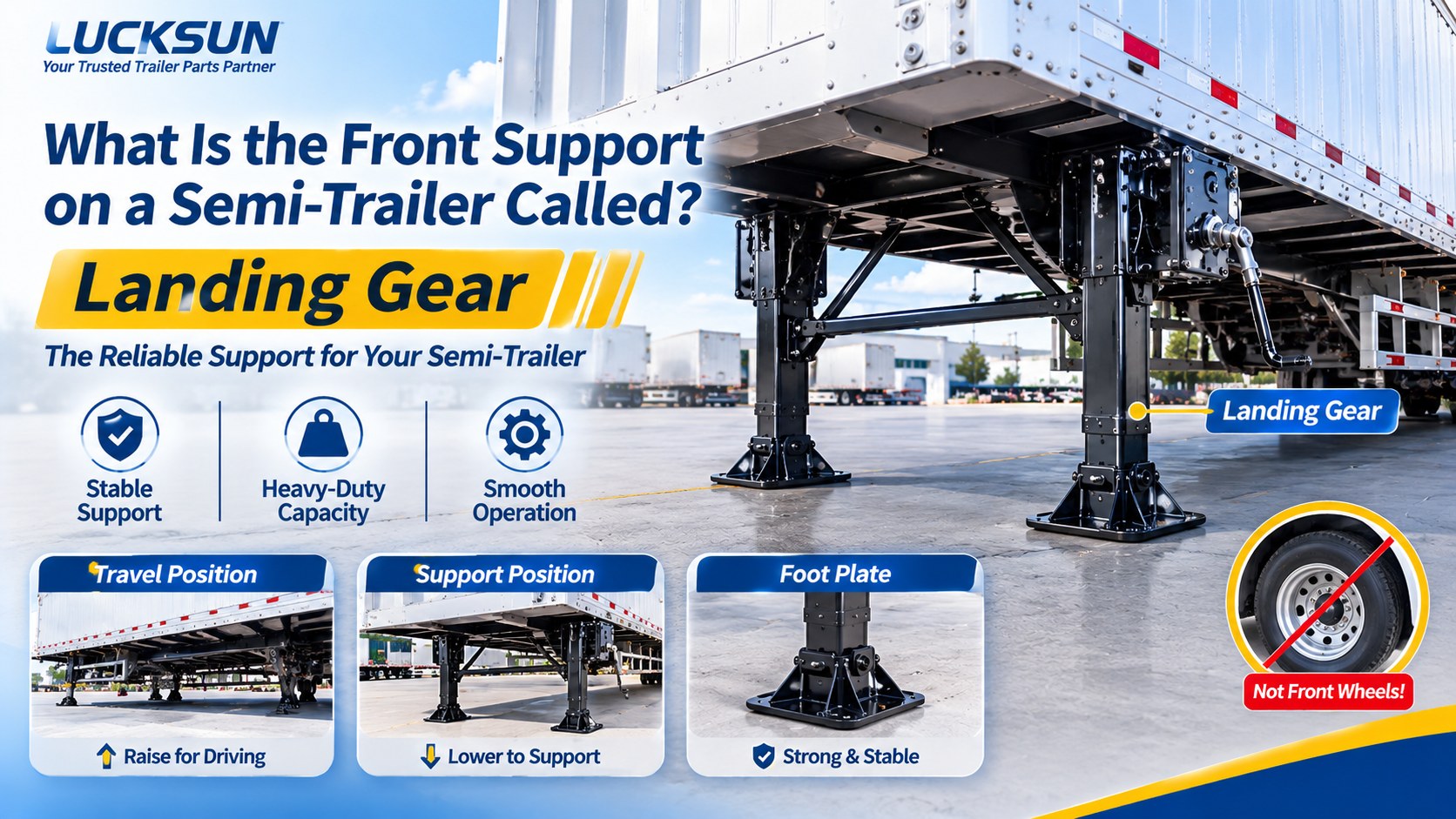
Semi-trailer landing gear front support legs with footplates and manual crank mechanism
A detailed illustration of heavy-duty semi-trailer landing gear, featuring twin support legs, a manual crank mechanism, mounting brackets and ground-contact footplates. The landing gear supports the front of a semi-trailer when disconnected from the tractor and is raised during normal towing operations.
Common Names for Semi-Trailer Landing Gear
| Common Term | Meaning |
|---|---|
| Landing Gear | Standard industry term for the front support assembly |
| Trailer Landing Legs | The two retractable support legs |
| Support Legs | General name for the trailer's front support |
| Trailer Jacks | Informal term for mechanical or lifting supports |
| Landing Gear Assembly | Complete assembly, including legs and operating mechanism |
| Landing Gear Foot Pads | Ground-contact components at the bottom of the legs |
If you are researching other trailer components, read the LUCKSUN semi-trailer components guide for an overview of the chassis, axles, suspension, coupling and braking systems.
2. What Does Semi-Trailer Landing Gear Do?
Landing gear has several important functions in daily trailer operations.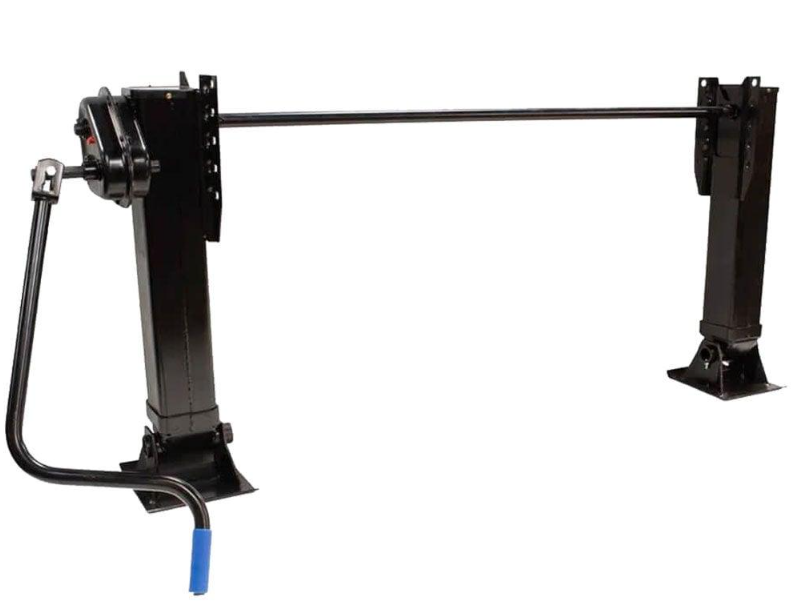
Semi-trailer landing gear diagram showing mounting bracket, cross shaft, gearbox, crank handle, outer leg, inner leg and foot pad. Heavy-duty trailer support legs for flatbed, container chassis, dump and tanker trailers.
Supporting the Trailer When Uncoupled
The primary function is to support the front portion of the semi-trailer after it has been disconnected from the tractor.
Without properly installed and deployed landing gear, a conventional semi-trailer cannot remain independently supported in its normal parked position.
Maintaining Trailer Stability
The two support legs work together to provide a stable base.
Their mounting positions, structural strength, ground-contact area and adjustment range all influence the support arrangement.
The trailer should be parked on suitable ground, and the landing gear must be operated according to the trailer manufacturer's instructions.
Assisting Coupling and Uncoupling
Landing gear allows the front height of the trailer to be adjusted during approved coupling and uncoupling procedures.
The driver can raise or lower the trailer's front section to achieve the required coupling height.
Supporting Parking and Loading Operations
When a trailer is parked without a tractor, landing gear helps maintain its front support position.
However, standard landing gear should not automatically be treated as a substitute for specially designed loading supports. Operations involving forklifts, concentrated loads or repeated dynamic loading require consideration of the trailer manufacturer's approved procedures.
For a better understanding of how the front coupling area works, see our guide to semi-trailer parts and their functions.
3. Main Components of a Semi-Trailer Landing Gear Assembly
A landing gear assembly contains several mechanical components that work together to raise, lower and support the trailer.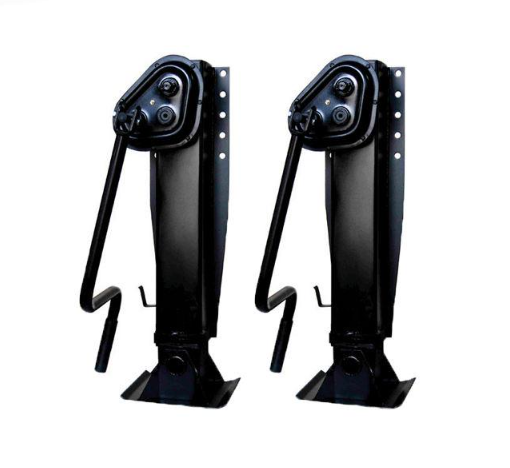
Semi-trailer landing gear front support legs with footplates and manual crank mechanism
3.1 Outer Leg
The outer leg is the main structural housing mounted to the trailer chassis.
It supports the internal lifting mechanism and transfers the support forces into the trailer mounting structure.
The mounting position and connection design should match the trailer frame.
3.2 Inner Leg
The inner leg is the telescoping section that extends or retracts during operation.
Its movement changes the overall landing gear height and allows the support foot to reach the ground.
3.3 Gearbox
The gearbox transfers the rotational force from the crank handle to the internal lifting mechanism.
Depending on the design, a landing gear may use a single-speed or two-speed gearbox.
Two-speed systems provide different operating ratios for different lifting conditions.
3.4 Crank Handle
The crank handle allows the driver to manually operate the landing gear.
It is used to raise or lower the support legs through the gearbox.
Handle position, operating direction and available clearance should be considered when selecting a replacement assembly.
3.5 Cross Shaft and Connecting Mechanism
On linked landing gear systems, a connecting shaft transfers rotation between the two legs.
This helps both legs operate together through a common drive arrangement.
The shaft length, connection type and alignment need to match the trailer installation.
3.6 Foot Pads or Support Shoes
Foot pads are located at the bottom of the landing gear legs.
They transfer the support force to the ground.
Different foot designs are available depending on the application and ground conditions.
Common designs include flat support feet, swivel feet and larger ground-contact shoes.
3.7 Mounting Brackets and Reinforcement
Mounting brackets connect the landing gear to the trailer chassis.
The surrounding frame structure must be designed to transfer the support forces safely.
The mounting plates, bolts, reinforcement members and installation dimensions should all be checked when replacing landing gear.
4. Different Types of Trailer Landing Gear
Landing gear is available in different designs according to trailer construction, operating requirements and support conditions.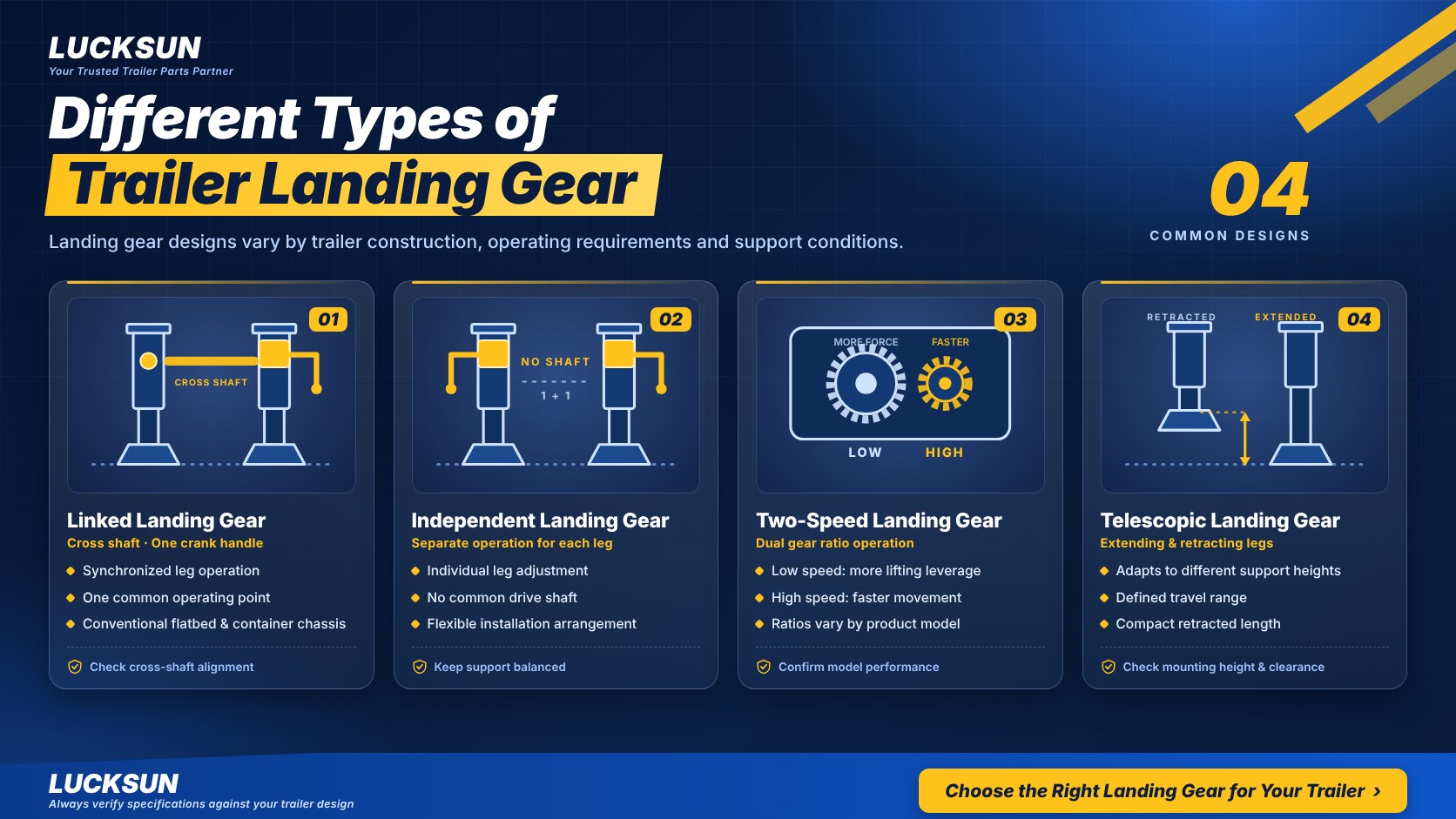
Different types of trailer landing gear: linked, independent, two-speed and telescopic landing gear for semi-trailers, with key features and installation checks.
Linked Landing Gear
Linked landing gear connects both support legs through a cross shaft or synchronized drive mechanism.
Both legs can be operated using a single crank handle.
Main characteristics:
-
Synchronized operation
-
One common operating point
-
Suitable for conventional semi-trailer configurations
-
Requires correct cross-shaft alignment and installation
Linked landing gear is commonly considered for standard flatbed, container chassis and other conventional semi-trailer applications.
Independent Landing Gear
Independent landing gear allows each support leg to be operated separately.
Each leg has its own operating mechanism.
Main characteristics:
-
Individual adjustment of each leg
-
Flexible operation
-
No common drive shaft required between the legs
-
Requires attention to balanced support and operating procedures
Independent systems may be considered where the trailer design or installation arrangement requires separate adjustment.
Two-Speed Landing Gear
Two-speed landing gear provides different gear ratios for operating the support legs.
A lower-speed mode generally provides more mechanical advantage for lifting under load, while a higher-speed mode allows faster movement when the resistance is lower.
The actual gear ratios and lifting performance depend on the specific product model.
Telescopic Landing Gear
Telescopic landing gear uses an extending and retracting leg structure to accommodate different support heights.
The required mounting height, travel range and retracted clearance should be checked against the trailer design.
5. Static Load Capacity vs. Lifting Capacity: What Is the Difference?
One of the most important points when purchasing landing gear is understanding its different load ratings.
Manufacturers may specify static load capacity, lifting capacity and side load capacity. These figures describe different operating conditions and should not be treated as interchangeable.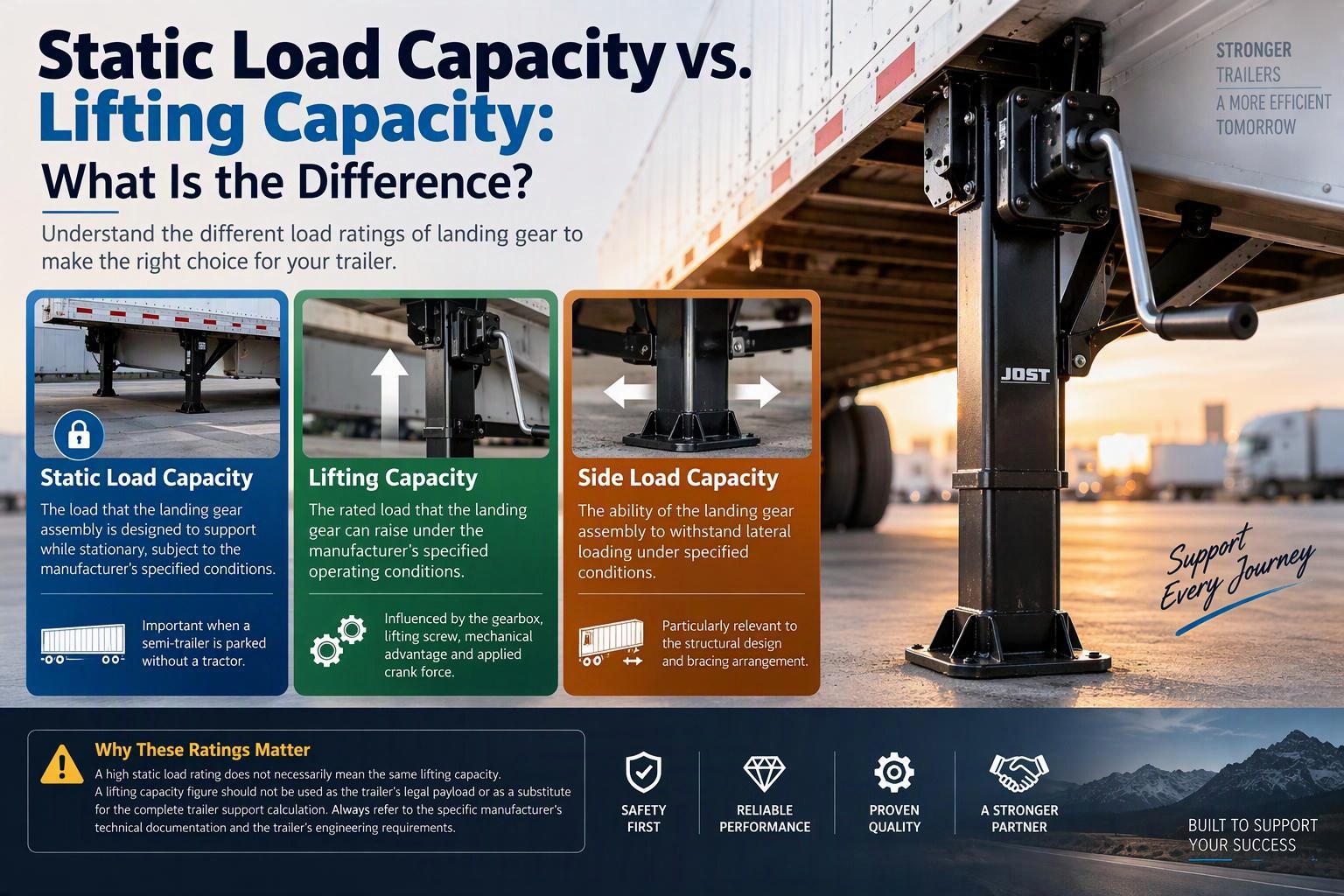
Static Load Capacity
Static load capacity describes the load that the landing gear assembly is designed to support while stationary, subject to the manufacturer's specified conditions.
It is an important consideration when a semi-trailer is parked without a tractor.
Lifting Capacity
Lifting capacity describes the rated load that the landing gear can raise under the manufacturer's specified operating conditions.
It is influenced by the gearbox, lifting screw, mechanical advantage and applied crank force.
Side Load Capacity
Side load capacity refers to the ability of the landing gear assembly to withstand lateral loading under specified conditions.
This is particularly relevant to the structural design and bracing arrangement.
Why These Ratings Matter
A landing gear assembly with a high static load rating does not necessarily have the same lifting capacity.
Similarly, a lifting capacity figure should not be used as the trailer's legal payload or as a substitute for the complete trailer support calculation.
For example, JOST publishes separate static, lifting and side-load ratings for its landing gear product families. This illustrates why buyers should always compare the correct rating rather than relying on a single capacity figure.
The final selection must follow the specific manufacturer's technical documentation and the trailer's engineering requirements.
6. How to Choose the Right Landing Gear for a Semi-Trailer
Selecting landing gear involves more than comparing product appearance or price.
The assembly must match the trailer structure, operating conditions and support requirements.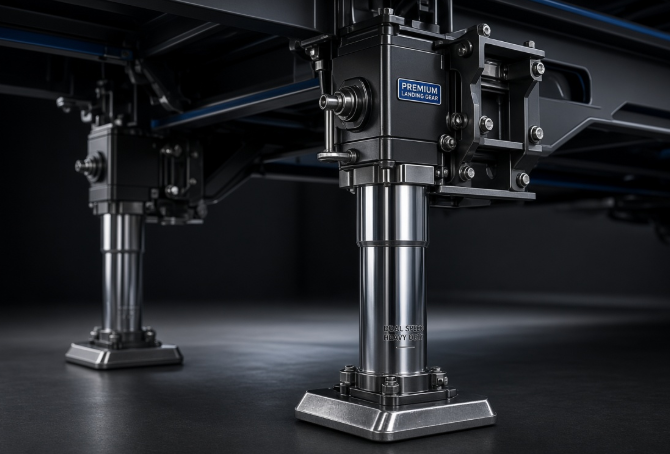
Premium Semi-Trailer Landing Gear Selection Guide · Precision Matched to Load & Operating Conditions
6.1 Confirm the Required Load Ratings
Start by identifying the required static support capacity and lifting capacity.
These values should be confirmed using the trailer design and the landing gear manufacturer's technical specifications.
Do not assume that all standard landing gear assemblies have the same ratings.
6.2 Check the Mounting Height
The mounting height determines the installation position of the landing gear on the trailer frame.
Buyers should check:
-
Required mounting height
-
Extended length
-
Retracted length
-
Total lifting travel
-
Available chassis clearance
The selected landing gear should provide the necessary operating range without interfering with other trailer components.
6.3 Select the Correct Gearbox
The gearbox design affects the operating mechanism and lifting performance.
Buyers should confirm whether a single-speed or two-speed arrangement is required.
The crank direction, gearbox position and shaft connection should also be checked.
6.4 Check the Foot Type
The ground-contact design should suit the expected operating environment.
A conventional flat foot may be suitable for many paved or firm surfaces.
For softer ground, a larger support area may help distribute the contact force. Suitable ground conditions and the use of approved support plates or pads must still be considered.
6.5 Verify Mounting Compatibility
Before ordering replacement landing gear, confirm:
-
Mounting plate dimensions
-
Bolt-hole arrangement
-
Bracket position
-
Leg spacing
-
Cross-shaft length
-
Gearbox orientation
-
Required operating clearance
Incorrect mounting dimensions can create installation problems even if the replacement product appears similar.
6.6 Consider Operating Frequency and Environment
Trailers used frequently for loading, unloading and interchange operations may require different landing gear configurations from trailers that remain coupled for long periods.
Dust, moisture, corrosion exposure and ground conditions should also be considered when selecting protection and maintenance requirements.
For buyers reviewing complete trailer running gear, the LUCKSUN trailer axle kit range provides additional information about related axle components.
7. Which Semi-Trailers Use Landing Gear?
Landing gear is used on many conventional semi-trailer designs.
The exact support arrangement depends on the trailer chassis and intended application.
Flatbed Semi-Trailers
Flatbed trailers use landing gear to support the front section when disconnected from the tractor.
The landing gear mounting structure must be compatible with the chassis and the intended operating conditions.
Explore the LUCKSUN 40ft flatbed semi-trailer.
Skeletal Container Chassis
Container chassis trailers use landing gear to support the trailer when it is parked or waiting for tractor connection.
Mounting dimensions and support height should be checked against the chassis structure.
See the LUCKSUN skeletal container chassis trailer.
Dump and Tipper Semi-Trailers
Dump trailers also require front support when disconnected.
Their landing gear should be selected according to the trailer's structural design, front support requirements and operating environment.
Lowbed Semi-Trailers
Lowbed trailers may have different chassis heights and front structural arrangements.
The landing gear's mounting height, operating travel and ground clearance should be reviewed carefully.
Tanker and Other Specialized Trailers
Tanker trailers and other specialized semi-trailers also use front support systems.
The correct configuration should be determined according to the trailer's structure, weight distribution and manufacturer-approved specifications.
For a broader comparison of trailer designs, read our semi-trailer vs. full-trailer guide.
8. Common Landing Gear Problems and Maintenance Tips
Regular inspection helps identify wear and operating problems before they cause more serious damage.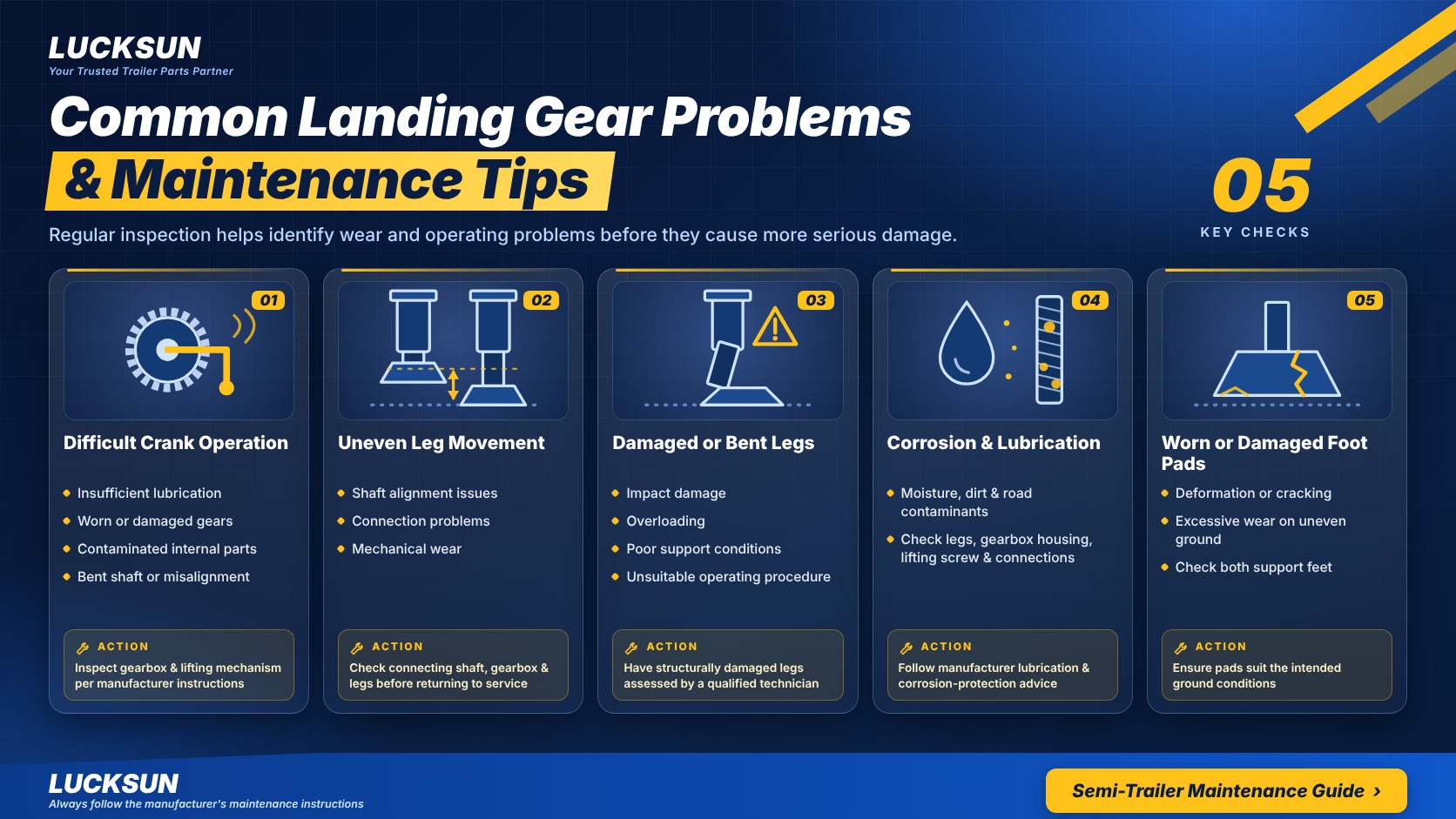
Common semi-trailer landing gear problems and maintenance tips: difficult crank operation, uneven leg movement, bent legs, corrosion and lubrication issues, and worn foot pads.
Difficult Crank Operation
Possible causes include:
-
Insufficient lubrication
-
Damaged or worn gears
-
Contaminated internal components
-
Bent operating shaft
-
Excessive loading or misalignment
Inspect the gearbox and lifting mechanism according to the manufacturer's maintenance instructions.
Uneven Movement Between the Two Legs
On linked systems, uneven movement may be related to shaft alignment, connection problems or mechanical wear.
Check the connecting shaft, gearbox and leg assemblies before returning the trailer to service.
Damaged or Bent Landing Gear Legs
Visible deformation may indicate impact damage, overloading, poor support conditions or an unsuitable operating procedure.
Structurally damaged legs should be assessed by a qualified technician.
Corrosion and Lubrication Problems
Moisture, dirt and road contaminants may affect moving parts and exposed surfaces.
Inspect the legs, gearbox housing, lifting screw and connections regularly.
Follow the component manufacturer's lubrication and corrosion-protection recommendations.
Worn or Damaged Foot Pads
Foot pads may suffer deformation, cracking or excessive wear after repeated contact with uneven ground.
Check the condition of both support feet and ensure they are suitable for the intended ground conditions.
For related trailer maintenance information, see the LUCKSUN semi-trailer maintenance guide.
9. What Should Buyers Check Before Ordering Landing Gear?
For international spare parts buyers, providing accurate information helps reduce the risk of ordering incompatible products.
Use the following checklist when requesting a quotation.
| Item | Information to Confirm |
|---|---|
| Product Type | Linked or independent landing gear |
| Gearbox | Single-speed or two-speed |
| Static Load Capacity | Manufacturer-rated value |
| Lifting Capacity | Manufacturer-rated value |
| Mounting Height | Required installation dimension |
| Lifting Travel | Required extension range |
| Foot Type | Standard foot, swivel foot or other design |
| Cross Shaft | Length and connection arrangement |
| Mounting Plate | Dimensions and bolt-hole pattern |
| Operation | Left-side, right-side or specified crank arrangement |
| Application | Flatbed, chassis, dump, tanker or other trailer |
| Quantity | Required sets or replacement legs |
| Destination | Country and delivery port |
If you are replacing an existing assembly, provide clear photographs of the complete landing gear, mounting brackets, gearbox and foot pads.
A technical drawing or original product number is even more useful.
For additional trailer parts and related products, visit the LUCKSUN semi-trailer parts section.
10. Why Landing Gear Quality Matters for Trailer Buyers
Landing gear is sometimes treated as a secondary accessory when evaluating a semi-trailer.
However, it performs an essential support function whenever the trailer is disconnected from its tractor.
For fleet operators, poor landing gear performance can create unnecessary maintenance work and operational delays.
For trailer importers and distributors, incorrect specifications can lead to installation problems, replacement difficulties and additional purchasing costs.
A suitable landing gear selection should consider the complete assembly, including:
-
Support leg structure
-
Gearbox and lifting mechanism
-
Cross-shaft arrangement
-
Mounting brackets
-
Foot design
-
Load ratings
-
Installation dimensions
-
Maintenance requirements
LUCKSUN supplies semi-trailers and related components for international markets. Buyers can discuss trailer configurations and spare parts according to their technical requirements.
Learn more about LUCKSUN's semi-trailer business.
11. Frequently Asked Questions About Semi-Trailer Landing Gear
Q1. What is the front wheel support on a semi-trailer called?
It is called landing gear or trailer landing legs. These retractable support legs hold the front of a semi-trailer when it is disconnected from the tractor.
Q2. Does a semi-trailer have front wheels?
A conventional semi-trailer does not have a front axle with road wheels. Its front section is supported by the tractor's fifth-wheel coupling during travel and by landing gear when disconnected.
Q3. How many landing legs does a semi-trailer have?
A typical conventional semi-trailer uses two front landing legs. The exact support arrangement depends on the trailer design.
Q4. What are the main parts of landing gear?
A typical assembly includes outer legs, inner legs, a gearbox, crank handle, lifting mechanism, connecting shaft, mounting brackets and foot pads.
Q5. What is the difference between linked and independent landing gear?
Linked landing gear connects both legs through a common operating mechanism, allowing synchronized operation. Independent landing gear allows each leg to be operated separately.
Q6. What is the difference between static load capacity and lifting capacity?
Static load capacity refers to the load supported while stationary under specified conditions. Lifting capacity refers to the load the assembly is rated to raise. These are separate technical ratings.
Q7. Can I replace only one landing gear leg?
This depends on the product design, condition of the remaining components and manufacturer's replacement instructions. Compatibility between the legs, gearbox and connecting mechanism must be checked.
Q8. What type of landing gear is suitable for a flatbed trailer?
The suitable type depends on the trailer's support requirements, mounting dimensions, operating frequency and required load ratings. Buyers should confirm the specification against the trailer engineering drawing.
Q9. Can landing gear be used on soft ground?
The ground must be suitable for the support forces involved. Where required, an approved larger support plate or suitable ground pad may help distribute the contact force. Never assume that standard foot pads are suitable for every surface.
Q10. What information should I provide when requesting a landing gear quotation?
Provide the required load ratings, mounting height, lifting travel, foot type, gearbox arrangement, mounting dimensions, trailer type and quantity. Photographs or technical drawings of the existing assembly are also helpful.
12. Contact LUCKSUN for Semi-Trailer Landing Gear and Spare Parts
Looking for semi-trailer landing gear, trailer support legs or related replacement components?
LUCKSUN welcomes inquiries from trailer importers, spare parts distributors, fleet operators, maintenance companies and semi-trailer manufacturers.
To help us identify a suitable configuration, please share:
-
Required landing gear type
-
Static and lifting capacity requirements
-
Mounting dimensions
-
Gearbox and crank arrangement
-
Foot type
-
Trailer model or application
-
Required quantity
-
Destination country
Our team can review your requirements and discuss product specifications, available configurations and quotation details.
Contact LUCKSUN today to discuss your semi-trailer landing gear requirements.
Visit our official website: https://www.lucksunvehicle.com/
LUCKSUN – Semi-Trailers and Spare Parts for Global Markets.