
What Are the Parts of a Semi Trailer? Key Components Explained
What Are the Parts of a Semi Trailer? Key Components Explained
A semi trailer is a heavy-duty transport unit designed to carry cargo without having a front axle of its own. It connects to a tractor through a kingpin and fifth wheel, while its rear axles support part of the trailer load.
Understanding the main semi trailer parts is important when purchasing, maintaining, or customizing a trailer for international transportation. The quality and configuration of each component can directly affect payload capacity, braking performance, service life, road safety, and compliance with local regulations.
For overseas importers, fleet operators, and engineering companies, choosing the right semi trailer components is not simply a matter of price. Axle capacity, suspension type, braking system, frame construction, tires, and cargo structure should all match the intended application and local road conditions.
As a professional Chinese semi trailer manufacturer, we supply and customize different types of semi trailers for international markets, including flatbed, lowbed, sidewall, tanker, and container skeletal trailers.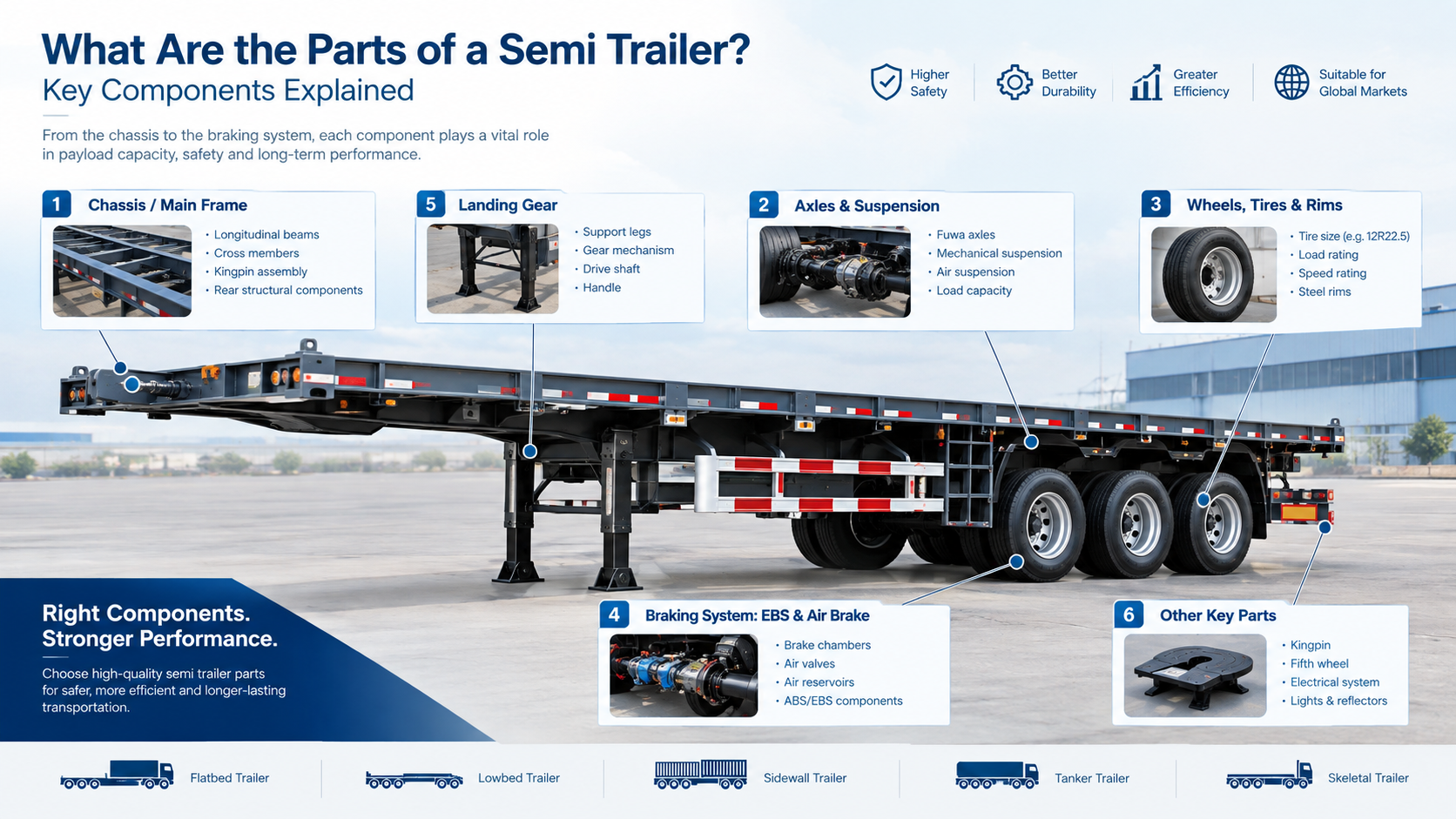
A professional overview of semi trailer components, highlighting the chassis, axles, suspension, tires, braking system, landing gear, and other key parts. This industrial infographic helps international buyers understand trailer structure, component selection, safety, and long-term performance.
1. Chassis / Main Frame
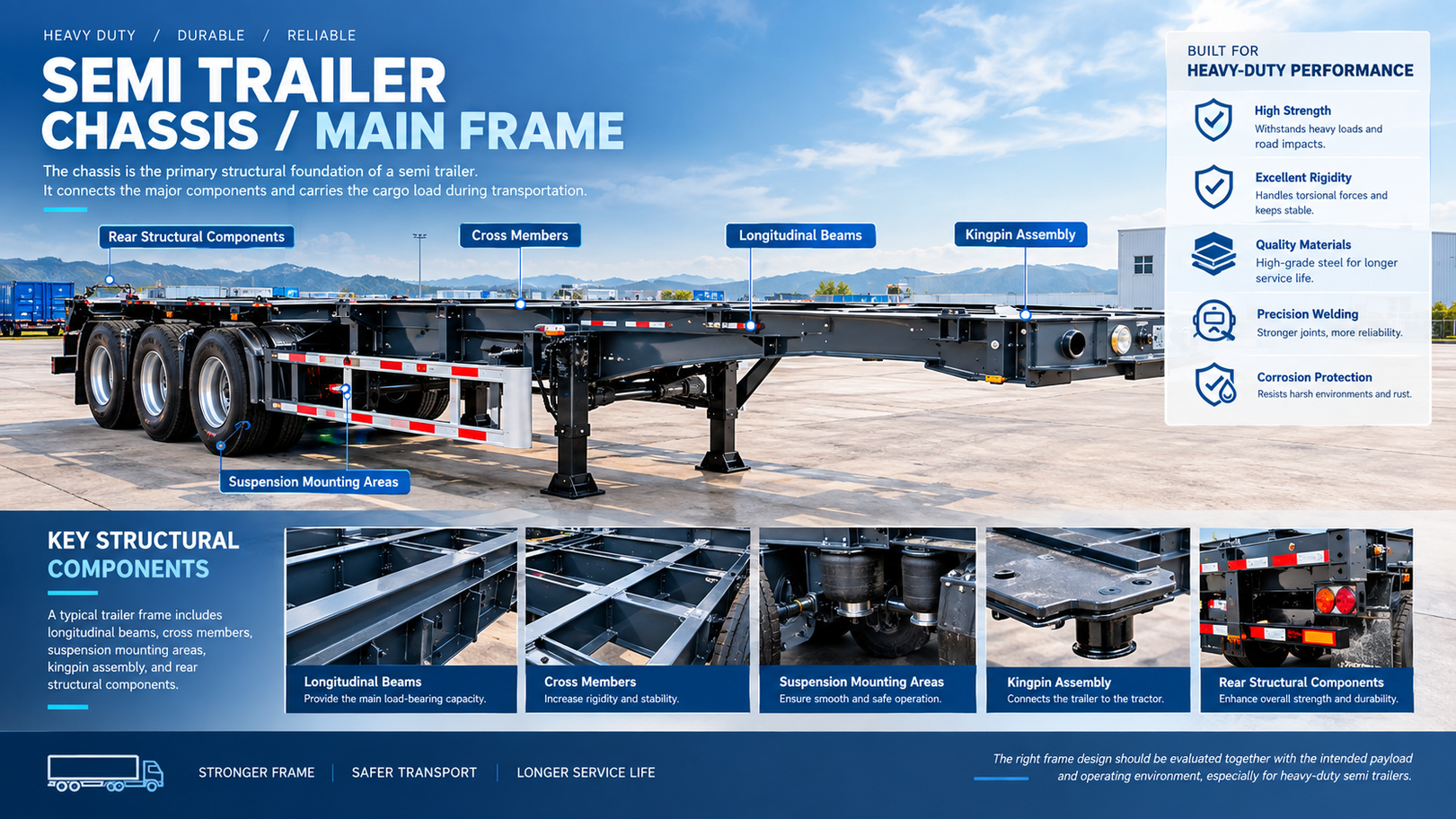
The chassis is the primary structural foundation of a semi trailer. It connects the major components and carries the cargo load during transportation.
A typical trailer frame includes longitudinal beams, cross members, suspension mounting areas, kingpin assembly, and rear structural components. For heavy-duty applications, the frame needs sufficient strength and rigidity to withstand repeated loading, road impacts, and torsional forces.
Frame material, steel grade, beam design, welding quality, and corrosion protection all influence the service life of the trailer.
For buyers looking for a heavy duty semi trailer, frame design should be evaluated together with the intended payload and operating environment rather than simply comparing steel thickness
2. Axles & Suspension
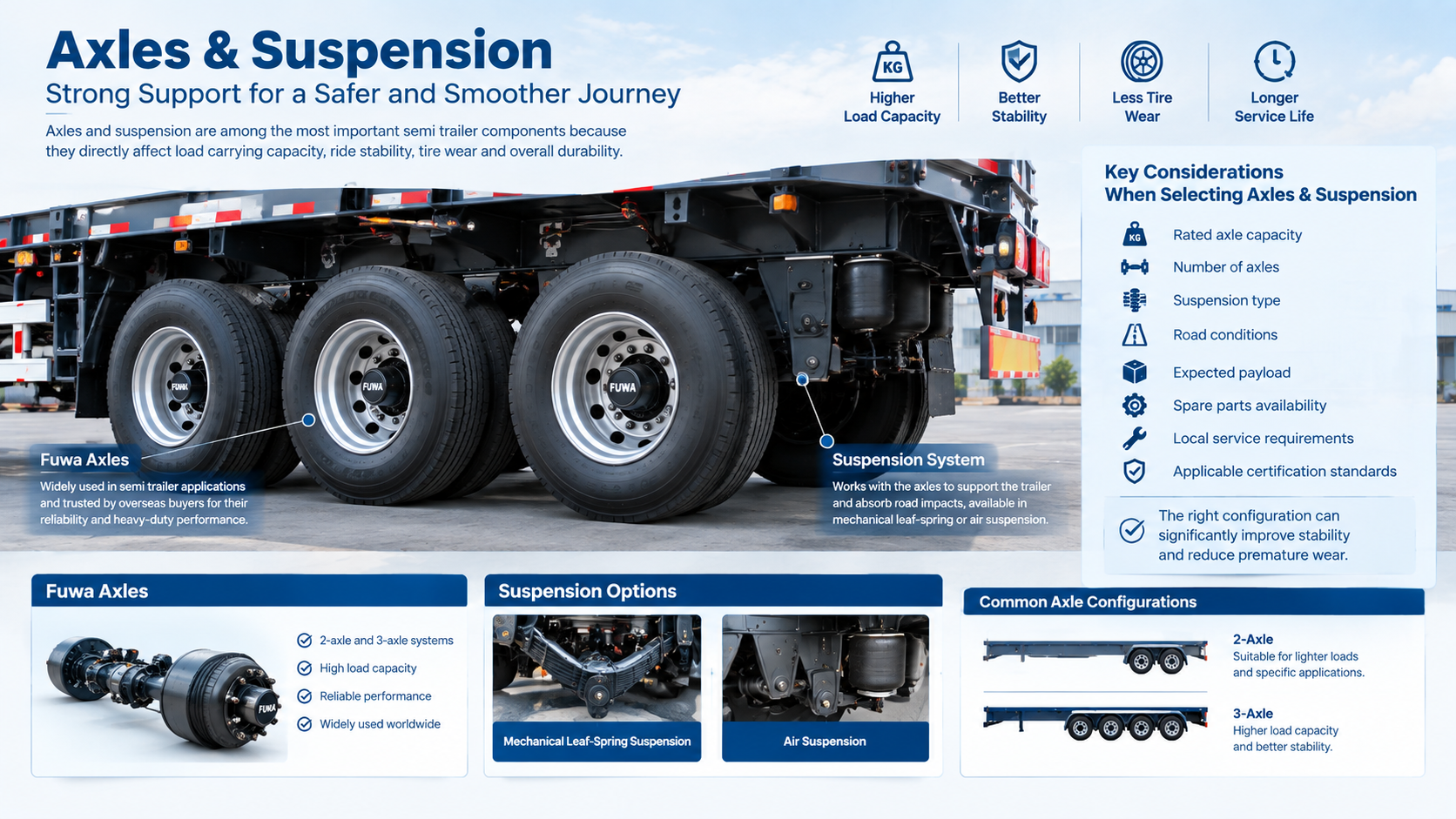
Axles and suspension are among the most important semi trailer components because they directly affect load carrying capacity, ride stability, tire wear, and overall durability.
Fuwa Axles
Fuwa axles are widely used in semi trailer applications and are frequently specified by overseas buyers because of their established reputation in heavy-duty trailer applications.
Common configurations include 2-axle and 3-axle systems, with axle capacity selected according to the trailer's gross vehicle weight and local regulations.
The suspension system works together with the axles to support the trailer and absorb road impacts. Common options include mechanical leaf-spring suspension and air suspension.
When selecting axles and suspension, buyers should consider:
-
Rated axle capacity
-
Number of axles
-
Suspension type
-
Road conditions
-
Expected payload
-
Spare parts availability
-
Local service requirements
-
Applicable certification standards
Correct axle and suspension configuration can significantly improve stability and reduce premature wear.
3. Wheels, Tires & Rims
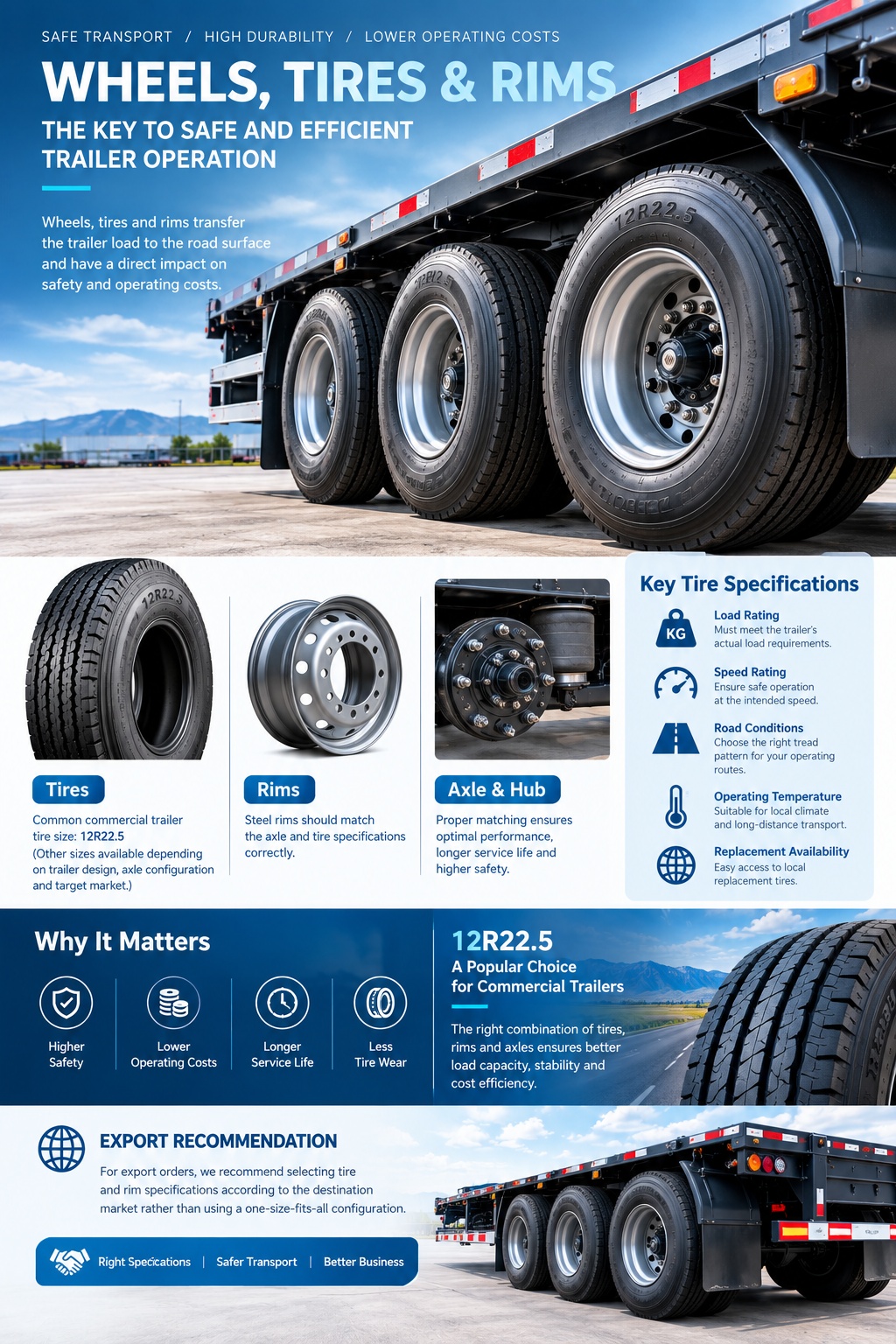
Wheels, tires, and rims transfer the trailer load to the road surface and have a direct impact on safety and operating costs.
Common commercial trailer tire sizes include 12R22.5, although the appropriate specification depends on the trailer design, axle configuration, and target market.
Tire selection should consider load rating, speed rating, road conditions, operating temperature, and local replacement availability.
Steel rims should also match the axle and tire specifications correctly. Using components with insufficient load ratings can increase tire wear and create unnecessary safety risks.
For export orders, we recommend selecting tire and rim specifications according to the destination market rather than using a one-size-fits-all configuration.
4. Braking System: EBS & Air Brake
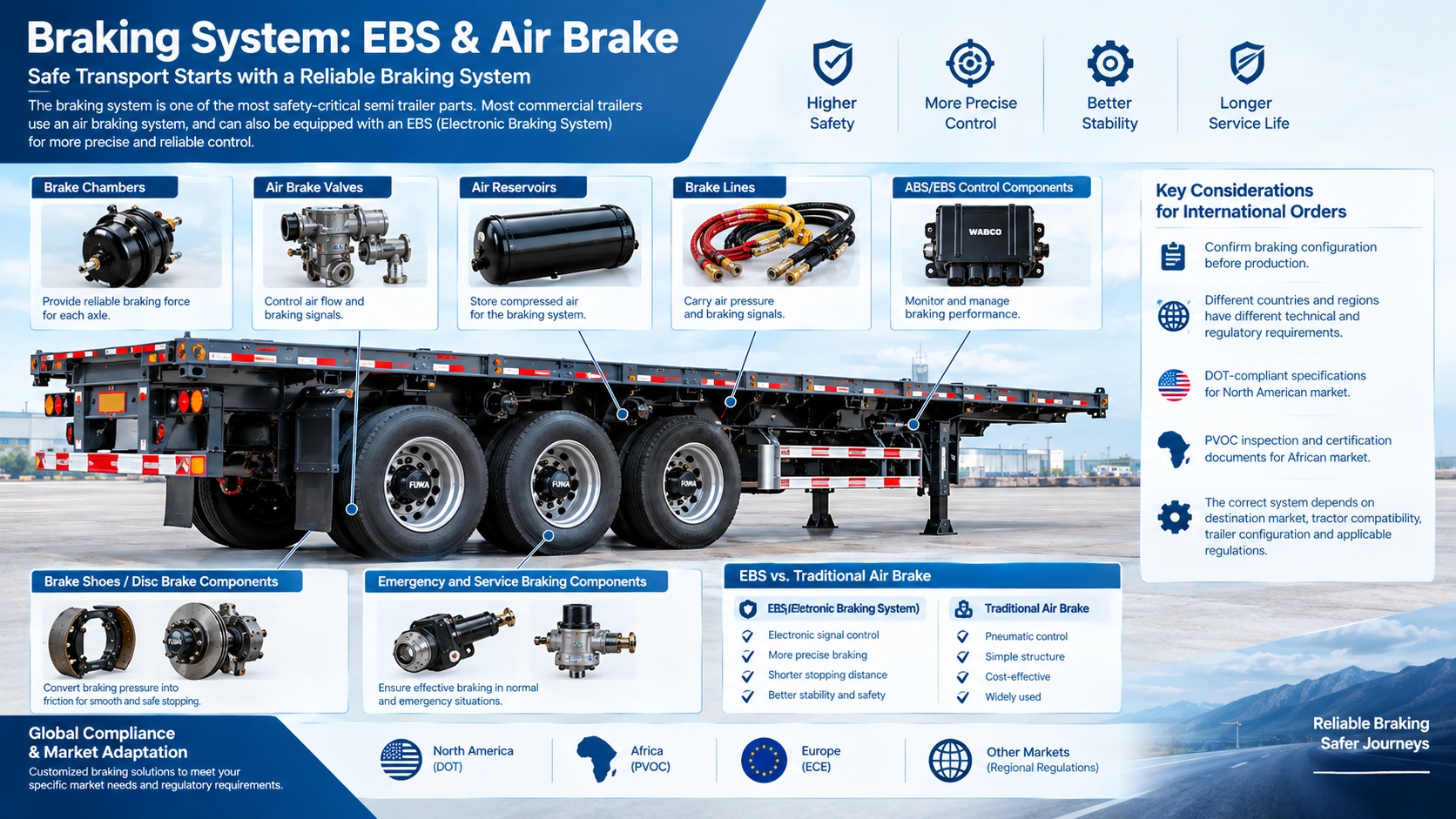
The braking system is one of the most safety-critical semi trailer parts
Most commercial semi trailers use an air braking system. Depending on the market and customer requirements, the trailer can also be equipped with an EBS (Electronic Braking System).
EBS electronically manages braking signals and can provide more precise brake control compared with a conventional air brake arrangement.
A typical trailer braking system may include:
-
Brake chambers
-
Air brake valves
-
Air reservoirs
-
Brake lines
-
ABS/EBS control components
-
Brake shoes or disc brake components
-
Emergency and service braking components
For international orders, the braking configuration should be confirmed before production because different countries and regions may have different technical and regulatory requirements.
For example, customers requiring DOT-compliant specifications may need a braking configuration designed around applicable North American requirements. For African markets, customers may also require documentation and specifications suitable for PVOC inspection and certification.
The correct system depends on the destination market, tractor compatibility, trailer configuration, and applicable regulations.
5. Landing Gear
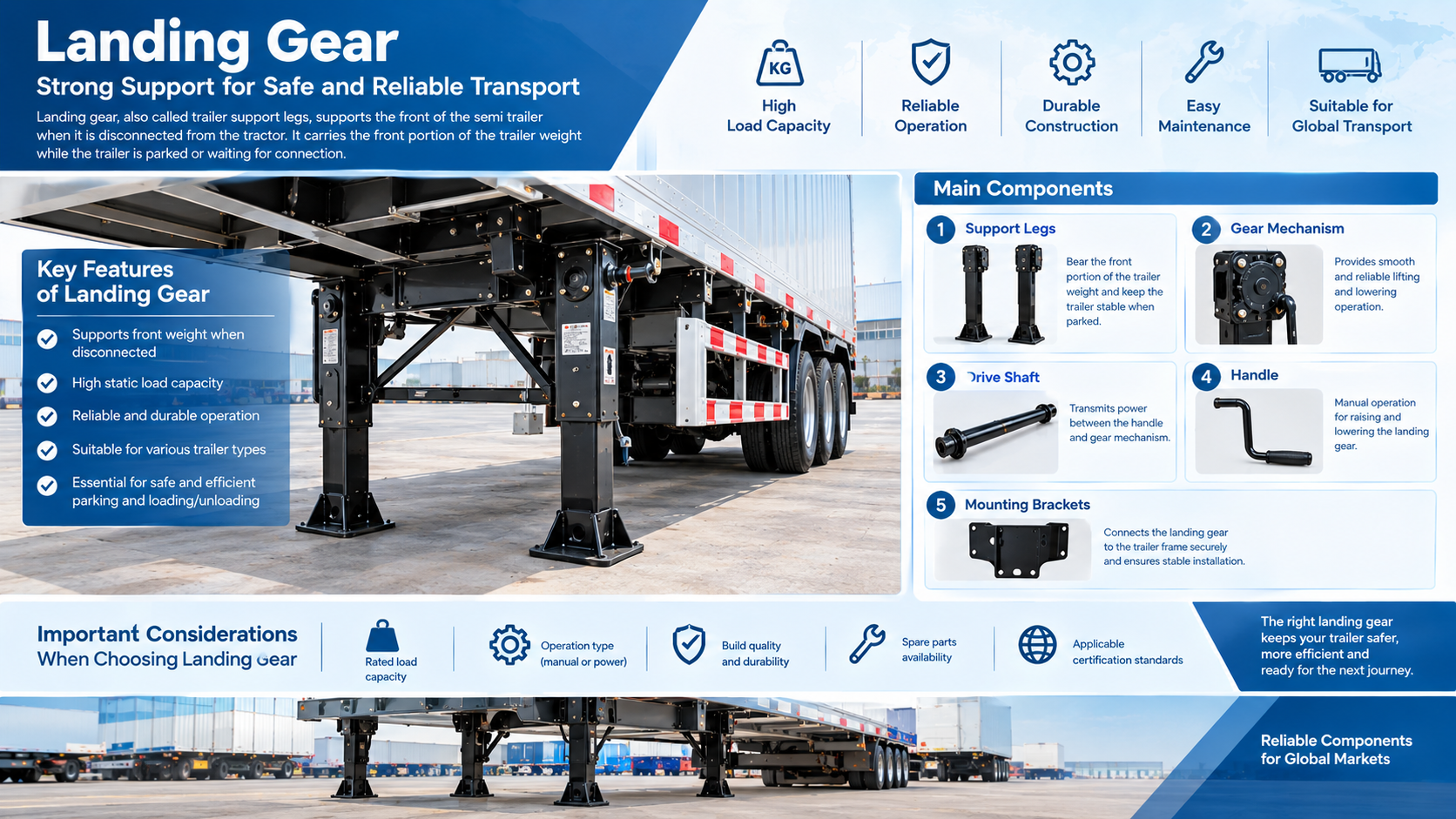
Landing gear, also called trailer support legs, supports the front of the semi trailer when it is disconnected from the tractor.
The landing gear carries the front portion of the trailer weight while the trailer is parked or waiting for connection.
A typical landing gear assembly includes:
-
Support legs
-
Gear mechanism
-
Drive shaft
-
Handle
-
Mounting brackets
For heavy-duty applications, landing gear needs to provide sufficient static load capacity and reliable operation.
Poor-quality landing gear can become difficult to operate or suffer mechanical damage under repeated loading. Therefore, the quality of the landing gear should be considered when evaluating the overall durability of a semi trailer for sale.
6. Kingpin
The kingpin is the connection point between the semi trailer and the tractor's fifth wheel.
It transfers pulling and braking forces between the tractor and trailer while allowing the trailer to articulate during turning.
Because the kingpin is a critical load-bearing component, its dimensions, material, mounting structure, and installation position must meet the requirements of the intended tractor and fifth-wheel system.
For export orders, the kingpin specification should be confirmed according to the target market and tractor configuration.
An incorrectly matched kingpin can cause coupling problems and may create serious safety concerns. This is why kingpin specifications should be checked before manufacturing and shipment.
7. Body / Cargo Structure
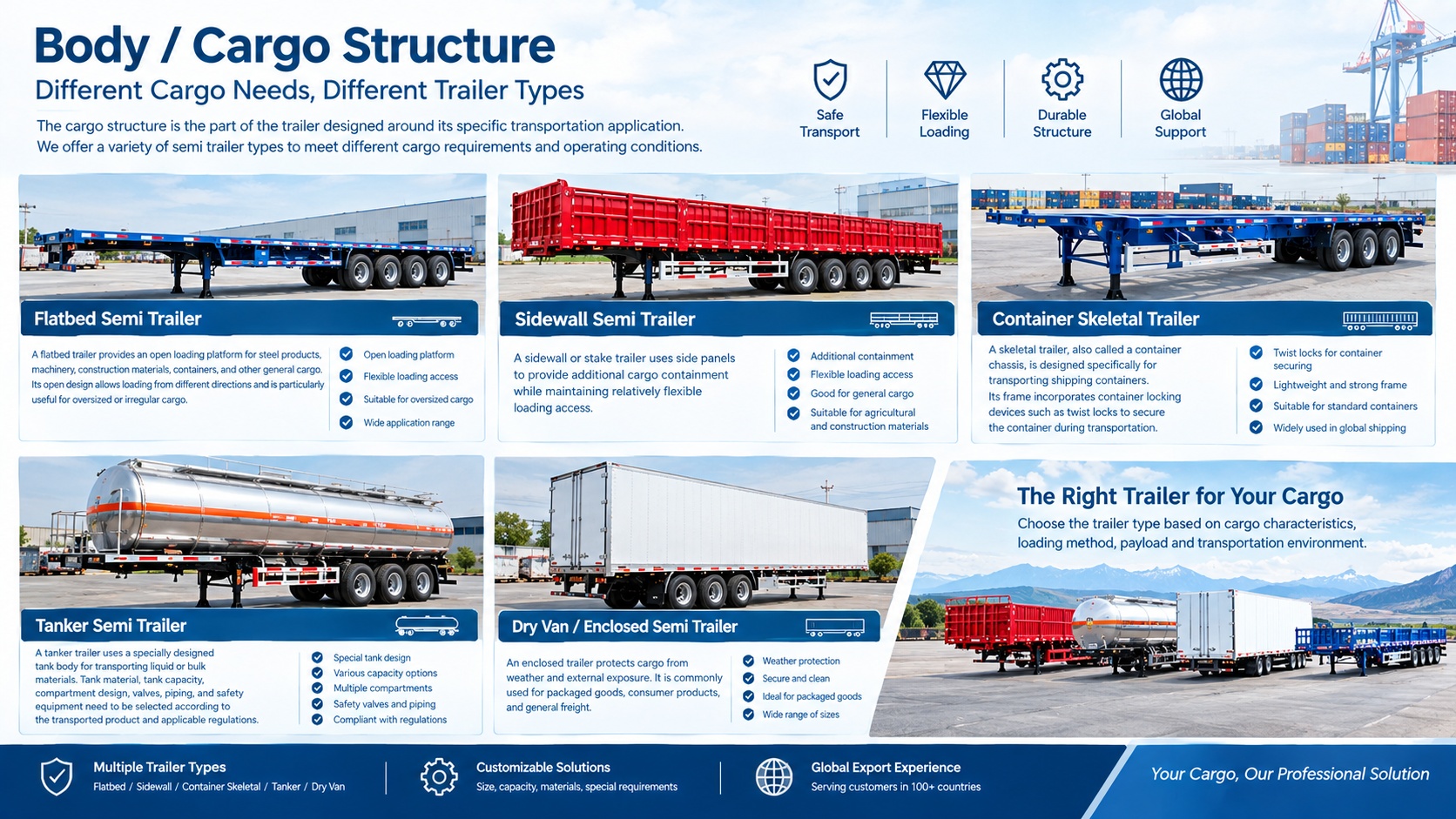
The cargo structure is the part of the trailer designed around its specific transportation application.
Different semi trailer types use different body structures.
Flatbed Semi Trailer
A flatbed trailer provides an open loading platform for steel products, machinery, construction materials, containers, and other general cargo.
Its open design allows loading from different directions and is particularly useful for oversized or irregular cargo.
Sidewall Semi Trailer
A sidewall or stake trailer uses side panels to provide additional cargo containment while maintaining relatively flexible loading access.
It is commonly used for general cargo, agricultural products, construction materials, and other packaged goods.
Container Skeletal Trailer
A skeletal trailer, also called a container chassis, is designed specifically for transporting shipping containers.
Its frame incorporates container locking devices such as twist locks to secure the container during transportation.
Tanker Semi Trailer
A tanker trailer uses a specially designed tank body for transporting liquid or bulk materials.
Tank material, tank capacity, compartment design, valves, piping, and safety equipment need to be selected according to the transported product and applicable regulations.
Dry Van / Enclosed Semi Trailer
An enclosed trailer protects cargo from weather and external exposure. It is commonly used for packaged goods, consumer products, and general freight.
The cargo structure is therefore one of the most important factors when choosing a trailer. Buyers should select the trailer type based on cargo characteristics, loading method, payload, and transportation environment.
8. Lights & Electrical System
The lighting and electrical system provides visibility and signaling functions and helps other road users identify the trailer.
Typical trailer electrical components include:
-
LED tail lights
-
Turn signal lights
-
Brake lights
-
Side marker lights
-
Clearance lights
-
Reflectors
-
Wiring harness
-
Electrical connectors
For export trailers, electrical specifications should be compatible with the tractor and destination market.
Lighting placement, connector type, wiring protection, and component quality can also affect regulatory compliance and long-term reliability.
A properly designed electrical system should provide stable performance under vibration, moisture, dust, and changing weather conditions.
9. Mudguards, Fenders & Accessories
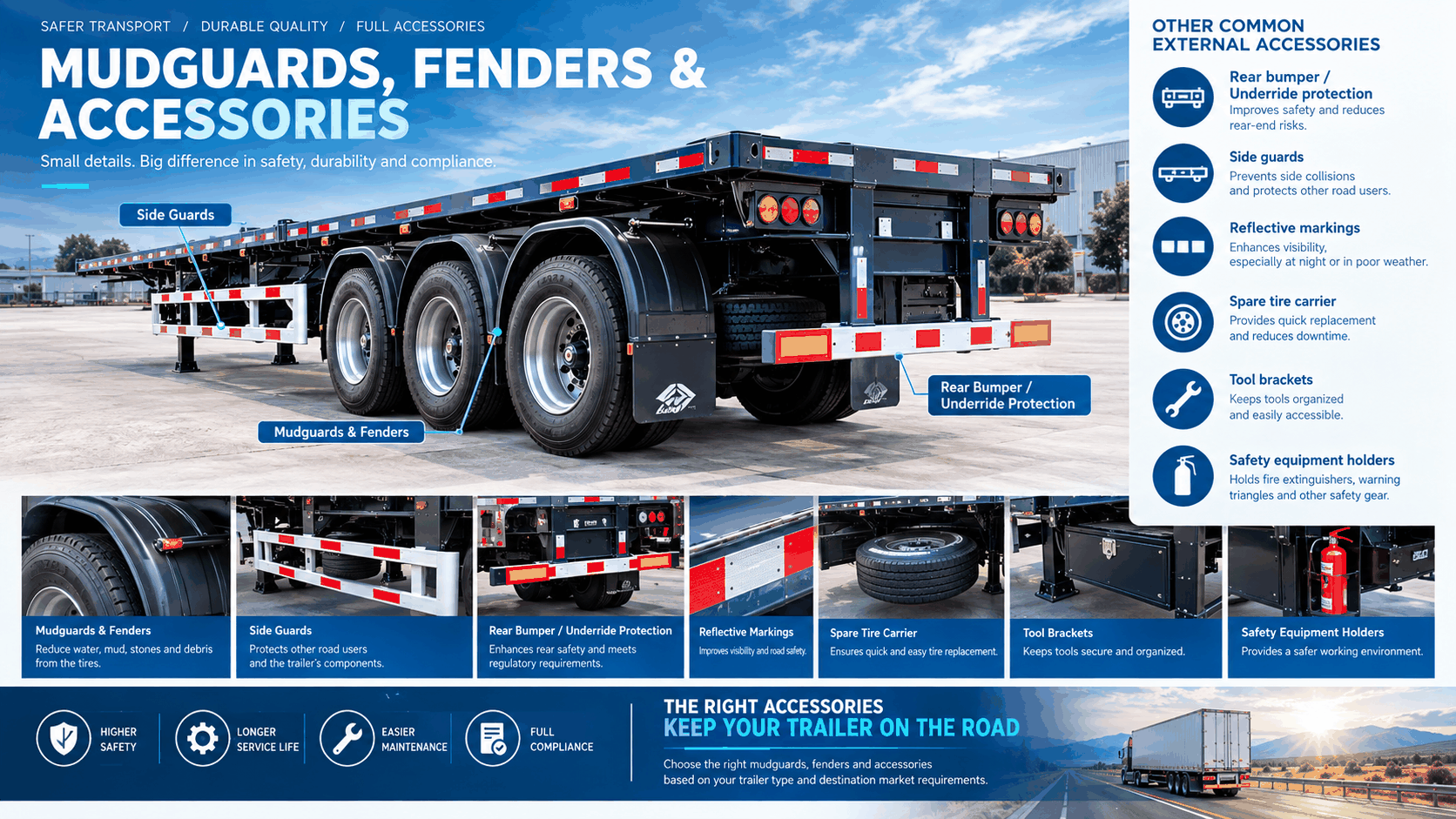
Mudguards and fenders help reduce the amount of water, mud, stones, and road debris thrown from the tires.
Depending on the trailer design, these components may be manufactured from steel, aluminum, rubber, or other suitable materials.
Other common external accessories include:
-
Rear bumper or underride protection
-
Side guards
-
Reflective markings
-
Spare tire carrier
-
Tool brackets
-
Safety equipment holders
Although these parts may appear secondary compared with the frame or axles, their design can still affect road safety, durability, maintenance, and compliance.
For export trailers, select accessory specifications based on the trailer type and destination-market requirements.
10. Optional Parts: Toolbox, Air Tank & More
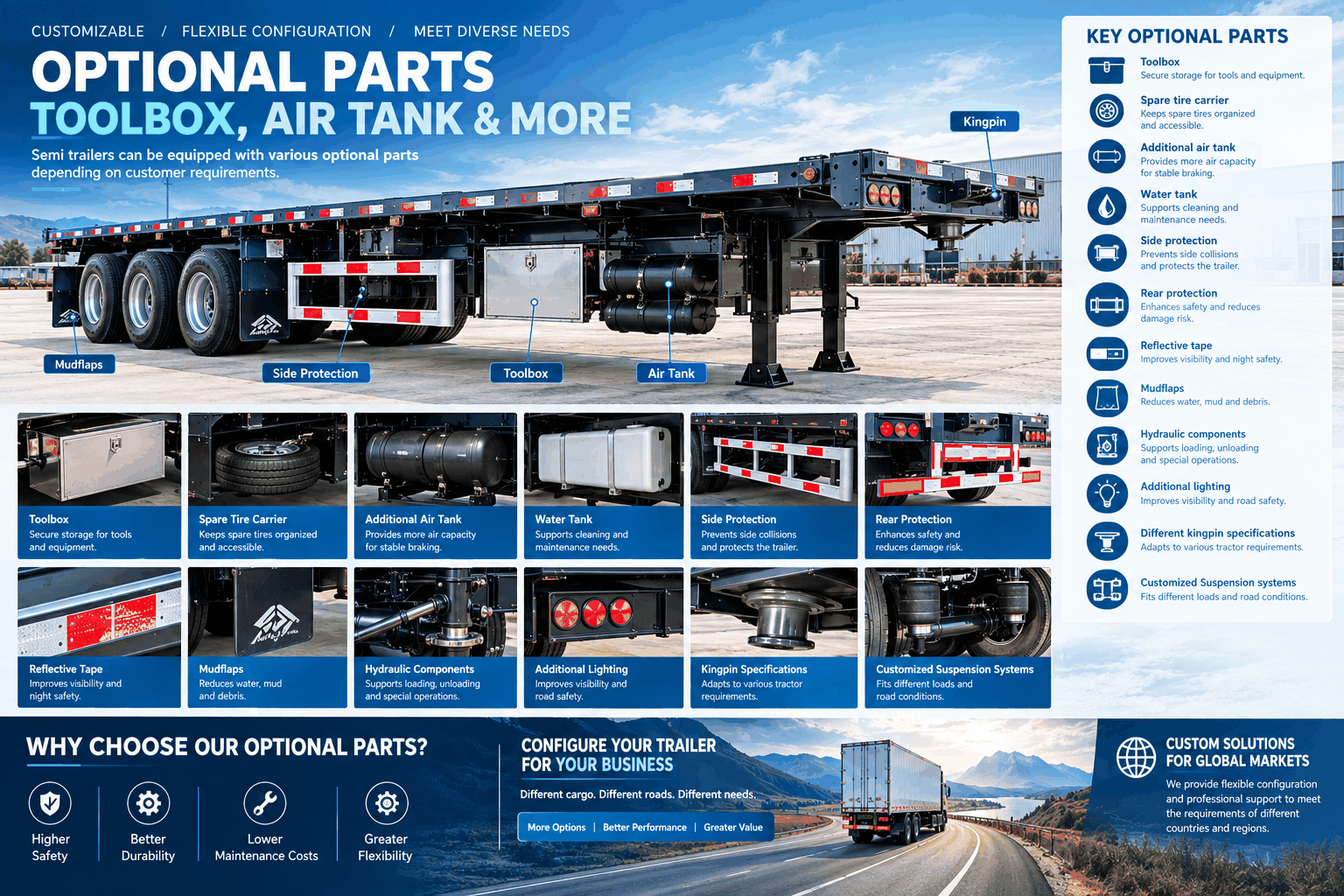
Semi trailers can be equipped with various optional parts depending on customer requirements
Common options include:
-
Toolbox
-
Spare tire carrier
-
Additional air tank
-
Water tank
-
Side protection
-
Rear protection
-
Reflective tape
-
Mudflaps
-
Hydraulic components
-
Additional lighting
-
Different kingpin specifications
-
Customized suspension systems
These options allow importers and fleet operators to configure the trailer for specific cargo, road conditions, and operating environments.
For example, a fleet operating in remote areas may place greater emphasis on spare tire storage and toolbox capacity, while a heavy-haul application may require upgraded axles, suspension, braking components, and reinforced frame structures.
How Do Semi Trailer Parts Affect Trailer Quality?
A semi trailer's performance depends on how its individual components work together.
A stronger frame cannot compensate for an incorrectly selected axle. High-quality tires cannot compensate for an inadequate braking system. Similarly, a reliable EBS system still requires the correct air brake components and proper installation.
When purchasing semi-trailer parts or a complete trailer, buyers should evaluate the entire configuration instead of focusing on one component.
Important factors include:
| Component | What Buyers Should Check |
|---|---|
| Main Frame | Steel grade, beam design, welding quality, payload capacity |
| Axles | Brand, rated capacity, number of axles, spare parts |
| Suspension | Mechanical or air suspension, load rating, road conditions |
| Tires | Size, load rating, brand, local availability |
| Braking System | Air brake, ABS/EBS configuration, market requirements |
| Kingpin | Size, material, fifth-wheel compatibility |
| Landing Gear | Load capacity, durability, operating mechanism |
| Cargo Structure | Trailer type, dimensions, loading method |
| Electrical System | Voltage, connector, lighting configuration |
| Accessories | Toolbox, spare tire carrier, mudguards, safety equipment |
Choosing the Right Semi Trailer Configuration for Export
The correct configuration depends on more than the trailer type.
Before placing an order, overseas buyers should provide information such as:
-
Target country
-
Cargo type
-
Maximum payload
-
Required trailer dimensions
-
Tractor specifications
-
Road and operating conditions
-
Axle requirements
-
Tire specifications
-
Braking requirements
-
Required certification
-
Quantity and delivery schedule
A professional semi trailer manufacturer can then recommend a suitable combination of frame, axles, suspension, tires, braking system, cargo structure, and optional equipment.
For export projects, consider certification and inspection requirements during the configuration stage, not after production.
Depending on the destination market and project requirements, we can support configurations for standards and inspection requirements such as PVOC and DOT.
Frequently Asked Questions
1. What are the main parts of a semi trailer?
The main parts include the chassis or main frame, axles, suspension, wheels and tires, braking system, landing gear, kingpin, cargo structure, electrical system, mudguards, and various optional accessories.
2. What type of axle is commonly used on semi trailers?
Fuwa axles are a common choice for heavy-duty semi trailer applications. The appropriate axle capacity and quantity depend on the trailer's gross weight, payload, road conditions, and local regulations.
3. What is the difference between ABS and EBS on a semi trailer?
ABS helps prevent wheel lock during braking, while EBS uses electronic control to manage braking more precisely. The required system depends on the target market, vehicle configuration, and applicable regulations.
4. Can semi trailer parts be customized for different countries?
Yes. Axles, suspension, tires, braking systems, electrical components, kingpins, cargo structures, and other components can be configured according to destination-market requirements, cargo conditions, road conditions, and certification needs.
5. How do I choose the right semi trailer for my business?
Start with the cargo type, required payload, dimensions, road conditions, tractor specifications, destination country, and certification requirements. A professional trailer manufacturer can then recommend the appropriate trailer type and component configuration.
Get a Semi Trailer Configuration & Quote
Choosing the right semi trailer components is an important step in controlling operating costs, safety risks, maintenance requirements, and long-term trailer performance.
We are a professional semi trailer manufacturer in China, supplying export-oriented trailer solutions for overseas importers, fleet operators, logistics companies, and engineering businesses.
Our main products include flatbed semi trailers, sidewall semi trailers, tanker semi trailers, lowbed trailers, and container skeletal trailers. We can customize axle configuration, suspension, tires, braking systems, cargo structure, dimensions, and other semi trailer parts according to your payload, road conditions, tractor specifications, and destination-market requirements.
PVOC and DOT-related configurations can also be supported according to the target market and applicable requirements.
Visible components, invisible dedication
Items such as fenders and reflective markers do not cost much to manufacture. However, if a manufacturer is willing to put in the effort to make them sturdy and compliant, it often indicates that the enterprise will also not cut corners in other unseen areas, such as frame welding and bearing material selection. When purchasing a vehicle or selecting a supplier, you may assess the reliability of the other party through these "minor details".
Send us your trailer requirements, including cargo type, payload, dimensions, destination country, quantity, and preferred configuration. We will provide a suitable semi trailer configuration and quotation for your project. You can contact us at any time.