
Benefits of a Tri-Axle Trailer: 8 Advantages for Heavy-Duty Transportation
When it comes to transporting heavy cargo, construction machinery, industrial equipment, and bulk materials, choosing the right trailer configuration can make a significant difference in transportation efficiency, safety, and operating costs.
One popular solution for heavy-duty transportation is the tri-axle trailer. Equipped with three axles, this trailer configuration is designed to distribute cargo weight across multiple wheels and suspension points, providing greater load-support potential and improved weight management for demanding transportation tasks.
But what are the actual benefits of a tri-axle trailer? Is it better than a tandem axle trailer? And when should a transportation company consider investing in one?
In this guide, we will explore the eight major benefits of tri-axle trailers, explain their practical applications, compare them with tandem axle configurations, and discuss the factors buyers should consider before making a purchase.
What Is a Tri-Axle Trailer?
A tri-axle trailer is a trailer equipped with three axles, usually arranged in a closely grouped configuration near the rear section of the trailer.
Each axle supports a portion of the trailer's load through its wheels, tires, and suspension system. Compared with single-axle and tandem-axle configurations, a tri-axle design provides additional support points and can accommodate higher gross vehicle weight ratings when the complete trailer structure and running gear are properly engineered.
Tri-axle configurations are commonly used in heavy-duty commercial transportation, including:
-
Flatbed semi trailers
-
Lowbed and lowboy trailers
-
Dump and tipper semi trailers
-
Container chassis trailers
-
Heavy-duty cargo trailers
-
Specialized industrial transport trailers
The exact payload capacity depends on axle ratings, suspension specifications, frame strength, tire capacity, kingpin load, tractor compatibility, and applicable road regulations.
For transportation businesses handling heavy or frequently loaded cargo, a tri-axle trailer can provide several important operational advantages.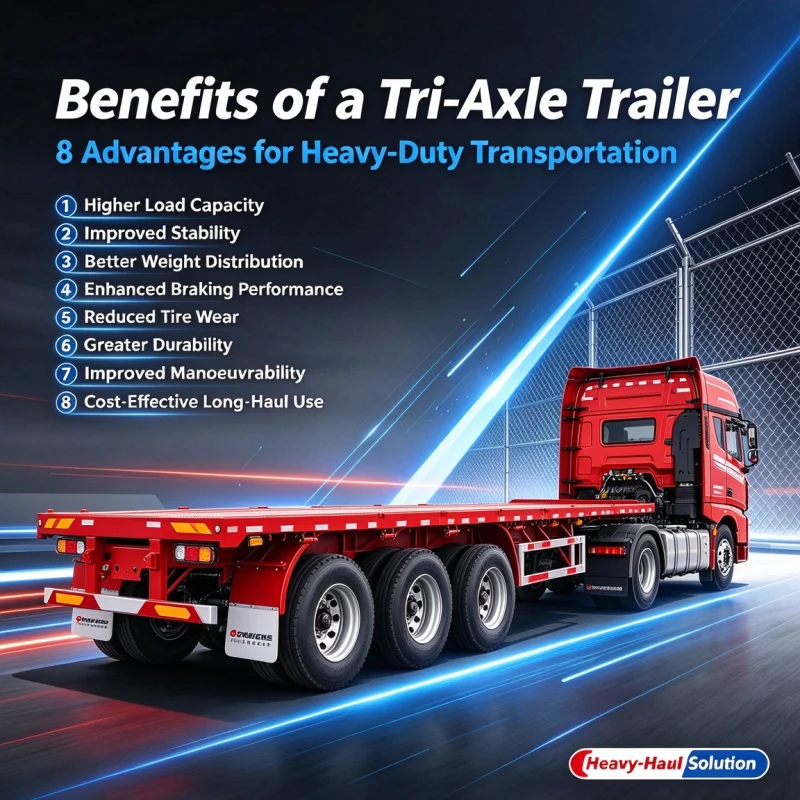
8 Major Benefits of a Tri-Axle Trailer
1. Better Load Distribution Across Three Axles
One of the biggest benefits of a tri-axle trailer is its ability to distribute the trailer load across three axle assemblies rather than two.
When a heavy load is transported, its weight creates significant forces on the trailer frame, suspension, axles, tires, and connecting components.
With an appropriately designed three-axle configuration, these forces can be distributed across more supporting points.
This offers several practical advantages:
-
Reduces the average load carried by each axle when the load is evenly distributed.
-
Helps manage stress on individual suspension components.
-
Provides additional support for heavy cargo.
-
Helps maintain a more balanced trailer structure.
-
Supports compliance with applicable axle-load restrictions.
For example, a company transporting steel products, construction machinery, or industrial equipment may benefit from a three-axle configuration because cargo weight can be distributed across a larger running-gear group.
However, axle count alone does not guarantee balanced loading. Cargo positioning, axle spacing, suspension design, and kingpin weight distribution remain essential.
2. Greater Potential Payload Capacity
Another important advantage of a tri-axle trailer is its potential to support heavier loads.
Adding a third axle increases the available axle-group capacity, provided that the chassis, suspension, tires, brakes, and other structural components are designed to handle the additional weight.
This makes tri-axle trailers particularly useful for businesses transporting:
-
Heavy construction machinery
-
Steel beams and metal products
-
Large industrial equipment
-
Containers and general cargo
-
Sand, gravel, and other bulk materials
For commercial transportation companies, the ability to carry a suitable heavier load in one trip can improve fleet productivity.
For instance, transporting construction materials in fewer trips may help reduce repeated loading and unloading operations, driver hours, and vehicle scheduling requirements.
It is important to remember that adding an axle does not automatically increase legal payload capacity. The actual allowable load must comply with the trailer's rated specifications, tractor limitations, axle-group regulations, and road restrictions in the destination market.
3. Improved Stability When Carrying Heavy Loads
Stability is another reason many heavy-duty transportation businesses choose tri-axle trailers.
A three-axle running gear provides additional support points beneath the trailer. When properly engineered and loaded, this can help distribute forces more effectively and support predictable handling during transportation.
This is especially relevant when carrying heavy machinery, construction materials, and other concentrated loads.
The potential stability benefits include:
-
Better support for heavy cargo.
-
More balanced load distribution across the running gear.
-
Reduced concentration of load forces on individual axles.
-
Improved control when the trailer is correctly matched with the tractor.
-
Better support for demanding commercial transportation operations.
However, trailer stability also depends on the center of gravity, cargo securing, suspension geometry, tire condition, speed, and road conditions.
A tri-axle trailer is not automatically safer in every situation. Proper engineering, loading, and driving practices remain essential.
4. Reduced Stress on Individual Tires and Axle Components
A heavily loaded trailer places considerable pressure on its tires, bearings, suspension components, and axles.
With three axles supporting the load, the average vertical load per axle can be lower than that of an otherwise comparable two-axle configuration.
This can help reduce excessive loading on individual components when the trailer is correctly designed and operated.
Potential advantages include:
-
More distributed tire loading.
-
Reduced average axle loading.
-
Better support for heavy-duty applications.
-
Improved management of mechanical stress.
-
Potentially longer component service life under suitable operating conditions.
For fleet operators, component durability is an important consideration because unexpected repairs can interrupt transportation schedules and increase operating expenses.
Nevertheless, a tri-axle trailer also has more tires, bearings, suspension components, and other parts to inspect and maintain. Its total maintenance cost is not necessarily lower than that of a tandem axle trailer.
5. Additional Braking Support and Safety Potential
Braking performance is essential when transporting heavy cargo.
Tri-axle trailers can be configured with braking systems across all three axles, providing additional braking equipment compared with a typical two-axle configuration.
When properly specified, installed, and maintained, this arrangement can contribute to effective braking performance and better management of braking forces.
Depending on the model and destination-market requirements, available braking configurations may include:
-
Air brake systems
-
Drum brakes
-
Disc brakes
-
ABS (Anti-lock Braking System)
-
EBS (Electronic Braking System)
For heavy-duty transportation, the complete braking system must be matched to the trailer's rated weight, tire specifications, tractor braking system, and applicable regulations.
An additional axle does not automatically guarantee a shorter stopping distance. Brake compatibility, adjustment, tire traction, road conditions, and vehicle speed all influence actual braking performance.
For buyers, selecting an appropriate braking configuration is just as important as selecting the axle quantity.
6. Better Adaptability to Different Heavy-Duty Applications
Tri-axle configurations can be incorporated into different trailer designs, making them suitable for a wide range of commercial transportation requirements.
The trailer body, deck structure, suspension, and loading equipment can be selected according to the type of cargo being transported.
Here are some common applications:
Tri-Axle Flatbed Semi Trailer
A tri-axle flatbed trailer is suitable for transporting containers, steel products, pipes, timber, construction materials, and general industrial cargo.
Its open platform allows loading from different directions using cranes and forklifts.
Explore LUCKSUN Flatbed Semi Trailers for different flatbed transportation solutions. Tri-Axle Flatbed Semi Trailer
Tri-Axle Lowbed Semi Trailer
Lowbed trailers are designed for transporting excavators, bulldozers, wheel loaders, and other heavy construction machinery.
Their low loading platforms help accommodate tall equipment while maintaining suitable overall transport height.
Explore LUCKSUN Low-Bed Semi Trailers for heavy equipment transportation applications. Tri-Axle Lowbed Semi Trailer
Tri-Axle Dump Semi Trailer
Dump trailers are commonly used to transport sand, gravel, soil, coal, and other bulk materials.
A hydraulic tipping system allows the cargo body to be raised for efficient unloading.
Explore LUCKSUN 3-Axle Tipper Dumper Semi Trailers for bulk material transportation.
Different trailer designs serve different operational requirements. Choosing the right body structure is therefore just as important as selecting the axle configuration. Tri-Axle Dump Semi Trailer
7. Greater Operational Efficiency for Heavy-Cargo Fleets
For transportation companies, efficiency is not simply about carrying more weight.
It also involves reducing unnecessary trips, improving equipment utilization, managing loading operations, and maintaining reliable transportation schedules.
A properly specified tri-axle trailer can support these objectives in several ways.
First, its additional axle capacity may allow businesses to transport certain heavy loads more efficiently, subject to legal weight restrictions.
Second, the wider range of available trailer configurations allows fleet operators to select equipment for specific cargo types.
Third, a suitable chassis and suspension combination can help the trailer withstand demanding operating conditions.
For example, a construction company transporting machinery between project sites may benefit from a tri-axle lowbed trailer designed around the equipment's weight, dimensions, and loading requirements.
Similarly, logistics companies transporting containers or steel products may find a tri-axle flatbed configuration suitable for their regular transportation operations.
The key is to match the trailer to the actual transportation task rather than selecting three axles simply because they appear to offer more capacity.
8. Greater Flexibility for Future Fleet Requirements
Transportation requirements can change as a business grows.
A company that initially handles general cargo may later expand into construction machinery, industrial equipment, or heavier commercial freight.
A tri-axle trailer can offer a useful platform for businesses whose regular transportation requirements involve heavier cargo and more demanding load-support needs.
Depending on the trailer design, buyers may select different configurations for:
-
Axle brands and rated capacities.
-
Mechanical or air suspension.
-
Drum or disc braking systems.
-
ABS or EBS equipment.
-
Tire specifications.
-
Cargo securing systems.
-
Deck dimensions and structural reinforcement.
This flexibility allows businesses to specify a trailer according to their current operating requirements while considering potential future applications.
For international buyers, it is particularly important to confirm that the trailer configuration is suitable for the road conditions, regulations, tractor specifications, and cargo requirements of the destination country.
Tri-Axle Trailer vs. Tandem Axle Trailer: Which Is Better?
Both tri-axle and tandem axle trailers are widely used in commercial transportation.
However, they are designed to address different load requirements and operating conditions.
The following comparison highlights their main differences.
| Comparison Factor | Tandem Axle Trailer | Tri-Axle Trailer |
|---|---|---|
| Number of axles | 2 | 3 |
| Load distribution | Across two axles | Across three axles |
| Payload potential | Suitable for many standard commercial loads | Greater potential for heavier loads |
| Stability | Good when properly designed and loaded | Additional load-support points |
| Tire quantity | Usually 4 | Usually 6 |
| Maintenance | Fewer components | More components to maintain |
| Initial investment | Generally lower | Generally higher |
| Turning maneuverability | Generally easier | More tire scrub in tight turns |
| Typical applications | General cargo and medium-duty transport | Heavy-duty cargo and specialized transport |
When Should You Choose a Tandem Axle Trailer?
A tandem axle trailer may be a better option if:
-
Your cargo does not require a higher axle-group capacity.
-
You regularly operate in confined loading and unloading areas.
-
Your transportation business prioritizes lower initial investment.
-
You want fewer tires and mechanical components to maintain.
When Should You Choose a Tri-Axle Trailer?
A tri-axle trailer may be more suitable if:
-
You regularly transport heavy machinery or industrial cargo.
-
Your operating conditions require additional axle support.
-
Your cargo weight and dimensions justify a three-axle configuration.
-
Your local road regulations and tractor specifications support the selected design.
-
You want a trailer configuration tailored to demanding commercial transportation.
Ultimately, the best choice depends on the cargo, operating environment, legal weight limits, and total cost of ownership.
Are There Any Disadvantages of a Tri-Axle Trailer?
Although tri-axle trailers provide several advantages, they also have certain limitations that buyers should understand.
1. Higher Initial Purchase Cost
A third axle adds tires, wheels, suspension components, braking equipment, and structural requirements. Consequently, a tri-axle trailer generally costs more than a comparable tandem axle model.
2. More Maintenance Components
Three axles mean more tires, bearings, brakes, and suspension components to inspect and maintain.
Regular maintenance planning is important for controlling long-term operating expenses.
3. Greater Tire Scrub During Tight Turns
When a trailer turns, its axles follow different paths. Closely grouped fixed axles can create tire scrub, particularly during sharp turns on paved surfaces.
This may accelerate tire wear and increase stress on certain running-gear components.
4. Higher Empty Weight
The additional axle and related equipment increase the trailer's tare weight.
If the legal gross weight remains unchanged, the heavier trailer may reduce the available payload.
5. More Complex Configuration Requirements
A tri-axle trailer requires careful coordination between axle ratings, suspension, tires, brakes, chassis design, and local regulations.
These factors should be considered before purchasing.
For businesses that regularly transport heavy cargo, the additional investment may be justified. For lighter transportation tasks, however, a tandem axle trailer may provide better overall value.
How to Choose the Right Tri-Axle Trailer for Your Business
Selecting a tri-axle trailer should involve more than comparing prices or counting axles.
Buyers should evaluate the complete trailer configuration to ensure it matches their transportation requirements.
Here are six important factors to consider.
1. Confirm Your Cargo Weight and Dimensions
Start by identifying the type of cargo you transport.
Consider:
-
Maximum cargo weight.
-
Cargo length, width, and height.
-
Weight distribution.
-
Loading and unloading methods.
-
Whether the cargo is concentrated or evenly distributed.
These details help determine the appropriate trailer structure and axle ratings.
2. Evaluate Axle Brand and Load Rating
Axle quality plays an important role in trailer performance.
Ask the manufacturer about available axle brands, rated capacities, braking compatibility, and replacement-part availability.
For example, LUCKSUN offers axle configuration options including FUWA and BPW, subject to the selected model and specification.
3. Select the Appropriate Suspension System
Suspension affects ride characteristics, load support, maintenance, and suitability for different road conditions.
Common options include:
-
Mechanical suspension: A practical solution for many heavy-duty commercial applications.
-
Air suspension: Offers adjustable air support and can provide improved ride characteristics for suitable applications.
The correct choice depends on cargo sensitivity, road conditions, maintenance resources, and budget.
4. Check the Braking Configuration
A reliable braking system is essential for heavy-duty transportation.
Confirm whether the trailer uses drum or disc brakes and whether ABS or EBS is required or available.
Also verify compatibility with the towing tractor and destination-country regulations.
5. Evaluate Frame Strength and Manufacturing Quality
A trailer's performance depends on more than its axle configuration.
The main beams, cross-members, welding quality, surface treatment, and overall structural design all contribute to durability.
Buyers should ask about:
-
Main beam material and dimensions.
-
Structural reinforcement.
-
Welding processes and inspection.
-
Anti-corrosion treatment.
-
Manufacturing quality control.
6. Consider Destination-Market Requirements
For international purchases, confirm the applicable axle-load limits, overall dimensions, braking requirements, lighting standards, and other vehicle regulations.
A trailer that works well in one country may require a different specification for another market.
Providing the manufacturer with your destination country, cargo details, preferred tractor model, and operating conditions will make it easier to develop a suitable configuration.
Why Choose LUCKSUN for Your Tri-Axle Semi Trailer?
Choosing a suitable manufacturer is an important part of purchasing a heavy-duty trailer.
LUCKSUN is a semi-trailer manufacturer offering different trailer solutions for international transportation markets.
Its product range includes flatbed semi trailers, lowbed trailers, dump trailers, skeletal trailers, tank trailers, and other commercial transportation equipment.
For buyers looking for tri-axle configurations, LUCKSUN provides customization options covering several important components.
Flexible Axle Configurations
Customers can discuss axle brands, quantities, and specifications according to their cargo requirements and local regulations.
Multiple Suspension and Braking Options
Depending on the selected model, available configurations include mechanical suspension, air suspension, air brakes, ABS, and EBS.
Different Trailer Applications
From container and steel transportation to heavy construction machinery and bulk material handling, buyers can select a trailer structure that matches their operational needs.
Manufacturing and Quality Control
LUCKSUN's official website describes its automated manufacturing capabilities, including robotic welding, electrophoretic coating, and intelligent assembly processes.
These production capabilities support consistent manufacturing processes and product quality management.
To learn more about the company and its manufacturing background, visit LUCKSUN About Us.
If you are comparing trailer configurations for your fleet, you can also explore the complete LUCKSUN Semi Trailer Product Range.
Frequently Asked Questions About Tri-Axle Trailers
1. What are the main benefits of a tri-axle trailer?
The main benefits include better load distribution, greater potential payload capacity, additional support points, improved load management, and flexibility for heavy-duty transportation applications.
2. Is a tri-axle trailer better than a tandem axle trailer?
Not necessarily. A tri-axle trailer is generally more suitable for applications requiring additional axle support and higher load capacity potential. A tandem axle trailer may be more economical and easier to maneuver for lighter or standard commercial loads.
3. How much weight can a tri-axle trailer carry?
There is no universal payload capacity for all tri-axle trailers.
The actual capacity depends on axle ratings, frame strength, suspension, tire specifications, kingpin load, tractor capacity, and local transportation regulations.
Always check the manufacturer's rated specifications before purchasing.
4. What types of cargo can a tri-axle trailer transport?
Depending on the trailer body design, tri-axle trailers can transport containers, steel products, construction machinery, industrial equipment, gravel, sand, timber, and other heavy commercial cargo.
5. Does a tri-axle trailer require more maintenance?
Generally, yes. A tri-axle trailer has additional tires, bearings, brakes, and suspension components compared with a similar tandem axle trailer.
Regular inspections and preventive maintenance help maintain safe and reliable operation.
6. Are tri-axle trailers suitable for long-distance transportation?
Yes. Properly designed and maintained tri-axle trailers can be suitable for long-distance commercial transportation.
The appropriate suspension, tires, braking system, chassis design, and tractor compatibility should be considered.
7. Can a tri-axle trailer be customized?
Yes. Depending on the manufacturer and trailer model, buyers can customize axle brands, suspension systems, braking equipment, tire specifications, deck dimensions, and cargo securing components.
8. How do I choose the right tri-axle trailer manufacturer?
Look for a manufacturer with relevant production experience, clear technical specifications, customization capabilities, quality control procedures, and export support.
It is also important to confirm the manufacturer's ability to provide a trailer configuration that meets your destination-market requirements.
Final Thoughts
A tri-axle trailer can be a valuable investment for transportation businesses that regularly handle heavy cargo and demanding commercial applications.
Its main advantages include better load distribution, greater potential load capacity, additional support points, and flexibility across different trailer designs.
However, the best configuration depends on more than the number of axles. Frame strength, suspension, braking systems, tire ratings, tractor compatibility, cargo characteristics, and local regulations all influence actual performance.
Before purchasing, evaluate your transportation requirements carefully and compare the complete specifications rather than focusing only on the axle configuration.
If you are looking for a reliable tri-axle semi trailer solution for your business, LUCKSUN can help you explore suitable trailer types and customized configurations.
Contact LUCKSUN today to discuss your cargo requirements and request a customized tri-axle semi trailer quotation.