
Enclosed Car Transporter Trailer: Sizes, Features and Applications
1. What Is an Enclosed Car Transporter Trailer?
An enclosed car transporter trailer is a specialized vehicle transport trailer designed to carry passenger cars, luxury vehicles, sports cars, classic cars, and other valuable automobiles inside a fully covered structure.
Unlike an open car carrier, an enclosed car transporter has a roof, side panels, and enclosed loading space. This design creates a physical barrier between transported vehicles and external conditions such as rain, dust, road debris, and direct sunlight.
For vehicle transport companies, car dealerships, automotive distributors, and international vehicle traders, an enclosed car transporter trailer provides an additional level of protection during transportation.
It is particularly useful when the condition and appearance of the vehicle are important to the customer.
Depending on the transport requirements, enclosed car transporter trailers can be designed in different configurations:
-
Single-car enclosed trailers for individual vehicle transportation.
-
Multi-car enclosed trailers for commercial vehicle logistics.
-
Enclosed semi-trailer configurations for tractor-trailer operations.
-
Customized enclosed transport trailers for luxury, classic, and specialty vehicles.
The correct design depends on vehicle dimensions, loading requirements, transport distance, road regulations, and operating costs.
For professional buyers, an enclosed car transporter should not be evaluated only by its external appearance. Structural strength, internal dimensions, loading equipment, braking performance, and vehicle securing systems are equally important.
2. How Is an Enclosed Car Transporter Trailer Manufactured?
Manufacturing an enclosed car transporter trailer requires coordination between structural engineering, material selection, welding, body assembly, and mechanical installation.
A properly manufactured trailer must support the vehicle load while maintaining structural stability during transportation.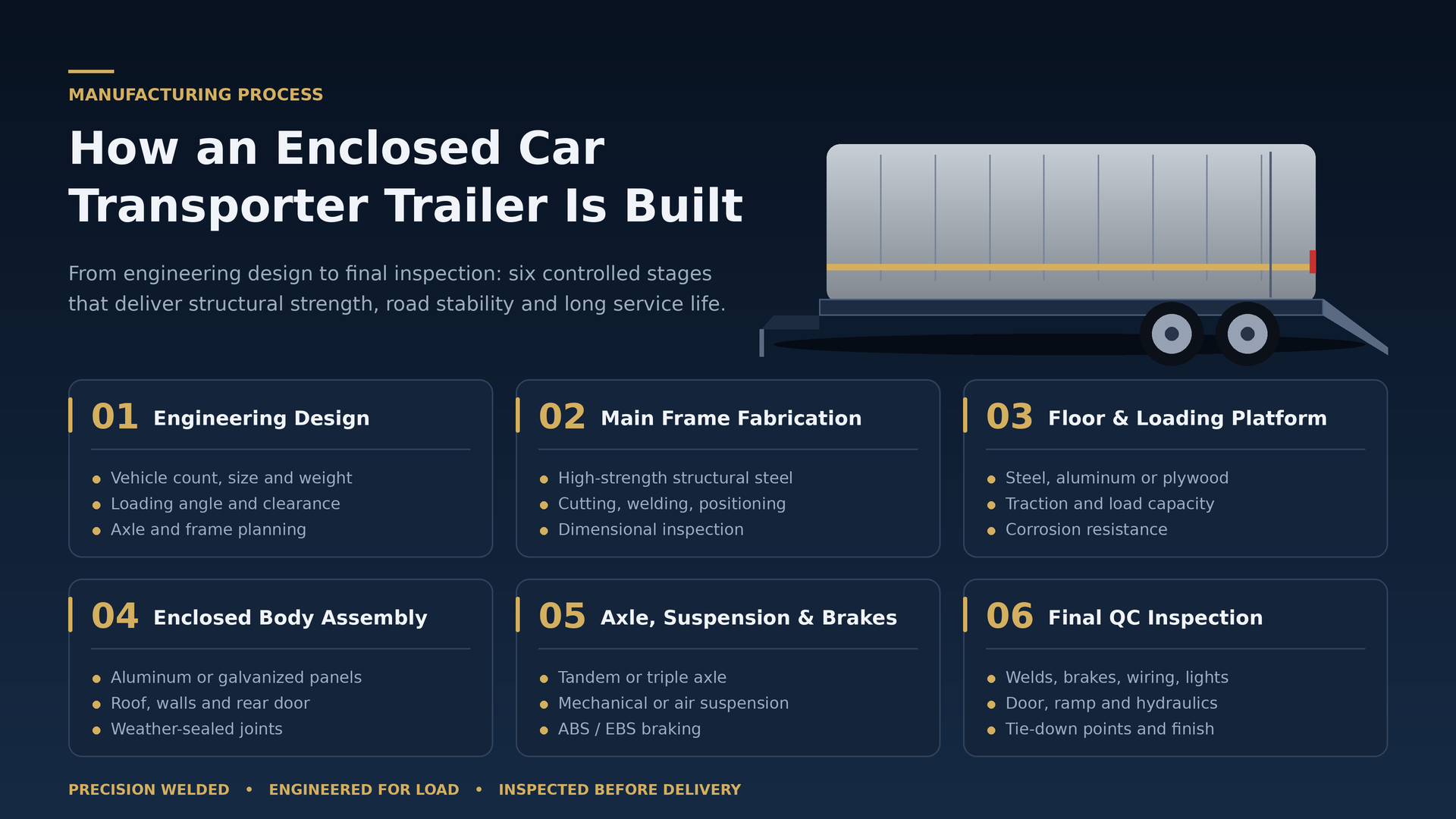
Enclosed car transporter trailer manufacturing process: engineering design, frame fabrication, flooring, body assembly, axle and brake installation, final inspection
2.1 Engineering Design and Dimension Planning
The manufacturing process starts with understanding the customer's transport requirements.
Engineers need to confirm:
-
Number of vehicles to be transported.
-
Maximum vehicle length, width, and height.
-
Individual vehicle weight.
-
Required internal loading clearance.
-
Loading and unloading methods.
-
Intended road conditions.
-
Applicable transportation regulations.
These details determine the trailer's overall dimensions, frame structure, axle configuration, and loading system.
For example, a trailer designed for low-profile sports cars requires different loading arrangements from one designed for standard passenger vehicles.
The rear loading angle, door opening height, and internal clearance must be checked before production.
2.2 Main Frame Fabrication
The main frame is the foundation of the trailer.
Depending on the design, manufacturers use high-strength structural steel sections to produce the longitudinal beams, cross members, and supporting structures.
The frame must withstand:
-
Vertical vehicle loads.
-
Dynamic forces during braking.
-
Road vibration and impact.
-
Uneven load distribution.
-
Torsional forces during cornering.
Cutting, positioning, welding, and dimensional inspection are important manufacturing stages.
Weld quality and dimensional accuracy directly influence the trailer's structural performance and service life.
2.3 Floor and Loading Platform Installation
The floor must support the weight of the transported vehicles and provide sufficient traction for loading operations.
Common flooring options include reinforced steel plates, aluminum flooring, and engineered plywood systems for suitable light-duty designs.
The selected material should consider:
-
Load-bearing capacity.
-
Surface friction.
-
Corrosion resistance.
-
Cleaning requirements.
-
Overall trailer weight.
For commercial vehicle transport, reinforced flooring and properly positioned support members are important.
2.4 Enclosed Body Assembly
After the main structure is completed, the roof, side walls, front section, and rear door assembly are installed.
Common construction options include:
-
Steel frame with aluminum exterior panels.
-
Steel frame with galvanized steel panels.
-
Aluminum structural components and aluminum panels.
-
Insulated panel construction for special applications.
Aluminum panels can help reduce body weight, while steel panels offer different advantages in terms of impact resistance, fabrication, and repair.
The choice should depend on operating conditions, payload requirements, budget, and maintenance expectations.
Weather-resistant joints, door seals, drainage arrangements, and protective coatings should also be considered.
2.5 Axle, Suspension and Brake Installation
The axle and suspension systems support the trailer load and help maintain stable road performance.
Depending on the trailer design and rated capacity, configurations may include tandem or triple axles.
Mechanical suspension is commonly selected for its relatively simple construction and maintenance requirements.
Air suspension can be considered where improved ride characteristics and specific vehicle transport requirements are important.
Braking equipment may include ABS or EBS, depending on the selected specification and applicable regulations.
2.6 Final Assembly and Quality Inspection
Before delivery, the trailer should undergo a systematic inspection.
Important checks include:
-
Frame dimensions and welding quality.
-
Axle and suspension installation.
-
Brake system operation.
-
Electrical wiring and lighting.
-
Rear door and ramp operation.
-
Hydraulic equipment, where fitted.
-
Wheel securing and tie-down points.
-
Body sealing and exterior finish.
A complete inspection helps identify manufacturing or assembly issues before the trailer enters service.
3. Enclosed Car Transporter Trailer Dimensions and Specifications
Dimensions are one of the most important considerations when purchasing an enclosed car transporter trailer.
A trailer may have sufficient external length but still lack the internal space required for a particular vehicle.
Buyers should pay particular attention to usable internal length, internal width, rear door opening, floor height, and internal roof clearance.
The following table provides indicative configuration ranges for different enclosed car transporter designs. These are reference values rather than fixed manufacturing standards.
| Specification | Single-Car Enclosed Trailer | Commercial Enclosed Semi-Trailer |
|---|---|---|
| Overall Length | 6–10 m | 12–16.5 m |
| Overall Width | 2.4–2.6 m | 2.5–2.6 m |
| Internal Width | 2.2–2.45 m | 2.3–2.5 m |
| Internal Height | 1.9–2.3 m | 2.2–3.0 m |
| Axle Configuration | 2–3 axles | 2–3 axles |
| Suspension | Leaf Spring / Torsion | Mechanical / Air |
| Main Material | Steel / Aluminum | Steel / Aluminum |
| Loading System | Rear Ramp / Hydraulic Lift | Rear Ramp / Hydraulic Lift |
| Main Application | Individual Vehicle Shipping | Commercial Vehicle Logistics |
Actual dimensions depend on the selected structure, vehicle clearance, loading equipment, and local road regulations.
3.1 Overall Length
The trailer length determines how much usable space is available for vehicle loading.
A shorter enclosed trailer may be sufficient for one passenger car.
Longer commercial configurations can accommodate larger vehicles or multiple vehicles, depending on the internal layout.
When choosing the length, buyers should consider vehicle wheelbase, front and rear overhang, loading clearance, and the space needed for securing equipment.
3.2 Overall and Internal Width
The external width determines whether the trailer meets local road restrictions.
The internal width determines whether vehicles can enter and be positioned safely.
Door frames, wall thickness, wheel arches, and structural supports can reduce the usable loading space.
For this reason, buyers should request an internal dimension drawing rather than relying only on the nominal external width.
3.3 Internal Height and Rear Door Opening
Internal height is especially important when transporting SUVs, luxury vehicles, and vehicles with roof-mounted equipment.
The rear door opening must also provide enough clearance for the tallest vehicle.
A trailer with sufficient internal height may still be unsuitable if its rear door opening is too low.
3.4 Axle Configuration and Payload
The axle configuration should match the trailer's gross vehicle weight rating and expected operating conditions.
Payload is calculated by subtracting the trailer's unladen weight from its permitted gross weight.
An enclosed body, loading ramps, hydraulic equipment, and additional structural reinforcement all add weight.
Buyers should therefore evaluate usable payload instead of selecting a trailer based only on the number of axles.
4. How Does an Enclosed Car Transporter Trailer Work?
The operating principle is straightforward: vehicles are driven or moved into the enclosed loading space, secured using dedicated restraint equipment, and transported inside the covered trailer.
However, safe operation depends on several coordinated systems.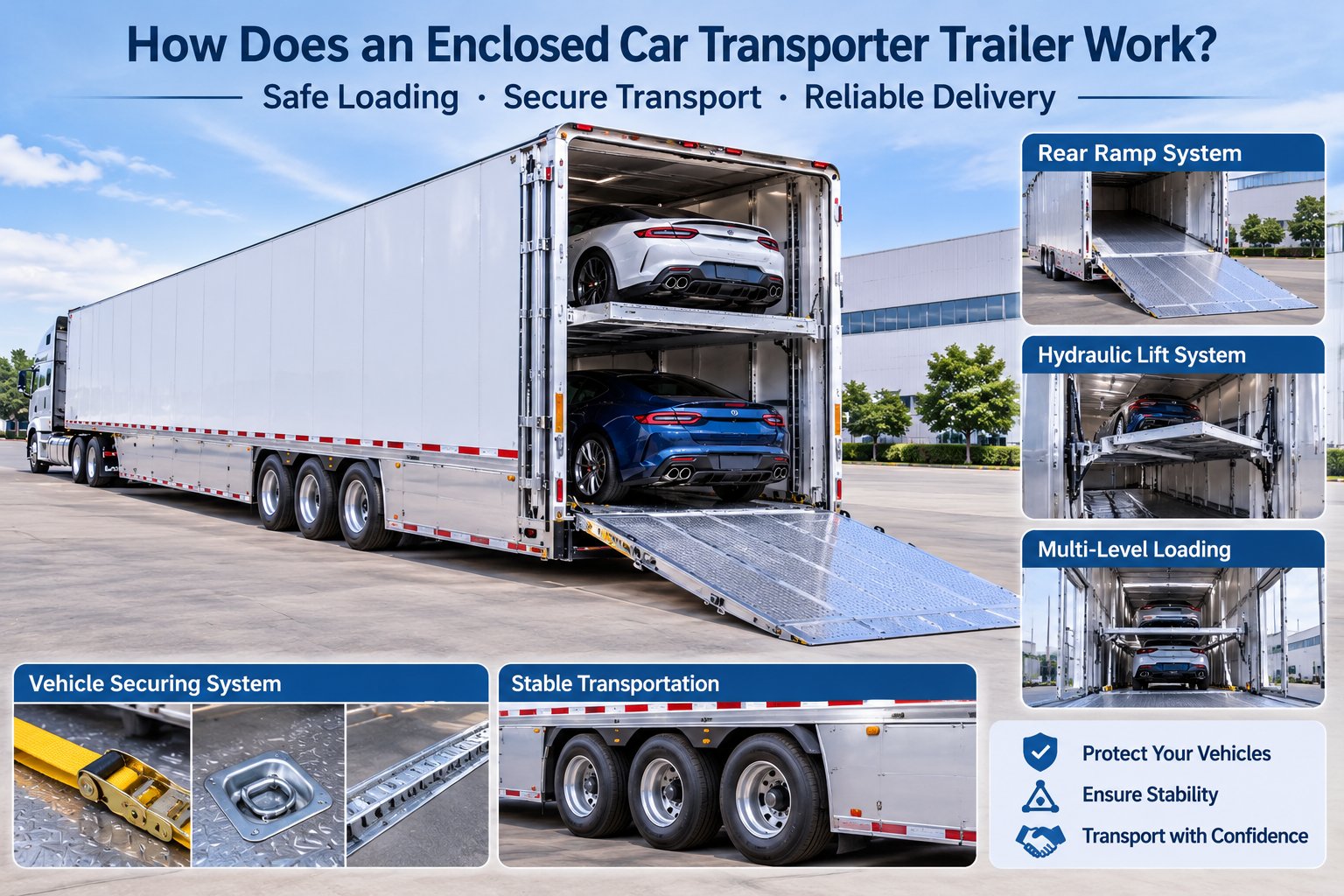
An enclosed car transporter trailer features an integrated loading system, including rear ramps, hydraulic lifts, and multi-level platforms. Secure wheel restraints and a stable multi-axle structure help ensure safe and efficient vehicle transportation while protecting valuable cars from external elements.
4.1 Loading and Unloading System
Most enclosed car transporters use one of the following loading arrangements.
Rear Ramp System
A rear ramp creates a driving surface between the ground and the trailer floor.
The vehicle moves into the trailer under its own power or is pulled using a winch.
Ramp length and loading angle must be suitable for the vehicle's ground clearance.
Hydraulic Lift System
Hydraulic lifting equipment raises or lowers a loading platform.
This arrangement can be useful for low-clearance vehicles or applications where a conventional ramp is difficult to use.
Hydraulic capacity, platform stability, and mechanical safety locks must be properly specified.
Multi-Level Loading System
Some commercial enclosed vehicle transporters use upper and lower loading platforms.
This arrangement increases vehicle carrying capacity without requiring an extremely long trailer.
However, the internal height, platform adjustment range, vehicle dimensions, and axle loading must all be carefully calculated.
4.2 Vehicle Securing System
Once the vehicle is inside, it must be secured to prevent movement.
Common equipment includes:
-
Heavy-duty wheel straps.
-
Recessed D-ring anchor points.
-
E-track or L-track systems.
-
Adjustable wheel restraints.
-
Dedicated securing rails.
The restraint arrangement should be suitable for the vehicle type and comply with the applicable cargo-securing requirements.
Straps should be positioned correctly and should not damage tires, wheels, brake components, or bodywork.
4.3 Transportation and Stability
During transportation, the trailer transfers vehicle loads through its floor and frame to the suspension, axles, and tires.
Correct weight distribution is essential.
Vehicles should be positioned according to the manufacturer's loading plan, with attention to axle loads and kingpin or hitch loading.
An enclosed body also creates a larger surface area exposed to crosswinds.
Drivers should account for wind conditions, braking distance, overall height, and road clearance.
5. Main Applications of Enclosed Car Transporter Trailers
Enclosed car transporter trailers serve businesses that require additional protection during vehicle transportation.
5.1 Luxury and Sports Car Transportation
Luxury vehicles and high-performance sports cars often have expensive paint finishes, low ground clearance, and specialized body components.
An enclosed trailer helps reduce exposure to road debris, rain, dust, and other external conditions.
This makes it suitable for transporting vehicles between dealerships, private collections, exhibitions, and storage facilities.
5.2 Classic and Vintage Car Shipping
Classic vehicles may have original paintwork, delicate trim, or components that are difficult to replace.
Exposure to moisture and road contaminants can increase the risk of deterioration.
An enclosed transport arrangement provides an additional protective barrier during transportation.
5.3 Automotive Dealership Logistics
Dealerships may need to transport premium vehicles between branches, auctions, storage locations, and customers.
An enclosed transporter can help maintain vehicle presentation during delivery.
It is particularly useful when the condition of the vehicle is an important part of the sales process.
5.4 Racing and Motorsport Transportation
Racing teams frequently move competition vehicles, spare wheels, tools, and related equipment between workshops and events.
An enclosed trailer can provide secure transportation and additional storage space.
Depending on the configuration, the interior can include tool cabinets, workbenches, lighting, and dedicated equipment storage.
5.5 Vehicle Auctions and International Vehicle Trading
Vehicle traders and auction operators may handle vehicles with different values and conditions.
Enclosed trailers can be used when additional protection and security are required.
For international buyers, the trailer configuration should also be checked against the dimensions, road regulations, and operating conditions of the destination market.
6. What Problems Does an Enclosed Car Transporter Trailer Solve?
The main reason businesses choose enclosed vehicle transport is the need to reduce risks associated with exposed transportation.
6.1 Reduces Exposure to Weather
Rain, snow, dust, sunlight, and road spray can affect vehicle appearance during transportation.
An enclosed body provides a physical barrier against normal external exposure.
It does not make the trailer completely waterproof under every condition, so proper sealing, drainage, and regular inspection remain necessary.
6.2 Helps Protect Against Road Debris
Stones, gravel, and other road debris can damage paintwork, glass, and exterior components.
Side walls and a roof help reduce direct exposure.
This is particularly important when transporting vehicles with expensive exterior finishes.
6.3 Improves Cargo Security
Vehicles carried in an enclosed trailer are less visible to people outside.
Lockable rear and side doors can also provide additional protection against unauthorized access.
However, an enclosed body should not replace proper locks, parking security, insurance, or cargo protection procedures.
6.4 Supports Specialized Vehicle Transportation
Some vehicles have very low ground clearance, special wheels, modified suspension, or valuable exterior components.
A customized loading system, appropriate ramp angle, and soft wheel straps can make transportation easier and reduce unnecessary contact with sensitive vehicle parts.
6.5 Provides Additional Storage Opportunities
Depending on the design, enclosed trailers can include storage cabinets, spare wheel holders, tool compartments, and maintenance equipment.
This can be useful for racing teams and specialized transport operators.
However, additional equipment should be included in the payload calculation.
7. Enclosed Car Transporter Trailer vs. Open Car Carrier Trailer
One of the most common purchasing questions is whether to choose an enclosed or open car transporter.
Both have advantages, but they serve different business requirements.
Enclosed Car Transporter Trailer
An enclosed design is suitable for high-value vehicles, classic cars, premium dealership deliveries, and specialty vehicle logistics.
Its main advantages include weather protection, reduced visibility of cargo, and additional security.
Its disadvantages include higher purchase costs, greater tare weight, and potentially higher fuel consumption due to additional body weight and aerodynamic resistance.
Open Car Carrier Trailer
An open carrier uses an exposed loading structure.
It is widely used for transporting standard passenger vehicles, dealership inventory, and large-volume vehicle shipments.
Its advantages include easier loading access, lower body weight, and generally lower purchase costs.
However, vehicles remain exposed to weather and road debris.
How Should Buyers Choose?
Choose an enclosed trailer when vehicle protection, privacy, and presentation are important.
Choose an open carrier when transport volume, loading flexibility, and lower operating costs are the main priorities.
The correct decision depends on the value of the vehicles, customer expectations, operating routes, and transport economics.
8. Enclosed Car Transporter Trailer vs. Standard Enclosed Cargo Trailer
Although these trailers may look similar, they are designed for different purposes.
A standard enclosed cargo trailer is mainly intended for general cargo, tools, motorcycles, and equipment.
An enclosed car transporter requires a reinforced loading floor, appropriate ramp capacity, vehicle-specific internal clearance, and dedicated securing points.
Important differences include:
-
Floor strength and load distribution.
-
Rear door dimensions and ramp design.
-
Internal width and vehicle clearance.
-
Wheel restraint and tie-down arrangements.
-
Axle ratings and payload capacity.
-
Loading angle and ground clearance requirements.
A standard cargo trailer should not automatically be considered suitable for transporting passenger cars.
Buyers should confirm that the frame, floor, axles, brakes, and loading equipment are designed for the intended vehicle weight.
9. How to Maintain an Enclosed Car Transporter Trailer
Regular maintenance helps reduce unexpected downtime and extends the working life of the trailer.
The following items should be included in a practical maintenance schedule.
9.1 Inspect the Main Frame
Check the main beams, cross members, welding joints, and supporting structures for cracks, deformation, corrosion, or loose connections.
Pay particular attention to areas around suspension mounts, axle brackets, and loading equipment.
Any structural damage should be assessed and repaired by qualified personnel.
9.2 Check the Roof and Side Panels
Inspect exterior panels, roof joints, door seals, and fasteners.
Look for water leakage, damaged sealant, loose panels, and corrosion.
Repairing small sealing problems early can prevent water damage to the interior and floor.
9.3 Maintain Axles and Suspension
Inspect suspension components, bushings, shock absorbers, air bags where fitted, and axle mounting points.
Check for abnormal tire wear, unusual noise, and changes in trailer handling.
Wheel bearings should be inspected and lubricated according to the axle manufacturer's recommendations.
9.4 Inspect the Brake System
Check brake pads or linings, brake chambers, air lines, electrical connections, and ABS or EBS components where fitted.
The braking system should be tested regularly.
Do not continue operating the trailer if a serious brake fault is identified.
9.5 Maintain the Rear Ramp and Hydraulic Equipment
Check ramp hinges, locking mechanisms, cables, springs, and support structures.
For hydraulic systems, inspect hoses, cylinders, fittings, and fluid levels.
Look for oil leakage and abnormal movement.
Hydraulic safety devices should be checked before loading vehicles.
9.6 Check Vehicle Restraint Equipment
Inspect straps, hooks, D-rings, E-track fittings, and other securing equipment.
Replace damaged straps or deformed fittings.
Never use damaged restraint equipment to secure valuable vehicles.
9.7 Clean the Interior
Remove dust, mud, oil, and other contaminants from the loading floor.
Keep drainage points clear and ensure that the interior remains dry.
A clean floor also makes it easier to identify oil leaks or structural damage.
10. Common Repairs and Troubleshooting
Even a properly manufactured trailer requires occasional repairs.
Understanding common problems helps transport operators identify issues before they cause serious downtime.
Water Leakage
Possible causes include damaged door seals, loose roof joints, cracked sealant, or damaged exterior panels.
The repair process involves identifying the leakage point, replacing damaged seals, and repairing the affected joint or panel.
Rear Ramp Difficult to Operate
Possible causes include damaged hinges, insufficient lubrication, worn springs, or hydraulic system problems.
Inspect the mechanism and replace worn components.
Hydraulic repairs should be performed after safely supporting the platform and releasing stored pressure according to the manufacturer's procedure.
Uneven Tire Wear
Possible causes include incorrect tire pressure, wheel alignment problems, overloaded axles, or suspension damage.
Check tire condition, axle alignment, loading distribution, and suspension components.
Brake Performance Problems
Brake faults may result from worn friction materials, air leaks, damaged wiring, or electronic system faults.
A qualified technician should inspect the complete braking system before the trailer returns to service.
Corrosion and Surface Damage
Road salt, moisture, and damaged coatings can contribute to corrosion.
Clean affected areas, remove loose corrosion, and apply an appropriate protective coating.
More extensive structural corrosion requires professional assessment.
11. How to Choose the Right Enclosed Car Transporter Trailer
Selecting the correct trailer requires more than comparing prices.
Professional buyers should evaluate the following factors.
11.1 Confirm Vehicle Dimensions
Prepare the maximum vehicle length, width, height, wheelbase, and ground clearance.
If multiple vehicle models will be transported, use the largest and most demanding vehicle as the starting reference.
11.2 Calculate Payload Requirements
Calculate the total weight of the vehicles and additional equipment.
Confirm that the trailer's permitted gross weight, axle ratings, tire capacity, and towing vehicle capacity are sufficient.
Do not select a trailer based only on its advertised vehicle capacity.
11.3 Select the Appropriate Loading System
A conventional rear ramp may be suitable for standard passenger cars.
Hydraulic loading equipment may be preferable for low-clearance vehicles or specialized applications.
The correct solution depends on loading frequency, vehicle design, and operating conditions.
11.4 Check the Materials
Compare steel and aluminum construction based on structural requirements, tare weight, corrosion protection, repair methods, and purchase budget.
The best material is the one that meets the operating requirements without creating unnecessary cost.
11.5 Confirm Local Regulations
For international purchases, buyers should confirm:
-
Maximum permitted vehicle and trailer dimensions.
-
Gross vehicle weight and axle-load restrictions.
-
Brake and lighting requirements.
-
Required safety equipment.
-
Registration and certification requirements.
-
Tractor and trailer compatibility.
Requirements vary between countries and regions.
A configuration suitable for one market may require modifications for another.
11.6 Evaluate the Manufacturer
Before placing an order, request technical drawings, material specifications, axle information, braking details, and manufacturing photographs.
Buyers should also confirm production lead time, warranty terms, spare parts availability, and after-sales support.
A reliable manufacturer should be able to explain the engineering decisions behind the proposed configuration.
12. Is an Enclosed Car Transporter Trailer Worth the Investment?
An enclosed car transporter generally requires a higher initial investment than a comparable open trailer.
However, purchase price is only one part of the operating cost.
For businesses transporting premium vehicles, the additional protection can support higher-value transport services and help meet customer expectations.
For general vehicle logistics, the higher tare weight and reduced payload may make an open carrier more economical.
Before purchasing, calculate the expected number of trips, average vehicle value, maintenance expenses, fuel consumption, insurance requirements, and revenue per trip.
The best investment is not necessarily the trailer with the largest capacity or the most expensive equipment.
It is the configuration that matches the actual transport business.
13. Why Choose LUCKSUN for an Enclosed Car Transporter Trailer?
Choosing a suitable enclosed car transporter requires a manufacturer that understands both trailer engineering and the practical requirements of vehicle logistics.
LUCKSUN focuses on semi-trailer and trailer component supply for international customers, offering solutions based on different transport requirements and market conditions.
For enclosed vehicle transport projects, important customization considerations include:
-
Overall trailer dimensions and internal loading space.
-
Main frame structure and material selection.
-
Axle and suspension configurations.
-
Braking systems and electrical equipment.
-
Rear ramp or hydraulic loading arrangements.
-
Interior securing systems and storage options.
-
Exterior panels, door structures, and protective finishes.
Different countries have different road regulations and vehicle transport requirements.
Therefore, a suitable specification should be developed according to the destination market, intended vehicle models, and operating conditions.
LUCKSUN can discuss customized trailer configurations and related components with importers, transport companies, vehicle dealers, and fleet operators.
For an accurate quotation, buyers should provide their destination country, required trailer dimensions, vehicle models, expected payload, axle configuration, and preferred equipment.
14. Frequently Asked Questions
Q1. What is an enclosed car transporter trailer used for?
It is used to transport passenger cars, luxury vehicles, sports cars, classic vehicles, and other automobiles inside a covered trailer. It helps reduce exposure to weather, road debris, and unauthorized access.
Q2. What size enclosed car transporter trailer do I need?
The required size depends on vehicle dimensions, loading clearance, and the number of vehicles transported. Buyers should confirm internal length, width, height, and rear door opening before selecting a model.
Q3. Can an enclosed car transporter trailer carry two cars?
Yes, certain longer or specially designed configurations can carry two vehicles. However, carrying capacity depends on internal dimensions, vehicle weight, loading arrangement, and permitted payload.
Q4. Is an enclosed car transporter better than an open car carrier?
Neither is universally better. Enclosed trailers provide additional protection and privacy, while open carriers generally offer lower purchase costs, lower tare weight, and easier loading access.
Q5. What materials are used to manufacture enclosed car transporter trailers?
Common materials include structural steel, galvanized steel, aluminum panels, and aluminum structural components. Material selection depends on strength, weight, corrosion resistance, and budget.
Q6. Does an enclosed car transporter trailer require special maintenance?
It requires regular inspection of the frame, roof, wall panels, seals, rear ramp, axles, suspension, brakes, tires, and vehicle securing equipment. Hydraulic components also require periodic inspection where fitted.
Q7. Can the trailer be customized for different countries?
Yes. Trailer dimensions, axle configurations, suspension, braking systems, lighting, and loading equipment can be specified according to customer requirements and applicable local regulations.
Q8. What information is needed to request a quotation?
Buyers should provide the destination country, vehicle dimensions, required loading capacity, trailer length, axle configuration, preferred materials, and loading system. Technical drawings or reference photographs are also helpful.
Conclusion
An enclosed car transporter trailer is a practical solution for businesses that need additional protection when transporting valuable vehicles.
Its performance depends on more than the enclosed body. Frame strength, internal dimensions, loading equipment, axle capacity, braking systems, and vehicle securing arrangements all influence its suitability.
Before purchasing, compare the trailer specifications with your actual vehicle dimensions, operating conditions, and destination market regulations.
If you are looking for an enclosed car transporter trailer for commercial vehicle shipping, contact LUCKSUN to discuss your requirements and request a customized configuration.