
Semi Trailer Landing Gear: Types, Load Capacity & Buying Guide
Semi trailer landing gear is an essential support system that allows a semi-trailer to stand independently when disconnected from its tractor unit. It plays an important role in parking, coupling, uncoupling and certain loading operations.
For trailer manufacturers, importers, fleet operators and spare parts distributors, choosing the correct landing gear involves more than comparing prices or selecting a product marked 28T. Buyers need to understand lifting capacity, static load capacity, side load resistance, mounting dimensions, operating mechanisms and compatibility with the trailer chassis.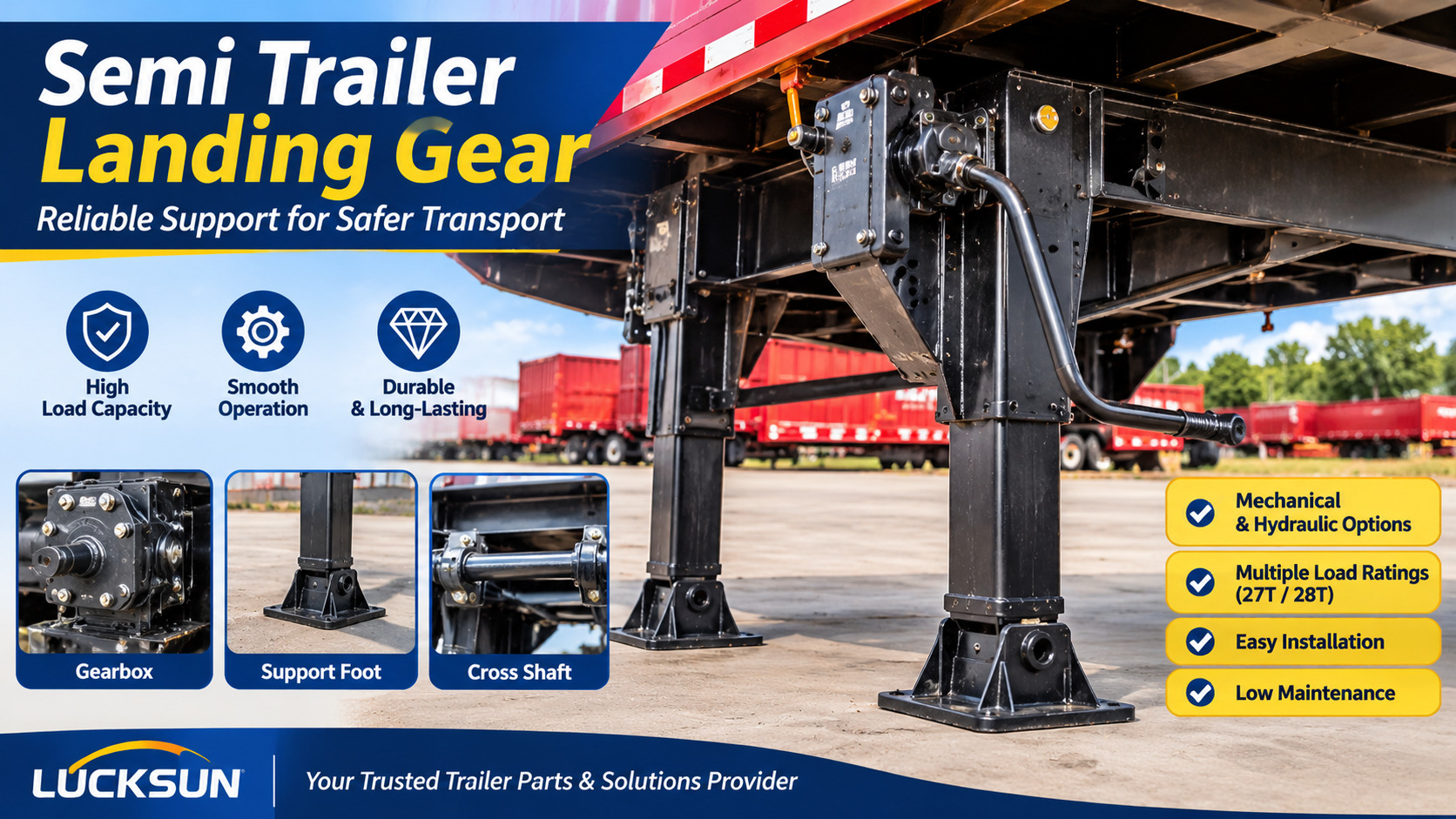
Heavy-duty semi trailer landing gear with durable support legs, gearbox and cross shaft for reliable trailer support.This image showcases heavy-duty semi trailer landing gear, highlighting the gearbox, support foot, cross shaft and mechanical support structure. Designed to support a semi-trailer when disconnected from the tractor unit, landing gear plays an important role in trailer stability, load support and daily operation. LUCKSUN provides semi-trailer parts and customized supply solutions for international trailer buyers.
Different trailers also have different support requirements. A 40ft flatbed, container chassis, dump trailer and heavy-duty lowbed may require different landing gear configurations depending on their frame height, front-end weight distribution and operating conditions.
This guide explains how semi-trailer landing gear works, compares common types, examines important technical specifications and provides practical advice for selecting replacement landing legs.
1. What Is Semi Trailer Landing Gear?
Semi trailer landing gear, also known as trailer landing legs, support legs or trailer jacks, is a mechanical or hydraulic support assembly installed near the front section of a semi-trailer.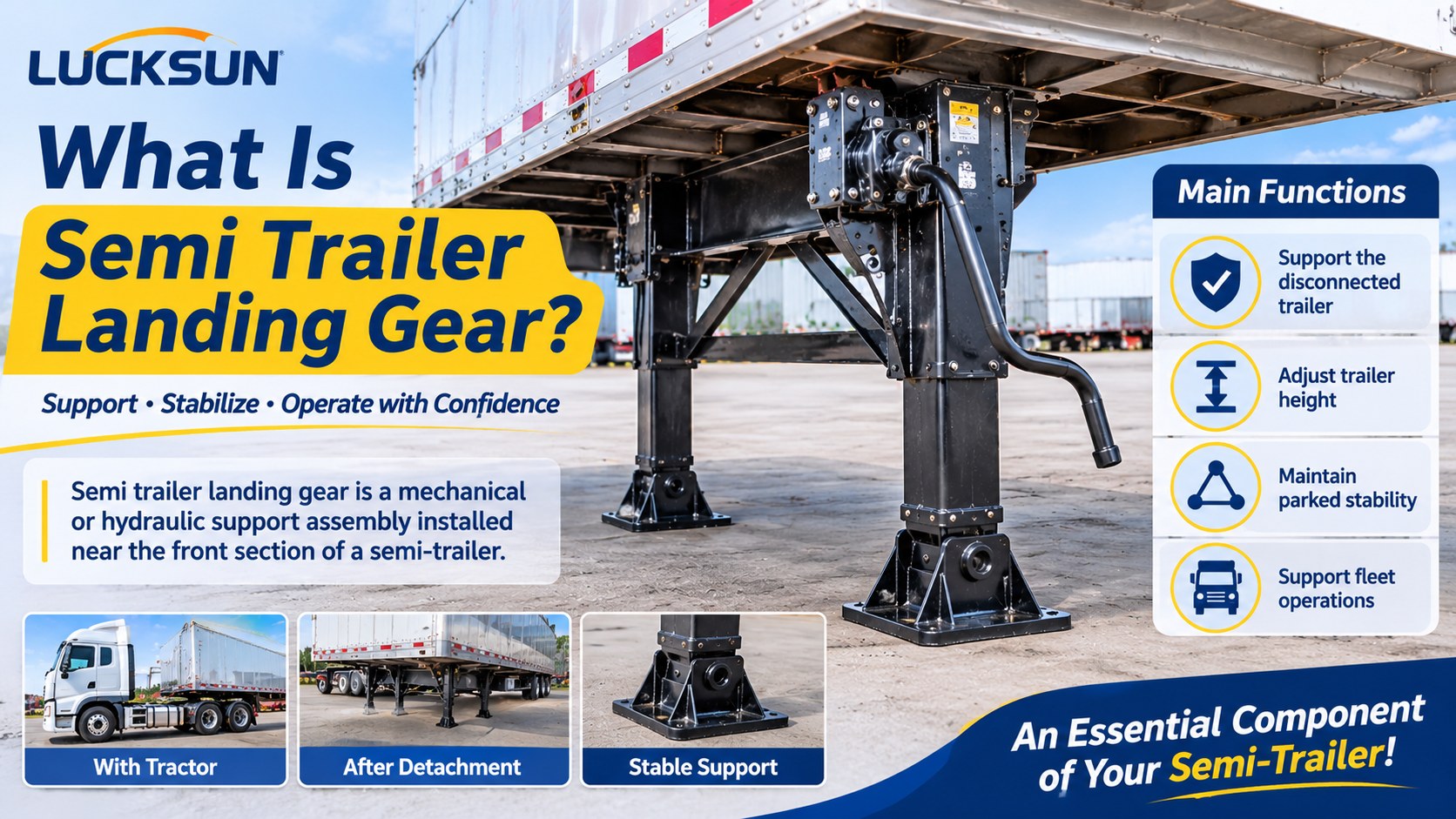
Semi trailer landing gear provides front support and stability when the trailer is disconnected from the tractor unit.This image illustrates semi trailer landing gear, also known as trailer landing legs or support legs, installed near the front section of a semi-trailer. The support assembly helps carry the trailer's front load when disconnected from the tractor, allows height adjustment during approved coupling and uncoupling procedures, and maintains stability while parked. It also highlights the importance of reliable landing gear in daily fleet operations, logistics yards and trailer parking areas. LUCKSUN supplies semi-trailer parts and components for international buyers.
A conventional semi-trailer does not have a front axle with road wheels. During transportation, its front section is supported by the tractor's fifth-wheel coupling. When the tractor disconnects, the landing gear provides the necessary front support.
A typical mechanical landing gear assembly consists of two vertical support legs connected through an operating mechanism. Depending on the design, the system may use a cross shaft to synchronize both legs.
The driver operates a crank handle or another approved control mechanism to extend or retract the support legs.
Main Functions of Trailer Landing Gear
Supporting the disconnected trailer
Landing gear carries the required front support load when the tractor is disconnected.
Adjusting trailer height
The support legs allow the trailer's front height to be adjusted during approved coupling and uncoupling procedures.
Maintaining parked stability
The two legs provide a support base that helps keep the trailer in its intended parked position.
Supporting fleet operations
Reliable landing gear makes trailer interchange and parking more practical in transport yards, distribution centers and logistics facilities.
Landing gear is therefore not simply an accessory. It is an important structural and operational component of the complete trailer.
For a basic explanation of the front support structure, see our guide to semi-trailer landing gear and front support components.
2. Main Components of a Semi-Trailer Landing Gear Assembly
A complete landing gear assembly contains several parts that work together to extend, retract and support the trailer.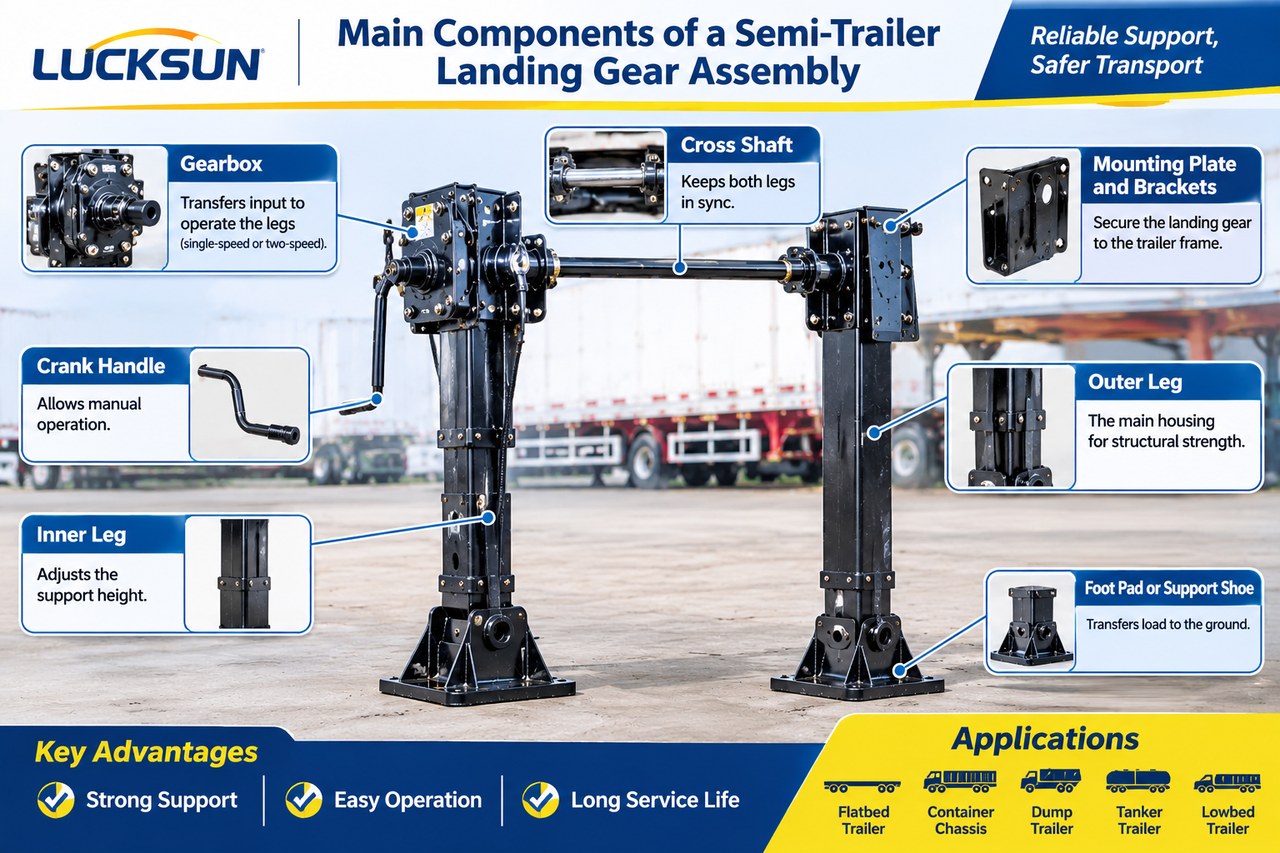
A semi-trailer landing gear assembly consists of a gearbox, crank handle, cross shaft, outer leg, inner leg, mounting brackets and foot pads.
This infographic illustrates the main components of a semi-trailer landing gear assembly and their functions. Key parts include the outer leg, inner leg, gearbox, crank handle, cross shaft, mounting plate and brackets, and foot pad or support shoe. Each component plays an important role in extending and retracting the support legs, connecting the assembly to the trailer chassis, synchronizing leg movement and transferring support force to the ground. Understanding these components helps trailer buyers identify compatible replacement parts and select a suitable landing gear assembly for different semi-trailer applications. LUCKSUN supplies semi-trailer parts and components for international markets.
Outer Leg
The outer leg is the main external housing of the support assembly. It is normally attached to the trailer chassis through mounting plates or brackets.
Its structural strength and mounting arrangement influence the overall support performance.
Inner Leg
The inner leg moves vertically inside the outer leg to adjust the support height.
The extension range should be suitable for the trailer's coupling height and normal parking conditions.
Gearbox
The gearbox transfers the driver's input through the internal gear mechanism to operate the landing legs.
Depending on the product design, it may provide single-speed or two-speed operation.
Gear quality, lubrication and internal component strength influence operating effort and service life.
Crank Handle
The crank handle provides manual input for extending or retracting the support legs.
Its length, connection design and operating direction should match the gearbox specifications.
Cross Shaft
On linked landing gear, the cross shaft connects the drive leg to the opposite leg.
It allows both legs to operate together and helps maintain synchronized movement.
Mounting Plate and Brackets
The mounting plate connects the landing gear to the trailer frame.
Its dimensions, thickness, hole arrangement and reinforcement structure must match the chassis design.
Foot Pad or Support Shoe
The foot pad transfers the support force to the ground.
Different designs are available for different ground conditions and installation requirements.
A flat foot, sand shoe or swivel-style foot may be selected according to the trailer design and operating environment.
Understanding these components is important when purchasing a complete assembly or individual replacement parts.
For more information about other related systems, visit the LUCKSUN semi-trailer parts and components guide.
3. Different Types of Semi Trailer Landing Gear
Landing gear can be classified according to its operating mechanism, leg arrangement and foot design.
Choosing the correct type depends on the trailer structure, operating frequency, required lifting performance and maintenance conditions.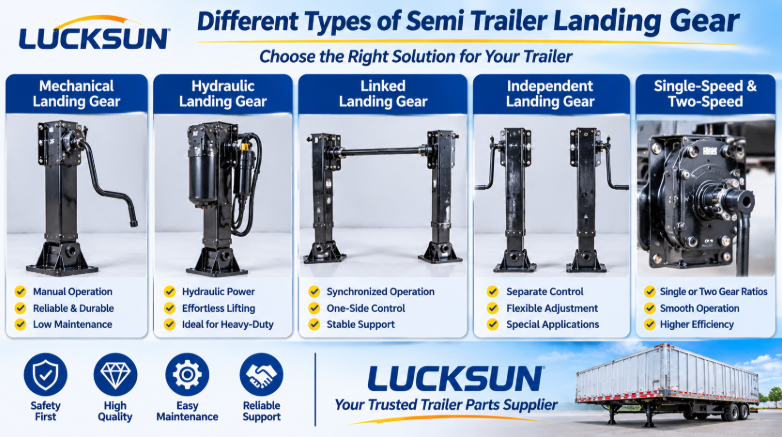
Compare mechanical, hydraulic, linked and independent landing gear systems, including single-speed and two-speed configurations for semi-trailers.
3.1 Mechanical Landing Gear
Mechanical landing gear is one of the most widely used configurations for conventional semi-trailers.
It operates through a manual crank handle and an internal gearbox.
When the handle is turned, the gear mechanism transfers movement to the support legs, extending or retracting them.
Main advantages include:
-
No separate hydraulic power source required.
-
Relatively straightforward mechanical construction.
-
Accessible inspection and maintenance.
-
Suitable for many standard commercial trailer applications.
-
Practical replacement of mechanical components when compatible parts are available.
Mechanical landing gear is commonly used on flatbed trailers, skeletal container chassis, tankers, dump trailers and other conventional semi-trailers.
It is often a practical choice for transport businesses that prioritize straightforward operation and accessible maintenance.
3.2 Hydraulic Landing Gear
Hydraulic landing gear uses hydraulic pressure to extend or retract the support mechanism.
Depending on the system design, it may be connected to the tractor's hydraulic power supply or a dedicated power unit.
Compared with manual systems, hydraulic landing gear can reduce physical operating effort and may improve turnaround time in operations involving frequent coupling and uncoupling.
However, it also introduces additional components that require inspection, including:
-
Hydraulic cylinders.
-
Hoses and connections.
-
Hydraulic valves.
-
Power supply components.
-
Seals and related fittings.
Hydraulic landing gear may be suitable for specialized heavy-duty applications or operations where frequent support adjustment is required.
The final selection should consider operating frequency, maintenance resources, system complexity and overall equipment cost.
3.3 Linked Landing Gear
Linked landing gear uses a cross shaft or connecting mechanism to synchronize both support legs.
One leg normally contains the main gearbox, while the opposite leg follows through the connecting shaft.
Its advantages include:
-
Both legs can be operated from one side.
-
More convenient synchronized adjustment.
-
Suitable for many standard trailer chassis designs.
-
Straightforward operating procedures.
Buyers should check shaft length, gearbox position, connection design and installation alignment before ordering a replacement assembly.
3.4 Independent Landing Gear
Independent landing gear allows each support leg to be operated separately.
This arrangement may be considered for specialized trailers or chassis designs that require individual adjustment.
However, the operator must follow the manufacturer's procedure to maintain appropriate support balance.
Independent operation should not be treated as interchangeable with a linked system without checking the trailer's structural and operating requirements.
3.5 Single-Speed and Two-Speed Landing Gear
Mechanical landing gear is also available with different gear arrangements.
Single-speed landing gear
A single-speed system uses one gear ratio throughout the operating range.
It provides a relatively straightforward mechanism and may be suitable for applications where operating speed and manual effort are within acceptable limits.
Two-speed landing gear
A two-speed system provides different gear ratios.
The lower-speed mode generally provides greater mechanical advantage, making it suitable for lifting operations where more turning effort is required.
The higher-speed mode allows faster leg movement when resistance is relatively low, such as approaching the ground or retracting unloaded legs.
The exact gear ratios and operating performance depend on the selected product.
Operators should follow the manufacturer's instructions and use the appropriate gear for each operating condition.
4. Static Load Capacity vs. Lifting Capacity vs. Side Load Capacity
One of the most important considerations when purchasing semi-trailer landing gear is understanding its load ratings.
Buyers often see specifications such as 25T, 27T or 28T and assume that these figures represent the total weight the landing gear can safely support.
This is not necessarily correct.
Three different load ratings need to be considered.
Lifting Capacity
Lifting capacity refers to the load that the landing gear is designed to raise through its operating mechanism under specified test conditions.
It is particularly relevant when adjusting the trailer's front height during coupling and uncoupling.
A higher lifting rating does not automatically mean that the product has the same static or lateral load rating.
Static Load Capacity
Static load capacity refers to the vertical load that the landing gear assembly can support while the trailer is stationary under specified conditions.
This is important when the trailer is parked without the tractor.
The support capacity should be evaluated against the actual front-end reaction load, not simply the trailer's total gross weight.
Side Load Capacity
Side load capacity describes the landing gear's ability to withstand lateral forces.
These forces can occur during imperfect coupling, uneven support conditions or other situations involving sideways loading.
For this reason, side load performance should not be overlooked when selecting landing gear for demanding operating environments.
Comparison of the Three Ratings
| Parameter | Main Function | Purchasing Importance |
|---|---|---|
| Lifting Capacity | Raises or lowers the trailer front | Determines lifting capability |
| Static Load Capacity | Supports the stationary trailer | Determines vertical support capability |
| Side Load Capacity | Resists lateral forces | Important for structural stability |
A useful comparison can be seen in published commercial landing gear specifications.
For example, TMC lists a product with 28,000 kg/pair capacity and 80,000 kg/pair static load capacity. These are separate ratings for a particular product, not universal specifications for all 28T landing gear.
Always compare the manufacturer's technical datasheet and test conditions before making a purchasing decision.
5. What Does 27T or 28T Landing Gear Mean?
The terms 27T and 28T are commonly used in the commercial trailer parts market to identify landing gear lifting-capacity classes.
However, product labels should not replace detailed technical specifications.
Two products carrying the same nominal lifting rating may have different:
-
Static load capacities.
-
Side load capacities.
-
Maximum lifting strokes.
-
Retracted heights.
-
Gear ratios.
-
Mounting plate dimensions.
-
Overall weights.
-
Foot configurations.
For example, a buyer comparing two 28T landing gear assemblies should check more than the headline lifting rating.
The gearbox design, support leg structure and mounting configuration can influence whether the product is suitable for the intended trailer.
Example Specification Comparison
| Technical Parameter | What to Confirm |
|---|---|
| Lifting Capacity | Rated lifting load per pair |
| Static Load | Permitted static support load per pair |
| Side Load | Rated lateral load |
| Maximum Lift | Available extension stroke |
| Retracted Height | Minimum installation height |
| Gear Type | Single-speed or two-speed |
| Operating Side | Left or right drive arrangement |
| Foot Type | Flat, sand, swivel or other design |
| Mounting Plate | Dimensions and hole arrangement |
| Standard Weight | Weight of the complete assembly |
Do not assume that all 27T or 28T landing gear products have identical dimensions or performance.
6. How to Choose the Right Landing Gear for Your Semi-Trailer
The correct landing gear should be selected according to the trailer's actual design and working conditions.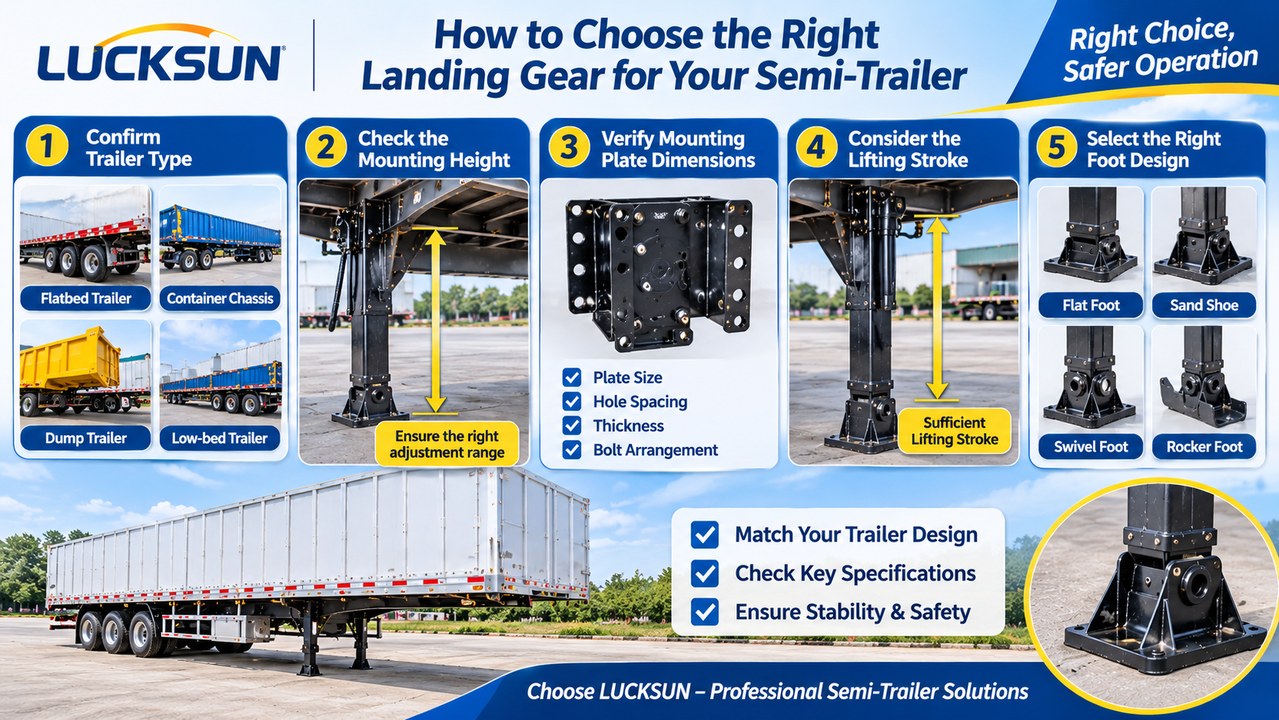
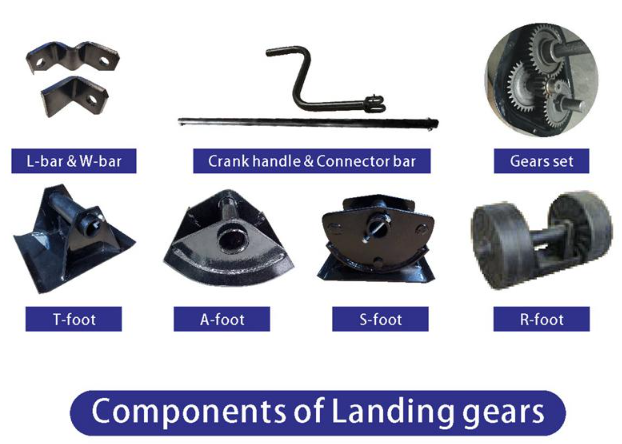
Five important factors to consider when selecting semi-trailer landing gear: trailer type, mounting height, mounting plate dimensions, lifting stroke and foot design.This infographic explains how to choose the right landing gear for a semi-trailer. It highlights five important selection factors: confirming the trailer type, checking the mounting height, verifying mounting plate dimensions, considering the required lifting stroke and selecting a suitable foot design. It also illustrates different trailer applications, including flatbed trailers, skeletal container chassis, dump trailers and low-bed semi-trailers, along with common support foot options such as flat feet, sand shoes, swivel feet and rocker feet. Buyers should confirm the complete landing gear specifications and compatibility with the trailer chassis before purchasing. LUCKSUN provides semi-trailer parts and customized supply solutions for international buyers.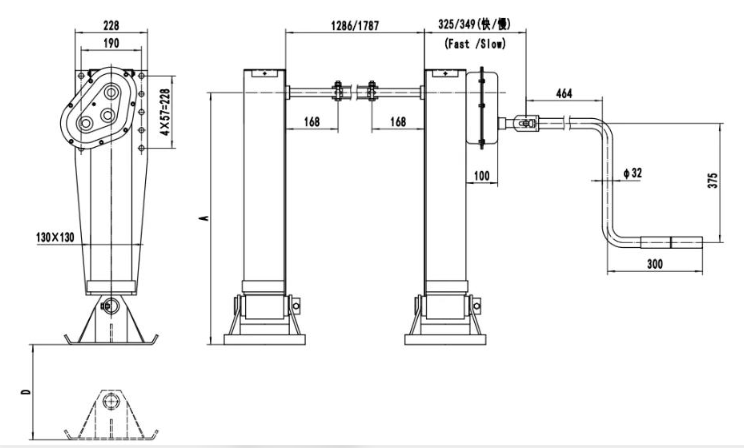
How to Choose the Right Landing Gear for Your Semi-Trailer
6.1 Confirm the Trailer Type
Different trailer types may require different landing gear arrangements.
Flatbed semi-trailers
Flatbeds commonly use conventional mechanical landing gear to support the front chassis when parked.
The installation height and support capacity should match the trailer frame and intended operating load.
Explore LUCKSUN flatbed semi-trailers.
Skeletal container chassis
Container chassis require landing gear compatible with the front chassis structure and the expected support requirements.
The mounting arrangement should be confirmed before replacement.
Dump semi-trailers
Dump trailers need landing gear compatible with their chassis design and front-end support requirements.
The support assembly should be selected as part of the complete trailer engineering configuration.
See the LUCKSUN dump and tipper semi-trailer range.
Low-bed semi-trailers
Lowbed trailers may have different chassis heights and structural layouts.
The required landing gear height and available extension range should therefore be checked carefully.
6.2 Check the Mounting Height
Mounting height is one of the most important dimensions when selecting replacement landing gear.
The selected assembly must fit the available installation space and provide the necessary adjustment range.
Buyers should measure:
-
Distance from the mounting reference point to the ground.
-
Required extended height.
-
Retracted height.
-
Available vertical clearance.
-
Position of nearby chassis components.
Incorrect mounting height may make coupling difficult or reduce the available support adjustment range.
6.3 Check the Mounting Plate Dimensions
The mounting plate connects the landing gear to the trailer chassis.
Before purchasing, confirm:
-
Plate length and width.
-
Plate thickness.
-
Mounting hole diameter.
-
Hole spacing.
-
Number of mounting holes.
-
Bolt arrangement.
-
Mounting position.
Even if two products have similar lifting capacities, their mounting plates may not be interchangeable.
Do not modify important chassis mounting structures without an appropriate engineering assessment.
6.4 Consider the Required Lifting Stroke
The lifting stroke determines how far the support leg can extend.
The required stroke depends on:
-
Trailer coupling height.
-
Chassis ground clearance.
-
Parking surface conditions.
-
Landing gear installation position.
-
Tractor fifth-wheel height.
A product with insufficient stroke may not provide the required adjustment range.
Excessive extension beyond the manufacturer's permitted operating range should also be avoided.
6.5 Select the Appropriate Foot Design
The foot transfers the support load to the ground.
Common options include:
-
Flat foot: suitable for specified firm and relatively level surfaces.
-
Sand shoe: provides a wider contact area for suitable softer ground conditions.
-
Swivel foot: accommodates certain ground-angle and installation requirements.
-
Rocker foot: allows limited movement according to its design.
The correct foot depends on the ground surface, support load and trailer configuration.
A larger foot does not automatically increase the landing gear's rated capacity. The complete assembly must be designed and tested for the intended load.
7. Important Installation Considerations
Correct installation is essential for maintaining landing gear performance.
Even a well-manufactured support assembly can experience premature damage if its mounting arrangement is unsuitable.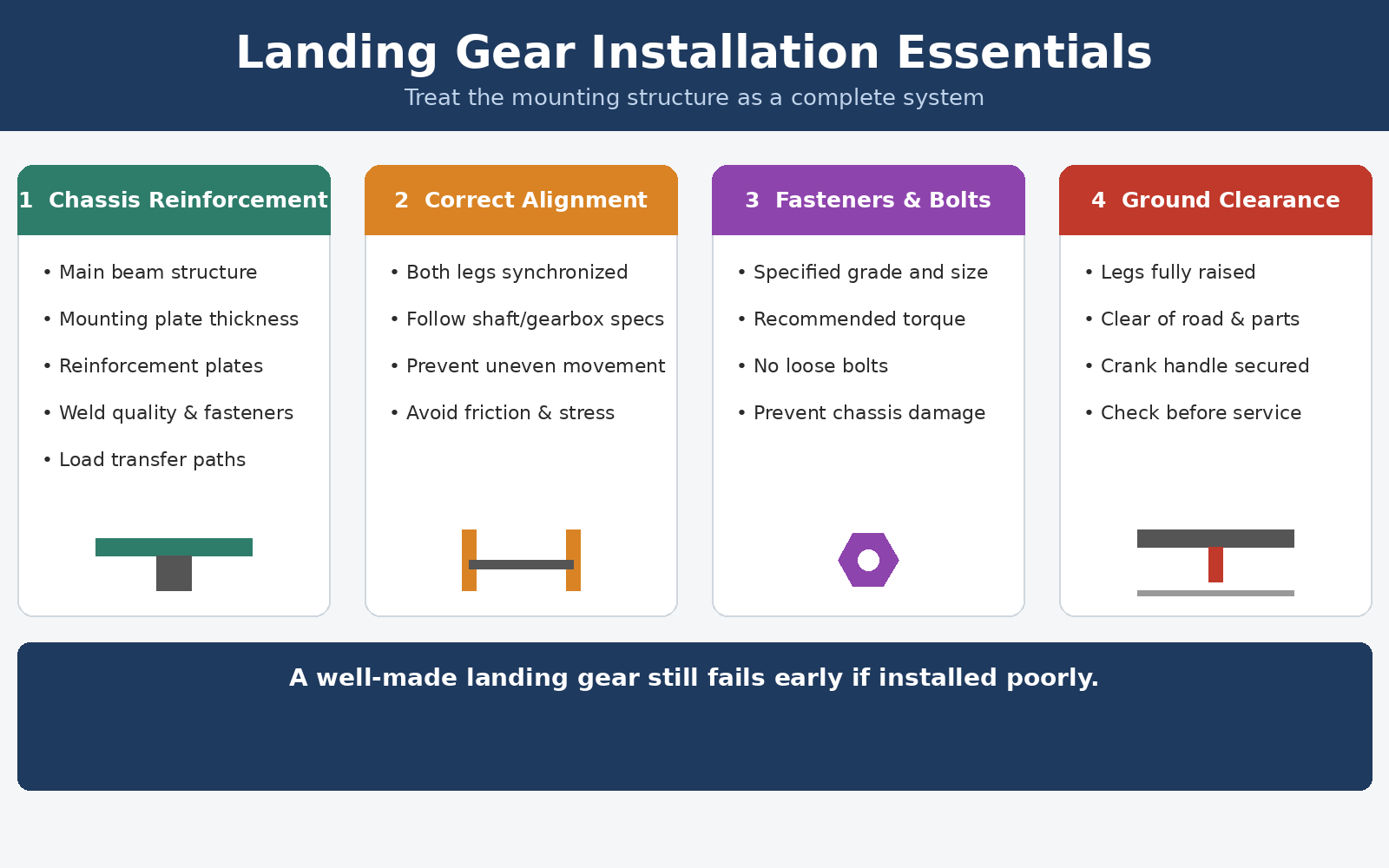
Landing Gear Installation Essentials
Chassis Reinforcement
The landing gear mounting area must be strong enough to transfer the support forces into the trailer frame.
Reinforcement design should consider:
-
Main beam structure.
-
Mounting plate thickness.
-
Local reinforcement plates.
-
Weld quality.
-
Fastener arrangement.
-
Load transfer paths.
The mounting structure should be checked as a complete system rather than treating the landing gear as an isolated component.
Correct Alignment
For linked landing gear, both legs should operate in a synchronized manner.
The cross shaft and gearbox connections should be installed according to the manufacturer's instructions.
Misalignment can cause uneven movement, additional friction and unnecessary stress on the internal mechanism.
Fasteners and Mounting Bolts
All mounting fasteners should match the manufacturer's specified grade, size and installation requirements.
Use the recommended tightening torque.
Loose mounting bolts can lead to movement between the landing gear and chassis, potentially damaging the mounting area.
Ground Clearance
When fully retracted, the landing gear must have sufficient clearance from the road and nearby trailer components.
Before returning the trailer to service, confirm that the legs are completely raised and the crank handle is secured in its designated position.
8. Common Landing Gear Problems and How to Identify Them
Regular inspection helps prevent operating delays and more serious component damage.
Landing Gear Is Difficult to Turn
Possible causes include:
-
Insufficient lubrication.
-
Worn internal gears.
-
Damaged gearbox components.
-
Bent or misaligned support legs.
-
Excessive load during operation.
Inspect the mechanism and confirm that the trailer is being operated according to the manufacturer's instructions.
One Landing Leg Moves Faster Than the Other
On linked systems, this may indicate a problem with the connecting shaft, gearbox or internal mechanism.
Check the shaft connections, alignment and condition of both legs.
Do not continue operating a system that shows significant uneven movement.
Landing Gear Makes Unusual Noise
Grinding, clicking or abnormal mechanical noise may indicate internal wear, poor lubrication or damaged components.
The gearbox and associated connections should be inspected.
Support Foot Is Bent or Damaged
Foot damage may result from uneven ground, excessive loading, side impact or incorrect positioning.
Inspect the foot and the lower section of the support leg.
Replace damaged components according to the manufacturer's requirements.
Mounting Plate or Chassis Area Shows Cracks
Visible cracks around the mounting area should be treated seriously.
The trailer should be inspected by qualified personnel before the landing gear is used again.
Repair procedures should be based on an engineering assessment of the affected structure.
9. Semi-Trailer Landing Gear Maintenance Checklist
Landing gear maintenance should be included in the trailer's regular inspection program.
Daily or Pre-Operation Checks
-
Check both support legs for visible damage.
-
Inspect the foot pads.
-
Check the crank handle and operating mechanism.
-
Confirm that the legs retract completely before travel.
-
Look for visible movement around mounting plates.
Periodic Maintenance
-
Inspect gearbox operation.
-
Check lubrication according to manufacturer recommendations.
-
Inspect the cross shaft and connection points.
-
Check mounting bolts and brackets.
-
Look for cracks or deformation.
-
Inspect the inner and outer legs for corrosion and damage.
-
Check the foot pads for excessive wear.
Lubrication
Lubrication requirements vary according to gearbox and landing gear design.
Use the lubricant specified by the manufacturer and follow the recommended maintenance intervals.
Avoid using unsuitable grease or lubricants that may affect seals and internal components.
For wider trailer maintenance information, read the LUCKSUN semi-trailer maintenance checklist.
10. How to Replace Semi-Trailer Landing Gear
When the existing landing gear is damaged or worn beyond repair, a compatible replacement assembly may be required.
However, replacing landing gear is not simply a matter of choosing another product with the same rated capacity.
Step 1: Identify the Existing Model
Record the original brand, model number and available identification markings.
Product drawings and manufacturer documentation can help confirm compatibility.
Step 2: Measure the Existing Assembly
Measure the mounting plate, mounting hole spacing, retracted height, extended height and overall dimensions.
Photographs from the front, side and bottom can help clarify the installation arrangement.
Step 3: Confirm the Gearbox and Drive Arrangement
Check whether the existing assembly is:
-
Single-speed or two-speed.
-
Linked or independent.
-
Left-hand or right-hand drive.
-
Compatible with the existing cross shaft.
The replacement must match the intended operating configuration.
Step 4: Confirm the Load Ratings
Check lifting capacity, static load capacity and side load capacity.
The selected replacement should meet the required ratings for the actual trailer application.
Step 5: Check the Foot and Mounting Options
Confirm the required foot design, mounting plate, brackets and connection hardware.
If the replacement involves changes to the chassis structure, obtain appropriate engineering approval.
Step 6: Arrange Professional Installation
Landing gear supports a heavy semi-trailer and should not be replaced using improvised lifting or support arrangements.
The trailer must be secured using suitable approved equipment and the replacement should be installed by qualified personnel following the relevant procedures.
11. What Should Importers Check Before Purchasing Landing Gear?
For international trailer importers and spare parts distributors, accurate technical information helps prevent ordering errors.
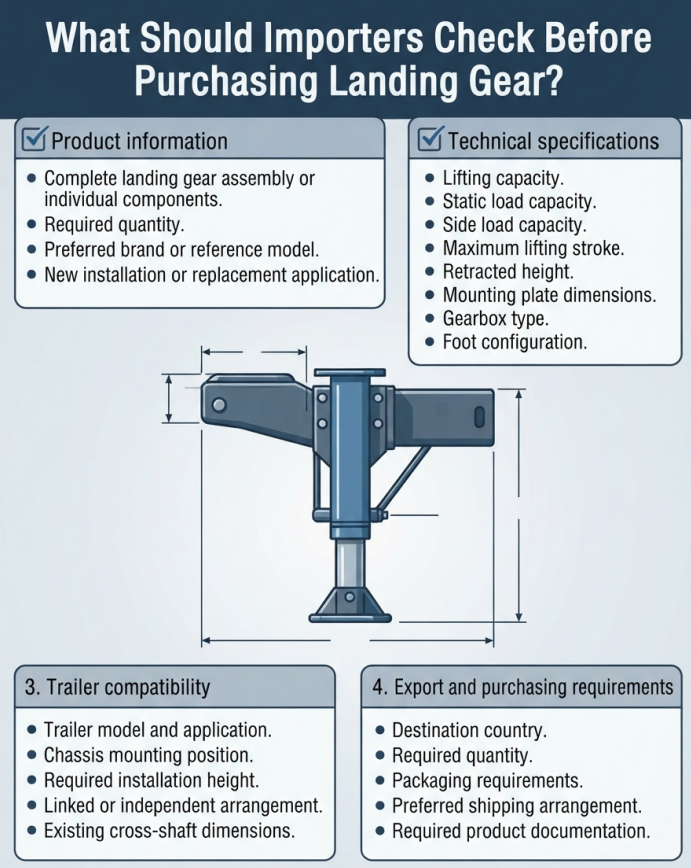
Before requesting a quotation, prepare the following details.
Product information
-
Complete landing gear assembly or individual components.
-
Required quantity.
-
Preferred brand or reference model.
-
New installation or replacement application.
Technical specifications
-
Lifting capacity.
-
Static load capacity.
-
Side load capacity.
-
Maximum lifting stroke.
-
Retracted height.
-
Mounting plate dimensions.
-
Gearbox type.
-
Foot configuration.
Trailer compatibility
-
Trailer model and application.
-
Chassis mounting position.
-
Required installation height.
-
Linked or independent arrangement.
-
Existing cross-shaft dimensions.
Export and purchasing requirements
-
Destination country.
-
Required quantity.
-
Packaging requirements.
-
Preferred shipping arrangement.
-
Required product documentation.
If you are sourcing several trailer components together, explore the LUCKSUN semi-trailer parts collection for related axle, suspension and braking products.
Other components may include trailer axle kits, leaf springs and trailer ABS components.
12. Why Landing Gear Should Be Considered as Part of the Complete Trailer System
Landing gear does not operate independently of the trailer chassis.
Its mounting position, support height and load transfer arrangement are connected to the overall trailer structure.
For example, a replacement assembly may have an adequate lifting rating but still be unsuitable if its mounting plate does not match the chassis.
Similarly, a landing gear assembly with sufficient static capacity may not provide the required extension range for a particular trailer.
This is why professional component selection should consider:
-
Landing gear load ratings.
-
Chassis mounting strength.
-
Support leg geometry.
-
Ground-contact conditions.
-
Operating frequency.
-
Maintenance resources.
-
Availability of compatible replacement components.
When purchasing complete trailers, the landing gear specification should also be included in the technical confirmation process.
LUCKSUN supplies semi-trailers and related components for international commercial vehicle markets. Customers can discuss different trailer configurations, component requirements and replacement parts according to their applications.
For more information about complete trailer solutions, visit the LUCKSUN official website.
13. Frequently Asked Questions About Semi Trailer Landing Gear
Q1. What is the purpose of landing gear on a semi-trailer?
Landing gear supports the front of a semi-trailer when it is disconnected from the tractor. It also allows the trailer's front height to be adjusted during approved coupling and uncoupling operations.
Q2. What is the difference between 27T and 28T landing gear?
These figures commonly refer to nominal lifting-capacity classes. Buyers should compare the actual lifting rating, static load capacity, side load capacity and product specifications rather than relying only on the model label.
Q3. What is the difference between static load and lifting capacity?
Lifting capacity refers to the load the landing gear can raise under specified conditions. Static load capacity refers to the vertical load it can support while stationary. These are different engineering ratings.
Q4. Is mechanical or hydraulic landing gear better?
Mechanical landing gear is a practical option for many standard semi-trailers because of its straightforward structure and manual operation. Hydraulic landing gear may be suitable for specialized operations requiring reduced manual effort or frequent adjustment. The correct choice depends on the trailer and operating environment.
Q5. What is two-speed landing gear?
Two-speed landing gear has high-speed and low-speed operating ratios. Low gear provides greater mechanical advantage for lifting, while high gear allows faster movement under lower resistance.
Q6. How do I know if replacement landing gear will fit my trailer?
Check the original model, mounting plate dimensions, hole spacing, installation height, lifting stroke, gearbox arrangement, cross shaft and foot design. A product with the same lifting rating is not necessarily a direct replacement.
Q7. Can landing gear be installed on any semi-trailer?
Landing gear must be compatible with the trailer chassis, mounting position, support requirements and intended operating conditions. Not every assembly fits every trailer design.
Q8. How often should trailer landing gear be inspected?
Visual checks should be included in regular pre-operation inspections. More detailed inspections and lubrication should follow the component manufacturer's maintenance schedule and actual operating conditions.
Q9. What causes semi-trailer landing gear failure?
Common causes include overloading, incorrect operation, insufficient lubrication, worn gearbox components, poor alignment, damaged mounting structures and unsuitable ground conditions.
Q10. What information should I provide when requesting a landing gear quotation?
Provide the required lifting and static load ratings, mounting dimensions, extension range, gearbox type, foot design, quantity and trailer application. Photographs and an existing product model number are also useful.
Conclusion
Semi-trailer landing gear is a critical support component that directly affects trailer parking, coupling operations and maintenance requirements.
Selecting the correct assembly requires more than comparing 27T or 28T product labels. Buyers should evaluate lifting capacity, static load capacity, side load resistance, installation dimensions, gearbox design and compatibility with the trailer chassis.
For importers, fleet operators and spare parts distributors, accurate technical confirmation before purchasing can reduce replacement errors and unnecessary maintenance costs.
If you are sourcing heavy-duty semi-trailer landing gear or other trailer components, contact LUCKSUN with your required specifications, product photographs or reference model. Our team can discuss suitable configurations and prepare a quotation according to your requirements.