
Heavy Duty Low-Maintenance 3 Axle Skeleton Trailer: A Practical Guide for Container Transport Flee
A heavy-duty 3 axle skeleton trailer is more than a container-carrying chassis. For transport companies, fleet operators, port logistics providers, and commercial vehicle importers, it is a long-term investment that directly affects operating costs, transportation efficiency, vehicle availability, and maintenance requirements.
When purchasing a low-maintenance 3 axle skeleton trailer, buyers should look beyond the initial purchase price. Frame strength, axle quality, suspension design, braking performance, corrosion protection, and the availability of replacement parts all influence the total cost of ownership.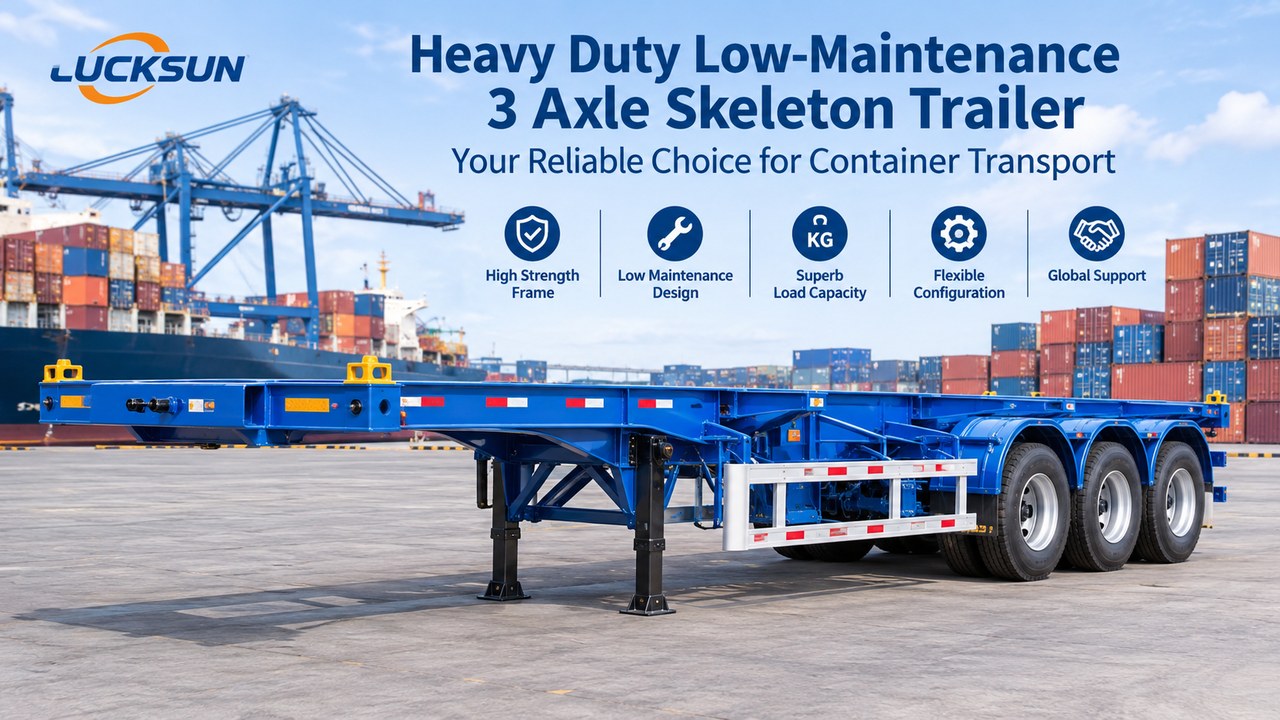
Heavy Duty Low-Maintenance 3 Axle Skeleton Trailer
LUCKSUN heavy duty 3 axle skeleton trailer with reinforced steel chassis for 40ft container transportation.
LUCKSUN heavy-duty 3 axle skeleton trailer designed for reliable 40ft container transportation. Featuring a reinforced steel chassis, durable axle configuration, practical container twist locks, and maintenance-friendly structural design, this skeletal semi-trailer is suitable for port logistics, container transport fleets, and international freight operations.
LUCKSUN supplies heavy-duty skeletal container chassis designed for international container transportation. Available configurations include 2-axle and 3-axle models, with customizable axle brands, suspension systems, container locking positions, tires, and braking components.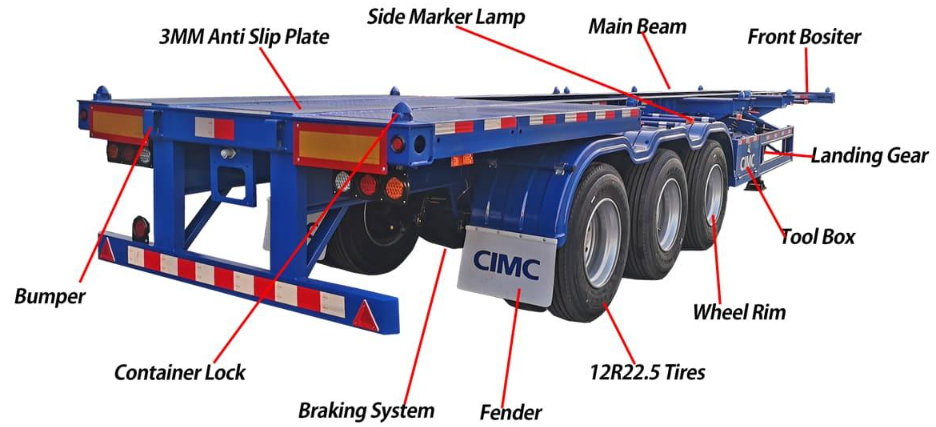
Main structure and components of a heavy-duty 3 axle skeleton trailer
This guide explains how to evaluate a heavy-duty low-maintenance skeletal trailer, which configurations matter most, and how to select a suitable 3 axle container chassis for your operating environment.
1. What Makes a Heavy Duty 3 Axle Skeleton Trailer Different?
A skeleton trailer, also called a skeletal semi-trailer or container chassis trailer, is designed specifically for transporting ISO shipping containers.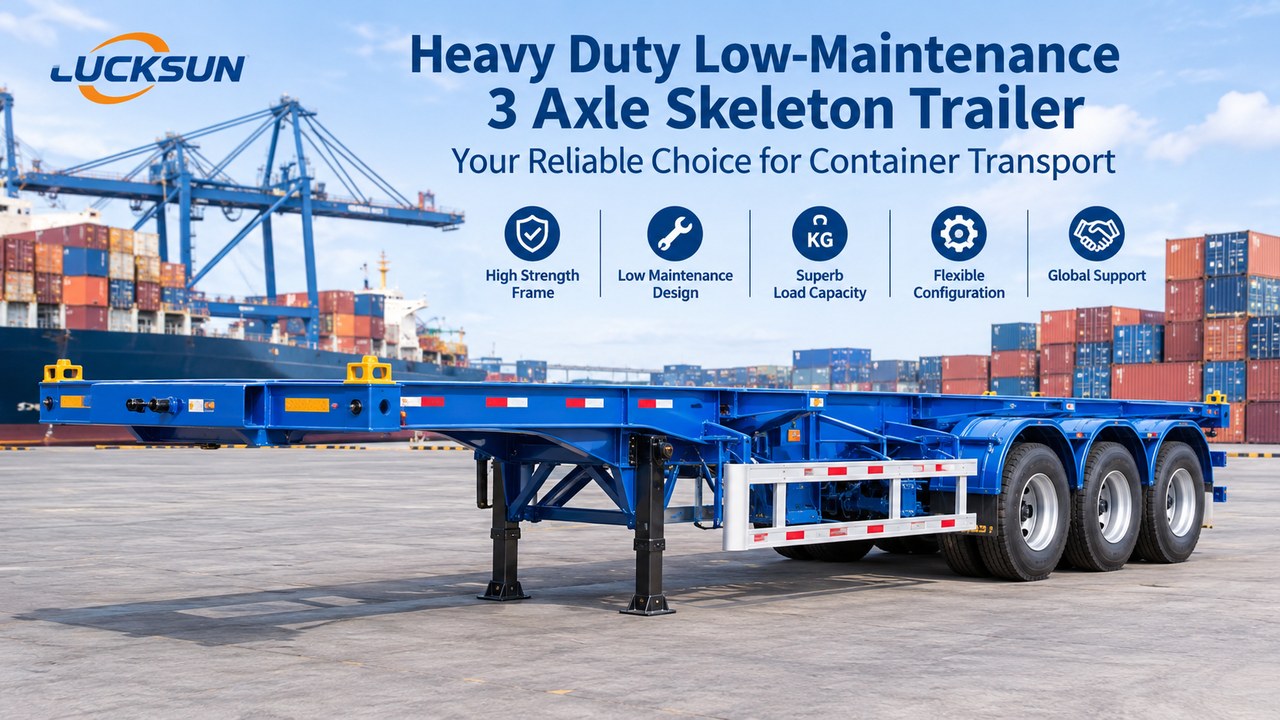
3 Axle Skeleton Trailer Structure and Main Components
A heavy-duty 3 axle skeleton trailer is designed for efficient ISO container transportation. Its open-frame structure features high-strength steel main beams, reinforced cross-members, three heavy-duty axles, mechanical or air suspension, ISO-compatible container twist locks, pneumatic braking components, and heavy-duty landing gear. The combination of these components provides reliable container support, practical maintenance access, and flexible configurations for 40ft container transportation. LUCKSUN offers customized skeletal semi-trailer solutions for different transport requirements and international markets.
Unlike a conventional flatbed trailer, it does not require a complete loading platform. Instead, its open-frame structure supports the container through strategically positioned cross-members and twist-lock assemblies.
A typical 3 axle skeleton trailer consists of:
-
High-strength steel main beams
-
Reinforced cross-members and connecting brackets
-
Three heavy-duty axles
-
Mechanical or air suspension
-
ISO-compatible container twist locks
-
Pneumatic braking components
-
Heavy-duty landing gear
-
Kingpin and fifth-wheel connection
-
Wheels, tires, and electrical lighting systems
The three-axle arrangement distributes the supported load across multiple axle positions. This makes it a practical configuration for many container transportation operations, subject to the trailer's engineering design and local road regulations.
For buyers comparing different chassis structures, our 40ft Skeletal Container Chassis Trailer provides a reference for available 2-axle and 3-axle configurations.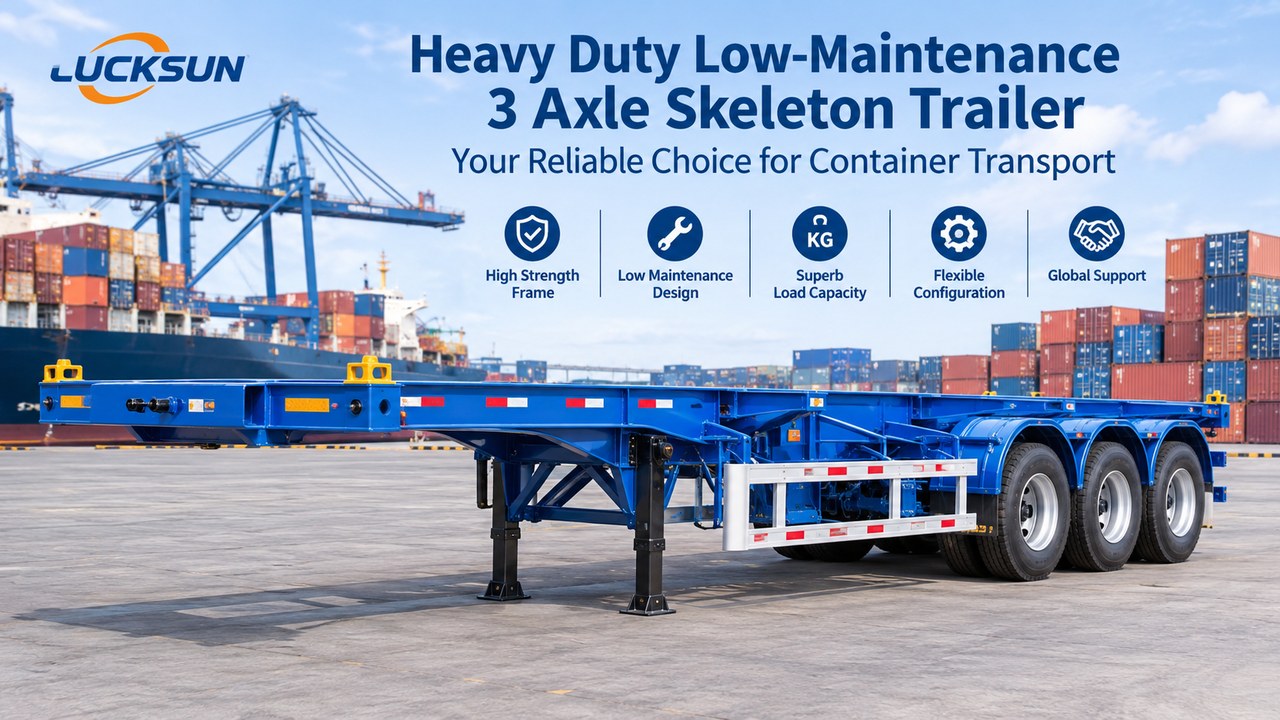
3 axle skeleton trailer with steel frame, twist locks, heavy-duty axles and suspension
2. Why Low Maintenance Matters in Container Transportation
For a commercial transport fleet, maintenance costs are not limited to spare parts and workshop labor.
Unexpected repairs can also result in:
-
Vehicle downtime
-
Missed container delivery schedules
-
Additional labor and towing expenses
-
Reduced fleet utilization
-
Delays in port and warehouse operations
A trailer that costs less initially may become more expensive if its axles, suspension, brakes, or structural components require frequent replacement.
A genuinely low-maintenance skeleton trailer should therefore be evaluated through several interconnected factors.
2.1 Reliable Axle and Wheel-End Components
Axles carry the trailer's supported load and transfer forces between the chassis and the road surface.
For a heavy-duty 3 axle skeletal trailer, buyers should examine:
-
Axle-rated capacity and compatibility with the intended load
-
Axle beam material and structural design
-
Wheel hub and bearing quality
-
Brake drum or disc specifications
-
Availability of replacement components
-
Compatibility with locally available service facilities
FUWA and BPW are commonly selected axle options for commercial trailers, depending on the market and buyer's requirements.
LUCKSUN offers axle configurations with FUWA, BPW, and other optional specifications.
The important consideration is not simply the brand name. The complete axle assembly must match the trailer's gross weight, suspension geometry, braking system, and expected operating conditions.
For more technical information, read our Trailer Axles Explained: Types, Components, Capacity and How to Choose.
2.2 Simplified Suspension Maintenance
Suspension has a direct influence on chassis stability, tire wear, and component durability.
Two common configurations are mechanical leaf spring suspension and air suspension.
Mechanical Suspension
Mechanical suspension is widely used in heavy-duty commercial trailers because of its relatively simple construction.
Its main advantages include:
-
Straightforward inspection procedures
-
Relatively simple replacement of worn components
-
Practical maintenance in markets with limited specialized service facilities
-
Suitability for many heavy-duty transportation applications
However, spring leaves, bushings, U-bolts, hangers, and equalizer components still require periodic inspection.
Air Suspension
Air suspension uses air springs and associated control components to support the trailer.
Depending on the design, it can provide:
-
Improved vibration isolation
-
Better ride characteristics
-
Adjustable suspension height
-
Reduced transmission of certain road impacts
Air suspension also introduces additional components, such as air bags, height control valves, air lines, and shock absorbers, which require inspection.
The best option depends on road conditions, operating frequency, service availability, budget, and local regulations.
For fleets operating on rough roads or in areas where simple repairs are a priority, mechanical suspension may be a practical choice. For operations emphasizing ride quality and specific vehicle requirements, air suspension may be more appropriate.
2.3 Durable Braking System
A reliable braking system is essential for a fully loaded container trailer.
Depending on the application, a 3 axle skeleton trailer may use:
-
Heavy-duty drum brakes
-
Disc brakes
-
Pneumatic brake chambers
-
ABS
-
EBS
The braking configuration must match the axle specification, tractor connection, intended operating environment, and applicable regulations.
Routine inspections should cover brake lining or pad wear, brake drums or discs, chambers, air hoses, valves, electrical connections, and adjustment mechanisms.
A well-matched braking system helps reduce uneven wear and avoid unnecessary component replacement.
2.4 Corrosion Protection for Long-Term Service
Container trailers often operate in demanding environments, including coastal ports, humid regions, dusty roads, and areas exposed to rain and road contaminants.
Corrosion can gradually affect the chassis, mounting brackets, cross-members, and exposed hardware.
For this reason, surface preparation and coating quality should be considered during purchasing.
LUCKSUN uses an electrophoretic coating and powder-spraying process for relevant trailer configurations. These treatments are intended to improve coating adhesion and corrosion resistance.
Buyers should also check:
-
Coverage of difficult-to-reach structural areas
-
Coating thickness and uniformity
-
Protection of welded connections
-
Drainage around enclosed or overlapping sections
-
Surface damage after loading and transportation
The actual service life depends on coating specifications, environmental exposure, and maintenance practices.
3. Heavy-Duty Chassis Design: Strength Without Unnecessary Weight
The chassis is the structural foundation of a skeleton semi-trailer.
Its design must balance load-bearing capability, torsional stiffness, structural weight, and long-term fatigue resistance.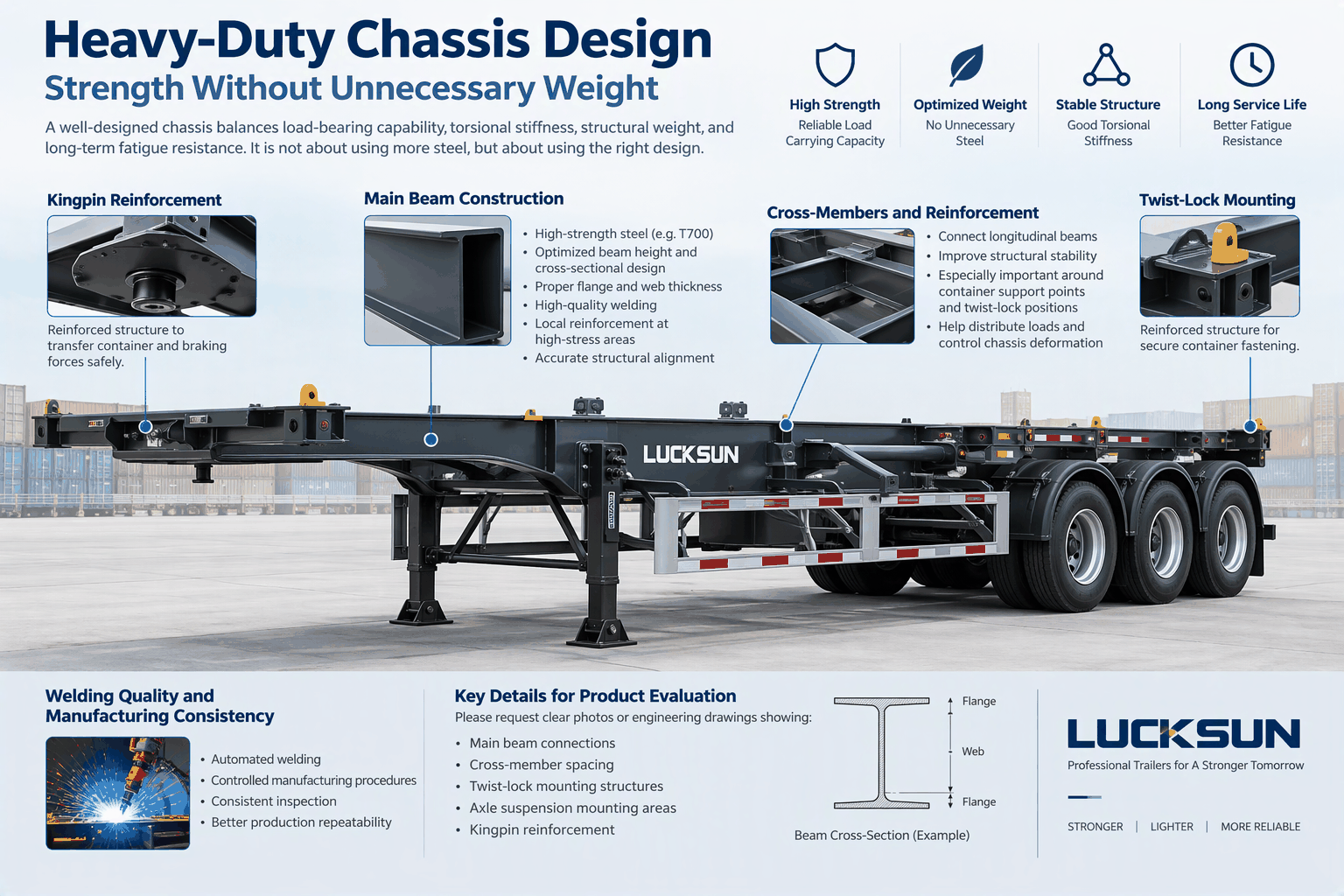
Heavy-Duty Chassis Design: Strength Without Unnecessary Weight
A high-performance skeleton semi-trailer chassis is engineered to achieve the optimal balance between load-bearing capacity, torsional stiffness, structural weight, and long-term durability. The reinforced main beams, strategically positioned cross-members, and strengthened kingpin and twist-lock areas work together to distribute forces efficiently while minimizing unnecessary weight. Combined with high-strength steel options, automated welding technology, and strict quality control procedures, the chassis delivers reliable performance, improved fatigue resistance, and consistent structural integrity for demanding container transportation applications.
Simply increasing steel thickness does not automatically produce a better trailer. An efficient chassis should distribute forces appropriately while avoiding unnecessary weight.
3.1 Main Beam Construction
The longitudinal main beams carry a substantial portion of the container load and transfer forces toward the suspension and kingpin areas.
Important considerations include:
-
Steel grade and mechanical properties
-
Beam height and cross-sectional design
-
Flange and web thickness
-
Welding quality
-
Local reinforcement around high-stress connections
-
Structural alignment
High-strength steel options, such as T700 or other suitable grades, may be considered depending on engineering requirements.
The correct selection depends on the intended gross weight, container arrangement, road conditions, and applicable design standards.
3.2 Cross-Members and Reinforcement
Cross-members connect the longitudinal beams and help maintain structural stability.
They are particularly important around container support points and twist-lock mounting positions.
A well-designed cross-member arrangement helps distribute loads and control chassis deformation.
During product evaluation, buyers should request clear photographs or engineering drawings showing:
-
Main beam connections
-
Cross-member spacing
-
Twist-lock mounting structures
-
Axle suspension mounting areas
-
Kingpin reinforcement
These details provide a more useful understanding of structural quality than appearance photographs alone.
3.3 Welding Quality and Manufacturing Consistency
Welding defects can become serious structural problems when a trailer operates under repeated loading and road vibration.
Automated welding, controlled manufacturing procedures, and consistent inspection help improve production repeatability.
LUCKSUN's manufacturing capabilities include automated welding and intelligent trailer assembly processes.
For buyers, the important questions are whether the structural design is appropriate, whether weld quality is controlled, and whether finished products undergo suitable inspections before delivery.
4. Container Locking System: Flexibility for Different Logistics Operations
Twist locks are among the most important functional components of a skeletal container chassis.
They secure the shipping container to the trailer and help prevent unwanted movement during transportation.
A 3 axle skeleton trailer can be designed with different locking positions according to the required container combinations.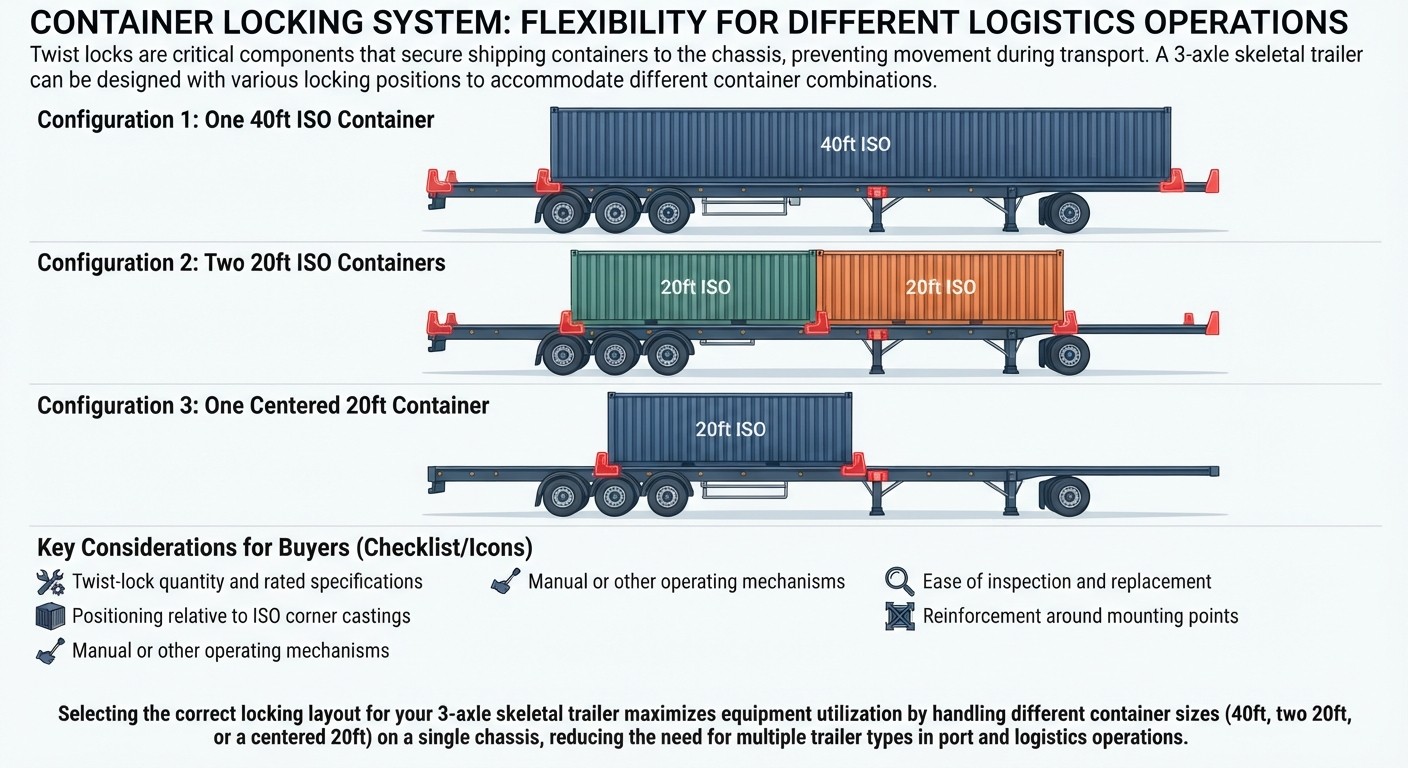
Common applications include:
-
One 40ft ISO container
-
Two 20ft ISO containers
-
One centered 20ft container
-
Other compatible container arrangements where the chassis design allows
Not every 40ft chassis automatically supports all these combinations. The number, spacing, and structural location of twist locks must be confirmed before ordering.
Buyers should pay attention to:
-
Twist-lock quantity and rated specifications.
-
Positioning relative to ISO container corner castings.
-
Manual or other operating mechanisms.
-
Ease of inspection and replacement.
-
Reinforcement around each mounting point.
For port operators handling different container sizes, selecting the correct locking layout can improve equipment utilization and reduce the need for multiple trailer types.
5. Reference Specifications for a 3 Axle Skeleton Trailer
The following table provides a reference configuration based on LUCKSUN's published skeletal container chassis product information.
Final specifications should be confirmed against the selected model and destination-market requirements.
| Parameter | Reference Specification |
|---|---|
| Product Type | 3 Axle Skeleton Semi-Trailer |
| Container Compatibility | 40ft; other layouts subject to design |
| Axle Configuration | 3 Axles |
| Reference Total Load | 39,000 kg |
| Reference Curb Weight | 5,800 kg |
| Main Frame | High-Strength Steel |
| Axle Brand | FUWA / BPW / Optional |
| Suspension | Mechanical / Air Suspension |
| Braking System | Drum / Disc, ABS or EBS options |
| Container Locks | 12 Twist Locks |
| Tires | Subject to selected configuration |
| Kingpin | JOST / Optional |
| Landing Gear | Heavy-Duty Support Legs |
| Electrical System | 24V |
| Surface Treatment | Electrophoretic Coating / Powder Spraying Options |
| Customization | Available |
Important specification note: The published 39,000 kg figure is identified as total load in the reference product configuration, not a universal payload rating. Curb weight and actual payload must be checked against the final engineering specification. Axle loads, kingpin loading, tire ratings, and local road limits must also be considered.
For detailed product information, visit the LUCKSUN 40ft Skeleton Semi-Trailer Product Page.
6. How to Reduce the Total Cost of Ownership
When comparing two heavy-duty skeleton trailers, purchase price alone is not enough.
A better purchasing method is to evaluate the total cost of ownership (TCO) over the expected operating period.
The main cost categories include:
| Cost Category | What Buyers Should Evaluate |
|---|---|
| Initial Purchase | Frame, axles, suspension, brakes and accessories |
| Tire Costs | Tire quality, wear rate and availability |
| Maintenance | Inspection, lubrication and replacement components |
| Repairs | Component reliability and repair accessibility |
| Downtime | Lost operating time and delayed deliveries |
| Corrosion | Coating performance and environmental exposure |
| Spare Parts | Local availability and replacement compatibility |
Practical Ways to Control Operating Costs
Choose compatible components from the beginning.
Using properly matched axles, suspension, tires, and brakes helps prevent premature wear caused by incompatible specifications.
Avoid unnecessary structural weight.
A suitable frame design can balance strength and tare weight. However, reducing weight must never compromise the required load capacity or safety.
Standardize fleet components.
Where possible, selecting common axle, brake, tire, and suspension specifications across a fleet can simplify spare-parts management.
Make inspections easier.
An open skeletal chassis provides access to many structural and mechanical areas. This can make visual inspections and certain maintenance tasks more convenient than on trailers with fully enclosed platforms.
Establish a preventive maintenance schedule.
Regular inspection of wheel ends, brake assemblies, twist locks, suspension, and structural connections helps identify problems before they result in major repairs.
For a practical inspection reference, see our Semi-Trailer Maintenance Checklist & Schedule.
7. Choosing the Right 3 Axle Skeleton Trailer for Different Markets
A suitable trailer configuration should reflect the actual transportation environment rather than follow a universal specification.
Africa: Port-to-Inland Container Transportation
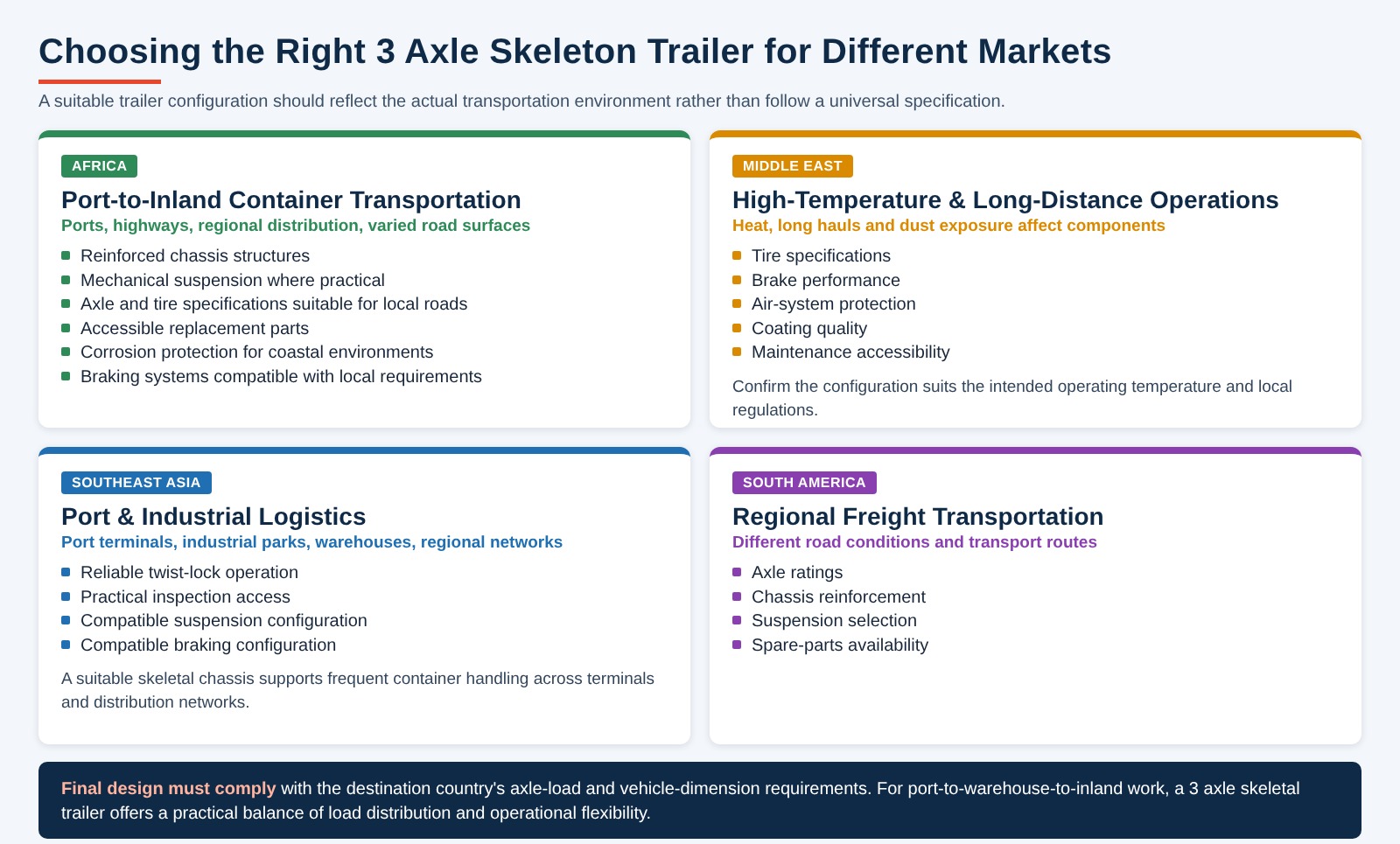
Infographic titled "Choosing the Right 3 Axle Skeleton Trailer for Different Markets," stating that trailer configuration should reflect the actual transportation environment rather than a universal specification. Four color-coded cards cover the key regions. Africa (port-to-inland container transportation): reinforced chassis structures, mechanical suspension where practical, axle and tire specifications suited to local roads, accessible replacement parts, corrosion protection for coastal environments, and braking systems compatible with local requirements. Middle East (high-temperature and long-distance operations): tire specifications, brake performance, air-system protection, coating quality, and maintenance accessibility, with a reminder to confirm suitability for operating temperature and local regulations. Southeast Asia (port and industrial logistics): reliable twist-lock operation, practical inspection access, and compatible suspension and braking configurations. South America (regional freight transportation): axle ratings, chassis reinforcement, suspension selection, and spare-parts availability. A footer banner states that the final design must comply with the destination country's axle-load and vehicle-dimension requirements, and that a 3 axle skeletal trailer offers a practical balance of load distribution and operational flexibility.
In many African markets, container transportation involves a combination of port operations, inland highways, regional distribution, and roads with varying surface conditions.
Buyers should consider:
-
Reinforced chassis structures
-
Mechanical suspension where practical
-
Axle and tire specifications suitable for local roads
-
Accessible replacement parts
-
Corrosion protection for coastal environments
-
Braking systems compatible with local requirements
For operators moving containers between ports, warehouses, and inland destinations, a 3 axle skeletal trailer can provide a practical balance of load distribution and operational flexibility.
Middle East: High-Temperature and Long-Distance Operations
High temperatures, long-distance transportation, and exposure to dust can affect trailer components.
Important considerations include tire specifications, brake performance, air-system protection, coating quality, and maintenance accessibility.
Buyers should confirm that the selected configuration is appropriate for the intended operating temperature and local regulations.
Southeast Asia: Port and Industrial Logistics
Container transportation in Southeast Asia frequently involves port terminals, industrial parks, warehouses, and regional distribution networks.
A suitable skeletal chassis should provide reliable twist-lock operation, practical inspection access, and compatible suspension and braking configurations.
South America: Regional Freight Transportation
For operators working across different road conditions and transport routes, axle ratings, chassis reinforcement, suspension selection, and spare-parts availability should all be considered.
The final design should comply with the destination country's axle-load and vehicle-dimension requirements.
8. Skeleton Trailer vs. Flatbed Trailer: Which One Should You Buy?
Both skeletal and flatbed semi-trailers are used in container transportation, but their structures and applications are different.
| Comparison | Skeleton Trailer | Flatbed Trailer |
|---|---|---|
| Main Purpose | Container Transport | General Cargo and Container Transport |
| Loading Platform | Open Structural Frame | Full Loading Deck |
| Container Securing | Twist Locks | Twist Locks and Other Securing Equipment |
| General Cargo | Limited | More Versatile |
| Structural Design | Container-Supporting Chassis | Full Platform Structure |
| Inspection Access | Generally Easier Around Open-Frame Areas | Depends on Deck Design |
| Typical Application | Ports and Container Logistics | General Freight and Container Transport |
A skeleton trailer is generally the more specialized option when container transportation is the primary business.
A flatbed trailer is more appropriate when the fleet also handles steel products, machinery, construction materials, and other general cargo.
Explore our 40ft Flatbed Semi-Trailer Solutions for an alternative cargo transportation configuration.
9. What Should Importers Check Before Placing an Order?
For international buyers, purchasing a heavy-duty 3 axle skeleton trailer involves more than confirming the model and price.
The following points should be included in the technical confirmation process.
1. Container Compatibility
Confirm whether the trailer is designed for one 40ft container, two 20ft containers, or other required configurations.
2. Actual Load Requirements
Provide the expected gross container weight, axle-load restrictions, and intended operating conditions.
3. Axle and Suspension Specifications
Confirm axle capacity, brand, suspension type, and compatibility with the selected chassis.
4. Braking and Electrical Systems
Specify drum or disc brakes, ABS/EBS requirements, air connections, voltage, and lighting standards.
5. Tractor Compatibility
Check kingpin dimensions, fifth-wheel height, landing gear clearance, and coupling requirements.
6. Tire and Spare Parts Requirements
Confirm tire size, wheel specifications, spare tire arrangements, and the availability of replacement components.
7. Surface Treatment
Ask about the coating process, corrosion protection, and suitable maintenance practices for the destination environment.
8. Export and Compliance Requirements
Confirm applicable vehicle dimensions, axle loads, lighting, braking, documentation, and inspection requirements before production.
LUCKSUN can discuss OEM/ODM configurations according to the buyer's container requirements, transportation conditions, and destination-market specifications.
For buyers who need different trailer structures or replacement components, explore our Semi-Trailer Product Range and Semi-Trailer Parts Guide.
10. Why Consider LUCKSUN for a Heavy-Duty Skeleton Trailer?
Selecting a trailer supplier is a long-term business decision. Consistent manufacturing quality, suitable product configurations, and reliable communication are important throughout the purchasing process.
LUCKSUN focuses on semi-trailers and related components for international markets.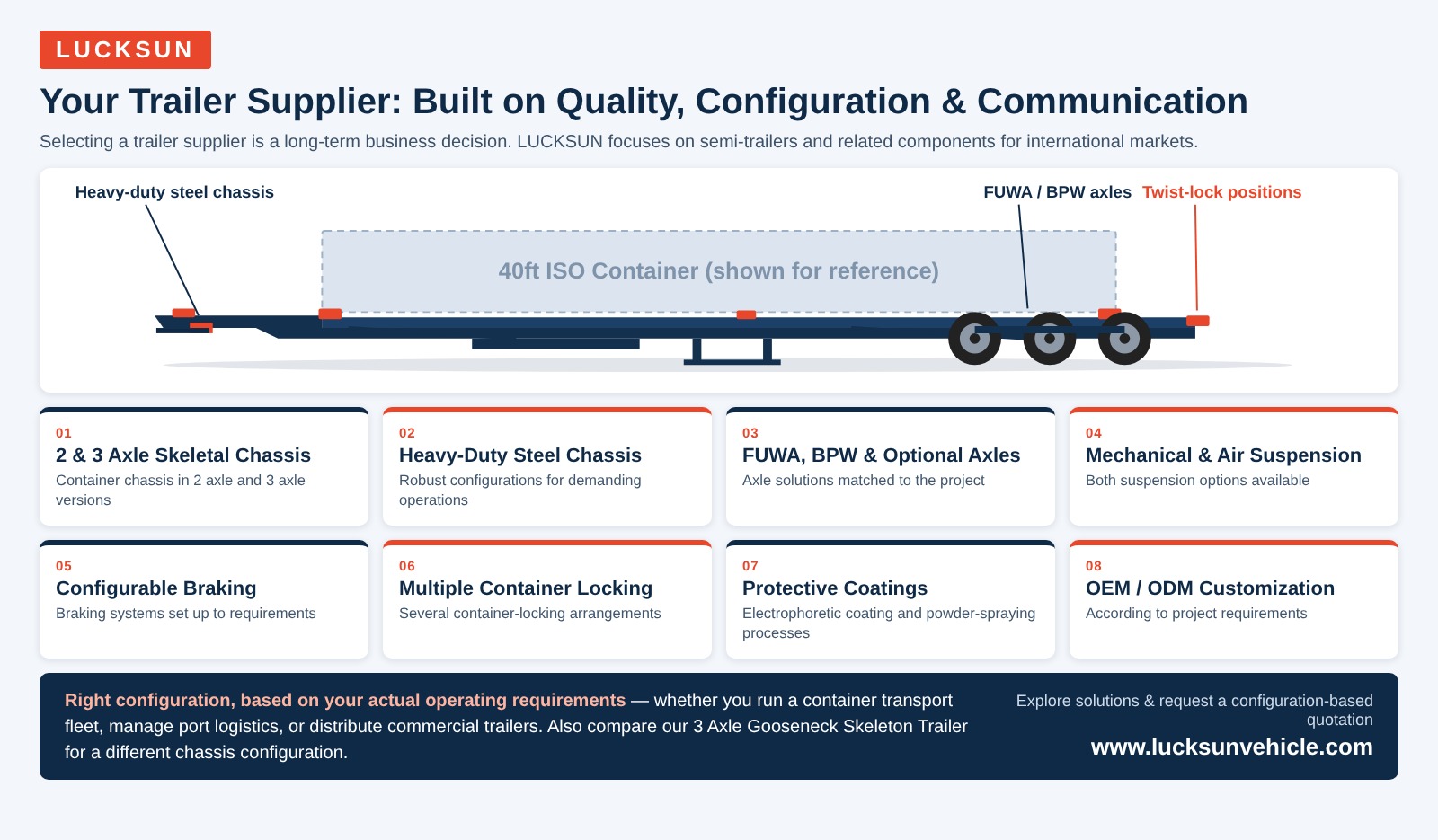
Infographic for LUCKSUN, a supplier of semi-trailers and related components for international markets, titled "Your Trailer Supplier: Built on Quality, Configuration & Communication." The top panel shows a side-view illustration of a 3-axle skeletal container chassis with a dashed 40ft ISO container outline for reference, with callouts for the heavy-duty steel chassis, FUWA / BPW axles, and red twist-lock positions. Below, eight numbered cards list the product and manufacturing capabilities: 2 and 3 axle skeletal chassis, heavy-duty steel chassis, FUWA, BPW and optional axles, mechanical and air suspension, configurable braking, multiple container-locking arrangements, electrophoretic coating and powder-spraying processes, and OEM/ODM customization according to project requirements. The footer banner says the right configuration should be based on actual operating requirements, whether for container transport fleets, port logistics, or commercial trailer distribution. It mentions the 3 Axle Gooseneck Skeleton Trailer as an alternative chassis configuration and invites viewers to visit www.lucksunvehicle.com for a configuration-based quotation.
Our product and manufacturing capabilities include:
-
2 axle and 3 axle skeletal container chassis
-
Heavy-duty steel chassis configurations
-
FUWA, BPW, and optional axle solutions
-
Mechanical and air suspension options
-
Configurable braking systems
-
Multiple container-locking arrangements
-
Electrophoretic coating and powder-spraying processes
-
OEM/ODM customization according to project requirements
Buyers can also compare our alternative 3 Axle Gooseneck Skeleton Trailer for applications requiring a different chassis configuration.
Whether you operate a container transport fleet, manage port logistics, or distribute commercial trailers, the right configuration should be based on your actual operating requirements.
Visit the LUCKSUN official website to explore our semi-trailer solutions or contact our team for a configuration-based quotation.
11. Frequently Asked Questions
Q1. What is a 3 axle skeleton trailer used for?
A 3 axle skeleton trailer is primarily used for transporting ISO shipping containers between ports, container terminals, warehouses, industrial facilities, and inland distribution centers.
Q2. Why choose a 3 axle skeleton trailer instead of a 2 axle model?
A 3 axle configuration provides an additional axle position for load distribution and may be more suitable for certain heavier container transportation applications. The correct choice depends on gross weight, axle-load regulations, chassis design, and operating conditions.
Q3. What makes a skeleton trailer low maintenance?
Low-maintenance performance depends on durable structural components, reliable axles, correctly matched suspension and braking systems, effective corrosion protection, accessible replacement parts, and regular preventive inspections.
No trailer is completely maintenance-free.
Q4. Can a 3 axle skeleton trailer carry two 20ft containers?
Yes, if the chassis is specifically designed with compatible container-locking positions and structural support. Buyers should confirm twist-lock locations and load distribution before ordering.
Q5. Which suspension is better for a heavy-duty skeleton trailer?
Mechanical suspension is often preferred for its relatively simple structure and practical servicing. Air suspension can offer improved ride characteristics and other operational benefits. The best choice depends on road conditions, budget, service availability, and local regulations.
Q6. Which axle brands are available?
Depending on the selected configuration, LUCKSUN can provide FUWA, BPW, and other optional axle solutions. Final specifications should be confirmed during quotation.
Q7. How can I reduce the maintenance cost of a container chassis?
Choose compatible components, establish regular inspections, monitor tire pressure and wear, maintain the braking system, check twist locks, and replace damaged parts before they cause additional failures.
Q8. Can the 3 axle skeleton trailer be customized for African markets?
Yes. Chassis dimensions, axle configuration, suspension, tires, braking systems, container-locking positions, and other components can be discussed according to the destination country's transport regulations and operating conditions.
Q9. What information is needed to obtain a quotation?
Buyers should provide the required container sizes, expected gross load, destination country, axle and suspension preferences, braking requirements, tire specifications, and order quantity. This information helps determine a suitable configuration and quotation.
Conclusion: Invest in a Trailer Designed for Long-Term Operation
A heavy-duty low-maintenance 3 axle skeleton trailer should be evaluated as a complete transportation system rather than simply a steel chassis with three axles.
Structural strength, component compatibility, suspension design, braking performance, corrosion protection, and maintenance accessibility all contribute to its long-term operating performance.
For importers, fleet operators, and container logistics companies, choosing the right configuration from the beginning can help reduce avoidable maintenance expenses and improve fleet utilization.
Looking for a heavy-duty 3 axle skeleton trailer for your container transportation business?
Contact LUCKSUN with your container specifications, expected load, destination country, and preferred configuration. Our team can help you evaluate suitable chassis options and provide a quotation based on your requirements.