
Bulk Commodity Trailer Heavy-Duty Bulk Cargo Trailer for Efficient Material Transportation
Bulk Commodity Trailer
Heavy-Duty Bulk Cargo Trailer for Efficient Material Transportation
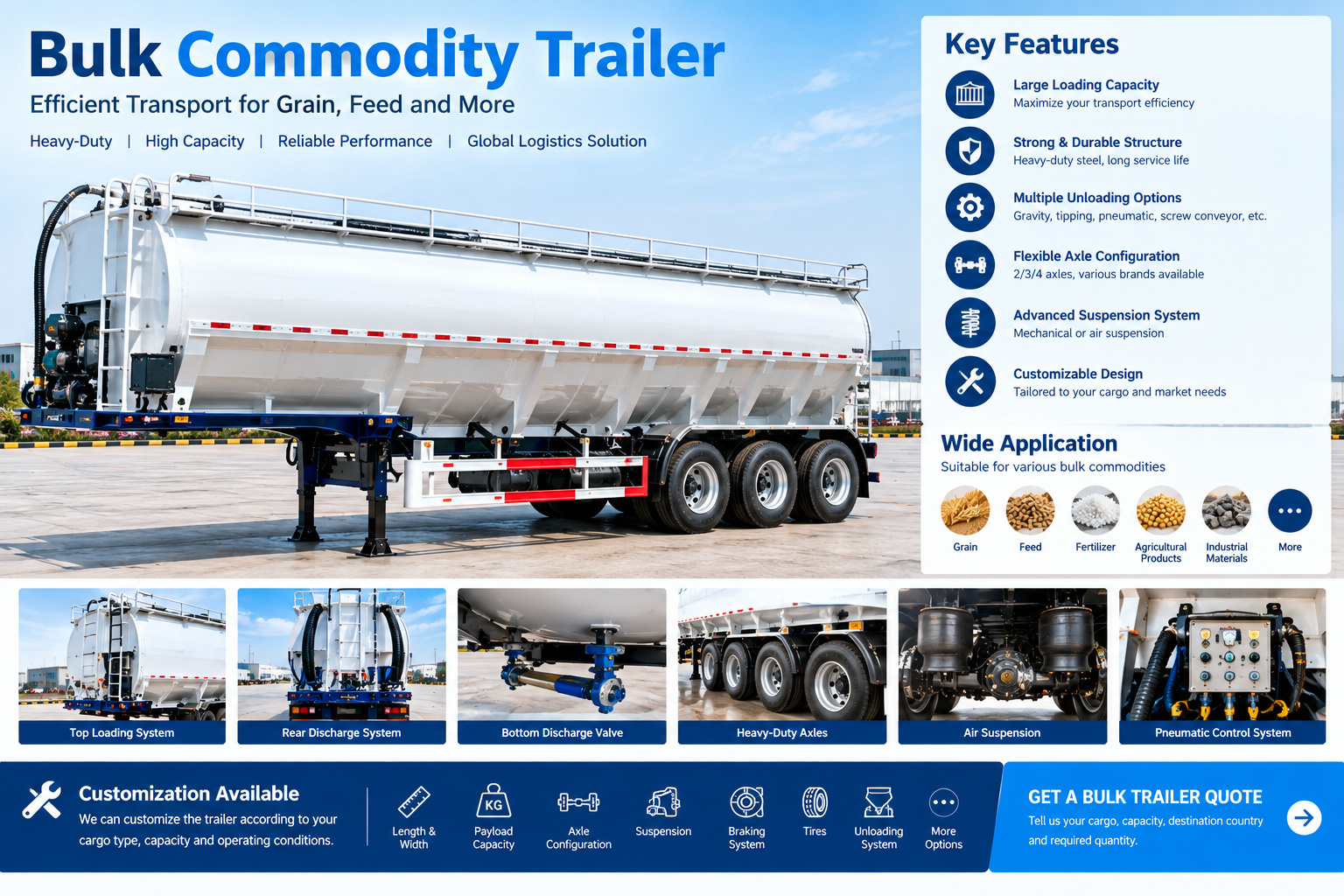
A bulk commodity trailer is designed for transporting large quantities of loose or dry bulk materials efficiently over short and long distances.
Depending on the trailer configuration, typical applications may include the transportation of grain, feed, agricultural products, seed, fertilizer, industrial raw materials and other suitable bulk commodities.
For logistics companies, agricultural businesses, bulk material distributors, fleet operators and trailer importers, choosing the right bulk cargo trailer is not simply about capacity or price. The trailer needs to match the transported material, loading method, unloading requirements, road conditions, tractor specifications and regulations of the destination market.
Our bulk commodity trailer configurations can be customized according to different transportation requirements, including body capacity, material, axle configuration, suspension, braking system, tires, loading equipment and unloading system.
What Is a Bulk Commodity Trailer?
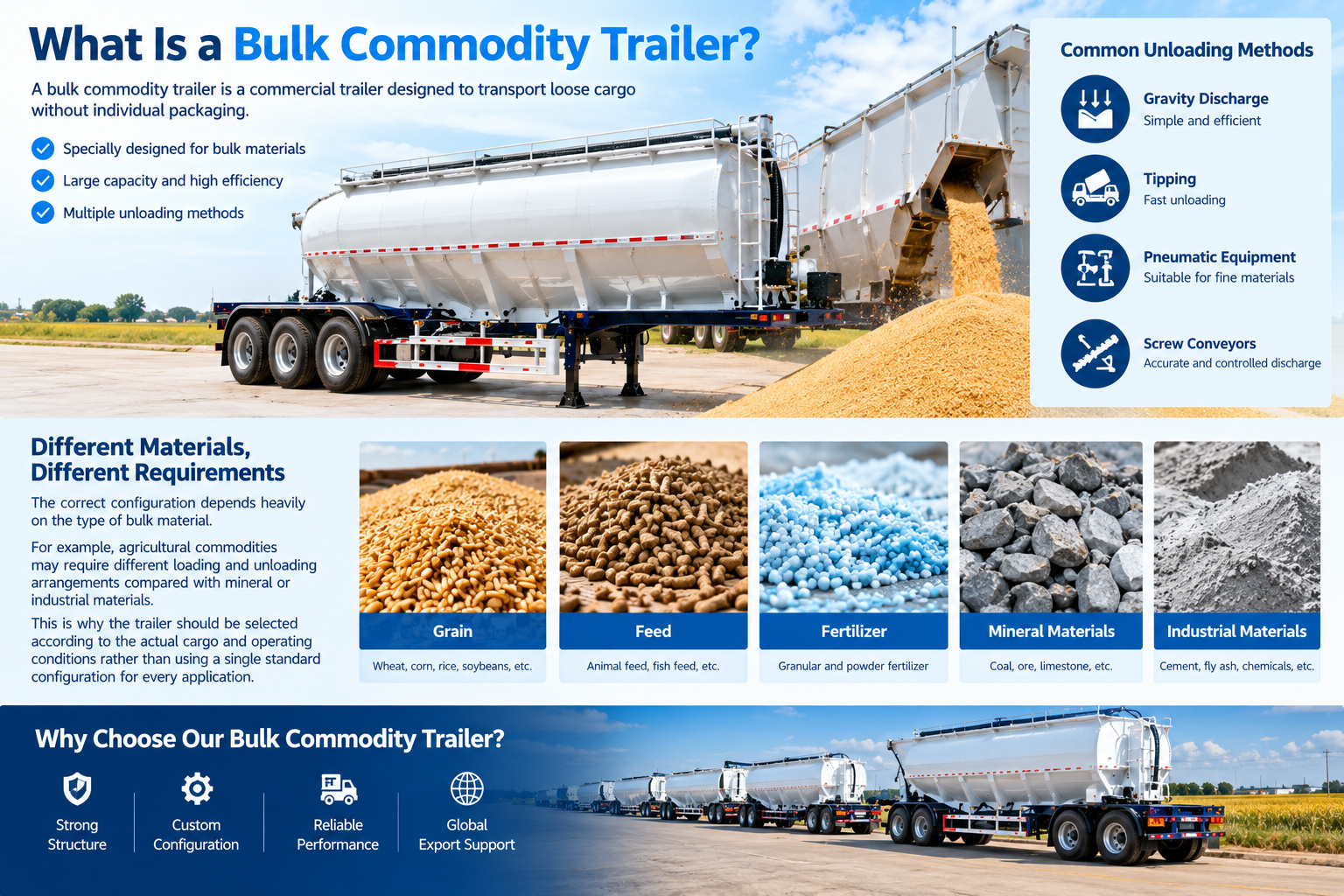
A bulk commodity trailer is a commercial trailer designed to transport loose cargo without individual packaging
Unlike a standard flatbed trailer, bulk cargo trailer or bulk transport semi trailer is generally designed around the specific characteristics of the material being transported
The cargo may be loaded in large quantities and discharged at the destination using gravity, tipping, pneumatic equipment, screw conveyors or other suitable unloading methods, depending on the trailer design.
The correct configuration depends heavily on the type of bulk material.
For example, agricultural commodities may require different loading and unloading arrangements compared with mineral or industrial materials.
This is why the trailer should be selected according to the actual cargo and operating conditions rather than using a single standard configuration for every application.
What Can a Bulk Commodity Trailer Transport?
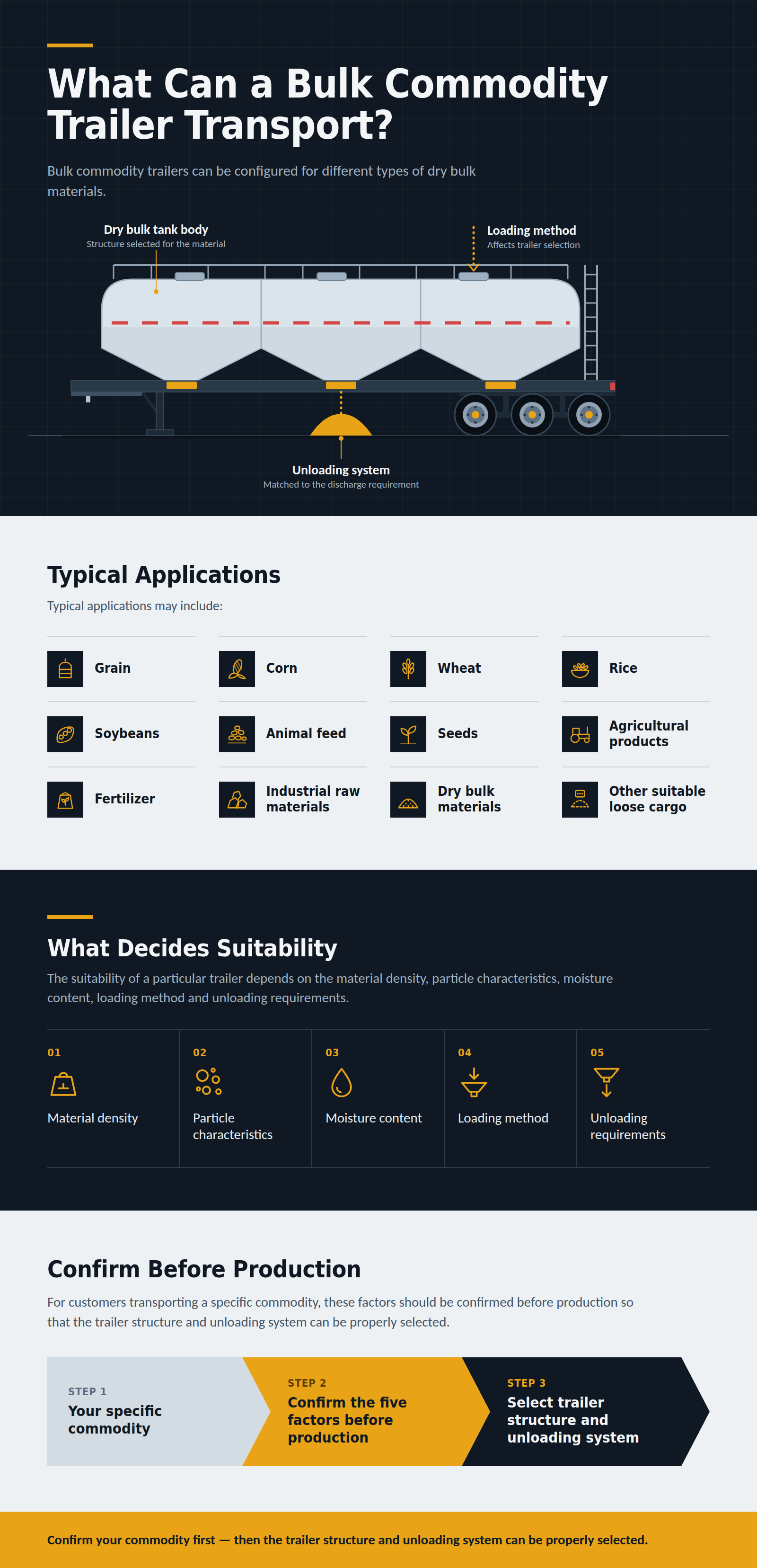
Bulk commodity trailers can be configured for different types of dry bulk materials
Typical applications may include:
- Grain
- Corn
- Wheat
- Rice
- Soybeans
- Animal feed
- Seeds
- Agricultural products
- Fertilizer
- Industrial raw materials
- Dry bulk materials
- Other suitable loose cargo
The suitability of a particular trailer depends on the material density, particle characteristics, moisture content, loading method and unloading requirements.
For customers transporting a specific commodity, these factors should be confirmed before production so that the trailer structure and unloading system can be properly selected.
Bulk Commodity Trailer Capacity
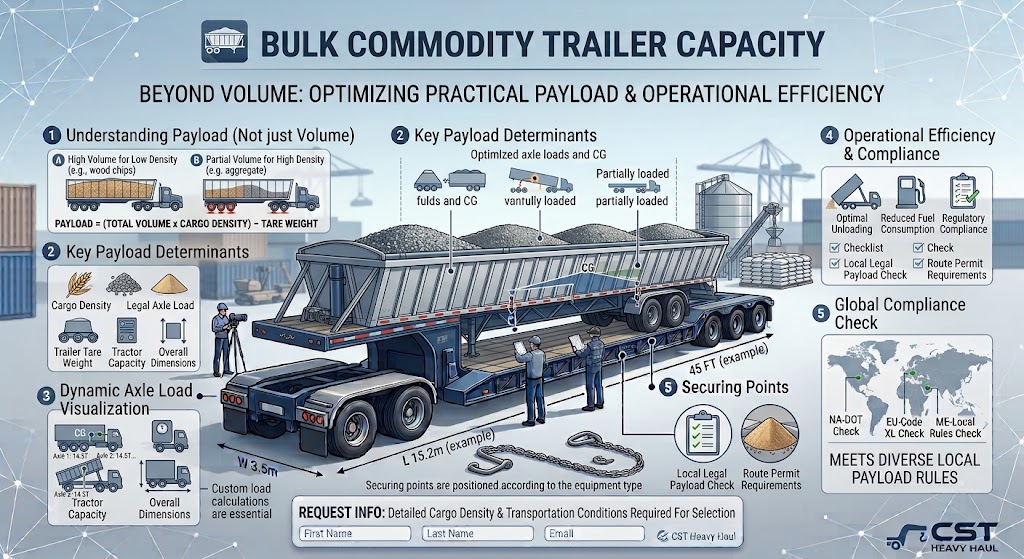
Trailer capacity is one of the first specifications international buyers consider
However, capacity should not be evaluated only by internal volume.
The actual payload is also affected by:
- Cargo density
- Legal axle load
- Trailer tare weight
- Axle configuration
- Road regulations
- Tractor capacity
- Overall vehicle dimensions
A high-volume trailer does not necessarily provide a higher practical payload if the cargo is particularly dense or local axle-load regulations limit the allowable gross weight.
For this reason, the ideal bulk commodity trailer should be selected according to both volume and legal payload requirements.
Customers should provide the expected cargo density and transportation conditions when requesting a quotation.
Bulk Cargo Trailer Structure
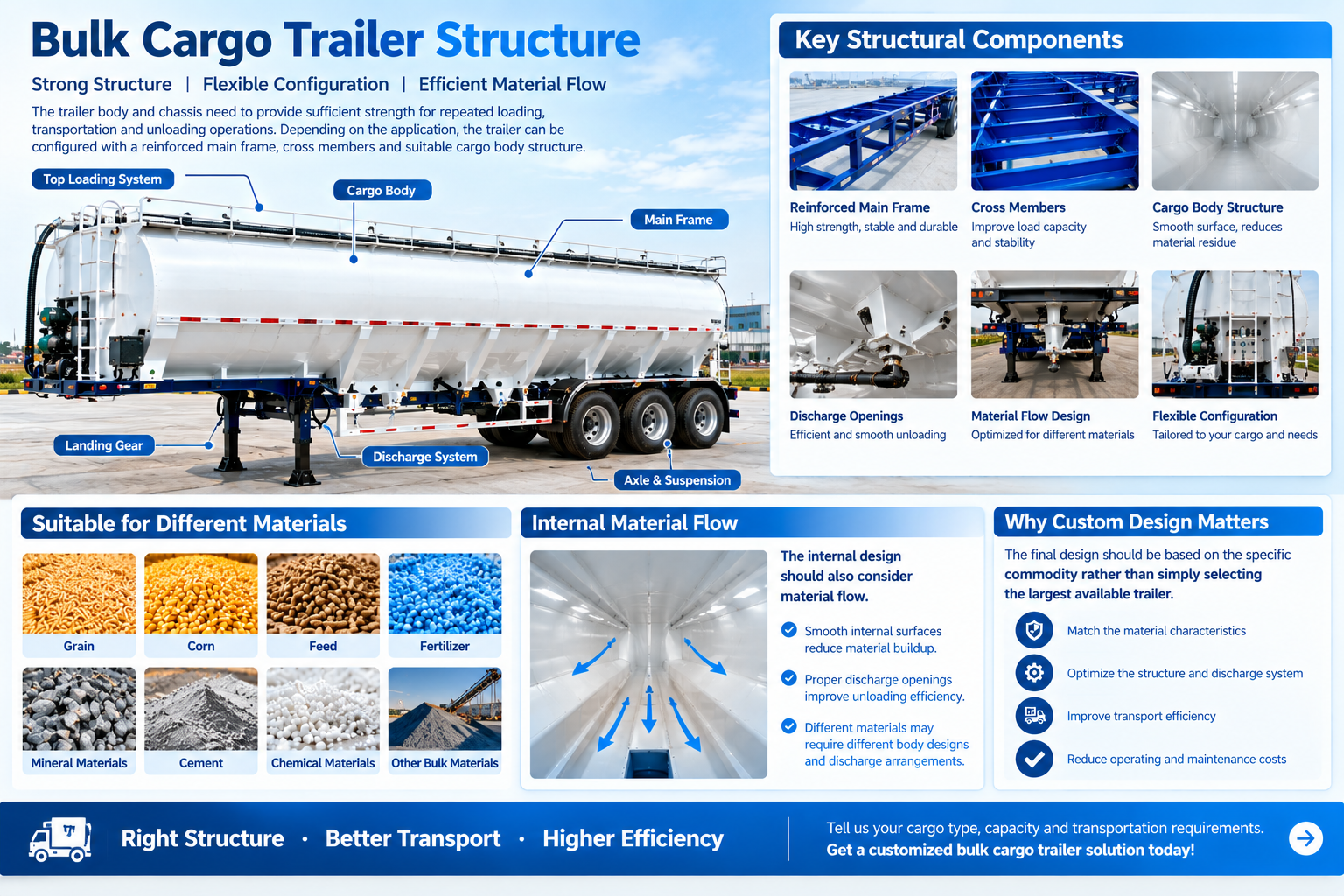
The trailer body and chassis need to provide sufficient strength for repeated loading, transportation and unloading operations
Depending on the application, the trailer can be configured with a reinforced main frame, cross members and suitable cargo body structure.
The internal design should also consider material flow.
For bulk agricultural products, smooth internal surfaces and appropriate discharge openings can help facilitate unloading.
For other dry bulk materials, the body design may require different structural or discharge arrangements.
The final design should therefore be based on the specific commodity rather than simply selecting the largest available trailer.
Loading and Unloading System
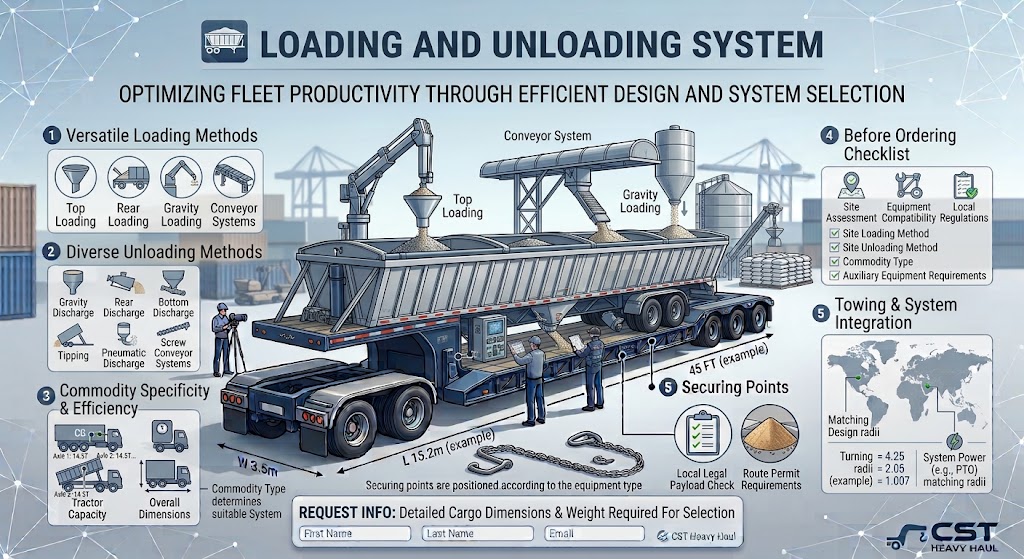
Loading and unloading efficiency has a direct impact on fleet productivity
Depending on the trailer type and cargo, loading may be carried out through:
- Top loading
- Rear loading
- Gravity loading
- Conveyor systems
- Other compatible loading equipment
Unloading methods may include:
- Gravity discharge
- Rear discharge
- Bottom discharge
- Tipping
- Pneumatic discharge
- Screw conveyor systems
Not every unloading system is suitable for every commodity.
Before ordering, buyers should confirm where and how the trailer will be loaded and unloaded.
This information helps determine the appropriate body structure, discharge openings and auxiliary equipment.
Axle and Suspension Configuration
The running gear is another important part of a bulk commodity trailer.
Depending on the destination market and required payload, customers can select different axle configurations and suspension systems.
Possible options include:
Axle Configuration:
- 2 axles
- 3 axles
- 4 axles
- Customized heavy-duty configurations
Axle Brands:
- FUWA
- BPW
- Other specified brands
Suspension:
- Mechanical suspension
- Air suspension
The correct configuration should be based on the legal axle loads, road conditions, cargo weight and tractor specifications of the destination market.
For international buyers, matching the trailer to local regulations before production can help avoid unnecessary modifications after delivery.
Braking System and Safety Equipment
A commercial bulk transport trailer requires a braking system suitable for its operating environment and loaded weight.
Depending on the market, the trailer can be equipped with an air brake system, ABS or EBS according to the customer's requirements and applicable regulations.
Other safety-related equipment may include:
- LED lighting
- Side marker lamps
- Rear lamps
- Reflective markings
- Mudguards
- Safety rails
- Emergency equipment
- Other market-specific equipment
The final specification should be confirmed according to the regulations of the destination country.
Tires and Wheels
Tire selection should also be considered together with the trailer's payload and operating environment.
Common commercial trailer tire specifications may include:
- 12R22.5
- 12.00R22.5
- 315/80R22.5
Different tire brands and wheel specifications can be provided according to customer requirements.
For long-distance bulk transportation, tire selection should consider road conditions, expected mileage, axle load and local replacement availability.
Bulk Commodity Trailer for Agricultural Transportation
Agricultural logistics is one of the important applications for bulk cargo transportation.
Grain, feed, seed and other agricultural commodities often need to be moved from farms and processing facilities to storage centers, feed mills, distribution centers or other destinations.
For these applications, loading and unloading efficiency can be just as important as trailer capacity.
Customers should consider:
Cargo density
Required volume
Loading equipment
Unloading location
Road conditions
Daily transportation distance
Legal payload
Cleaning requirements
These factors can help determine whether a particular bulk trailer configuration is suitable for the operation.
Bulk Trailer for International Markets
Overseas buyers often operate in environments that are very different from the supplier's domestic market.
Road conditions, legal axle loads, tractor specifications, trailer dimensions and maintenance resources can vary significantly between countries.
For this reason, a bulk commodity trailer intended for export should be configured according to the destination market.
Before ordering, buyers should confirm:
Destination country
Cargo type
Cargo density
Required capacity
Required payload
Loading method
Unloading method
Road conditions
Tractor specification
Axle-load regulations
Brake requirements
Tire requirements
Required quantity
This information allows the trailer configuration to be developed around the customer's actual operating conditions.
Custom Bulk Commodity Trailer
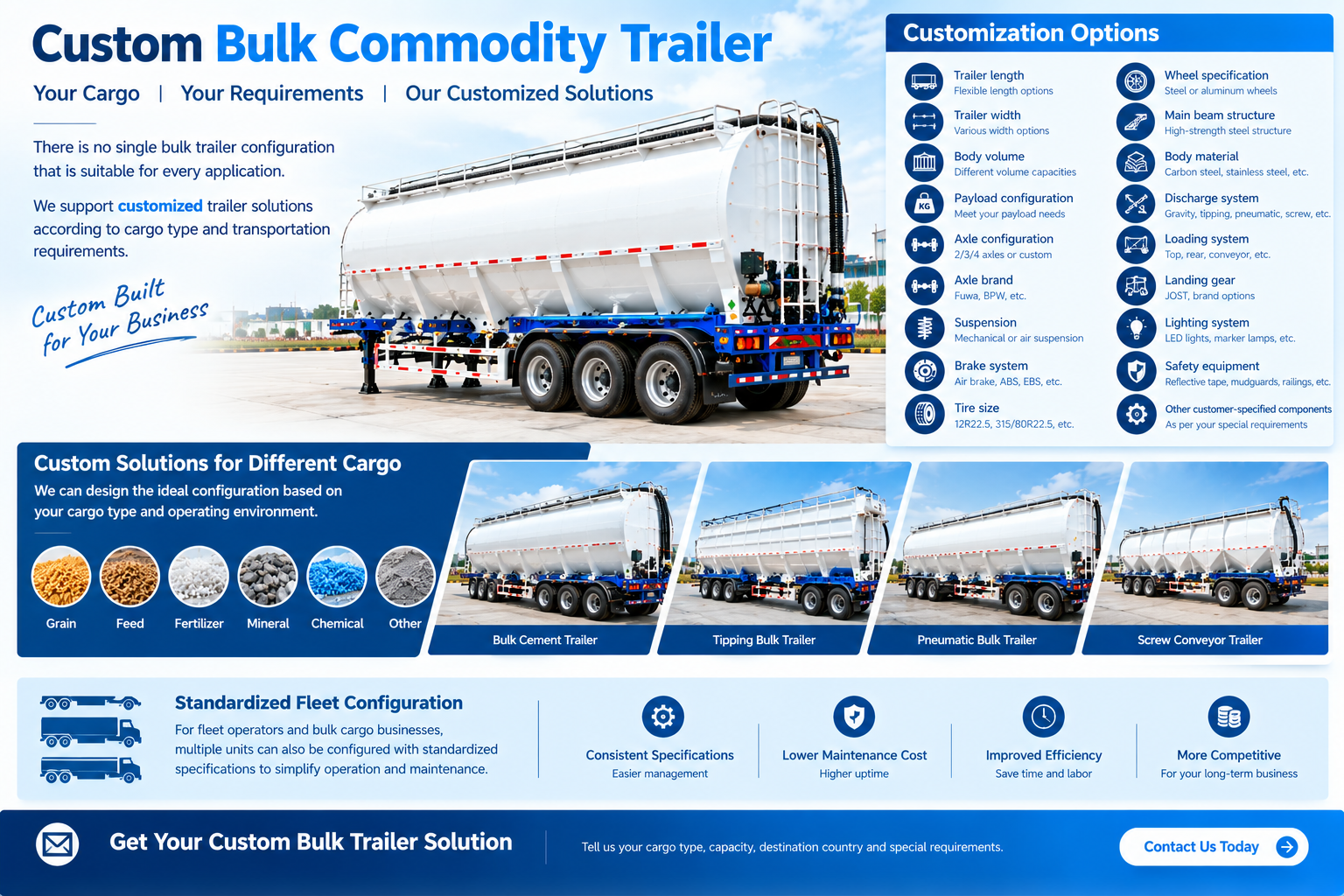
There is no single bulk trailer configuration that is suitable for every application
We support customized trailer solutions according to cargo type and transportation requirements.
Customization options may include:
- Trailer length
- Trailer width
- Body volume
- Payload configuration
- Axle configuration
- Axle brand
- Suspension
- Brake system
- Tire size
- Wheel specification
- Main beam structure
- Body material
- Discharge system
- Loading system
- Landing gear
- Lighting system
- Safety equipment
- Other customer-specified components
For fleet operators and bulk cargo businesses, multiple units can also be configured with standardized specifications to simplify operation and maintenance.
How to Choose the Right Bulk Commodity Trailer?
Before purchasing a bulk commodity trailer, buyers should first define the actual transportation requirements.
1. Identify the Cargo
What material will the trailer transport?
Grain, feed, fertilizer and industrial materials may have different requirements.
2. Confirm Cargo Density
Cargo density affects the relationship between volume and actual payload.
3. Determine Required Capacity
Select the trailer volume according to the expected cargo and legal transportation limits.
4. Check Loading Conditions
Determine whether the trailer will be loaded from the top, rear or another loading point.
5. Check Unloading Conditions
Confirm whether unloading will use gravity, tipping, pneumatic equipment, conveyors or another method.
6. Confirm Tractor Compatibility
The trailer should match the customer's tractor, fifth wheel, braking system and electrical connections.
7. Check Local Regulations
Confirm legal axle loads, vehicle dimensions, braking requirements and other applicable regulations.
8. Consider Maintenance
Axles, tires, suspension, valves and other components should ideally be supported by an accessible local spare-parts supply.
Bulk Commodity Trailer Manufacturer for Global Buyers
For overseas trailer buyers, the supplier's ability to customize the trailer can be just as important as the basic product specification.
A suitable export trailer should be developed around the buyer's actual transportation requirements.
We can discuss the complete trailer configuration with customers, including:
- Cargo requirements
- Trailer dimensions
- Payload
- Axles
- Suspension
- Tires
- Braking system
- Loading system
- Unloading system
- Safety equipment
- Export requirements
For bulk orders, the configuration can be standardized across multiple units according to the buyer's fleet requirements.
Get a Quote for a Bulk Commodity Trailer
Looking for a bulk commodity trailer for agricultural products, grain, feed or other dry bulk materials?
Instead of choosing a trailer based only on price, tell us how you plan to use it.
Please send us:
1. Destination Country
2. Cargo Type
3. Cargo Density
4. Required Capacity
5. Required Payload
6. Loading Method
7. Unloading Method
8. Tractor Specification
9. Required Quantity
Based on this information, we can recommend a suitable bulk trailer configuration and prepare a quotation according to your actual transportation requirements.
Send your requirements today and request a customized bulk commodity trailer quotation.
Welcome to our homepage to learn more, and please feel free to contact us.