
Skeletal Semi Trailer: Complete Guide for Container Transport
Skeletal Semi Trailer: Complete Guide for Container Transport
A skeletal semi trailer is a specialized trailer designed for transporting shipping containers by road. Also known as a container chassis trailer, it features an open chassis frame with container twist locks that secure the container during transportation.
Skeletal semi trailers are widely used by logistics companies, container carriers, freight forwarders, port operators, and fleet owners for moving 20ft, 40ft, and other standard shipping containers between ports, terminals, warehouses, and inland distribution centers.
For overseas buyers looking to purchase a skeletal semi trailer from China, understanding the trailer structure, container compatibility, axle configuration, suspension, braking system, and customization options is essential before requesting a quotation.
What Is a Skeletal Semi Trailer?
A skeletal semi trailer is a semi trailer specifically designed for container transportation. Unlike a flatbed semi trailer, it does not have a full loading platform. Instead, the container is supported directly by the trailer's structural chassis.
The main components typically include:
-
Main chassis frame
-
Cross members
-
Container twist locks
-
Axles
-
Suspension system
-
Landing gear
-
Air brake system
-
Wheels and tires
-
Electrical and lighting system
-
Mudguards and other safety components
The open-frame structure makes the trailer lighter and simpler than many general-purpose cargo trailers while providing the necessary support for standardized shipping containers.
Depending on the design, a skeletal trailer can be configured for different container lengths and locking positions.
Skeletal Semi Trailer – Durable Chassis for Container Transport
Built for heavy-duty container logistics, this skeletal semi trailer features a robust steel ladder-frame chassis designed to maximize strength while minimizing tare weight. The extendable front gooseneck allows flexible coupling with different tractor units, while the reinforced cross-members and twist-lock mounts ensure secure, stable container handling during transit.
Equipped with a tandem/tri-axle configuration, heavy-duty suspension, and wear-resistant tires, the trailer delivers reliable performance on long-haul routes and rough terrain alike. The anti-slip checker-plate deck section, high-visibility rear reflective panels, and protective mud flaps add an extra layer of safety and durability for everyday port and highway operations.
How Does a Skeletal Trailer Work?
The operation of a skeletal trailer is relatively simple.
First, a container is loaded onto the chassis using suitable container-handling equipment, such as a reach stacker, crane, or container handler.
Once the container is correctly positioned, the twist locks engage with the container's corner castings. These locking devices secure the container to the chassis and help prevent movement during transportation.
The container load is then transferred through the chassis frame to the suspension and axle system before being distributed to the road through the tires.
This design makes skeletal semi trailers particularly suitable for container movements between:
-
Ports and container terminals
-
Ports and warehouses
-
Logistics parks
-
Distribution centers
-
Rail terminals
-
Industrial facilities
Main Components of a Skeletal Semi Trailer
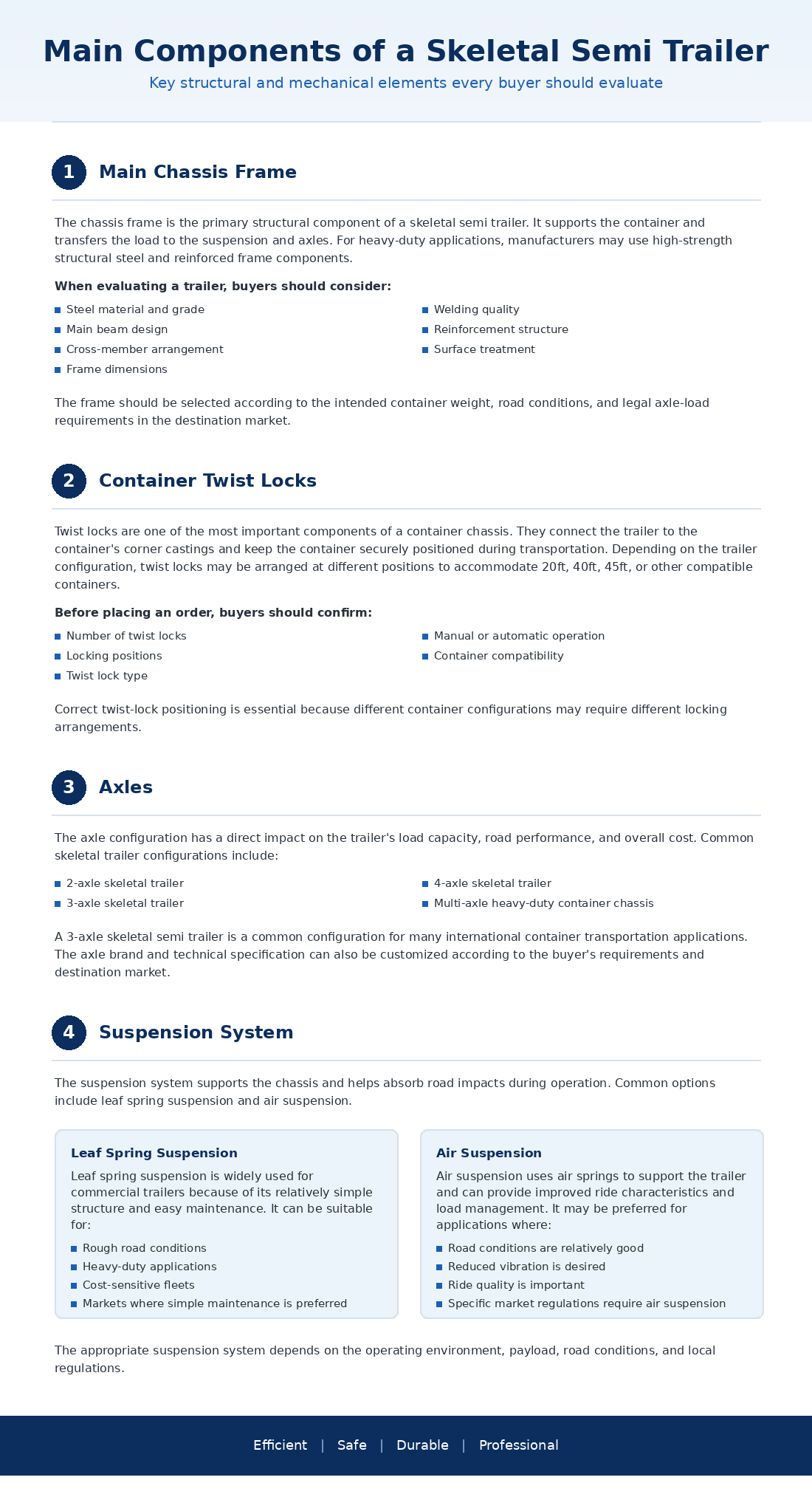
1. Main Chassis Frame
The chassis frame is the primary structural component of a skeletal semi trailer.
It supports the container and transfers the load to the suspension and axles. For heavy-duty applications, manufacturers may use high-strength structural steel and reinforced frame components.
When evaluating a trailer, buyers should consider:
-
Steel material and grade
-
Main beam design
-
Cross-member arrangement
-
Frame dimensions
-
Welding quality
-
Reinforcement structure
-
Surface treatment
The frame should be selected according to the intended container weight, road conditions, and legal axle-load requirements in the destination market.
2. Container Twist Locks
Twist locks are one of the most important components of a container chassis.
They connect the trailer to the container's corner castings and keep the container securely positioned during transportation.
Depending on the trailer configuration, twist locks may be arranged at different positions to accommodate 20ft, 40ft, 45ft, or other compatible containers.
Before placing an order, buyers should confirm:
-
Number of twist locks
-
Locking positions
-
Twist lock type
-
Manual or automatic operation
-
Container compatibility
Correct twist-lock positioning is essential because different container configurations may require different locking arrangements.
3. Axles
The axle configuration has a direct impact on the trailer's load capacity, road performance, and overall cost.
Common skeletal trailer configurations include:
-
2-axle skeletal trailer
-
3-axle skeletal trailer
-
4-axle skeletal trailer
-
Multi-axle heavy-duty container chassis
A 3-axle skeletal semi trailer is a common configuration for many international container transportation applications.
The axle brand and technical specification can also be customized according to the buyer's requirements and destination market.
4. Suspension System
The suspension system supports the chassis and helps absorb road impacts during operation.
Common options include leaf spring suspension and air suspension.
Leaf Spring Suspension
Leaf spring suspension is widely used for commercial trailers because of its relatively simple structure and easy maintenance.
It can be suitable for:
-
Rough road conditions
-
Heavy-duty applications
-
Cost-sensitive fleets
-
Markets where simple maintenance is preferred
Air Suspension
Air suspension uses air springs to support the trailer and can provide improved ride characteristics and load management.
It may be preferred for applications where:
-
Road conditions are relatively good
-
Reduced vibration is desired
-
Ride quality is important
-
Specific market regulations require air suspension
The appropriate suspension system depends on the operating environment, payload, road conditions, and local regulations.
Skeletal Semi Trailer Sizes and Container Compatibility
Container compatibility should be confirmed before purchasing a skeletal semi trailer.
Common container sizes include:
| Container Type | Typical Application |
|---|---|
| 20ft container | Short and regional container transportation |
| 40ft container | Standard international container transportation |
| 45ft container | High-volume container logistics |
| 20ft / 40ft combination | Flexible fleet applications |
Not every skeletal trailer can transport every container size or combination.
The chassis must have the correct dimensions and twist-lock positions for the intended containers.
Before ordering, buyers should confirm:
-
Container length
-
Container height
-
Maximum gross weight
-
Corner casting position
-
Twist-lock locations
-
Local legal requirements
For fleet operators transporting different container sizes, a flexible chassis configuration can provide broader operating capability.
20ft vs 40ft Skeletal Semi Trailer
20ft Skeletal Trailer
A 20ft skeletal trailer is designed primarily for transporting standard 20ft containers.
Typical applications include:
-
Port drayage
-
Regional container delivery
-
Short-distance logistics
-
Industrial container transportation
Its compact configuration can be practical for operations where 20ft containers represent a large proportion of the fleet's workload.
40ft Skeletal Trailer
A 40ft skeletal trailer is designed for transporting longer containers and is widely used in international container logistics.
Typical applications include:
-
Port-to-warehouse transportation
-
Long-distance container transport
-
Freight forwarding
-
Distribution logistics
-
Container fleet operations
For companies handling both 20ft and 40ft containers, a multi-position skeletal chassis may provide greater flexibility.
Skeletal Container Trailer – Extendable Multi-Axle Chassis
This heavy-duty skeletal semi trailer is engineered for efficient, flexible container transport. Its slim, open-frame chassis is built from high-strength steel beams, keeping tare weight low while maintaining excellent load-bearing capacity. The extendable rear platform allows the trailer to adapt to different container lengths, making it a versatile choice for mixed-cargo operations.
Riding on a tri-axle configuration with heavy-duty suspension and dual-wheel assemblies, the trailer offers stable handling and reliable performance across yard, port, and highway conditions. The compact rear landing gear, side storage box, and protective mudguards round out a design focused on durability and ease of daily operation.
What Can a Skeletal Semi Trailer Carry?
Think of it as the ultimate container workhorse. Its open, ladder-style frame is built specifically to carry standard shipping containers — 20ft, 40ft, or 45ft — securely locked in place with twist locks at the corners.
It's the trailer you'll see hauling goods from ports to warehouses, moving everything from electronics and furniture to machinery parts, food products, and building materials — basically anything that ships in a container. Because the frame itself is open (no solid deck), it's lighter than a flatbed, which means more payload capacity and better fuel efficiency on long hauls.
It's a favorite for port drayage, cross-border freight, and everyday container logistics where speed, simplicity, and reliability matter most
Skeletal Semi Trailer Braking System
The braking system is a critical part of any commercial trailer.
Depending on the destination market and customer requirements, a skeletal semi trailer may be equipped with:
-
Air brake system
-
ABS
-
EBS
-
Brake chambers
-
Relay valves
-
Air reservoirs
-
Brake pipelines
For some export markets, EBS (Electronic Braking System) may be required or preferred.
The braking configuration should be selected according to the local regulations, towing vehicle compatibility, operating conditions, and certification requirements.
Before production, overseas buyers should confirm the required braking standard with the manufacturer.
Wheels and Tires
Tires and wheels affect the trailer's load capacity, operating cost, and compatibility with the customer's existing fleet.
A common heavy-duty commercial trailer tire specification is 12R22.5, although other sizes may be available depending on the target market.
Buyers should confirm:
-
Tire size
-
Tire brand
-
Load rating
-
Rim specification
-
Number of tires
-
Spare tire requirements
For fleet operators, using tire and wheel specifications compatible with existing vehicles can simplify spare-parts management and maintenance.
Common Applications of Skeletal Semi Trailers
Skeletal semi trailers are primarily designed for container transportation.
Port and Terminal Transportation
They are commonly used to move containers between ports, container terminals, warehouses, and logistics facilities.
Intermodal Transportation
Skeletal trailers can support road transportation as part of an intermodal logistics chain involving road, rail, and sea transportation.
International Container Logistics
Importers, exporters, freight forwarders, and logistics companies use container chassis to move shipping containers between ports and inland destinations.
Container Fleet Operations
Large logistics companies may operate fleets of skeletal semi trailers for regular container transportation.
Tank Container Transportation
Some specialized skeletal trailer configurations can be designed to transport tank containers.
The chassis configuration must be suitable for the specific tank container dimensions, weight, and locking requirements.
What Affects Skeletal Semi Trailer Price?
The price of a skeletal semi trailer depends on its technical configuration rather than simply its basic dimensions.
Several factors can affect the final quotation.
Axle Configuration
A 2-axle, 3-axle, and multi-axle trailer will have different manufacturing costs and load capabilities.
Axle Brand
Different axle brands and specifications can affect both the initial price and long-term maintenance requirements.
Suspension System
Leaf spring and air suspension have different costs and are suitable for different operating conditions.
Twist Lock Configuration
The number, position, and type of twist locks can affect the chassis design and final price.
Braking System
ABS, EBS, and other braking configurations may have different component and installation costs.
Frame Design
Heavy-duty applications may require reinforced beams, stronger cross members, and higher-grade structural materials.
Tires and Wheels
Tire brand, size, quantity, and load rating all contribute to the total trailer price.
Surface Treatment
Depending on the market, buyers may choose:
-
Spray painting
-
Powder coating
-
Galvanizing
-
Customized anti-corrosion treatment
Export Requirements
Different countries may require different:
-
Lighting systems
-
Electrical connectors
-
Braking systems
-
Safety equipment
-
Certification
-
Reflective markings
-
Road compliance specifications
For this reason, buyers should compare complete trailer specifications rather than comparing quotations based only on the headline price.
How to Choose the Right Skeletal Semi Trailer
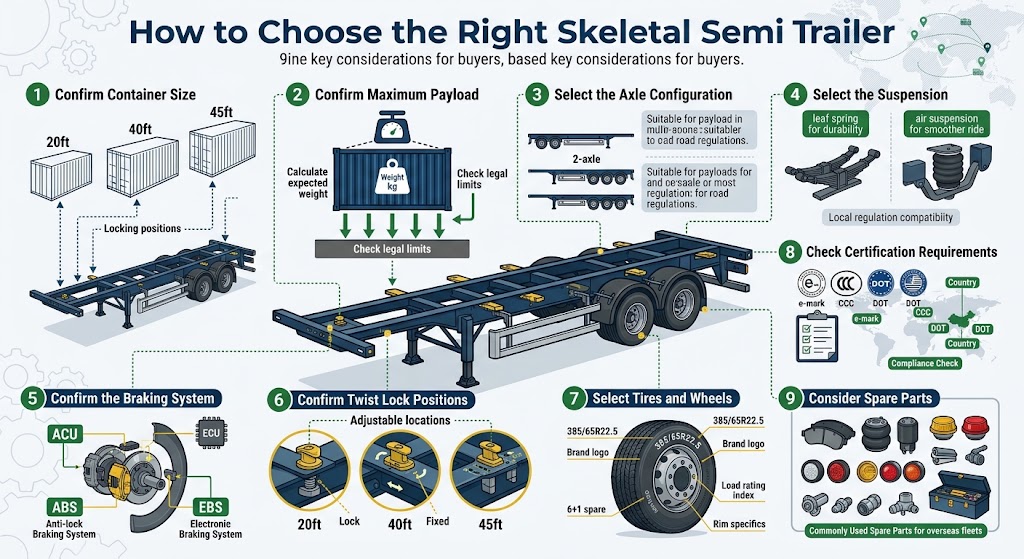
Before requesting a quotation, overseas buyers should define their actual operating requirements.
1. Confirm Container Size
Determine which containers the trailer will transport:
-
20ft
-
40ft
-
45ft
-
Other compatible container types
2. Confirm Maximum Payload
Calculate the expected container weight and check the legal axle-load limits in the destination market.
3. Select the Axle Configuration
Choose the appropriate number of axles based on payload, road regulations, and operating conditions.
4. Select the Suspension
Choose leaf spring or air suspension according to road conditions, maintenance requirements, and local regulations.
5. Confirm the Braking System
Determine whether ABS, EBS, or another braking configuration is required.
6. Confirm Twist Lock Positions
Make sure the locking positions match the container sizes that your fleet will transport.
7. Select Tires and Wheels
Confirm tire size, brand, quantity, load rating, and rim specifications.
8. Check Certification Requirements
Before production, verify the certification and compliance requirements of the destination country.
9. Consider Spare Parts
For overseas fleets, commonly used spare parts should be considered when selecting the trailer configuration.
Buying Skeletal Semi Trailers from China
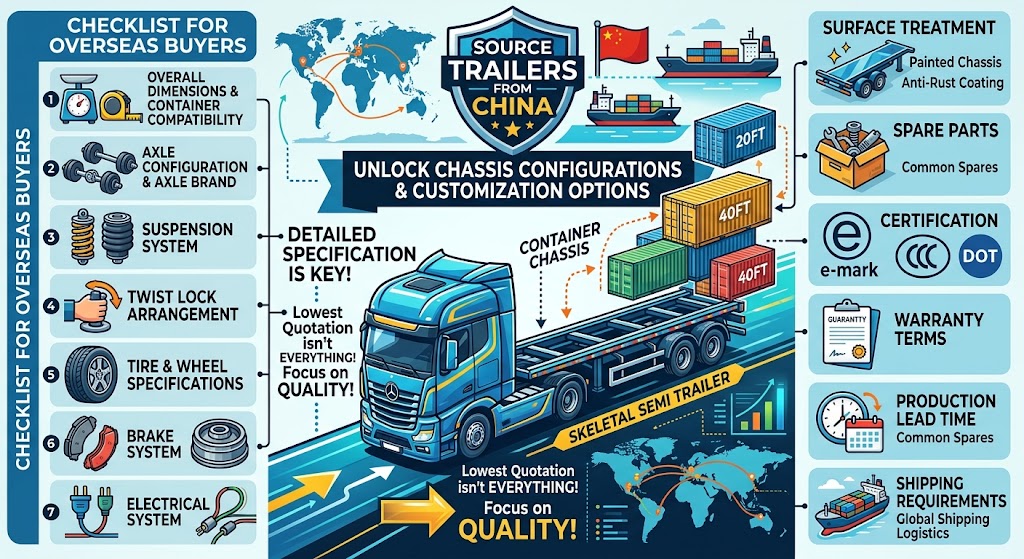
China is an important manufacturing and export market for commercial trailers, including skeletal semi trailers and container chassis trailers.
For overseas buyers, sourcing directly from a Chinese trailer manufacturer can provide access to different chassis configurations and customization options.
However, the lowest quotation is not necessarily the only factor to consider.
Before placing an order, buyers should request a detailed specification covering:
-
Overall dimensions
-
Container compatibility
-
Axle configuration
-
Axle brand
-
Suspension system
-
Twist lock arrangement
-
Tire and wheel specifications
-
Brake system
-
Electrical system
-
Surface treatment
-
Spare parts
-
Certification
-
Warranty terms
-
Production lead time
-
Shipping requirements
A detailed configuration sheet helps both the buyer and manufacturer confirm exactly what will be supplied.
What Should You Check When Choosing a Skeletal Trailer Manufacturer?
Choosing a suitable skeletal trailer manufacturer involves more than comparing prices.
Product Specifications
The manufacturer should be able to provide detailed technical specifications for the chassis, axles, suspension, brakes, twist locks, tires, and other major components.
Customization Capability
Different markets may have different requirements for dimensions, axle loads, braking systems, lighting, electrical connections, and container compatibility.
The manufacturer should be able to configure the trailer according to the buyer's operating requirements.
Component Selection
Major components should be clearly identified in the quotation and technical specification.
This includes:
-
Axles
-
Suspension
-
Braking system
-
Twist locks
-
Tires
-
Wheels
-
Landing gear
-
Electrical components
Quality Control
Buyers should understand how the manufacturer checks welding, frame dimensions, axle installation, braking systems, lighting, and overall trailer assembly before shipment.
Export Experience
International export experience can be important when the trailer needs to meet specific destination-market requirements and shipping conditions.
Spare Parts and After-Sales Support
For overseas fleet operators, the availability of replacement parts and technical support can help reduce downtime.
Skeletal Semi Trailer vs Flatbed Semi Trailer
Although both trailer types can transport certain types of cargo, their structures and primary applications are different.
| Feature | Skeletal Semi Trailer | Flatbed Semi Trailer |
|---|---|---|
| Main Application | Container transportation | General cargo transportation |
| Main Structure | Open skeletal chassis | Full flat loading platform |
| Twist Locks | Standard feature | Optional depending on design |
| Container Transport | Specialized | Possible with suitable configuration |
| General Cargo | Limited | Suitable for many cargo types |
| Loading Flexibility | Mainly designed for containers | High |
| Typical Applications | Ports and container logistics | Machinery, steel, construction materials, general cargo |
A skeletal trailer is primarily designed around container transportation, while a flatbed semi trailer provides a larger and more versatile loading platform for general cargo.
Frequently Asked Questions About Skeletal Semi Trailers
What is a skeletal semi trailer?
A skeletal semi trailer is an open-frame trailer designed primarily for transporting shipping containers. It normally uses twist locks to secure the container to the chassis.
What is another name for a skeletal trailer?
A skeletal trailer is commonly called a container chassis, container chassis trailer, or skeletal container trailer, depending on the market and industry terminology.
Can a skeletal trailer carry both 20ft and 40ft containers?
Some skeletal trailers are designed with multiple twist-lock positions and can accommodate both 20ft and 40ft containers. However, compatibility depends on the specific chassis design.
How many axles does a skeletal semi trailer have?
Common configurations include 2-axle and 3-axle skeletal trailers, while heavy-duty applications may use four or more axles depending on local regulations and payload requirements.
What is the difference between a skeletal trailer and a flatbed trailer?
A skeletal trailer is primarily designed for containers and uses twist locks to secure them. A flatbed trailer has a full loading platform and is designed for a wider range of general cargo.
Can a skeletal semi trailer be customized?
Yes. Depending on the manufacturer, buyers can typically customize axle configuration, suspension, twist-lock positions, tires, wheels, braking systems, electrical components, dimensions, and surface treatment.
What tire size is commonly used on skeletal trailers?
12R22.5 is a common heavy-duty commercial trailer tire specification, but the appropriate tire size depends on the trailer configuration and destination-market requirements.
How much does a skeletal semi trailer cost?
The final price depends on factors such as axle configuration, steel specification, suspension, twist locks, braking system, tires, dimensions, surface treatment, and export requirements. Buyers should request a detailed configuration-based quotation rather than relying on a general price range.
Final Thoughts
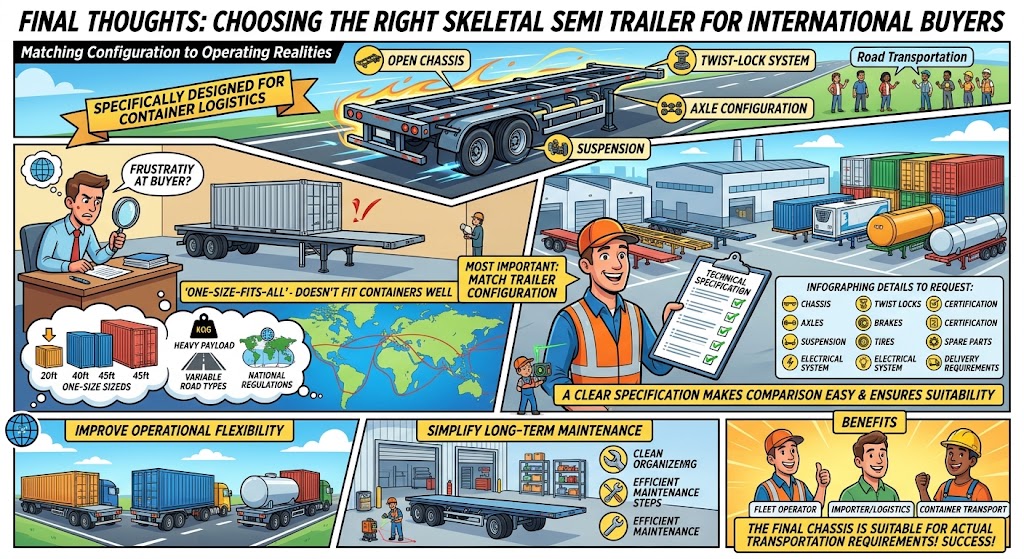
A skeletal semi trailer provides a practical solution for road transportation of shipping containers. Its open chassis design, twist-lock system, axle configuration, suspension, and braking system are specifically designed around container logistics.
For international buyers, the most important step is to match the trailer configuration with the intended container sizes, payload requirements, road conditions, and regulations of the destination market.
When purchasing a skeletal semi trailer from China, buyers should request a complete technical specification covering the chassis, axles, suspension, twist locks, brakes, tires, electrical system, certification, spare parts, and delivery requirements.
A clear specification makes supplier comparison easier and helps ensure that the final container chassis is suitable for the buyer's actual transportation requirements.
For fleet operators, importers, logistics companies, and container transport businesses, choosing the right skeletal trailer configuration can also help improve operational flexibility and simplify long-term fleet maintenance.
Welcome to our website to learn more about our products; please feel free to contact us with any inquiries.