
Flatbed vs Reefer Trailer: Which One Is Right for Your Cargo?
Flatbed vs Reefer Trailer: Which One Is Right for Your Cargo?
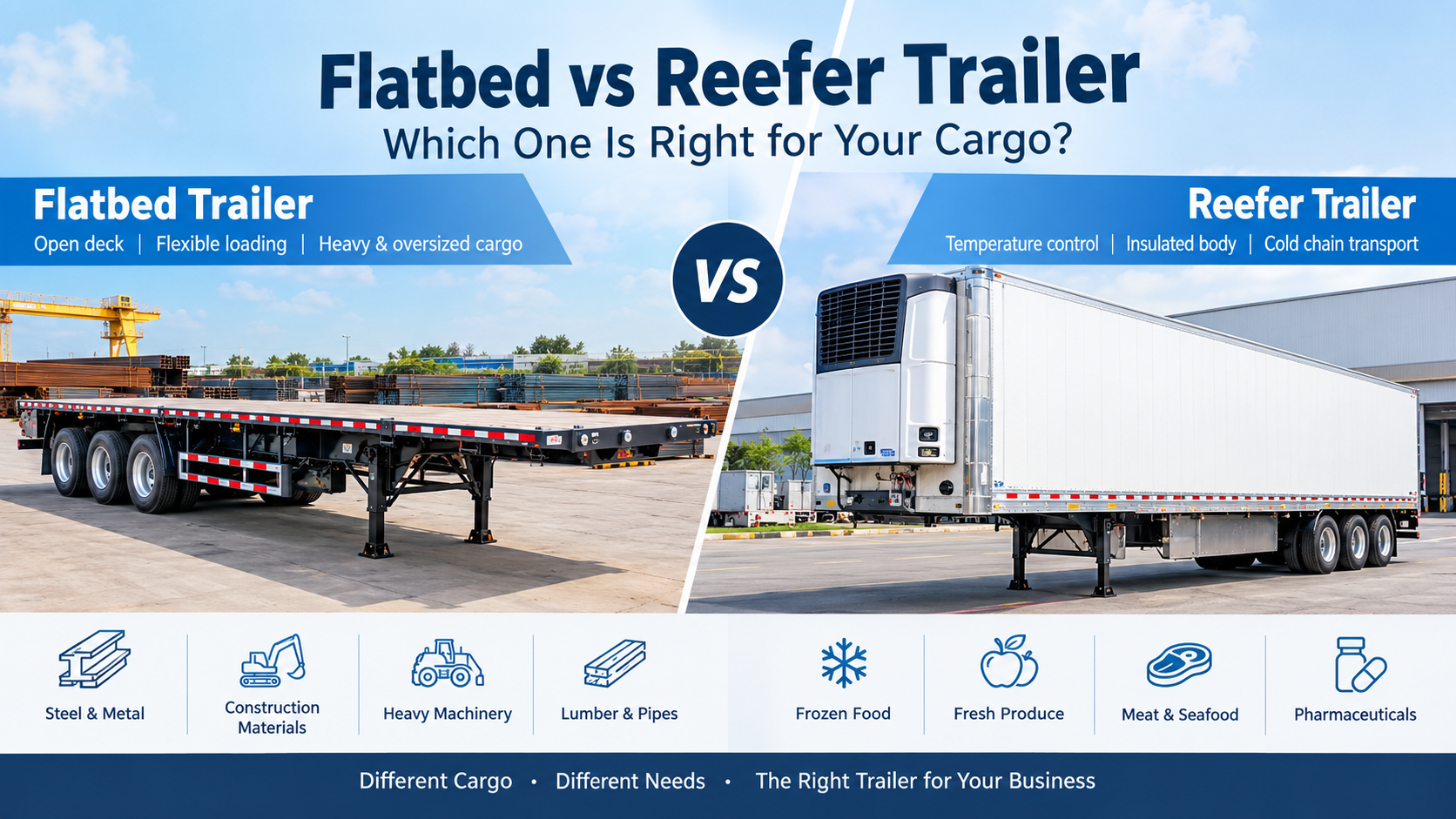
Choosing the right semi trailer is an important decision for fleet owners, logistics companies, freight operators, and overseas trailer buyers. Two very different options are the flatbed trailer and the reefer trailer.
A flatbed trailer is designed around flexibility. Its open deck allows cargo to be loaded from the side or from above, making it suitable for machinery, steel, construction materials, pipes, lumber, and other large or irregular loads.
A reefer trailer, also known as a refrigerated trailer, is designed around temperature control. It combines an insulated cargo body with a refrigeration unit to transport goods that need to remain within a controlled temperature range.
So, when comparing flatbed vs reefer, the question is not simply which trailer is better. The real question is:
Which trailer is better suited to your cargo, loading method, transportation route, and operating requirements?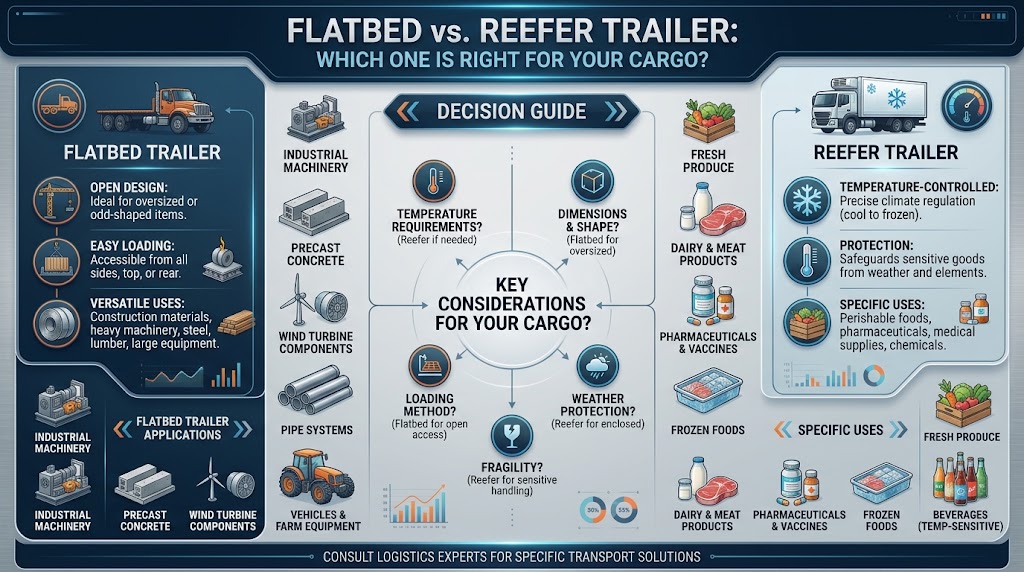
Flatbed vs Reefer: Quick Comparison
| Feature | Flatbed Trailer | Reefer Trailer |
|---|---|---|
| Trailer Type | Open-deck semi trailer | Refrigerated enclosed semi trailer |
| Main Purpose | Heavy, oversized, and irregular cargo | Temperature-sensitive cargo |
| Cargo Protection | Open to weather unless covered | Enclosed and insulated |
| Temperature Control | No | Yes |
| Loading Method | Top, side, or rear | Mainly rear loading |
| Typical Cargo | Steel, machinery, lumber, pipes, construction materials | Frozen food, fresh produce, meat, dairy, pharmaceuticals |
| Refrigeration Unit | No | Yes |
| Cargo Securing | Straps, chains, tarps, etc. | Internal load restraint and proper airflow |
| Maintenance | Relatively simple structure | More complex due to refrigeration equipment |
| Best For | Flexible industrial transportation | Cold-chain logistics |
The basic difference is straightforward: flatbeds are built for cargo flexibility, while reefers are built for temperature control. Flatbeds are commonly used when cargo is too large or awkward to load into an enclosed trailer, while reefers are used when maintaining cargo temperature is essential.
What Is a Flatbed Trailer?
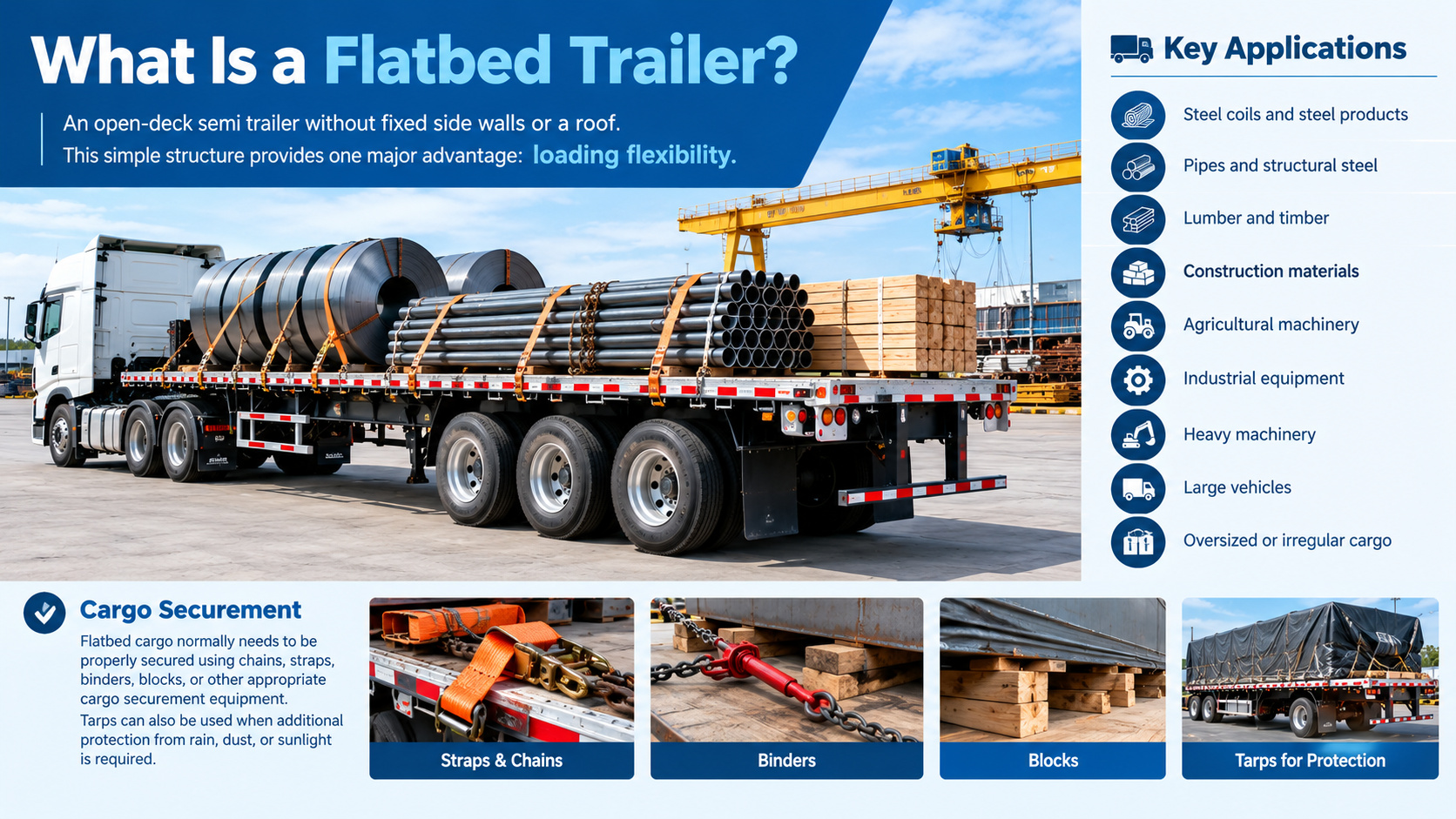
A flatbed trailer is an open-deck semi trailer without fixed side walls or a roof.
This simple structure provides one major advantage: loading flexibility.
Cargo can often be loaded from the rear, side, or above using forklifts, cranes, or other lifting equipment. This makes flatbed trailers especially useful for cargo that cannot easily pass through the doors of an enclosed trailer.
Typical flatbed trailer applications include:
-
Steel coils and steel products
-
Pipes and structural steel
-
Lumber and timber
-
Construction materials
-
Agricultural machinery
-
Industrial equipment
-
Heavy machinery
-
Large vehicles
-
Oversized or irregular cargo
Flatbed cargo normally needs to be properly secured using chains, straps, binders, blocks, or other appropriate cargo securement equipment. Tarps can also be used when additional protection from rain, dust, or sunlight is required.
Main Advantages of Flatbed Trailers
1. Flexible loading
The open deck allows loading from multiple directions. This is especially valuable at construction sites, industrial facilities, and locations without standard loading docks.
2. Suitable for oversized cargo
Large machinery and long materials may not fit inside an enclosed trailer. A flatbed provides significantly more loading flexibility.
3. Easy cargo access
Because there are no fixed side walls or roof, workers can access cargo more easily during loading and unloading.
4. Simple trailer structure
Compared with a refrigerated trailer, a standard flatbed has fewer specialized components. This can simplify maintenance and reduce equipment complexity.
5. Wide range of applications
A flatbed can transport many types of industrial and commercial cargo, making it a practical choice for construction, manufacturing, agriculture, and general heavy-duty transportation.
What Is a Reefer Trailer?
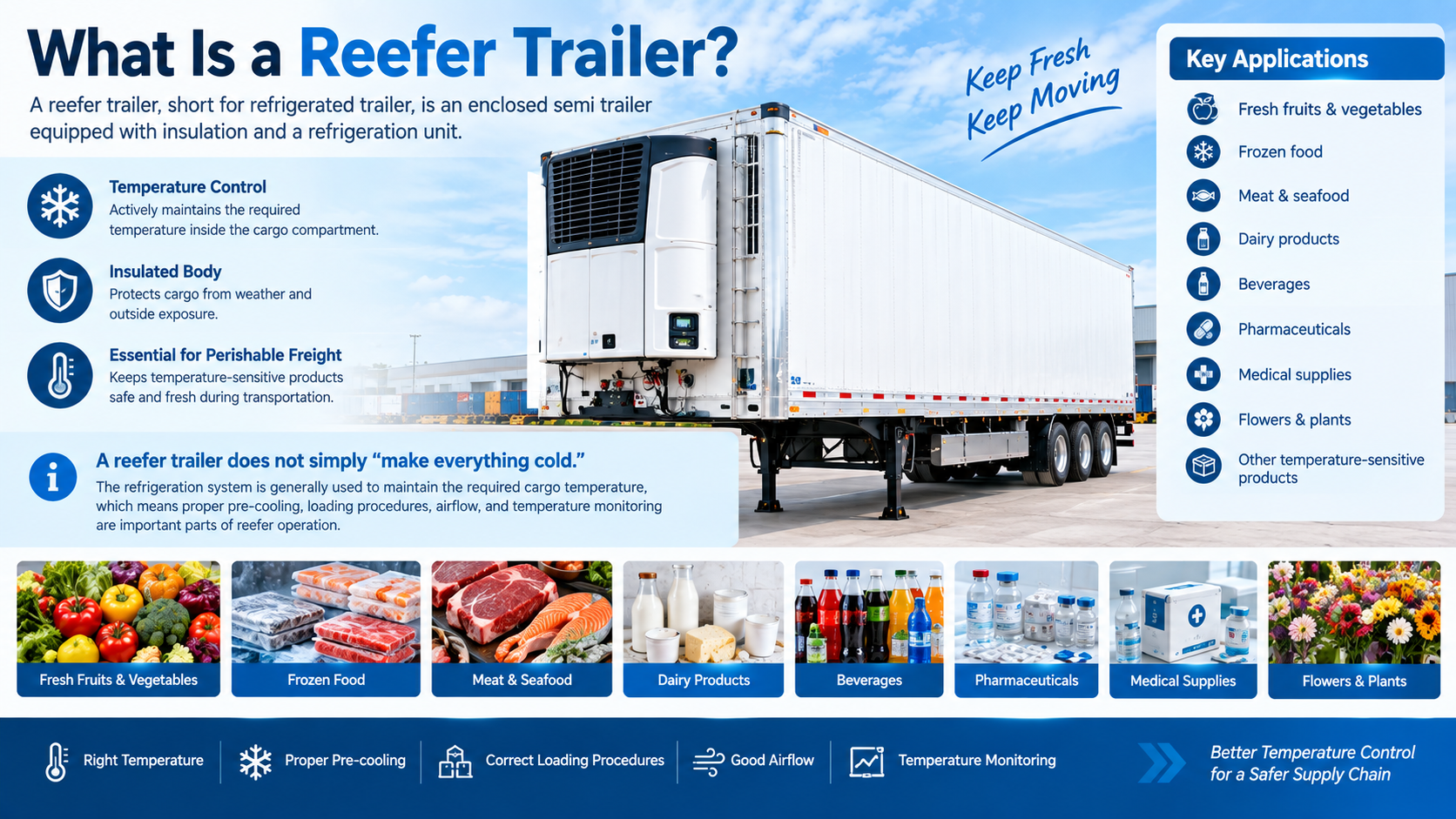
A reefer trailer, short for refrigerated trailer, is an enclosed semi trailer equipped with insulation and a refrigeration unit.
Unlike a standard enclosed trailer that mainly protects cargo from weather and outside exposure, a reefer is designed to actively control the temperature inside the cargo compartment.
This makes reefer trailers essential for temperature-sensitive and perishable freight. Common applications include:
-
Fresh fruits and vegetables
-
Frozen food
-
Meat and seafood
-
Dairy products
-
Beverages
-
Pharmaceuticals
-
Medical supplies
-
Flowers and plants
-
Other temperature-sensitive products
A reefer trailer does not simply "make everything cold." The refrigeration system is generally used to maintain the required cargo temperature, which means proper pre-cooling, loading procedures, airflow, and temperature monitoring are important parts of reefer operation.
Main Advantages of Reefer Trailers
1. Temperature control
The primary advantage is the ability to maintain a controlled temperature during transportation.
2. Protection from outside conditions
The insulated body provides an additional barrier against external heat, cold, dust, rain, and other environmental conditions.
3. Suitable for cold-chain logistics
Reefers are widely used in food, pharmaceutical, healthcare, and other temperature-sensitive supply chains.
4. Flexible temperature applications
Depending on the equipment specification and cargo requirements, reefer trailers can be configured for chilled or frozen transportation.
5. Suitable for long-distance transportation
For companies operating temperature-sensitive freight over long distances, reefer equipment can help maintain product quality throughout the transportation process.
Flatbed vs Reefer: Which Cargo Should You Choose?
The easiest way to choose between a flatbed and reefer is to start with the cargo itself.
Choose a Flatbed Trailer If:
Your cargo is:
-
Heavy
-
Oversized
-
Long or wide
-
Irregularly shaped
-
Loaded by crane or forklift
-
Not temperature-sensitive
-
Difficult to load through rear doors
For example, construction machinery, steel beams, pipes, timber, and industrial equipment are generally better suited to flatbed transportation.
Choose a Reefer Trailer If:
Your cargo:
-
Requires controlled temperature
-
Is perishable
-
Is sensitive to heat or freezing
-
Requires cold-chain transportation
-
Has strict temperature requirements
-
Needs protection from external temperature changes
For example, frozen food, fresh produce, meat, dairy products, and many pharmaceutical products are typical reefer cargo.
The decision should therefore be based on cargo requirements rather than simply trailer price.
Flatbed vs Reefer: Loading and Unloading
Loading method is another major difference.
Flatbed Loading
Flatbeds provide excellent access because the cargo area is open.
Depending on the cargo, loading can be performed using:
-
Forklifts
-
Cranes
-
Side loading equipment
-
Rear loading equipment
This is one reason flatbeds are widely used for industrial and construction cargo.
However, because the cargo is exposed, proper cargo securement is critical. Weather conditions and cargo dimensions should also be considered before transportation.
Reefer Loading
Reefer trailers normally use rear loading through the trailer doors.
Because the trailer is insulated and temperature-controlled, loading procedures need to consider:
-
Required cargo temperature
-
Pre-cooling requirements
-
Air circulation
-
Cargo spacing
-
Door-open time
-
Temperature monitoring
For temperature-sensitive freight, the loading process can have a direct impact on cargo quality. A reefer is therefore not simply an enclosed trailer with a cooling unit; the entire loading and temperature-management process matters.
Flatbed vs Reefer: Maintenance Requirements
Maintenance is another important consideration for fleet owners.
Flatbed Maintenance
A flatbed has a relatively straightforward mechanical structure. Regular inspections normally focus on:
-
Axles
-
Suspension
-
Braking system
-
Tires and wheels
-
Landing gear
-
Main frame
-
Deck condition
-
Cargo securement equipment
-
Lighting and electrical components
If the trailer is frequently used for heavy-duty cargo, frame condition and suspension performance deserve particular attention.
Reefer Maintenance
A reefer requires all the normal trailer maintenance mentioned above, plus maintenance of the refrigeration system.
Important components may include:
-
Refrigeration unit
-
Compressor
-
Condenser
-
Evaporator
-
Temperature sensors
-
Insulated body
-
Door seals
-
Electrical system
This means reefer trailers generally involve more specialized maintenance than standard flatbed trailers.
For fleet operators, the total operating cost should therefore include not only the trailer purchase price but also refrigeration fuel consumption, servicing, spare parts, and technical support.
Flatbed vs Reefer: Cost Considerations
The purchase price is only one part of the total cost of ownership.
A flatbed trailer generally has a simpler structure because it does not require an insulated cargo body or refrigeration unit.
A reefer trailer requires additional equipment, including:
-
Insulated walls
-
Refrigeration unit
-
Temperature-control system
-
Specialized doors and seals
-
Temperature monitoring equipment
As a result, reefer equipment normally involves higher equipment complexity and operating requirements.
For international buyers, the total purchasing cost should be evaluated together with:
Trailer price + shipping + customs + spare parts + maintenance + operating costs + after-sales support.
For fleet operators, the right trailer is the one that generates the best operational value for the intended cargo rather than simply the lowest initial purchase price.
Flatbed vs Reefer for International Trailer Buyers
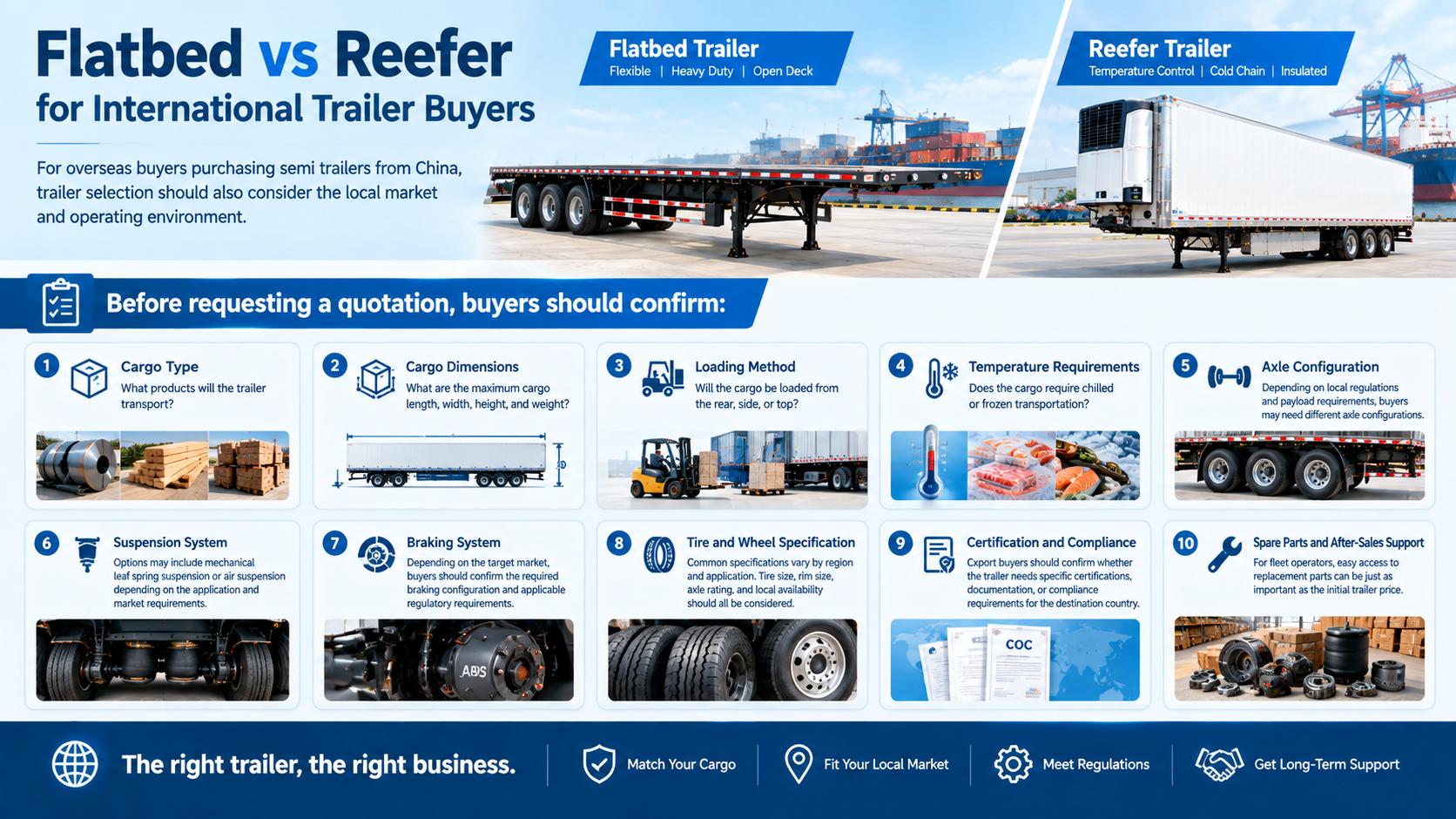
For overseas buyers purchasing semi trailers from China, trailer selection should also consider the local market and operating environment
Before requesting a quotation, buyers should confirm:
1. Cargo Type
What products will the trailer transport?
2. Cargo Dimensions
What are the maximum cargo length, width, height, and weight?
3. Loading Method
Will the cargo be loaded from the rear, side, or top?
4. Temperature Requirements
Does the cargo require chilled or frozen transportation?
5. Axle Configuration
Depending on local regulations and payload requirements, buyers may need different axle configurations.
6. Suspension System
Options may include mechanical leaf spring suspension or air suspension depending on the application and market requirements.
7. Braking System
Depending on the target market, buyers should confirm the required braking configuration and applicable regulatory requirements.
8. Tire and Wheel Specification
Common specifications vary by region and application. Tire size, rim size, axle rating, and local availability should all be considered.
9. Certification and Compliance
Export buyers should confirm whether the trailer needs specific certifications, documentation, or compliance requirements for the destination country.
10. Spare Parts and After-Sales Support
For fleet operators, easy access to replacement parts can be just as important as the initial trailer price.
Flatbed or Reefer: Which One Is Better?
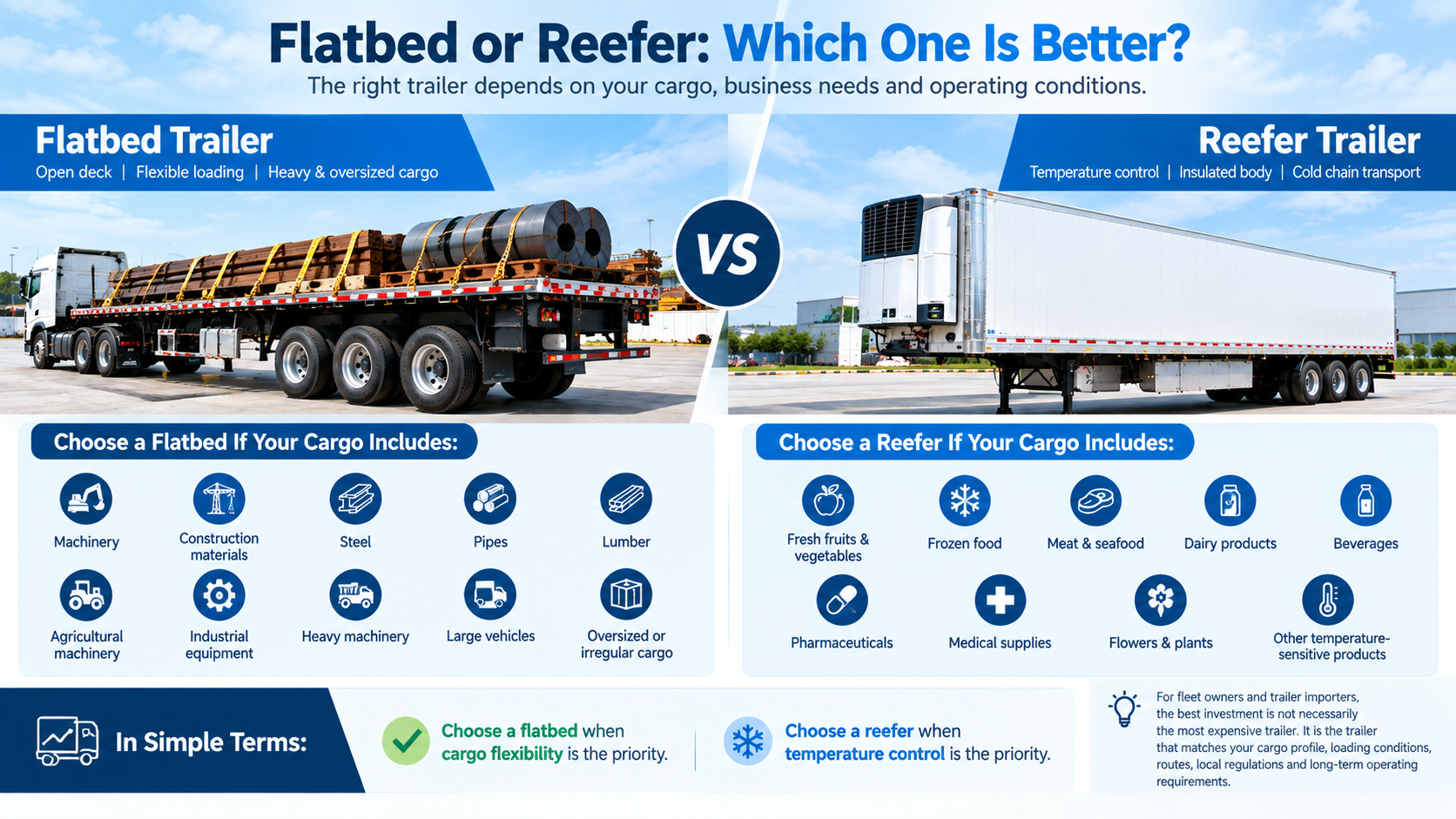
There is no universal winner in the flatbed vs reefer comparison
A flatbed is the better choice when your business focuses on machinery, construction materials, steel, pipes, lumber, and other heavy or irregular cargo.
A reefer is the better choice when your business handles food, pharmaceuticals, fresh produce, frozen goods, dairy products, or other temperature-sensitive cargo.
In simple terms:
Choose a flatbed when cargo flexibility is the priority.
Choose a reefer when temperature control is the priority.
For fleet owners and trailer importers, the best investment is not necessarily the most expensive trailer. It is the trailer that matches the cargo profile, loading conditions, routes, local regulations, and long-term operating requirements.
Final Checklist Before Buying a Semi Trailer
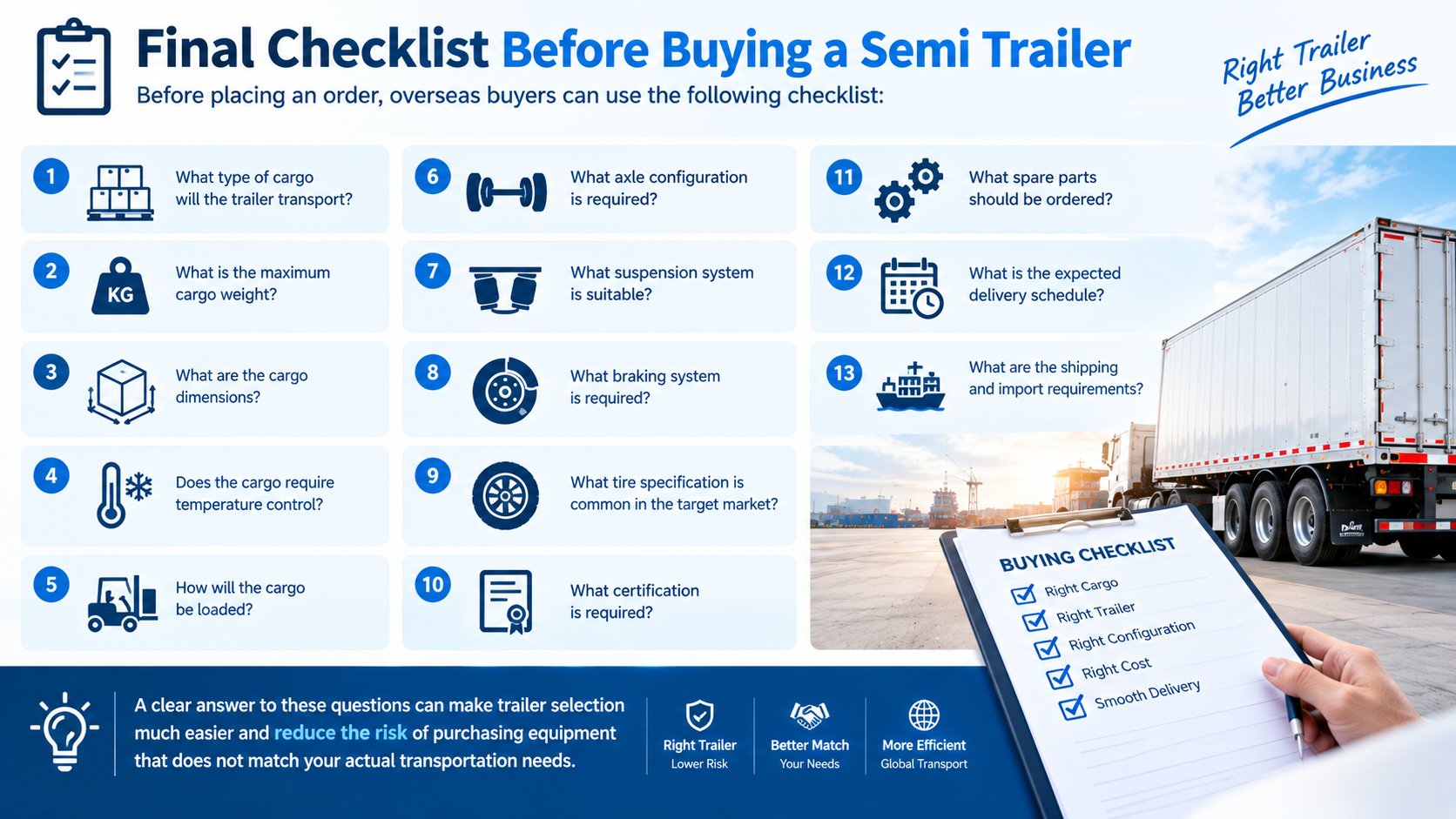
Before placing an order, overseas buyers can use the following checklist:
-
What type of cargo will the trailer transport?
-
What is the maximum cargo weight?
-
What are the cargo dimensions?
-
Does the cargo require temperature control?
-
How will the cargo be loaded?
-
What axle configuration is required?
-
What suspension system is suitable?
-
What braking system is required?
-
What tire specification is common in the target market?
-
What certification is required?
-
What spare parts should be ordered?
-
What is the expected delivery schedule?
-
What are the shipping and import requirements?
A clear answer to these questions can make trailer selection much easier and reduce the risk of purchasing equipment that does not match your actual transportation needs.
We invite you to visit our website and contact us promptly.