
Semi Trailer Types with Pictures: Complete Guide to 8 Common Trailer Types
Semi Trailer Types with Pictures: Complete Guide to 8 Common Trailer Types
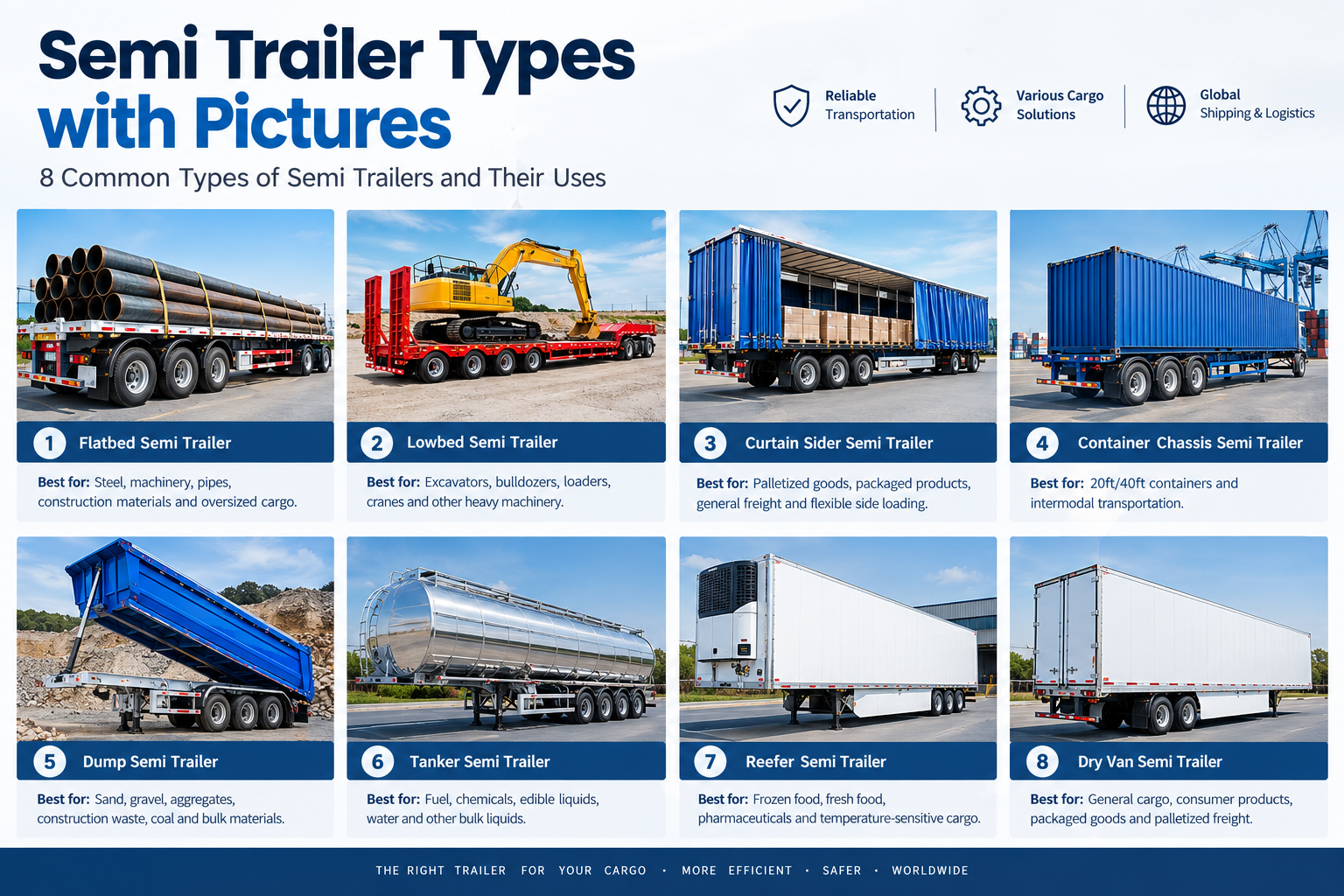
Choosing the right semi trailer starts with understanding the different trailer types available for commercial transportation. A semi trailer is not a one-size-fits-all piece of equipment. Its structure, deck height, body design, axle configuration, suspension system, and loading method are all designed around specific cargo and operating conditions.
For international buyers, importers, fleet operators, and logistics companies, knowing the main semi trailer types can make it easier to compare specifications, request accurate quotations, and select the right configuration for a particular market.
This guide introduces 8 common types of semi trailers, explains what each trailer is designed for, and highlights the key factors buyers should consider when purchasing trailers for domestic or international transportation.
What Is a Semi Trailer?
A semi trailer is a trailer without a front axle. Its front section connects to the tractor through a kingpin and fifth wheel, while the rear section is supported by the trailer's axle and suspension system.
Unlike a full trailer, part of the semi trailer's weight is carried by the tractor unit. This design allows semi trailers to handle a wide range of cargo, from general freight and containers to construction machinery, bulk materials, liquids, and temperature-sensitive products.
The design of a semi trailer varies significantly according to:
-
Cargo type
-
Cargo dimensions
-
Cargo weight
-
Loading method
-
Road conditions
-
Axle-load regulations
-
Local certification requirements
-
Suspension configuration
-
Braking system
-
Operating environment
For overseas buyers, these factors should be confirmed before requesting a final quotation.
1. Flatbed Semi Trailer
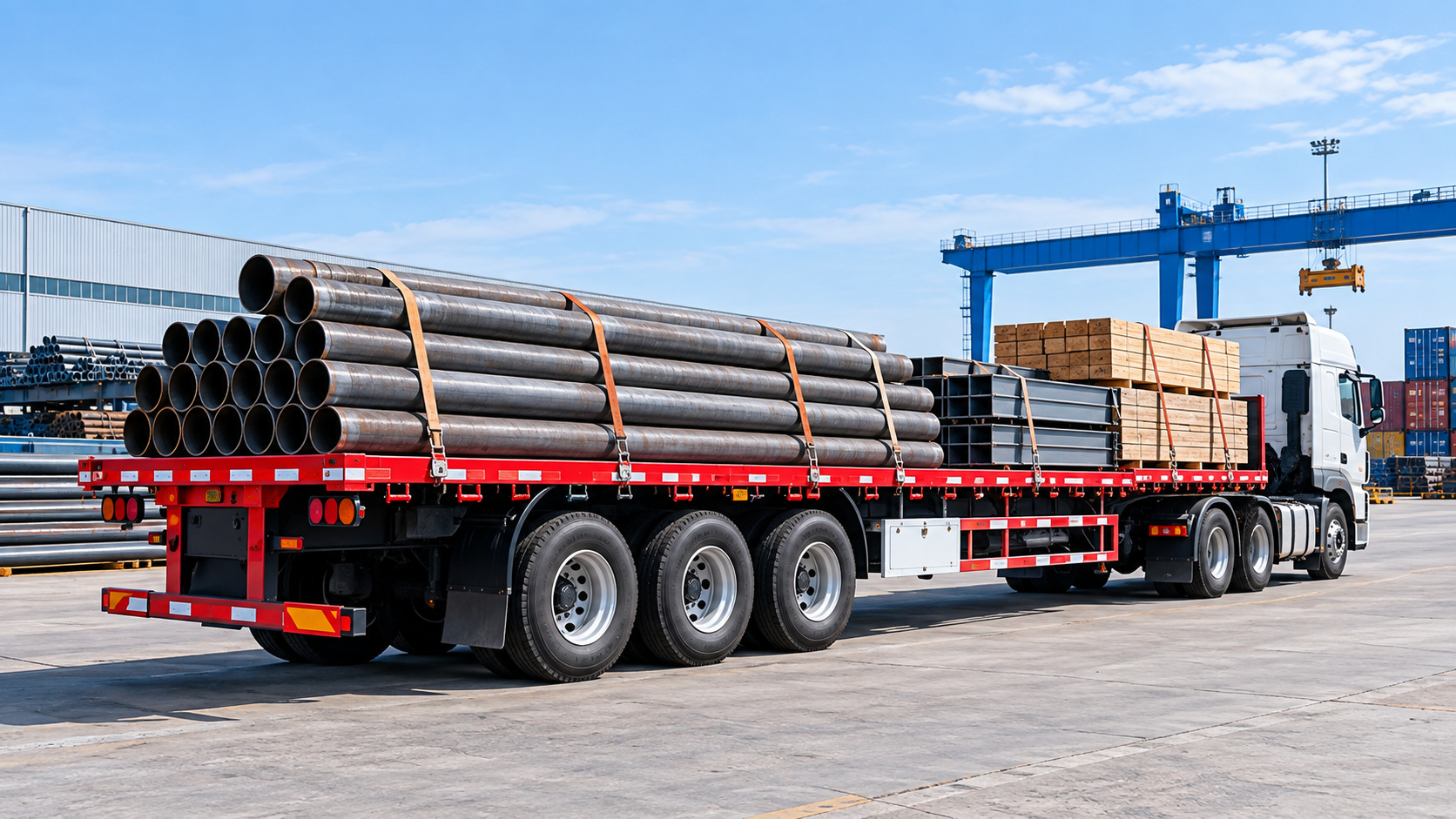
Best for: Steel, machinery, pipes, timber, construction materials, oversized and general cargo
A flatbed semi trailer features an open loading platform without a fixed roof or enclosed side walls. Its open structure allows cargo to be loaded from the rear, side, or top using forklifts, cranes, or other loading equipment.
Flatbed trailers are widely used for cargo that is too large, long, wide, or irregularly shaped to fit inside an enclosed trailer.
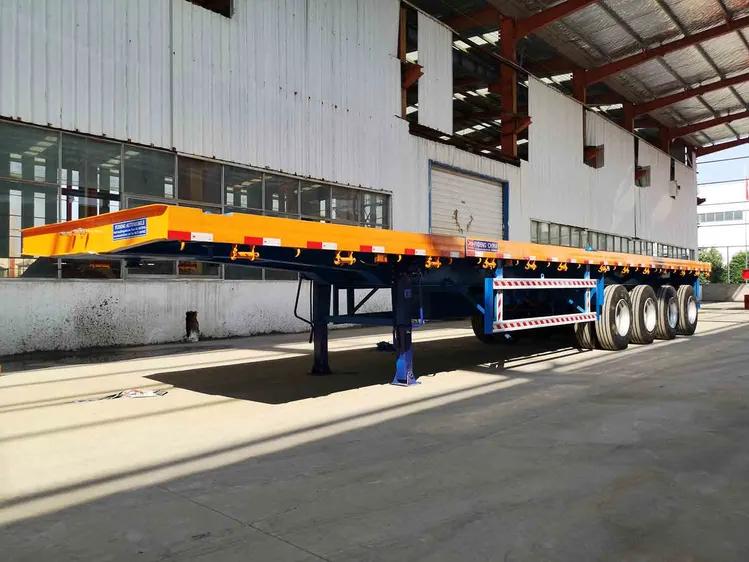
Typical applications include:
-
Steel coils and steel structures
-
Pipes and construction materials
-
Timber and lumber
-
Agricultural machinery
-
Industrial equipment
-
Building materials
-
Project cargo
The open deck provides excellent loading flexibility, but cargo normally requires appropriate tie-down equipment, chains, straps, or tarpaulins depending on the cargo and local regulations.
Typical export configurations may include 2-axle, 3-axle, or multi-axle designs, with leaf spring or air suspension depending on the market and payload requirements.
2. Lowbed / Lowboy Semi Trailer
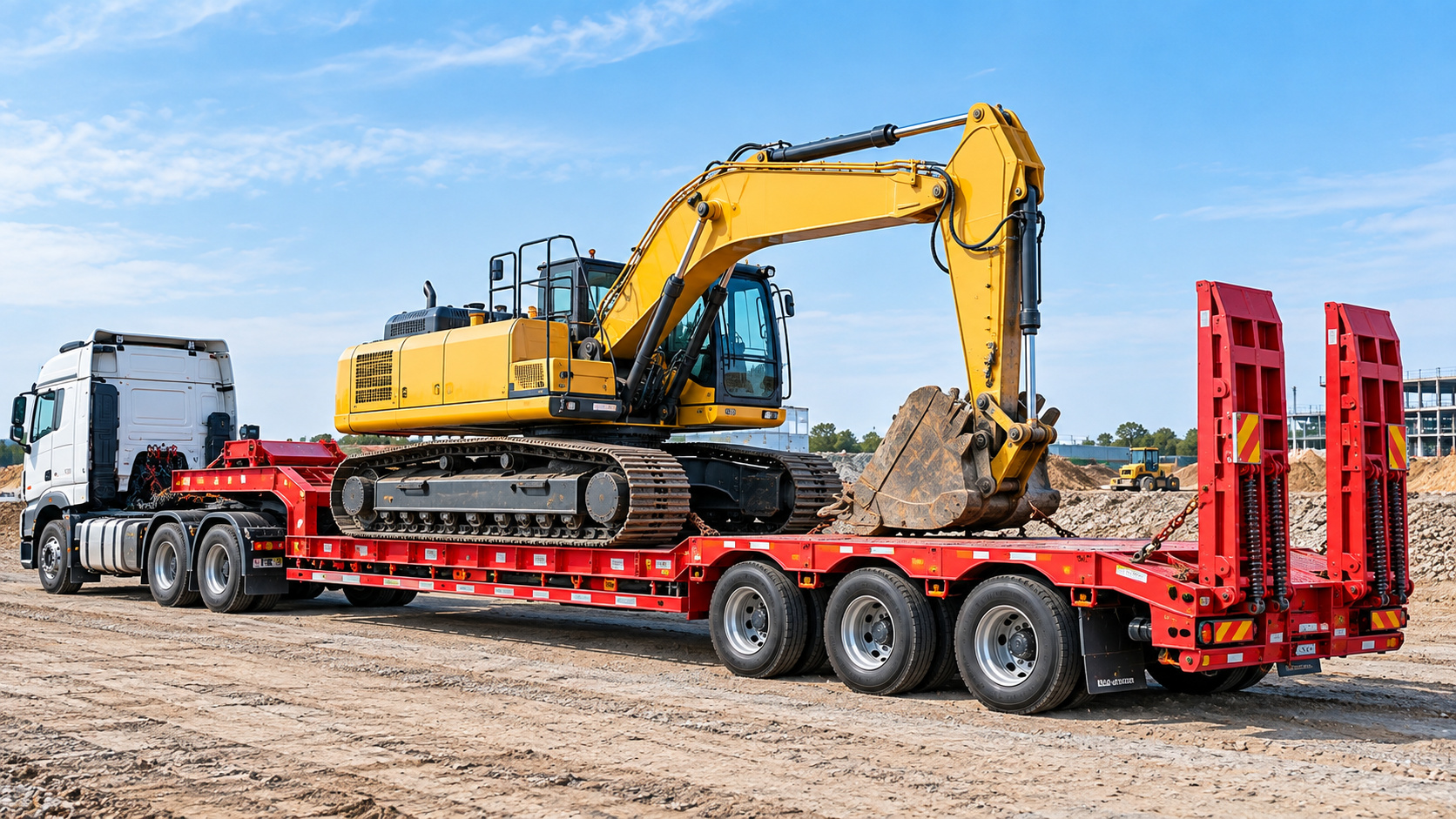
Best for: Excavators, bulldozers, loaders, cranes, and other heavy construction machinery
A lowbed semi trailer, also known as a lowboy in some markets, is designed with a significantly lower loading deck than a conventional flatbed trailer.
The lower deck height provides additional vertical clearance when transporting tall machinery. This makes lowbed trailers particularly suitable for construction, mining, infrastructure, and heavy equipment transportation.
Common cargo includes:
-
Excavators
-
Wheel loaders
-
Bulldozers
-
Road rollers
-
Cranes
-
Agricultural machinery
-
Large industrial equipment
Depending on the application, lowbed trailers can be equipped with different axle configurations and deck structures.
Some heavy-duty models use hydraulic suspension, hydraulic steering, removable gooseneck or detachable structures to facilitate machinery loading and unloading.
The most important considerations when purchasing a lowbed trailer include:
-
Maximum payload
-
Deck height
-
Loading deck length
-
Ramp design
-
Axle capacity
-
Suspension system
-
Kingpin configuration
-
Local road weight regulations
For international projects, the actual machine dimensions and operating country should be confirmed before the trailer is designed.
Image suggestion:
Heavy-duty tri-axle lowbed semi trailer transporting a large yellow excavator on a construction site.
3. Curtain Sider Semi Trailer
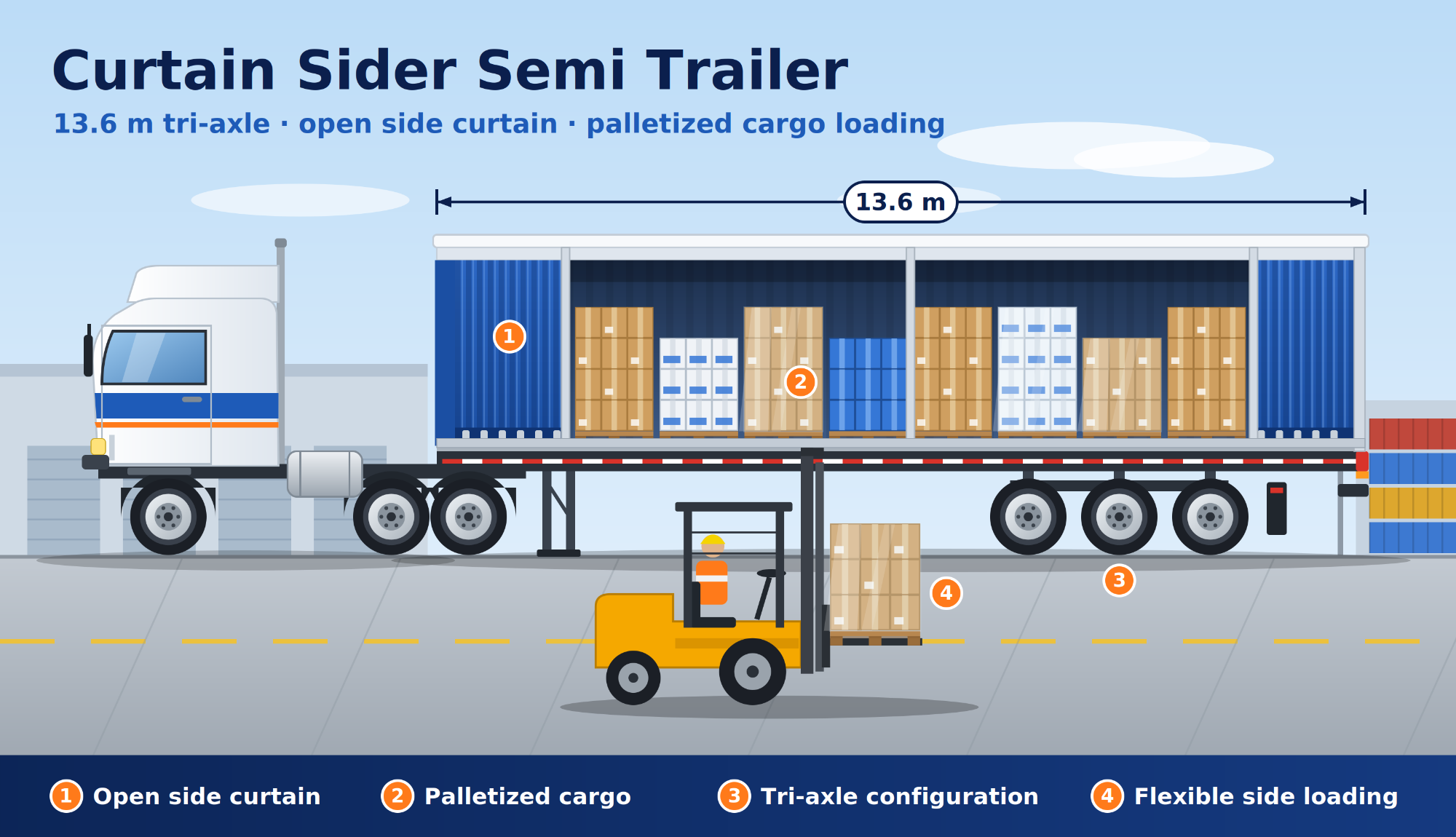
Best for: Palletized goods, packaged products, general freight, machinery and cargo requiring flexible side loading
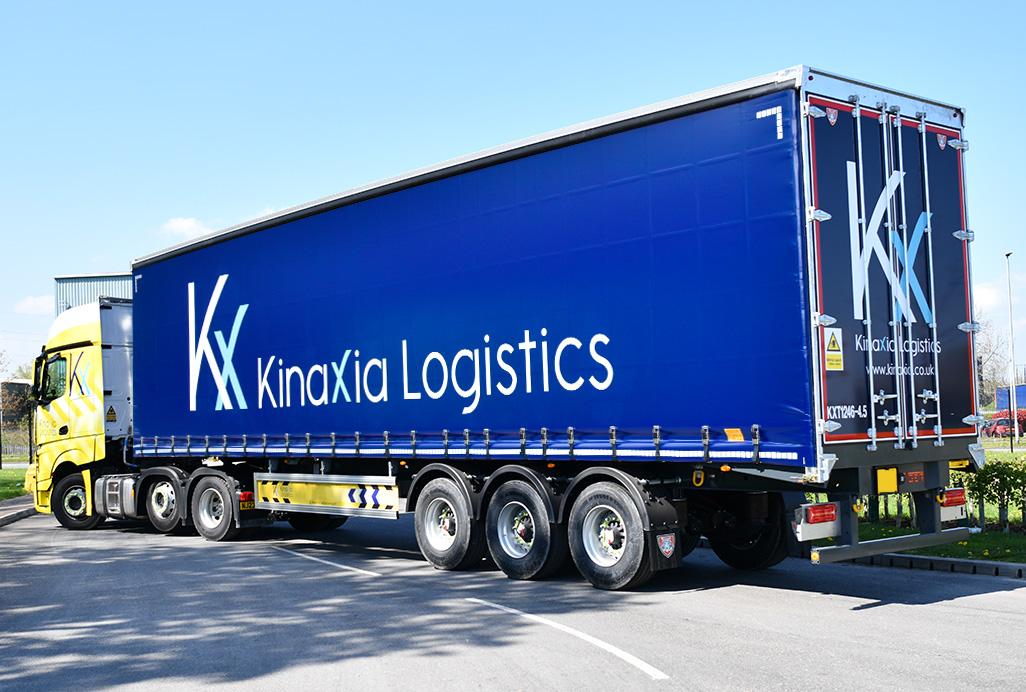
A curtain sider semi trailer, also called a curtain side trailer or curtainsider, combines an enclosed roof and rear structure with flexible curtain-side access.
Unlike a conventional box trailer, the side curtains can be opened to provide convenient access to the cargo area. This makes curtain sider trailers particularly useful for loading and unloading goods from the side.
Common applications include:
-
Palletized cargo
-
General merchandise
-
Building materials
-
Industrial products
-
Furniture
-
Agricultural products
-
Distribution cargo
The main advantage of a curtain sider is the balance between cargo protection and loading flexibility.
For European and international markets, buyers often specify dimensions around the common 13.6-meter trailer format, while other markets may use different length and width standards. Actual dimensions should always be designed according to the destination country's regulations.
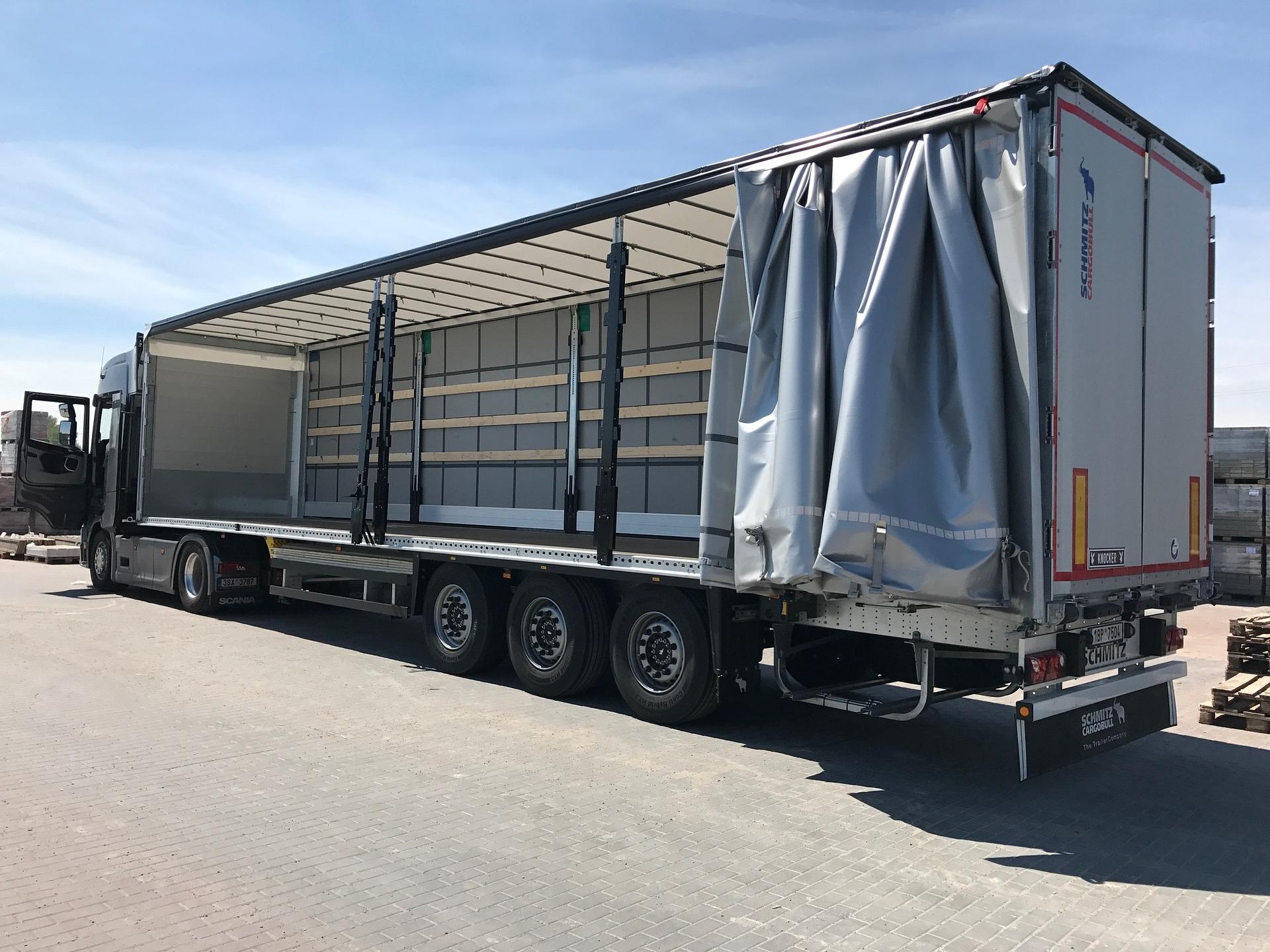
Important options include:
-
Curtain material
-
Roof structure
-
Rear doors
-
Side posts
-
Floor construction
-
Axle configuration
-
Air suspension
-
EBS
-
TIR-compatible configuration where required
Image suggestion:
13.6 m tri-axle curtain sider semi trailer with open side curtain showing palletized cargo loading.
4. Container Chassis / Skeletal Semi Trailer
Best for: 20 ft, 40 ft and other standard shipping containers
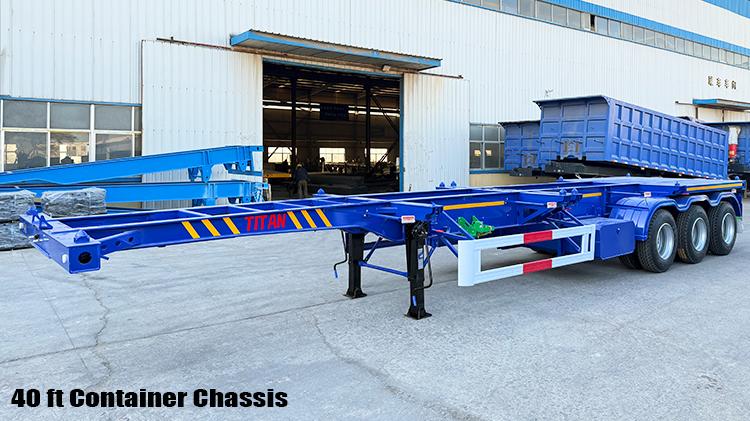
A container chassis trailer, also known as a skeletal trailer or container semi trailer, is specifically designed to transport intermodal shipping containers.
Instead of using a full loading platform, the trailer uses a structural frame equipped with container twist locks to secure the container during transportation.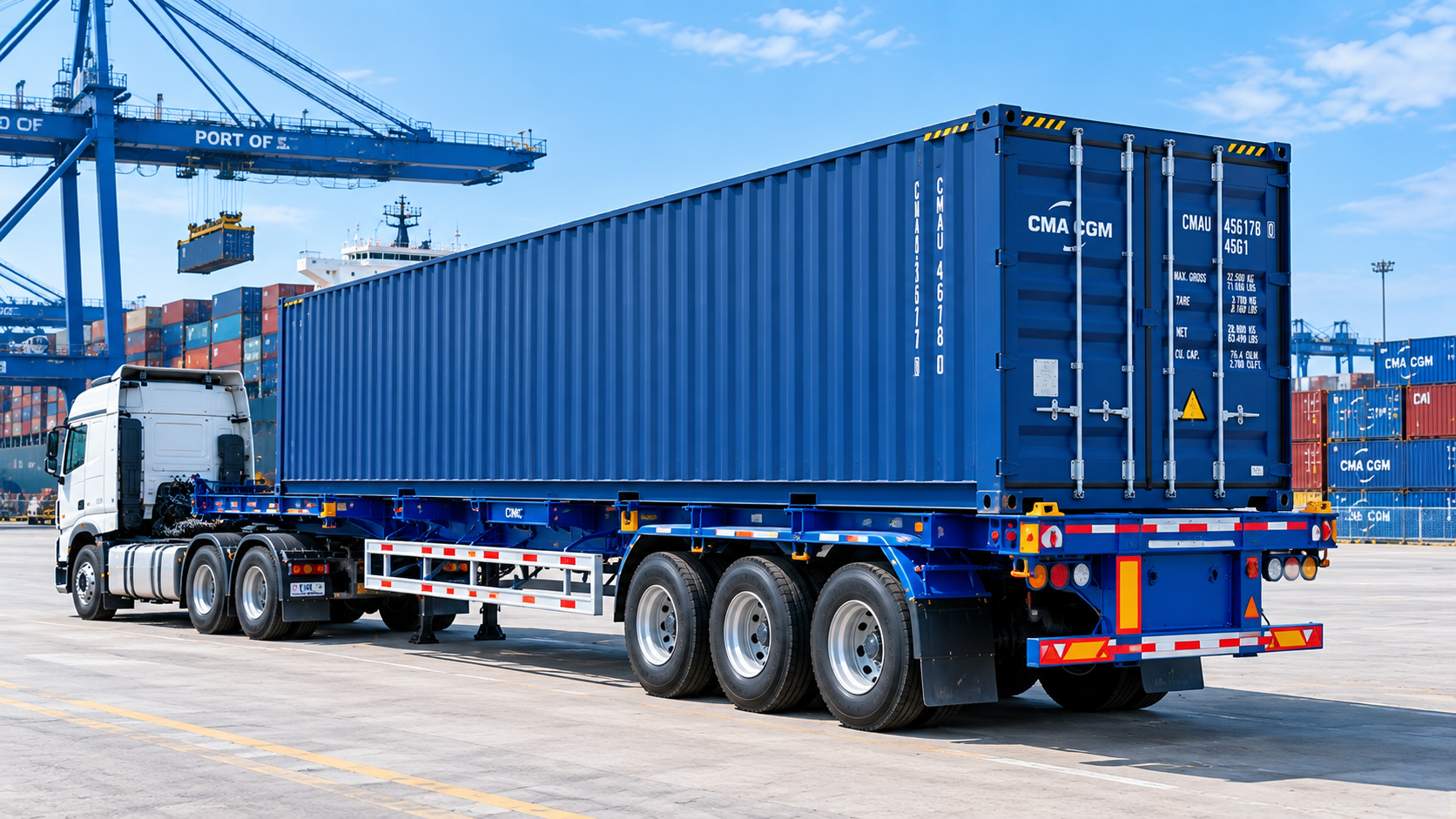
Common applications include:
-
20 ft containers
-
40 ft containers
-
45 ft containers, depending on chassis design
-
Port-to-warehouse transportation
-
Intermodal logistics
-
International container transportation
Container chassis configurations vary by market. Some models are designed specifically for a single container length, while extendable or adjustable versions can accommodate multiple container sizes.
Key components include:
-
Main chassis frame
-
Twist locks
-
Landing gear
-
Axles
-
Suspension
-
Air brake system
-
EBS
-
Lighting system
-
Rear underride protection
For international buyers, it is important to confirm whether the chassis needs to comply with specific ISO container handling requirements, road regulations, or port requirements.
Image suggestion:
Tri-axle skeletal container chassis semi trailer carrying a 40 ft shipping container at a modern international port.
5. Dump / Tipper Semi Trailer
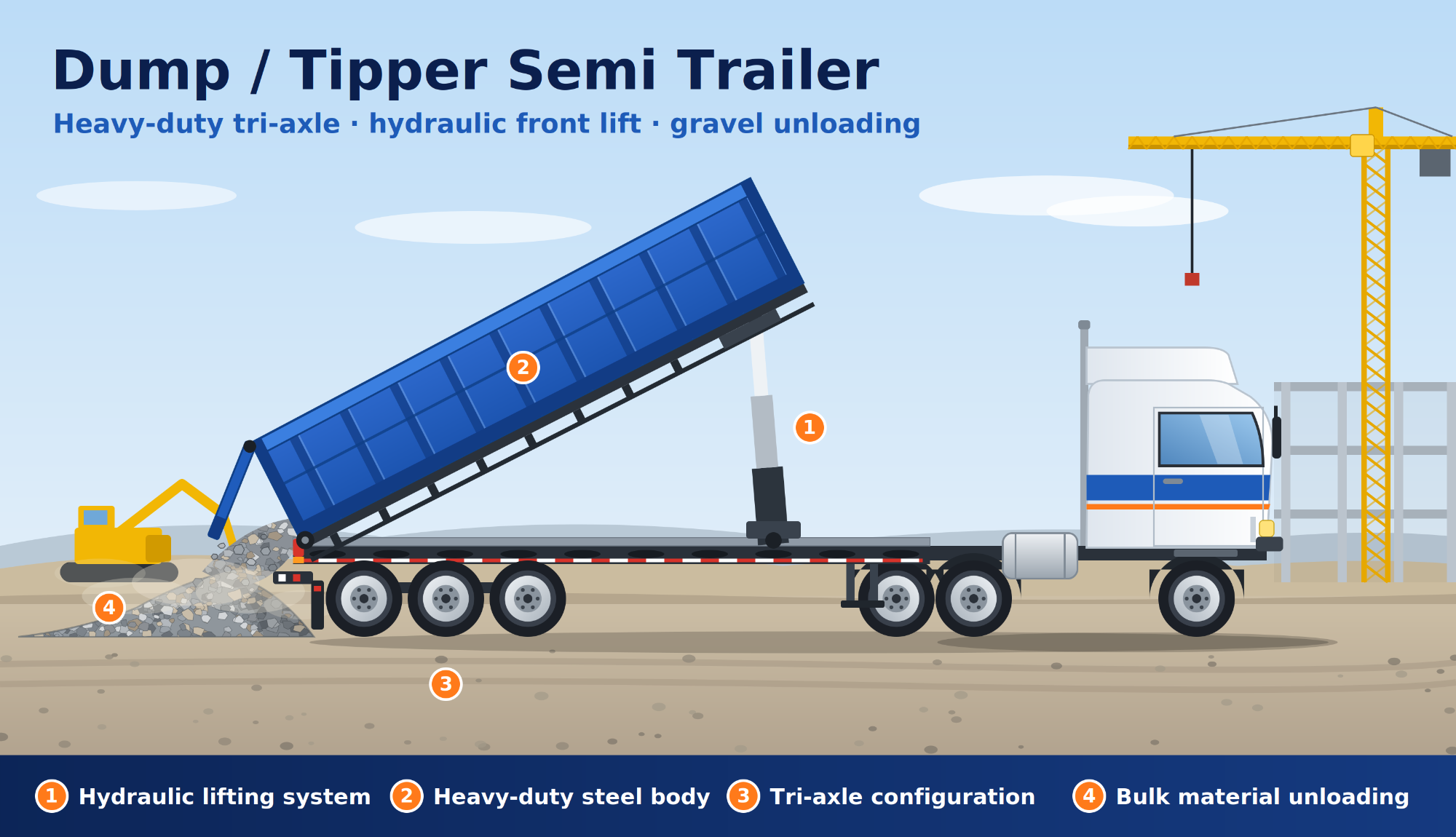
Best for: Sand, gravel, aggregates, construction waste, coal, grain and other bulk materials
A dump semi trailer, also known as a tipper trailer in many markets, is designed to transport and unload bulk materials efficiently.
The cargo body is usually operated by a hydraulic lifting system. When unloading, the front of the cargo box is raised so that the material can slide toward the rear.
Typical applications include:
-
Sand
-
Gravel
-
Stone
-
Coal
-
Construction waste
-
Agricultural bulk materials
-
Minerals
Dump trailers can use different body materials and structural designs. Steel bodies are commonly selected for demanding applications involving abrasive or heavy materials, while aluminum designs may be considered when reducing trailer tare weight is important.
Important specifications include:
-
Body volume
-
Body material
-
Floor thickness
-
Side wall thickness
-
Hydraulic cylinder
-
Axle configuration
-
Suspension
-
Rear door design
-
Hydraulic system
For export orders, the body volume should be matched to both cargo density and the destination market's legal weight limits.
Image suggestion:
Heavy-duty tri-axle dump semi trailer unloading gravel at a large construction site.
6. Tanker Semi Trailer
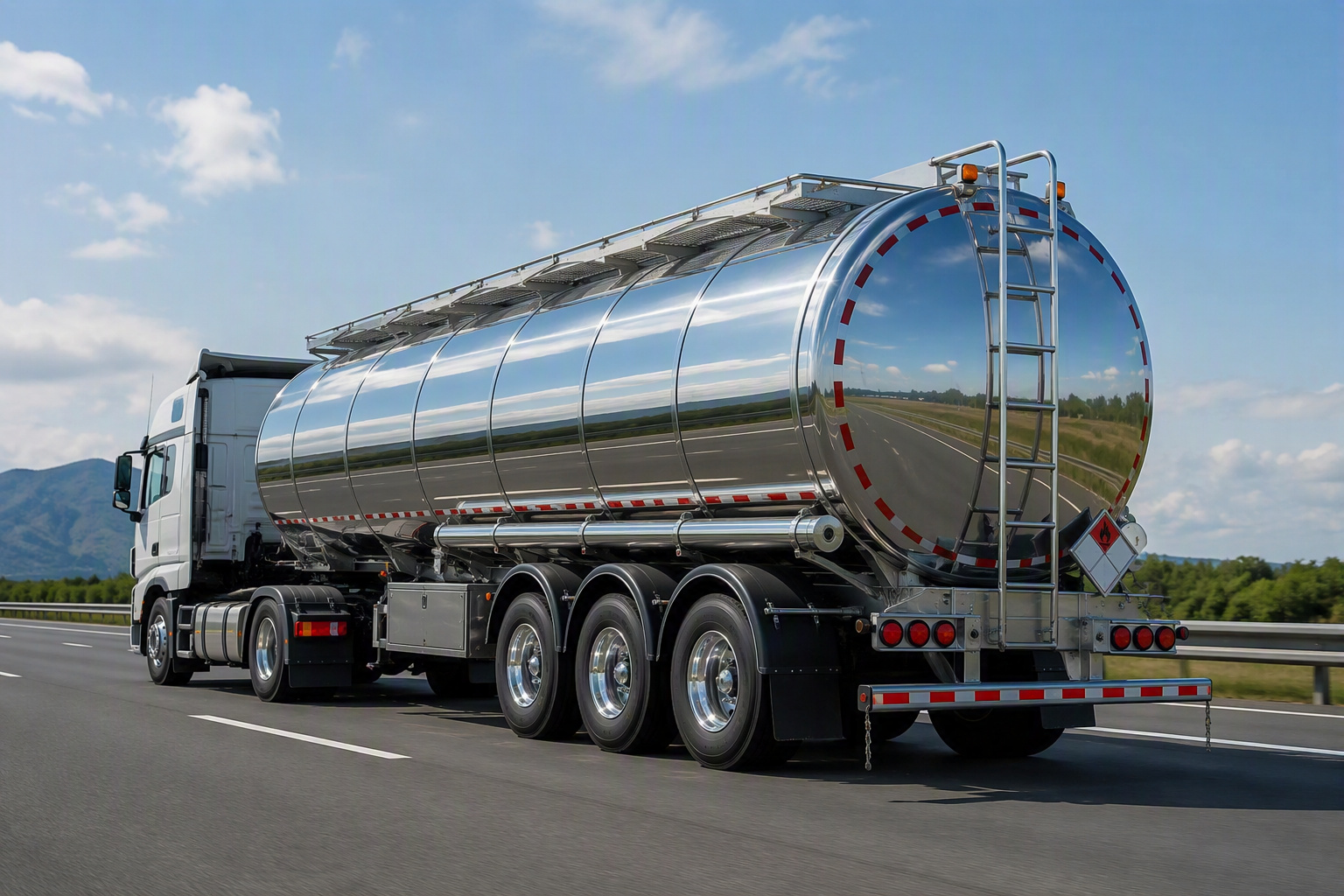
Best for: Fuel, chemicals, edible liquids, water and other bulk liquid transportation
A tanker semi trailer uses a cylindrical or specially engineered tank body to transport liquid or, in certain designs, dry bulk materials.
Tanker trailers are highly application-specific. A trailer designed for fuel transportation should not automatically be used for food-grade liquids or chemicals.
Depending on the cargo, tanker trailers may require different:
-
Tank materials
-
Tank volumes
-
Compartments
-
Valves
-
Pumps
-
Discharge systems
-
Safety equipment
-
Pressure ratings
-
Certification requirements
Typical applications include:
-
Fuel transportation
-
Water transportation
-
Milk and food-grade liquids
-
Edible oil
-
Chemical liquids
-
Industrial liquids
For international purchasing, the cargo type must be identified before the trailer is designed. Tank material, internal coating, compartment structure, pressure requirements and applicable certification can all vary according to the transported product.
Image suggestion:
Stainless steel tanker semi trailer on a highway, professional commercial transportation photography.
7. Refrigerated / Reefer Semi Trailer
Best for: Frozen food, fresh food, pharmaceuticals and temperature-sensitive cargo
A reefer semi trailer, or refrigerated semi trailer, is designed to maintain a controlled temperature inside the cargo compartment.
Compared with a standard dry van, a reefer trailer uses an insulated cargo body and a refrigeration unit.
Common applications include:
-
Frozen food
-
Fresh fruit and vegetables
-
Meat and seafood
-
Dairy products
-
Pharmaceuticals
-
Temperature-sensitive products
The refrigeration system, insulation thickness, floor design, rear doors and interior materials all affect the trailer's performance.
Buyers should consider:
-
Required temperature range
-
Refrigeration unit brand
-
Insulation thickness
-
Cargo volume
-
Floor design
-
Temperature monitoring
-
Power requirements
-
Certification requirements
A reefer normally has less usable interior space than a comparable dry van because of the insulation and refrigeration equipment. Therefore, buyers should evaluate both cargo volume and payload requirements when selecting a refrigerated trailer.
Image suggestion:
Modern white tri-axle reefer semi trailer with refrigeration unit parked at a cold-chain logistics center.
8. Dry Van / Box Semi Trailer
Best for: General cargo, packaged goods, consumer products and palletized freight
A dry van semi trailer, also called a box trailer or enclosed semi trailer, is one of the most widely used trailer configurations for general freight.
The enclosed body protects cargo from rain, dust and other external conditions. It is particularly suitable for palletized and packaged goods that do not require temperature control.
Typical cargo includes:
-
Consumer goods
-
Electronics
-
Clothing
-
Packaged food
-
Paper products
-
Retail goods
-
Industrial products
A dry van generally uses rear doors for loading and unloading. Depending on the application, buyers can select different floor materials, door designs, interior lining, roof structures and loading equipment.
When comparing a dry van with a curtain sider, the key difference is the cargo access and body structure. A dry van provides a more enclosed cargo environment, while a curtain sider offers greater side-loading flexibility.
Image suggestion:
Modern white dry van semi trailer connected to a tractor unit at a distribution warehouse.
Semi Trailer Types Comparison
The following table provides a practical overview of the major trailer categories:
| Semi Trailer Type | Main Cargo | Loading Method | Main Feature |
|---|---|---|---|
| Flatbed | Steel, machinery, pipes, construction materials | Rear / side / top | Open loading platform |
| Lowbed | Excavators, loaders, heavy machinery | Rear / ramp | Low loading height |
| Curtain Sider | Pallets, general freight | Rear / side | Flexible side loading |
| Container Chassis | 20 ft / 40 ft containers | Container handling equipment | Twist-lock container securing |
| Dump Trailer | Gravel, sand, coal, aggregates | Top / rear unloading | Hydraulic tipping system |
| Tanker | Fuel, chemicals, liquids | Pump / discharge system | Specialized tank body |
| Reefer | Frozen food, fresh products, pharmaceuticals | Rear / dock | Temperature control |
| Dry Van | General packaged cargo | Rear | Fully enclosed body |
Trailer dimensions and payload capacities vary according to the manufacturer, axle configuration, destination country and local regulations. For example, North American flatbeds are commonly offered in 48–53 ft configurations, while European articulated trailers often use approximately 13.6 m loading lengths. These figures should be treated as market references rather than universal specifications.
How to Choose the Right Semi Trailer Type
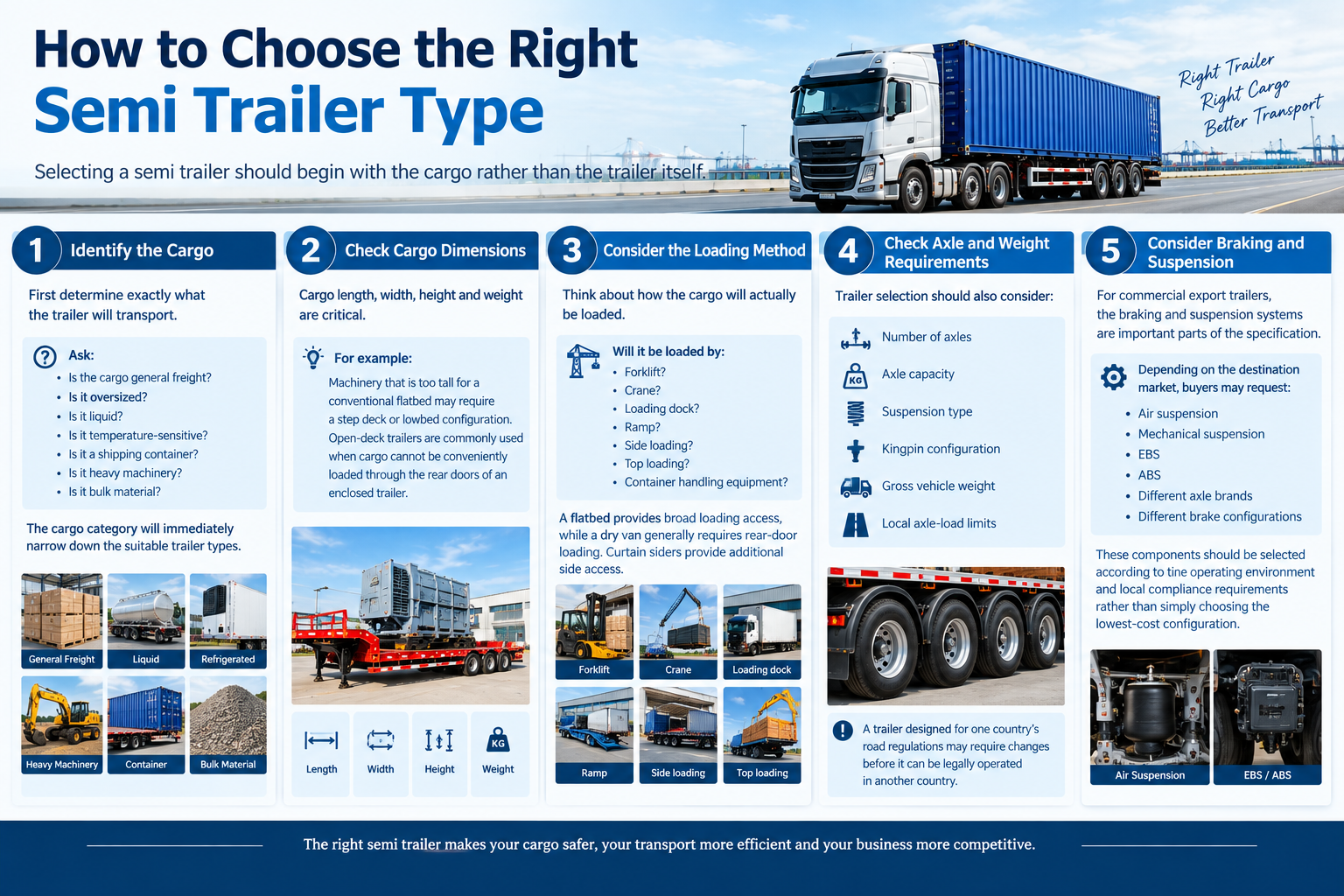
Selecting a semi trailer should begin with the cargo rather than the trailer itself
1. Identify the Cargo
First determine exactly what the trailer will transport.
Ask:
-
Is the cargo general freight?
-
Is it oversized?
-
Is it liquid?
-
Is it temperature-sensitive?
-
Is it a shipping container?
-
Is it heavy machinery?
-
Is it bulk material?
The cargo category will immediately narrow down the suitable trailer types.
2. Check Cargo Dimensions
Cargo length, width, height and weight are critical.
For example, machinery that is too tall for a conventional flatbed may require a step deck or lowbed configuration. Open-deck trailers are commonly used when cargo cannot be conveniently loaded through the rear doors of an enclosed trailer.
3. Consider the Loading Method
Think about how the cargo will actually be loaded.
Will it be loaded by:
-
Forklift?
-
Crane?
-
Loading dock?
-
Ramp?
-
Side loading?
-
Top loading?
-
Container handling equipment?
A flatbed provides broad loading access, while a dry van generally requires rear-door loading. Curtain siders provide additional side access.
4. Check Axle and Weight Requirements
Trailer selection should also consider:
-
Number of axles
-
Axle capacity
-
Suspension type
-
Kingpin configuration
-
Gross vehicle weight
-
Local axle-load limits
A trailer designed for one country's road regulations may require changes before it can be legally operated in another country.
5. Consider Braking and Suspension
For commercial export trailers, the braking and suspension systems are important parts of the specification.
Depending on the destination market, buyers may request:
-
Air suspension
-
Mechanical suspension
-
EBS
-
ABS
-
Different axle brands
-
Different brake configurations
These components should be selected according to the operating environment and local compliance requirements rather than simply choosing the lowest-cost configuration.
Semi Trailer Types for International Buyers
For buyers importing semi trailers from China, the basic trailer category is only the starting point.
A complete export specification may also include:
-
Trailer dimensions
-
Axle brand and capacity
-
Suspension type
-
Brake system
-
EBS / ABS configuration
-
Tire and wheel specifications
-
Kingpin specification
-
Landing gear
-
Lighting system
-
Reflective markings
-
Paint and surface treatment
-
Spare parts
-
Certification
-
Shipping dimensions
-
Loading quantity
For example, two trailers may both be described as flatbed semi trailers, but their axle brand, suspension, brake system, frame structure, tire size, payload rating and local compliance configuration can be significantly different.
This is why international buyers should provide a detailed specification before comparing prices.
Semi Trailer Types: Final Buying Checklist
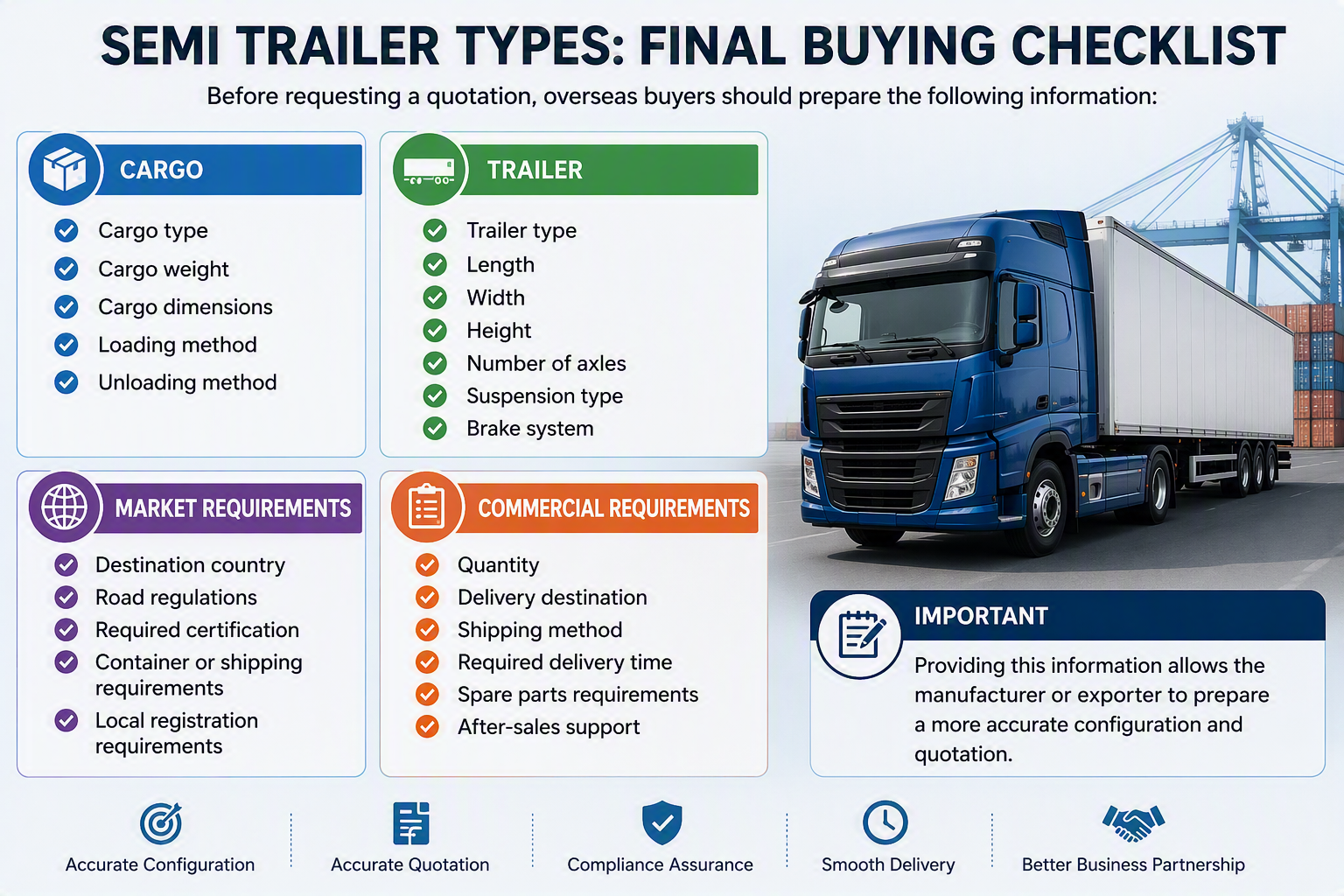
Before requesting a quotation, overseas buyers should prepare the following information:
Cargo
-
Cargo type
-
Cargo weight
-
Cargo dimensions
-
Loading method
-
Unloading method
Trailer
-
Trailer type
-
Length
-
Width
-
Height
-
Number of axles
-
Suspension type
-
Brake system
Market Requirements
-
Destination country
-
Road regulations
-
Required certification
-
Container or shipping requirements
-
Local registration requirements
Commercial Requirements
-
Quantity
-
Delivery destination
-
Shipping method
-
Required delivery time
-
Spare parts requirements
-
After-sales support
Providing this information allows the manufacturer or exporter to prepare a more accurate configuration and quotation.
Conclusion
There is no single semi trailer type that is suitable for every transportation application.
Flatbed trailers provide flexible open-deck loading, while lowbed trailers are designed for tall and heavy machinery. Curtain sider trailers combine cargo protection with flexible side access. Container chassis trailers are designed specifically for intermodal container transportation. Dump trailers handle bulk materials, while tankers are designed for specialized liquid cargo. Reefer trailers provide temperature-controlled transportation, and dry van trailers offer enclosed protection for general freight.
For international buyers, the right choice should be based on cargo characteristics, loading requirements, road regulations, axle configuration, braking and suspension systems, certification requirements, and the destination market.
Understanding the differences between these types of semi trailers is the first step toward specifying the right trailer and obtaining an accurate export quotation.
We invite you to visit our website to view our full range of products and contact us; we would be happy to introduce our products based on your specific needs.