
Fuel Tanker Semi Trailer: Complete Guide
A fuel tanker semi trailer is a specialized trailer designed to transport gasoline, diesel, aviation fuel, and other liquid petroleum products safely and efficiently. Unlike general cargo trailers, fuel tankers must be engineered around liquid dynamics, pressure, corrosion resistance, braking performance, grounding, and regulatory requirements.
For fuel distributors, petroleum companies, logistics operators, gas station suppliers, and trailer importers, choosing the right tanker is not simply a matter of selecting a larger tank. Tank capacity, compartment configuration, axle arrangement, tank material, suspension, braking system, loading method, and local regulations can all affect the trailer's purchase price and operating cost.
This guide explains the key specifications of fuel tanker semi trailers, compares common configurations, discusses applications and safety requirements, and provides practical advice for buyers looking to purchase from a professional manufacturer.
What Is a Fuel Tanker Semi Trailer?
A fuel tanker semi trailer consists of a tank body mounted on a chassis and connected to a tractor through a fifth-wheel coupling.
It is primarily used to transport liquid fuels between:
- Oil refineries
- Fuel terminals
- Storage depots
- Distribution centers
- Airports
- Gas stations
- Industrial facilities
- Mining sites
- Construction projects
The tank is normally divided into several compartments. Multiple compartments allow one trailer to transport different fuel grades or products without mixing them.
For example, a tanker may carry:
- Diesel
- Gasoline
- Kerosene
- Jet fuel
- Other compatible petroleum products
A multi-compartment configuration can therefore improve fleet utilization and reduce the number of trips required for fuel distribution.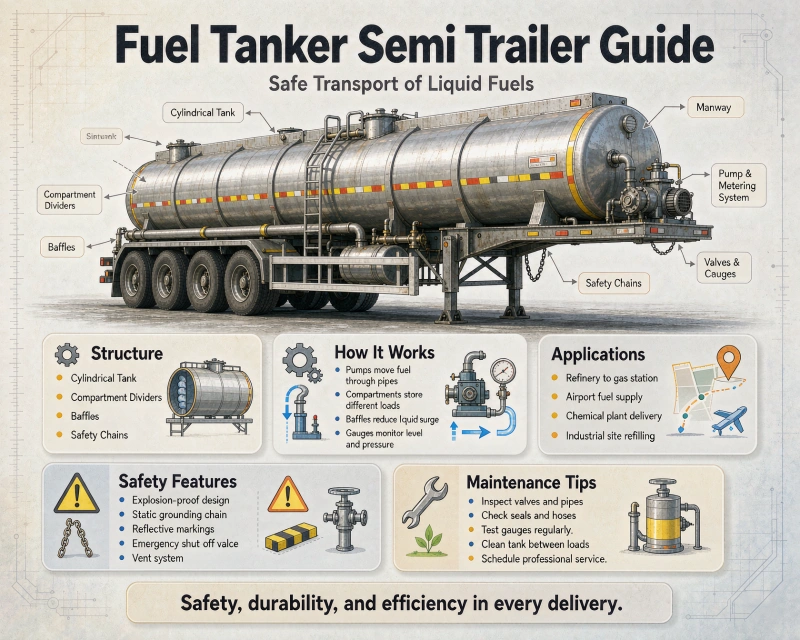
Fuel Tanker Semi Trailer Standard Specifications
Fuel tanker specifications vary considerably by country and application. A typical configuration for international markets may have the following characteristics:
| Specification | Typical Range |
|---|---|
| Tank Capacity | 30,000–60,000 L |
| Tank Material | Carbon steel, aluminum or stainless steel |
| Compartments | 1–8 |
| Length | Approximately 10–14 m |
| Width | Approximately 2.5–2.6 m |
| Tank Shape | Elliptical or circular |
| Axles | 2–4 |
| Suspension | Mechanical or air suspension |
| Braking System | Air brake / ABS or EBS where required |
| Discharge | Gravity or pump-assisted |
| Loading | Top loading or bottom loading |
| Typical Products | Diesel, gasoline, kerosene and other liquid fuels |
These figures are general manufacturing ranges rather than universal legal limits. Always determine maximum permissible capacity and dimensions based on the destination country's road and dangerous-goods regulations.
How Much Fuel Can a Semi Tanker Carry?
Fuel tanker capacity is one of the most important factors when searching for and purchasing a tanker.
Common configurations include:
| Tank Capacity | Approximate Application |
|---|---|
| 20,000–30,000 L | Regional or restricted-road distribution |
| 30,000–40,000 L | General fuel distribution |
| 40,000–50,000 L | High-volume fuel logistics |
| 50,000–60,000 L | Long-distance and large-scale distribution |
| 60,000 L+ | Specialized applications subject to local regulations |
However, tank volume is not the same as legal payload.
The actual amount of fuel that can be transported depends on:
- Tank capacity
- Fuel density
- Trailer tare weight
- Tractor weight
- Axle load limits
- Maximum gross vehicle weight
- Local dangerous-goods regulations
For example, diesel is considerably denser than gasoline. A 50,000-liter tanker filled with diesel therefore weighs more than the same tanker filled with gasoline.
This is why professional fleet operators calculate fuel transportation based on both liters and kilograms/tons.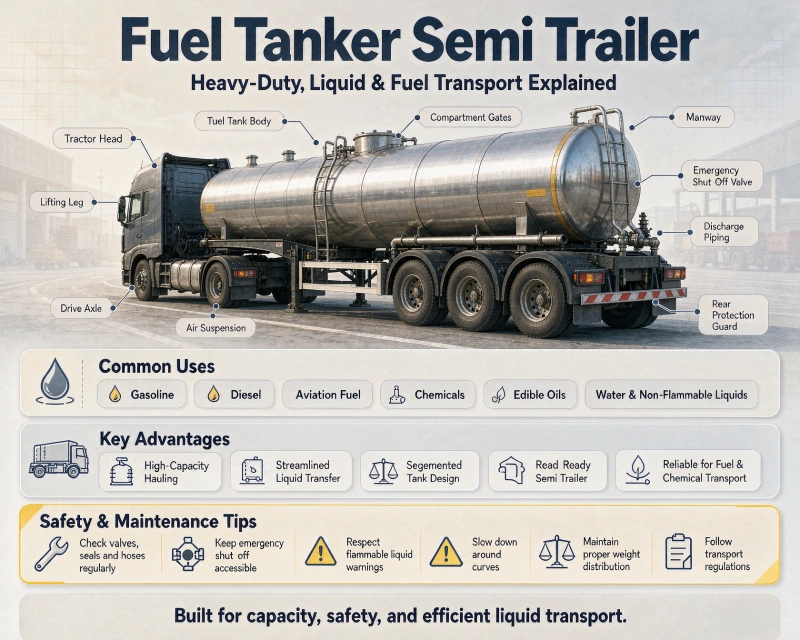
Common Types of Fuel Tanker Semi Trailers
Single-Compartment Fuel Tanker
A single-compartment tanker carries one fuel product.
It is relatively simple and can be suitable when the operator has dedicated routes for one type of fuel.
Advantages:
- Simple construction
- Easier cleaning
- Lower initial cost
- Straightforward operation
Disadvantages:
- Limited product flexibility
- More trips may be required for different fuel grades
This configuration is suitable for dedicated diesel or gasoline distribution.
Multi-Compartment Fuel Tanker
A multi-compartment tanker divides the tank into separate chambers.
Typical configurations include:
- 2 compartments
- 3 compartments
- 4 compartments
- 5 compartments
- 6 compartments
- 7 or 8 compartments
For example, a 45,000-liter tanker could theoretically be configured as 10,000 + 10,000 + 10,000 + 15,000 liters.
The actual compartment sizes should be designed around the operator's delivery requirements.
Advantages:
- Multiple fuel products in one trip
- Better route efficiency
- Reduced empty mileage
- Greater flexibility for fuel distributors
Disadvantages:
- More complex piping
- Higher manufacturing cost
- More components to maintain
- Internal cleaning requires greater attention
For fuel distribution companies supplying multiple gas stations, a multi-compartment tanker is often the more practical investment.
Elliptical vs. Circular Fuel Tanker
Tank cross-section is another important design choice.
Elliptical Tank
Elliptical tanks provide a relatively low center of gravity.
This can improve:
- Stability
- Road handling
- Overall vehicle height
They are commonly used for road fuel transportation.
Circular Tank
Circular tanks offer excellent structural strength and are widely used for various liquid transportation applications.
They can be particularly useful where tank pressure or specialized structural requirements are important.
The best configuration depends on the fuel product, regulatory requirements, capacity, and chassis design.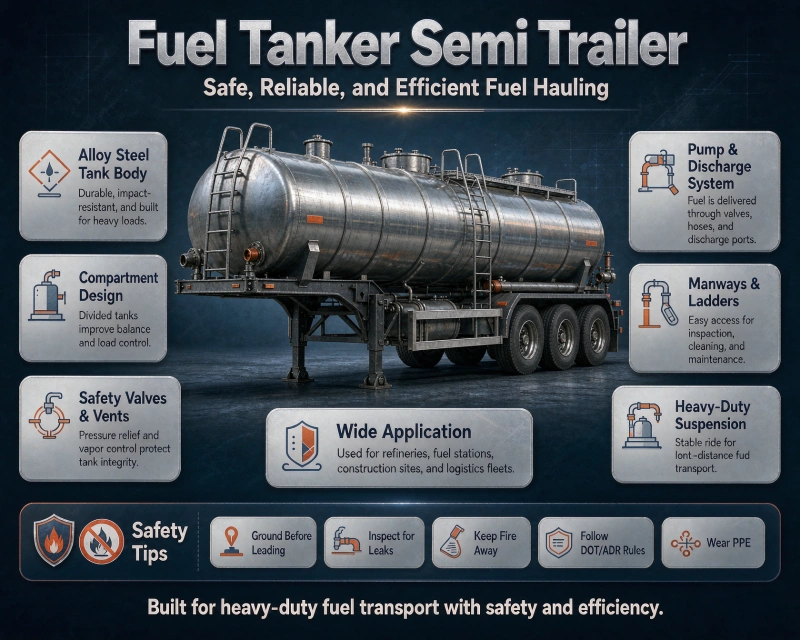
Fuel Tanker Semi Trailer Materials
Carbon Steel
Carbon steel is one of the most common choices for petroleum tanker trailers.
Benefits include:
- High structural strength
- Relatively low cost
- Easy fabrication
- Good availability of raw materials
Proper surface treatment and corrosion protection are important for extending service life.
Aluminum Alloy
Aluminum tanker bodies can significantly reduce tare weight.
This can provide:
- Higher potential payload
- Better fuel economy
- Reduced corrosion concerns
- Lower overall vehicle weight
The trade-off is a higher initial manufacturing cost and different fabrication requirements.
Stainless Steel
Stainless steel is used when corrosion resistance and product compatibility are priorities.
It is more expensive than ordinary carbon steel, so it is generally selected for specific applications rather than simply because it is "better."
For standard diesel and gasoline transportation, carbon steel or aluminum may provide a more economical balance depending on the market.
Fuel Tanker Safety Features
Fuel is classified as a hazardous cargo, so tanker safety cannot be treated as an optional feature.
Important systems may include:
Emergency Shut-Off System
An emergency shut-off system can rapidly stop fuel flow when abnormal conditions occur.
Safety Valves
Pressure and emergency valves help control the tank's internal pressure and reduce the risk of uncontrolled discharge.
Anti-Static Grounding
Fuel transfer can generate static electricity. Appropriate grounding and bonding systems help control ignition risks during loading and unloading.
Spill Prevention
Well-designed manholes, valves, piping, and discharge systems help reduce leakage during transportation and fuel transfer.
Anti-Rollover Protection
Tankers must be designed with stability in mind. Internal baffles, suitable tank geometry, axle positioning, and a low center of gravity can all contribute to safer handling.
Braking System
A properly matched air braking system is essential for a heavily loaded tanker.
Depending on the destination market, buyers may require:
- ABS
- EBS
- Automatic braking systems
- Emergency braking functions
The exact requirement depends on local regulations.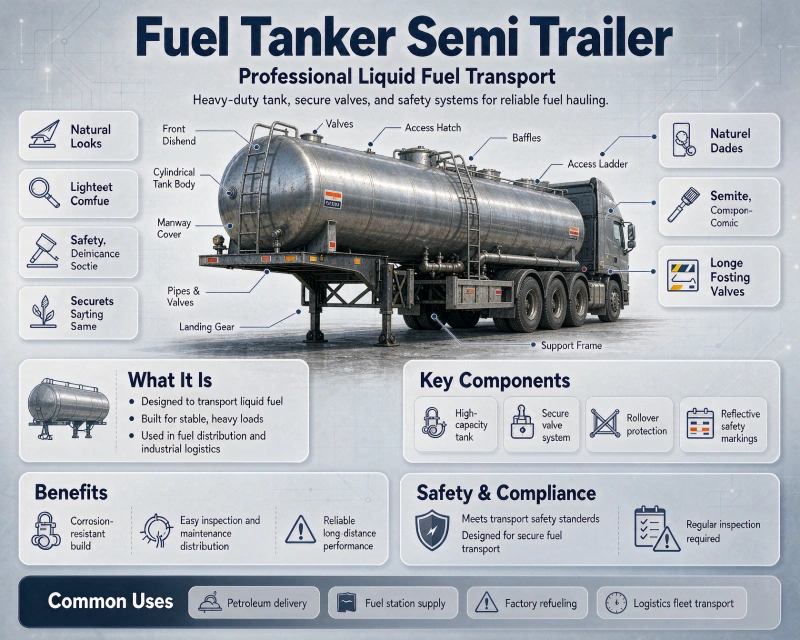
Why Internal Baffles Matter
Liquid cargo behaves differently from solid cargo.
When a tanker accelerates, brakes, or turns, the liquid can move inside the tank. This phenomenon is known as sloshing.
Large liquid movement can influence:
- Vehicle stability
- Braking behavior
- Cornering
- Rollover risk
Internal baffles divide the liquid and reduce excessive movement.
For this reason, tanker design requires significantly more engineering than simply mounting a large metal tank on a trailer chassis.
Top Loading vs. Bottom Loading
Fuel tanker trailers can use different loading configurations.
Top Loading
Fuel enters the tank through openings on the top.
Benefits:
- Traditional and relatively simple
- Suitable for certain loading facilities
- Lower equipment complexity in some configurations
Limitations:
- Requires access to the top of the tanker
- More operator exposure during loading
- Loading speed may depend on facility design
Bottom Loading
Fuel enters through lower loading connections.
Benefits:
- Faster loading and unloading
- Reduced operator access to the tank top
- Well suited to modern fuel distribution terminals
Limitations:
- More complex piping and valve systems
- Higher initial equipment cost
- Compatibility with loading infrastructure is required
If your fleet operates primarily between modern fuel terminals and gas stations, bottom loading may provide significant operational advantages.
Applications of Fuel Tanker Semi Trailers
Fuel tankers are used throughout the petroleum supply chain.
Gas Station Fuel Delivery
This is one of the most common applications.
A tanker transports different fuel grades from a distribution terminal to retail stations.
Multi-compartment tanks are particularly useful because one vehicle can deliver multiple products.
Mining Operations
Mining sites often consume large quantities of diesel.
Fuel tankers can supply:
- Excavators
- Dump trucks
- Drilling equipment
- Generators
- Heavy machinery
In remote mining regions, rugged chassis and reliable suspension are particularly important.
Construction Projects
Large construction projects may require continuous diesel supplies for:
- Cranes
- Generators
- Earthmoving equipment
- Concrete plants
- Asphalt equipment
Airport Fuel Logistics
Aviation fuel requires highly controlled handling and specialized equipment.
Aircraft refueling operations can involve strict requirements concerning:
- Product cleanliness
- Filtration
- Grounding
- Hose systems
- Fuel quality
- Safety procedures
A standard road diesel tanker should not automatically be assumed suitable for aviation fuel.
Fuel Tanker Semi Trailer Advantages and Disadvantages
Advantages
High transportation capacity
A single tanker can transport tens of thousands of liters, making bulk distribution significantly more efficient than small fuel vehicles.
Multiple products in one trip
Multi-compartment designs allow distributors to combine several fuel grades.
Lower cost per liter
Higher transport capacity can reduce logistics costs per unit of fuel when the trailer is efficiently utilized.
Suitable for long-distance transportation
Heavy-duty chassis and suspension systems allow tankers to operate over long highway routes.
Customizable
Manufacturers can customize:
- Tank capacity
- Compartments
- Axles
- Suspension
- Loading system
- Discharge system
- Tank material
- Branding
Disadvantages
Higher purchase cost
Fuel tankers cost more than ordinary flatbed or side-board trailers because they require specialized tanks and safety systems.
Higher regulatory requirements
Dangerous-goods transportation is subject to stricter rules than ordinary freight.
More complicated maintenance
Valves, pumps, piping, grounding systems, safety equipment, and tank structures require regular inspection.
Higher accident consequences
Fuel is flammable, so improper operation, poor maintenance, or non-compliant equipment can create serious safety risks.
How Much Does a Fuel Tanker Semi Trailer Cost?
The purchase price depends heavily on capacity, material, axle configuration, equipment, and destination requirements.
As a broad manufacturing-market reference, buyers may encounter factory prices roughly in the following ranges:
| Configuration | Approximate Factory Price |
|---|---|
| 30,000–35,000 L | US$15,000–22,000 |
| 40,000–45,000 L | US$18,000–28,000 |
| 50,000 L | US$22,000–32,000 |
| 55,000–60,000 L | US$25,000–38,000+ |
These are indicative ranges rather than fixed quotations. A tanker equipped with aluminum construction, advanced loading systems, branded axles, sophisticated braking equipment, or special dangerous-goods certification can cost considerably more.
The final landed cost can also include:
- Ocean freight
- Insurance
- Import duties
- Port charges
- Local taxes
- Certification
- Registration
- Inspection
- Spare parts
- Local modifications
Therefore, buyers should compare total landed cost, not only the manufacturer's FOB price.
How to Choose the Right Fuel Tanker Semi Trailer
A professional buyer should evaluate at least eight factors.
1. Determine the Fuel Product
Diesel, gasoline, kerosene, aviation fuel, and chemicals may have different technical requirements.
Do not select a tanker based only on capacity.
2. Calculate Required Capacity
Estimate:
- Daily fuel demand
- Average delivery distance
- Number of deliveries per week
- Gas station storage capacity
- Legal payload
A larger tank is not automatically better if road weight limits prevent you from fully loading it.
3. Choose the Number of Compartments
If you regularly transport multiple fuel grades, choose a multi-compartment tanker.
If you transport only one product, a single compartment can reduce cost and maintenance complexity.
4. Select Tank Material
Carbon steel generally offers an attractive price-to-strength ratio.
Aluminum is worth considering when reducing tare weight is important.
Stainless steel is suitable for applications where its corrosion resistance and product compatibility justify the additional cost.
5. Check the Axle Configuration
The number and capacity of axles should correspond to:
- Trailer tare weight
- Maximum payload
- Local axle regulations
- Road conditions
6. Consider Suspension
Mechanical suspension is generally simpler and economical.
Air suspension can offer improved ride quality and may be preferred for certain highway applications.
7. Confirm Braking Requirements
Always verify the requirements of the destination country before production.
A trailer manufactured for one market may require modifications before it can legally operate in another.
8. Evaluate After-Sales Support
A tanker is a specialized commercial asset. Spare parts availability and technical support can be just as important as the initial purchase price.
Should You Buy a New or Used Fuel Tanker?
A used tanker can have a lower acquisition cost, but buyers should inspect it carefully.
Important inspection points include:
- Tank wall condition
- Weld seams
- Internal corrosion
- Previous cargo history
- Valve condition
- Piping
- Suspension
- Axles
- Brake system
- Tires
- Grounding system
- Safety equipment
- Inspection records
For a fuel tanker, the cheapest trailer can become the most expensive one if hidden corrosion or maintenance problems lead to downtime.
For long-term fleet operation, a new tanker with specifications matched to your market can offer better reliability and easier compliance.
Why Buy a Fuel Tanker Semi Trailer From a Chinese Manufacturer?
China has become a major manufacturing center for commercial trailers, including fuel tankers.
Direct factory sourcing can provide:
- Competitive manufacturing costs
- OEM customization
- Multiple axle options
- Customized tank capacity
- Compartment configuration
- Branding and painting
- Component selection
- Spare parts support
However, buyers should not choose a supplier based solely on the lowest quotation.
Before placing an order, request:
- Factory business information
- Technical drawings
- Tank material specification
- Axle and suspension details
- Brake system specification
- Welding and inspection procedures
- Dangerous-goods compliance information
- Previous export experience
- Warranty terms
- Spare parts list
A reliable manufacturer should be able to explain exactly what is included in the quotation.
Fuel Tanker Semi Trailer vs. Fuel Tank Truck
These two terms are often confused.
A fuel tanker truck has the tank permanently mounted on the powered truck chassis.
A fuel tanker semi trailer has its own tank and chassis but requires a tractor unit.
The semi-trailer configuration offers an important fleet advantage: one tractor can potentially operate with multiple trailers.
For example:
1 tractor + 2 tanker trailers
can provide greater operational flexibility than a single integrated tanker truck, depending on local regulations and fleet practices.
This can be particularly valuable for companies operating large distribution fleets.
Fuel Tanker Maintenance Checklist
Regular maintenance helps protect both the trailer and the operator.
Inspect:
- Tank body
- Welds
- Manhole covers
- Valves
- Piping
- Pressure-relief equipment
- Emergency shut-off system
- Grounding cable
- Axles
- Brakes
- Tires
- Suspension
- Lighting
- Coupling system
Inspection frequency should follow local regulations, manufacturer recommendations, and the operating environment.
A tanker operating in coastal, humid, mining, or heavily corrosive environments may require more frequent inspection than one operating in dry inland conditions.
Frequently Asked Questions
How many liters does a fuel tanker semi trailer hold?
Most road fuel tanker semi trailers have capacities of approximately 30,000–60,000 liters, although specialized configurations can differ.
What is the most common fuel tanker capacity?
For many distribution applications, 40,000–50,000 liters provides a practical balance between capacity, payload, maneuverability, and road restrictions.
How many compartments does a fuel tanker have?
Fuel tankers can have one to eight compartments, depending on product requirements and local regulations.
What materials are used to manufacture fuel tankers?
Common materials include carbon steel, aluminum alloy, and stainless steel. Carbon steel is widely used because of its strength and relatively competitive cost.
Can one tanker transport gasoline and diesel?
Yes, a properly designed multi-compartment tanker can transport different compatible petroleum products in separate compartments. The tanker must meet the relevant safety and regulatory requirements.
Is aluminum better than carbon steel for a fuel tanker?
Not necessarily. Aluminum is lighter and can increase payload potential, while carbon steel generally provides high strength at a lower material cost. The better option depends on payload requirements, budget, road regulations, and operating conditions.
How long does a fuel tanker semi trailer last?
A well-maintained commercial tanker can operate for many years, but service life depends on material quality, road conditions, loading cycles, maintenance, corrosion, and inspection practices.
What should I check before buying a fuel tanker?
Pay particular attention to tank material and thickness, weld quality, compartment design, axle capacity, suspension, braking system, valves, grounding equipment, regulatory compliance, and after-sales support.
Final Buying Advice
Choosing a fuel tanker semi trailer should begin with your transportation operation, not the manufacturer's catalog.
First determine what fuel you will carry, how many liters you need per trip, how many products must be transported simultaneously, and which countries or regions the trailer will operate in. Then select the tank material, compartment layout, axle configuration, suspension, loading system, and safety equipment.
For most fuel distribution companies, a 40,000–50,000-liter multi-compartment tanker can provide a strong balance between capacity and flexibility. However, the optimal configuration depends on local gross-weight and axle-load regulations.
If your business has stable fuel transportation demand, buying a new tanker customized to your routes and regulatory requirements is usually more economical over the long term than relying on unsuitable or frequently rented equipment.
For importers and fleet operators sourcing from China, the most important question should not be “Who offers the cheapest fuel tanker?” but rather “Which manufacturer can build a compliant tanker that will remain reliable throughout its working life?”
That difference can save considerably more money than negotiating another few hundred dollars off the initial quotation.