
Types of Semi Trailers: Complete Guide
Choosing the right semi trailer is an important decision for logistics companies, freight carriers, construction contractors, agricultural businesses, and trailer distributors. Different types of semi trailers are designed for completely different cargo, road conditions, loading methods, and transportation requirements.
A flatbed trailer may be ideal for steel and construction machinery, while a refrigerated trailer is designed for temperature-sensitive products. A tanker is built for liquids, a lowboy handles heavy equipment, and a container chassis is optimized for intermodal transportation.
Understanding these differences before purchasing or renting a trailer can help reduce transportation costs, improve cargo safety, and increase fleet utilization.
This guide provides a practical comparison of the most common semi trailer types, including their typical dimensions, applications, advantages, disadvantages, and purchasing considerations.
What Is a Semi Trailer?
A semi trailer is a non-powered trailer that connects to a tractor unit through a fifth-wheel coupling. Unlike a full trailer, part of the semi trailer's weight is supported by the tractor.
A typical semi trailer consists of:
- Main chassis or frame
- Axles
- Suspension system
- Braking system
- Landing gear
- Fifth-wheel kingpin
- Wheels and tires
- Cargo body or platform
Depending on the design, the trailer may carry general freight, containers, vehicles, bulk materials, liquids, timber, heavy machinery, or temperature-controlled products.
The biggest advantage of the semi-trailer system is flexibility. A logistics company can use one tractor with different trailers according to its transportation requirements.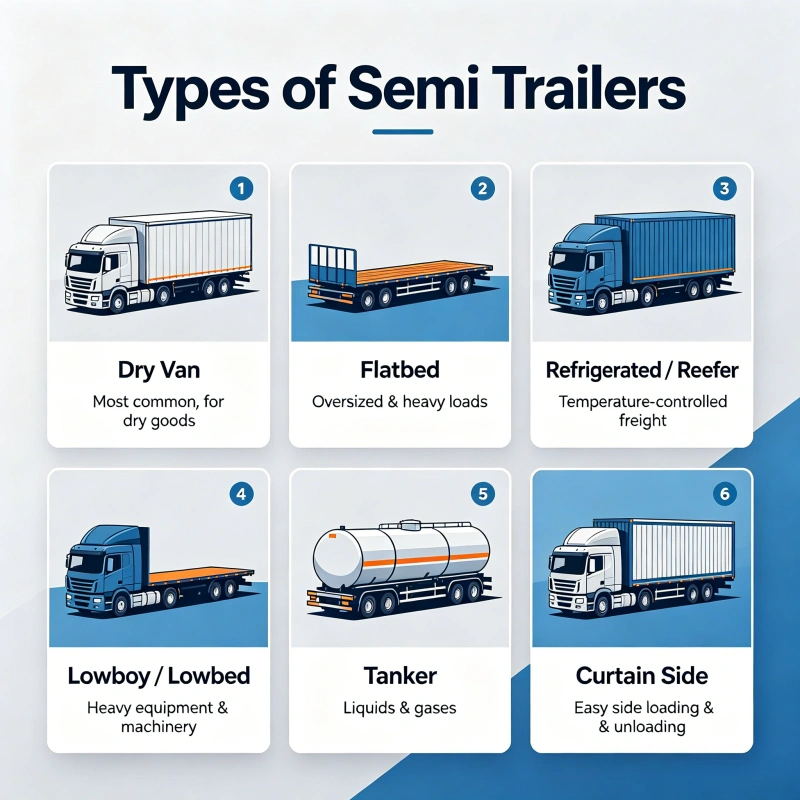
Main Types of Semi Trailers
The most common semi trailer types include:
- Flatbed Semi Trailer
- Side Board Semi Trailer
- Fence Semi Trailer
- Curtain Side Semi Trailer
- Dry Van Semi Trailer
- Refrigerated Semi Trailer
- Lowbed Semi Trailer
- Drop Deck Semi Trailer
- Rear Dump Semi Trailer
- Side Dump Semi Trailer
- Container Skeleton Semi Trailer
- Tanker Semi Trailer
- Car Carrier Semi Trailer
- Log Semi Trailer
- Extendable Semi Trailer
- Bulk Cement Semi Trailer
Each type is optimized for a particular transportation application.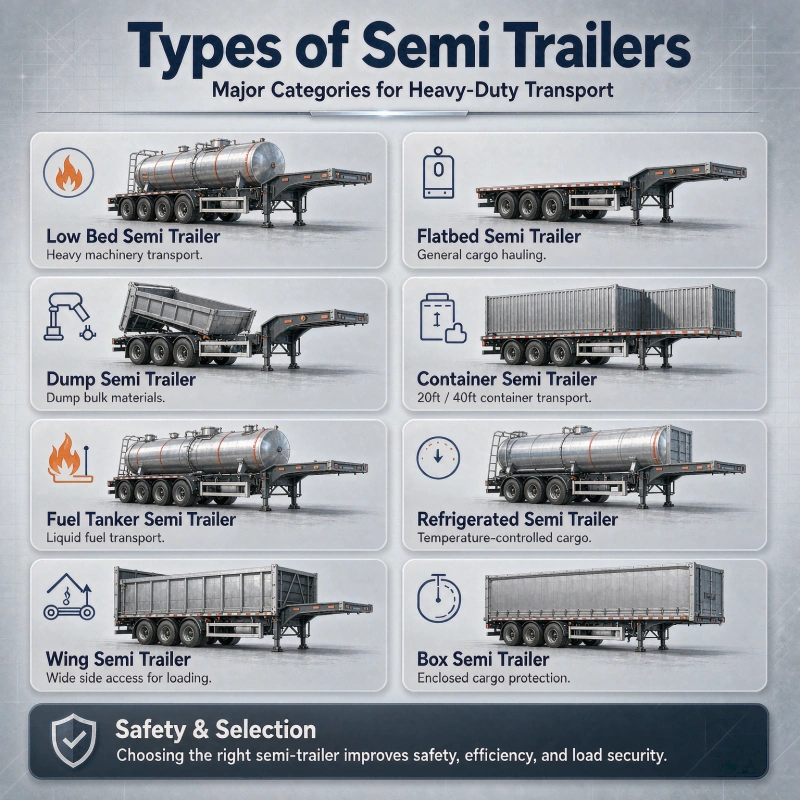
Flatbed Semi Trailer
A flatbed semi trailer is one of the most versatile trailer designs. It has a completely open cargo deck without fixed side walls or a roof.
Typical Dimensions
| Specification | Typical Range |
|---|---|
| Length | 40–53 ft |
| Width | 8.5 ft |
| Deck Height | Approximately 1.3–1.6 m |
| Payload | Approximately 30–60 tons |
Applications
Flatbeds are commonly used for:
- Steel coils
- Steel pipes
- Lumber
- Construction materials
- Machinery
- Concrete products
- Industrial equipment
Advantages
- Loading from all sides
- Easy crane loading
- Excellent cargo flexibility
- Simple structure
- Relatively easy maintenance
Disadvantages
- No weather protection
- Cargo requires proper securing
- Tarpaulins may be necessary
A flatbed is often the best choice when cargo dimensions vary significantly.
Side Board Semi Trailer
A side board semi trailer combines an open deck with removable or foldable side panels.
Typical lengths include 40 ft, 45 ft, 48 ft, and 53 ft, while side board heights commonly range from approximately 600 to 1,200 mm.
It is commonly used for:
- Agricultural products
- Cement bags
- Steel products
- Construction materials
- General cargo
Advantages
- More cargo protection than a flatbed
- Flexible loading
- Removable side panels
- Relatively low cost
- Suitable for mixed cargo
Disadvantages
- Limited weather protection
- Tarpaulin required for rain-sensitive products
- Less secure than enclosed trailers
For companies transporting different types of cargo, side board trailers can provide a strong balance between flexibility and price.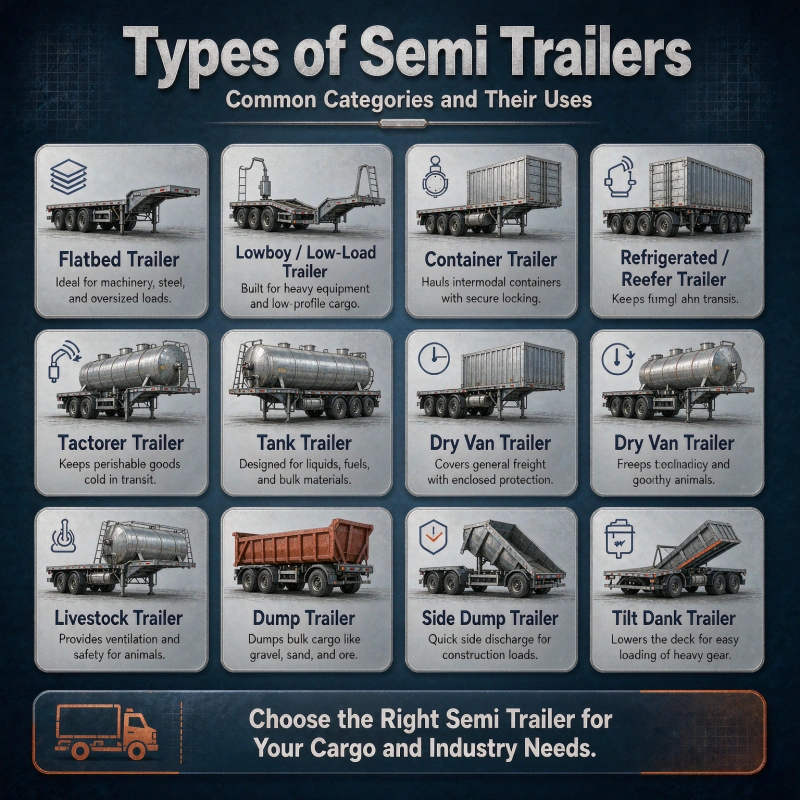
Fence Semi Trailer
A fence semi trailer uses vertical posts and side rails to contain cargo.
It is especially common in agricultural and bulk cargo transportation.
Applications
- Grain
- Agricultural products
- Feed
- Fertilizer
- Bagged goods
- Some livestock-related cargo
Advantages
- Good ventilation
- Flexible loading
- High cargo capacity
- Easy access
Disadvantages
- Limited weather protection
- Not suitable for temperature-sensitive cargo
- Cargo may require additional covering
Fence trailers are particularly useful in markets where agricultural transportation represents a large proportion of freight demand.
Curtain Side Semi Trailer
Curtain side trailers use flexible PVC curtains instead of conventional rigid side walls.
A typical European curtain trailer is approximately 13.6 m long, 2.55 m wide, and around 4 m high overall, subject to local specifications.
Applications
- Palletized goods
- Retail products
- Consumer goods
- Beverages
- Industrial products
Advantages
- Side loading
- Fast forklift access
- Weather protection
- Flexible cargo handling
- Efficient warehouse operations
Disadvantages
- Curtains can be damaged
- Less secure than rigid box trailers
- Curtain replacement creates additional maintenance costs
Curtain-side trailers are particularly valuable for distribution operations where loading speed matters.
Dry Van Semi Trailer
A dry van is an enclosed trailer designed for general freight.
The popular North American configuration is the 53-foot dry van.
Typical characteristics include:
- Length: 53 ft
- Width: approximately 102 in
- Enclosed cargo area
- Rear door access
- Optional side doors
Applications
- E-commerce
- Retail
- Consumer products
- Electronics
- Packaged food
- General freight
Advantages
- Excellent weather protection
- Better cargo security
- Large internal volume
- Suitable for long-distance transportation
Disadvantages
- Loading is mainly from the rear
- Less suitable for oversized cargo
- Higher weight than an open flatbed
For general freight transportation, the dry van remains one of the most widely used semi trailer designs.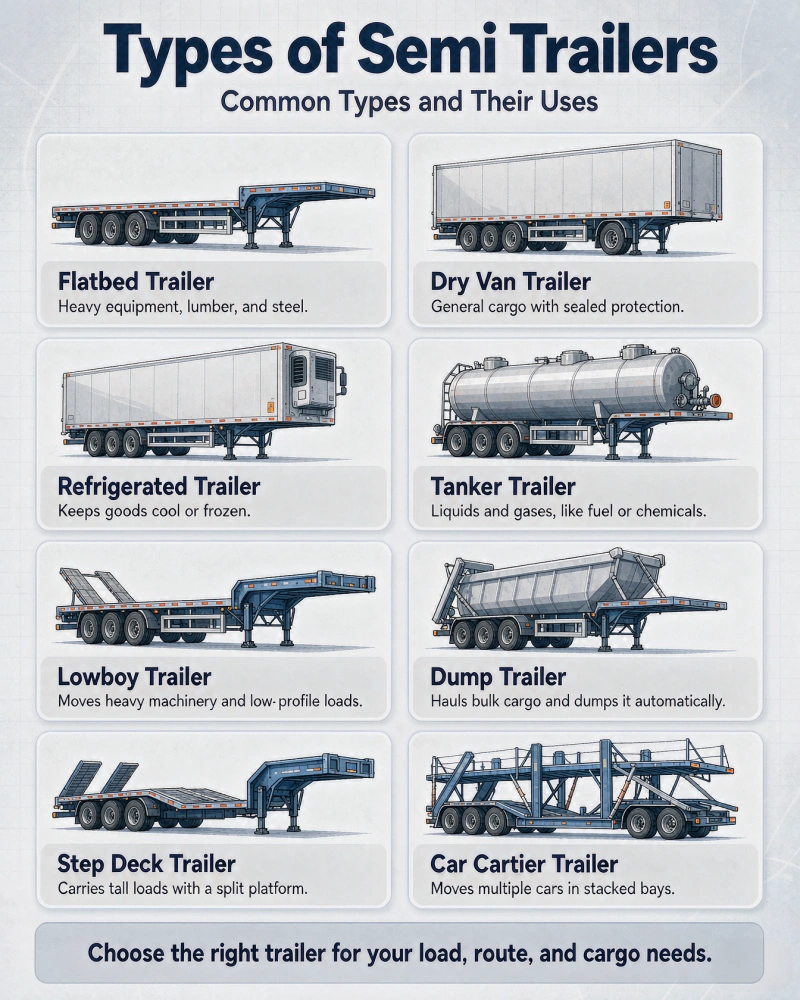
Refrigerated Semi Trailer
A refrigerated semi trailer, commonly called a reefer, uses an integrated refrigeration system to maintain controlled cargo temperatures.
Typical temperature ranges can extend from approximately -30°C to +25°C, depending on the refrigeration unit and trailer specification.
Applications
- Frozen food
- Fresh vegetables
- Meat
- Seafood
- Dairy products
- Pharmaceuticals
- Flowers
Advantages
- Temperature control
- Suitable for cold-chain logistics
- Protects sensitive products
Disadvantages
- Higher purchase price
- Refrigeration fuel consumption
- More complicated maintenance
- Regular temperature monitoring required
If cargo has strict temperature requirements, a standard dry van should not be substituted for a reefer simply to reduce the initial purchase price.
Lowbed Semi Trailer
A lowbed or lowboy semi trailer is designed to transport heavy and tall machinery.
The cargo deck sits significantly lower than that of a conventional flatbed.
Applications
- Excavators
- Bulldozers
- Wheel loaders
- Cranes
- Mining equipment
- Agricultural machinery
Typical Payload
Depending on the configuration, lowbed trailers can be engineered for approximately 40–150 tons or more.
Advantages
- Low center of gravity
- Suitable for tall equipment
- High load capacity
- Improved overhead clearance
Disadvantages
- Specialized application
- Higher purchase cost
- Oversize permits may be required
- More complex axle configurations for very heavy loads
For heavy equipment transportation, lowbed trailers are generally much more appropriate than standard flatbeds.
Drop Deck Semi Trailer
A drop deck trailer has a raised front section and a lower central deck.
The lower deck provides additional vertical clearance for cargo.
Applications
- Construction machinery
- Industrial equipment
- Agricultural machinery
- Tall machinery
Advantages
- More vertical cargo clearance
- Easier loading than some lowbeds
- More flexible than specialized heavy-haul trailers
Disadvantages
- Lower capacity than some heavy-duty lowbeds
- Height restrictions still apply
- More complicated frame construction
Rear Dump Semi Trailer
A rear dump semi trailer uses hydraulic lifting equipment to discharge bulk cargo through the rear.
Typical applications include:
- Sand
- Gravel
- Coal
- Ore
- Construction waste
- Agricultural materials
Typical capacities can range from approximately 25 to 60 m³, depending on body design.
Advantages
- Fast unloading
- High productivity
- Suitable for bulk materials
- Reduced manual labor
Disadvantages
- Higher center of gravity while tipping
- Requires stable ground
- Hydraulic maintenance required
- Not suitable for ordinary palletized freight
Dump trailers are particularly valuable for construction, mining, and aggregate transportation.
Side Dump Semi Trailer
A side dump trailer discharges cargo from the side rather than the rear.
This design can be useful where unloading space behind the trailer is restricted.
Applications
- Mining
- Road construction
- Quarry operations
- Aggregate transportation
Advantages
- Fast unloading
- Can unload where rear access is limited
- Good for large construction sites
Disadvantages
- More specialized
- Hydraulic system increases complexity
- Requires adequate side clearance
Container Skeleton Semi Trailer
A container skeleton trailer, also known as a container chassis, is designed to transport standard shipping containers.
Common configurations support:
- 20-foot containers
- 40-foot containers
- 45-foot containers
- Twin 20-foot containers in suitable configurations
Applications
- Ports
- Container terminals
- International logistics
- Rail-road transportation
Advantages
- Lightweight
- Simple structure
- Low maintenance
- Efficient container transportation
Disadvantages
- Limited to containerized freight
- Cannot carry ordinary loose cargo
- Requires compatible twist-lock systems
For companies working directly with ports or shipping lines, a container chassis is usually more appropriate than a general-purpose trailer.
Tanker Semi Trailer
A tanker semi trailer transports liquids, powders, or other bulk materials in a specialized tank body.
Fuel tankers are used for:
- Diesel
- Gasoline
- Kerosene
- Petroleum products
Other tanker designs can transport:
- Milk
- Food-grade liquids
- Chemicals
- Asphalt
- Powdered cement
Tank capacities commonly range from approximately 20,000 to 60,000 liters, depending on the product and regulatory requirements.
Advantages
- High liquid transportation efficiency
- Specialized cargo handling
- Large capacity
- Multiple compartment options
Disadvantages
- Higher safety requirements
- More complicated maintenance
- Strict regulatory compliance
- Higher purchase price
For fuel and chemical transportation, buyers should pay particular attention to tank material, valves, emergency systems, grounding, braking, and applicable dangerous-goods regulations.
Car Carrier Semi Trailer
Car carrier trailers are specifically designed to transport multiple vehicles.
Depending on the design, they can carry approximately 6–12 passenger vehicles, although capacity varies according to vehicle size and trailer configuration.
Applications
- Automotive manufacturers
- Vehicle dealerships
- Vehicle distributors
- Used-car exporters
Advantages
- High vehicle transport efficiency
- Multi-level loading
- Hydraulic adjustment on some models
Disadvantages
- Specialized use
- More complex loading
- Higher maintenance requirements
If your business only transports vehicles occasionally, renting may be more economical than purchasing a dedicated car carrier.
Log Semi Trailer
Log trailers are designed to transport timber and logs.
They normally use strong stakes or uprights to prevent logs from moving during transportation.
Applications
- Forestry
- Sawmills
- Paper mills
- Timber processing plants
Advantages
- High structural strength
- Efficient timber loading
- Specialized cargo restraint
Disadvantages
- Limited cargo flexibility
- Requires proper log securing
- Demand may depend on local forestry activity
Extendable Semi Trailer
An extendable trailer is designed for oversized or unusually long cargo.
The frame can extend to accommodate products that exceed standard trailer dimensions.
Applications
- Steel beams
- Wind turbine components
- Pipes
- Bridges
- Construction structures
- Long machinery
Advantages
- Handles long cargo
- Reduces overhang
- Flexible configuration
Disadvantages
- Higher purchase cost
- More complicated operation
- Oversize permits may be necessary
For specialized project logistics, an extendable trailer can eliminate the need for multiple smaller transport solutions.
Bulk Cement Semi Trailer
A bulk cement trailer, often called a powder tanker, is designed to transport dry powdered materials.
Common cargo includes:
- Cement
- Fly ash
- Lime
- Powdered minerals
The trailer generally uses pneumatic discharge equipment.
Advantages
- Fast bulk unloading
- Reduced manual handling
- High-volume transportation
Disadvantages
- Specialized equipment
- Compressor maintenance
- Requires appropriate loading and unloading facilities
Semi Trailer Types Comparison
| Trailer Type | Main Cargo | Typical Length | Main Advantage |
|---|---|---|---|
| Flatbed | Steel, machinery | 40–53 ft | Maximum loading flexibility |
| Side Board | General cargo | 40–53 ft | Versatility |
| Fence | Agricultural goods | 40–53 ft | Ventilation |
| Curtain Side | Palletized goods | 13.6 m / 45 ft | Fast side loading |
| Dry Van | General freight | 48–53 ft | Weather protection |
| Reefer | Perishables | 48–53 ft | Temperature control |
| Lowbed | Heavy machinery | 10–18 m | Heavy-haul capability |
| Drop Deck | Tall machinery | 48–53 ft | Increased vertical clearance |
| Rear Dump | Bulk materials | 8–12 m | Fast unloading |
| Side Dump | Aggregate | 8–12 m | Side unloading |
| Container Chassis | Containers | 20/40/45 ft | Intermodal transport |
| Tanker | Liquids | 10–14 m | Bulk liquid transport |
| Car Carrier | Vehicles | 13–22 m | Multiple vehicles |
| Log Trailer | Timber | 12–16 m | Secure log transport |
| Extendable | Long cargo | Variable | Oversized cargo |
| Cement Tanker | Powder | 10–14 m | Pneumatic unloading |
Dimensions are typical manufacturing ranges. Actual legal dimensions and payload limits vary by country, axle configuration, road regulations, and cargo requirements.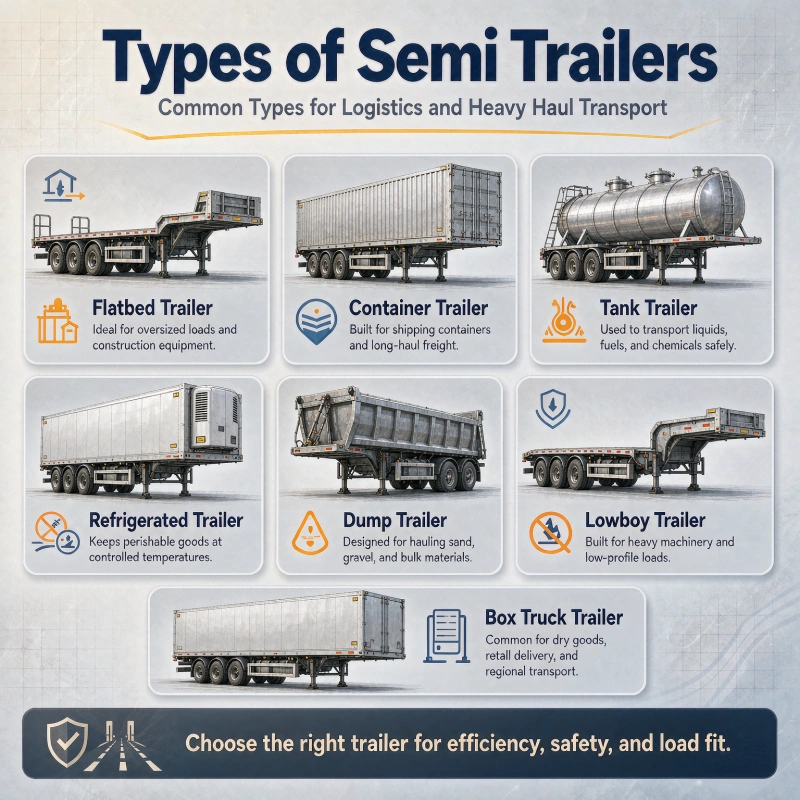
How to Choose the Right Semi Trailer
The correct trailer should be selected according to cargo + route + loading method + regulations + utilization rate.
Match the Trailer to Your Cargo
| Cargo | Recommended Trailer |
|---|---|
| General packaged goods | Dry Van |
| Palletized cargo | Curtain Side |
| Steel and pipes | Flatbed |
| Construction machinery | Lowbed |
| Sand and gravel | Dump Trailer |
| Shipping containers | Container Chassis |
| Fuel | Fuel Tanker |
| Perishable food | Reefer |
| Passenger vehicles | Car Carrier |
| Timber | Log Trailer |
| Long steel structures | Extendable Trailer |
| Cement powder | Bulk Cement Trailer |
This simple matching process can eliminate many costly purchasing mistakes.
Consider Your Loading and Unloading Method
Your trailer should also match the equipment available at your facilities.
For example:
- Crane loading → Flatbed
- Forklift side loading → Curtain Side
- Rear dock loading → Dry Van
- Top loading → Certain bulk or tanker applications
- Hydraulic unloading → Dump Trailer
- Container crane → Container Chassis
A trailer with excellent specifications is still inefficient if your warehouse cannot load it efficiently.
Consider Road and Legal Restrictions
Before purchasing a trailer, confirm:
- Maximum gross vehicle weight
- Maximum axle load
- Maximum overall length
- Maximum width
- Maximum height
- Brake requirements
- Lighting regulations
- Dangerous-goods requirements
A trailer designed for one country may require modifications before it can legally operate in another.
This is particularly important for exporters purchasing trailers from overseas manufacturers.
New vs. Used Semi Trailers
New Semi Trailer
A new trailer offers:
- Latest specifications
- OEM customization
- Full control over components
- Lower initial maintenance risk
- Manufacturer warranty
It is generally better for companies planning long-term fleet operation.
Used Semi Trailer
Used trailers offer:
- Lower initial investment
- Faster acquisition
- Potentially lower depreciation
However, buyers should inspect:
- Frame cracks
- Corrosion
- Axle condition
- Suspension
- Brakes
- Tires
- Kingpin
- Landing gear
- Hydraulic systems
- Tank condition where applicable
A cheap used trailer can become expensive if major repairs are required shortly after purchase.
Renting vs. Buying a Semi Trailer
The decision between renting and buying depends primarily on utilization.
Renting Is Better When
Renting may make sense when:
- Demand is seasonal
- You need a trailer temporarily
- You are testing a new logistics route
- You have limited capital
- Your cargo requirements change frequently
The biggest advantage is flexibility.
Buying Is Better When
Buying is generally more attractive when:
- The trailer operates year-round
- Freight demand is predictable
- You need customized specifications
- The trailer will be used for many years
- You want to build your own fleet
Although purchasing requires more capital initially, a well-utilized trailer can have a lower cost per operating year over its service life.
For specialized equipment such as tankers, reefers, and lowbeds, purchasing can also make sense when the equipment is used frequently enough to justify its higher investment.
How Much Does a Semi Trailer Cost?
Semi trailer prices vary substantially depending on type and specifications.
A simplified factory-price reference might look like:
| Trailer Type | Indicative Factory Price |
|---|---|
| Flatbed | US$8,000–15,000 |
| Side Board | US$9,000–16,000 |
| Fence | US$9,000–17,000 |
| Curtain Side | US$12,000–22,000 |
| Dry Van | US$12,000–25,000 |
| Reefer | US$25,000–45,000+ |
| Container Chassis | US$7,000–14,000 |
| Lowbed | US$15,000–40,000+ |
| Dump Trailer | US$15,000–30,000+ |
| Fuel Tanker | US$15,000–38,000+ |
These figures are general manufacturing-market references rather than fixed quotations. Specifications, steel prices, axles, suspension, tires, braking systems, certifications, and destination requirements can significantly change the final price.
For international buyers, remember that the total acquisition cost can also include:
- FOB or CIF price
- Ocean freight
- Insurance
- Import duty
- VAT or local tax
- Port fees
- Certification
- Registration
- Local modifications
Therefore, comparing only the factory quotation can produce a misleading result.
What Should You Ask a Semi Trailer Manufacturer?
Before placing an order, professional buyers should request detailed information about:
Trailer Structure
Ask for:
- Frame material
- Steel grade
- Main beam dimensions
- Cross-member spacing
- Floor thickness
Axles and Suspension
Confirm:
- Axle brand
- Axle capacity
- Number of axles
- Suspension type
- Spare-parts availability
Brake System
Check:
- Brake chamber type
- ABS availability
- EBS requirements
- Local compliance
Tires
Compare:
- Tire size
- Tire brand
- Load rating
- Number of spare tires
Customization
Ask whether the factory can customize:
- Trailer length
- Width
- Height
- Axle configuration
- Suspension
- Paint
- Logo
- Side boards
- Hydraulic equipment
- Loading systems
This information allows buyers to compare manufacturers based on the complete specification rather than simply the lowest price.
Practical Advice for Semi Trailer Buyers
After working with trailer buyers and fleet operators, one of the most important lessons is that trailer utilization is often more important than maximum capacity.
A 60-ton trailer sounds impressive, but if your roads legally permit only 40 tons, the additional capacity provides little commercial value. Similarly, a 53-foot trailer may maximize cargo volume on highways but become difficult to maneuver in narrow urban distribution areas.
Before purchasing, calculate:
Annual freight volume ÷ realistic trailer utilization = required fleet capacity
Also consider empty return trips. A trailer that performs perfectly on the outbound journey may have poor economics if it cannot find suitable return cargo.
For this reason, logistics operators should evaluate the entire transportation cycle rather than focusing only on payload.
Final Thoughts
There is no single best type of semi trailer for every business.
Flatbeds and side board trailers are excellent for flexible general cargo. Curtain-side and dry van trailers are better for palletized goods requiring weather protection. Reefers are essential for cold-chain logistics. Lowbeds handle heavy machinery, while dump trailers are optimized for bulk construction materials. Tankers specialize in liquids, container chassis trailers support intermodal logistics, and car carriers efficiently move vehicles.
The best purchasing decision comes from matching cargo characteristics, transportation routes, loading methods, legal restrictions, utilization rate, and total ownership cost.
For companies buying from a semi trailer manufacturer, the most important question is not simply “How much does this trailer cost?” It is “Will this trailer remain productive, compliant, and economical throughout its working life?”
That is the question that turns a trailer purchase from a simple equipment transaction into a profitable fleet investment.