
Semi Truck Trailer Dimensions: Complete Guide for International Buyers
Semi Truck Trailer Dimensions: A Complete Guide for International Buyers
When buying a semi truck trailer, dimensions are more than just numbers on a specification sheet.
Trailer length, width, height, axle configuration and cargo capacity can directly affect transportation efficiency, road compliance and operating costs.
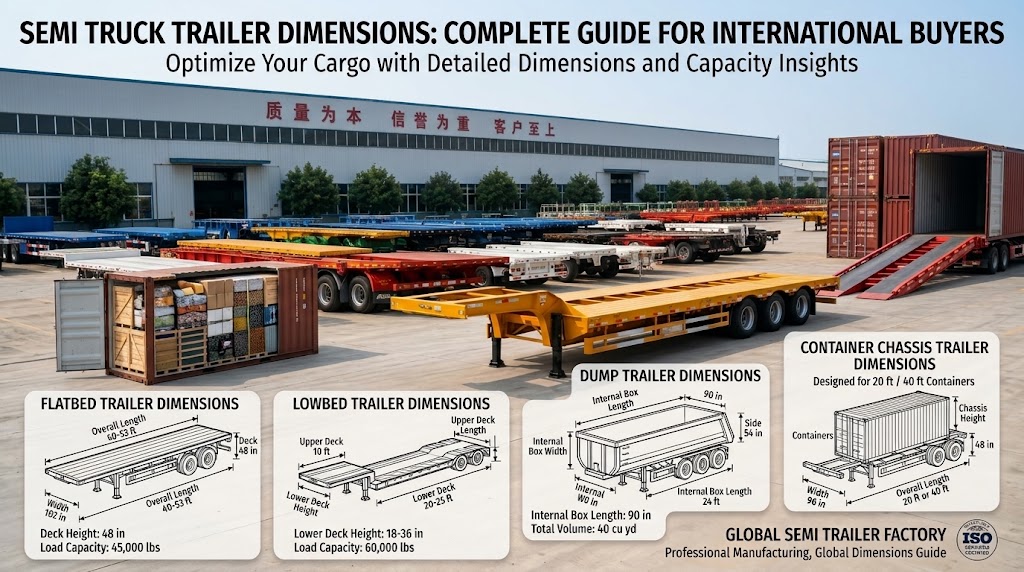
For international buyers sourcing trailers from China, choosing the correct dimensions is especially important because regulations and transportation conditions can vary significantly between countries and regions.
A trailer designed for one market may not be suitable for another.
So before placing an order, the key question is not simply:
“What is the standard trailer size?”
The more important question is:
“What trailer dimensions are suitable for my cargo, tractor, roads and local regulations?”
This guide explains the key dimensions international buyers should understand before purchasing a semi truck trailer.
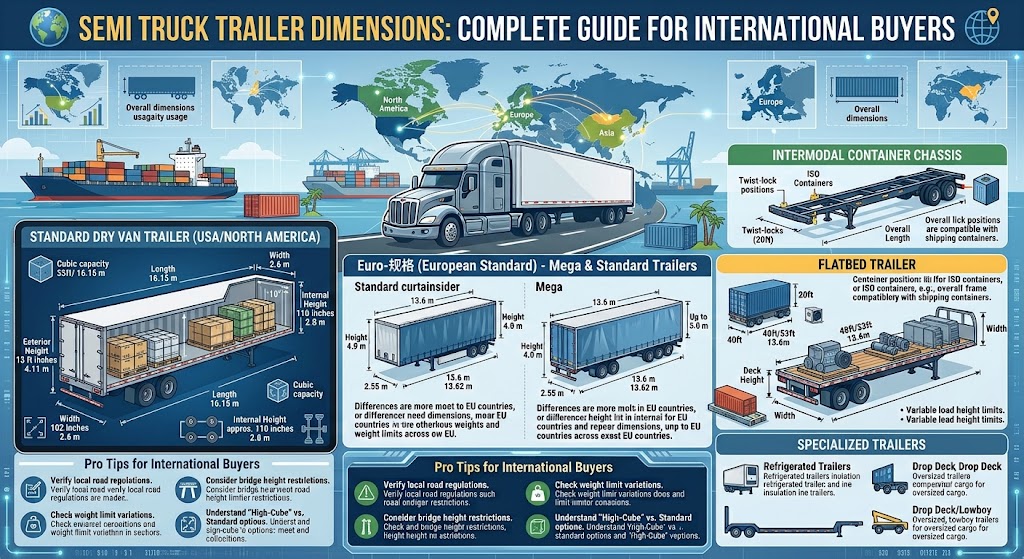
1. What Are the Main Semi Truck Trailer Dimensions?
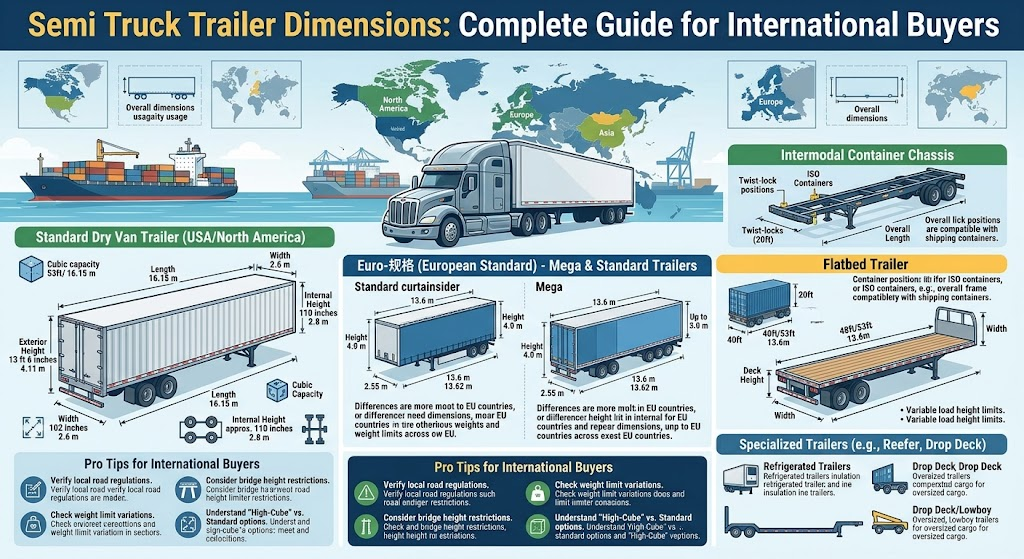
When discussing semi truck trailer dimensions, buyers normally need to consider five major specifications:
- Overall length
- Overall width
- Overall height
- Deck or internal dimensions
- Payload and axle configuration
These dimensions work together.
For example, increasing trailer length may provide more loading space, but the complete tractor-trailer combination still needs to comply with the regulations of the destination market.
Similarly, a wider or taller trailer may provide more usable cargo volume but could create problems with road restrictions, bridges, tunnels or local registration requirements.
This is why trailer dimensions should always be evaluated as part of the complete vehicle combination, not as an isolated number.
2. Semi Truck Trailer Length
Trailer length is one of the first specifications international buyers ask about.
Common trailer lengths vary depending on the trailer type and target market.
For example, long flatbed and dry freight trailers are often designed around the cargo and road regulations of the intended market, while lowbed trailers, container chassis and specialized trailers can have very different dimensions.
For international sourcing, buyers should confirm:
- Overall trailer length
- Effective loading length
- Kingpin position
- Rear overhang
- Tractor-trailer combination length
- Local maximum length requirements
In the United States, for example, trailer and combination rules are governed within a specific regulatory framework, while European markets use different dimensional requirements.
The European Commission's published information identifies 16.5 m as the maximum length for articulated vehicles under the EU framework, while maximum width is generally 2.55–2.60 m and maximum height is 4 m, subject to applicable rules and exceptions.
This demonstrates an important point:
There is no single universal “standard semi trailer dimension” for every export market.
3. Semi Truck Trailer Width
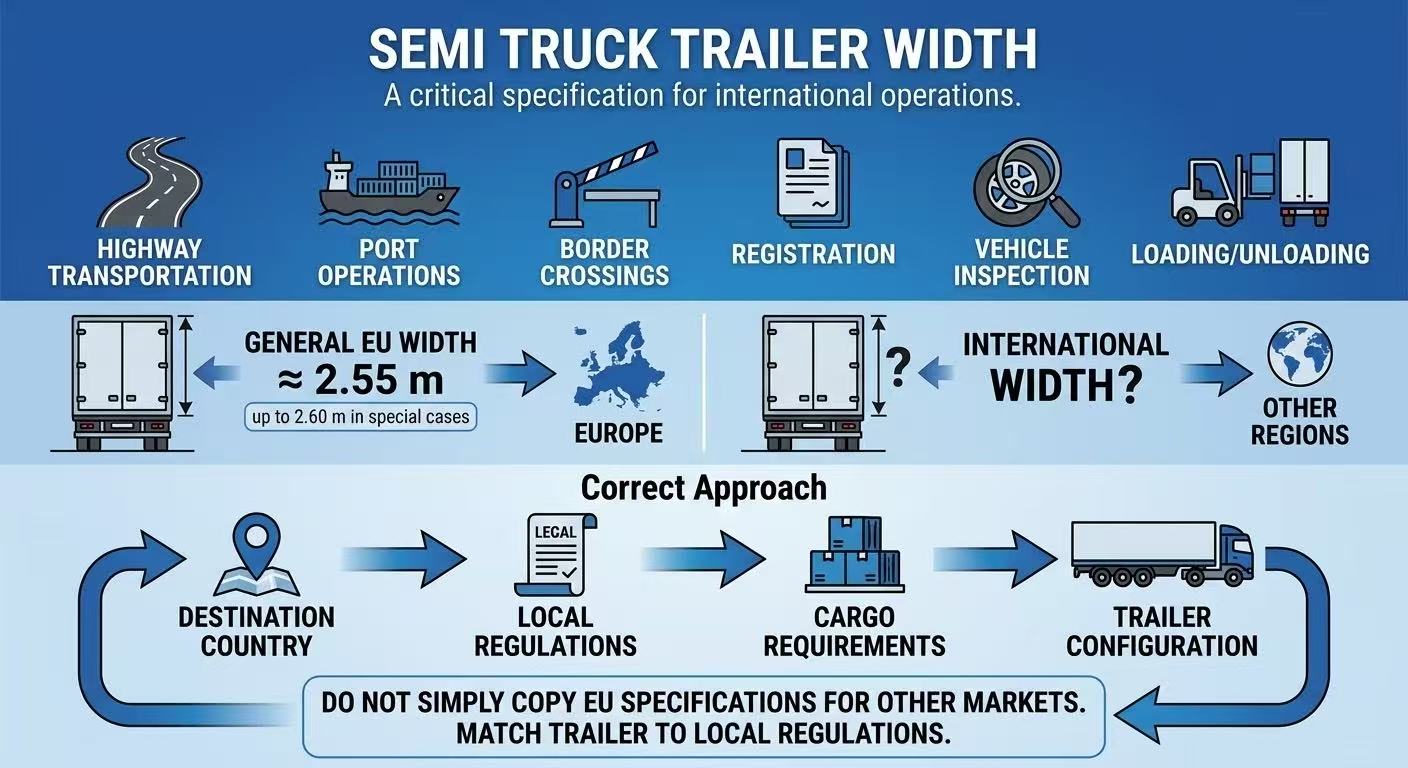
Trailer width is another critical specification.
A trailer that is too wide for the intended road network may create problems during:
- Highway transportation
- Port operations
- Border crossings
- Registration
- Vehicle inspection
- Loading and unloading
For many international markets, trailer width is designed around local maximum vehicle-width regulations.
In Europe, for example, the general maximum width referenced by the European Commission is around 2.55 m, with 2.60 m applying in certain cases.
However, buyers should not simply copy a European specification when purchasing for another country.
The correct approach is:
Destination country → local regulations → cargo requirements → trailer configuration
4. Semi Truck Trailer Height
Trailer height can become particularly important when transporting equipment, machinery or high-volume cargo.
Overall height may include:
- Trailer frame
- Deck
- Sidewall
- Cargo body
- Tires and suspension
- Loaded cargo
For lowbed trailers, reducing the loading platform height can be especially important.
The lower the cargo platform, the more flexibility the operator may have when transporting tall machinery while keeping the overall transport height within permitted limits.
This is one reason lowbed trailers are commonly used for excavators, bulldozers, loaders and other heavy equipment.
For general trailers, buyers should consider the maximum overall height together with:
- Bridge clearance
- Tunnel clearance
- Road restrictions
- Cargo height
- Local legal limits
In the EU framework referenced above, the general maximum height is 4 m.
5. Loading Platform Dimensions
Overall trailer dimensions do not tell the whole story.
For cargo transportation, the usable loading area may be more important.
Buyers should ask the manufacturer for:
Loading length × loading width × deck height
For a flatbed trailer, for example, the usable deck dimensions determine how many containers, steel products, machines or other cargo can be transported.
A trailer with a larger overall size does not necessarily provide better loading efficiency.
The design of:
- Cross beams
- Main beams
- Side structures
- Wheel position
- Suspension
- Kingpin location
can all affect the usable loading area.
6. Trailer Dimensions by Type
Different semi trailers require different dimensional designs.
Flatbed Semi Trailer
Flatbed trailers are commonly used for:
- Containers
- Steel products
- Machinery
- Construction materials
- General cargo
Their dimensions can be configured according to the target market, cargo requirements and axle regulations.
The key specifications usually include:
Length + width + deck height + axle configuration + payload
Lowbed Semi Trailer
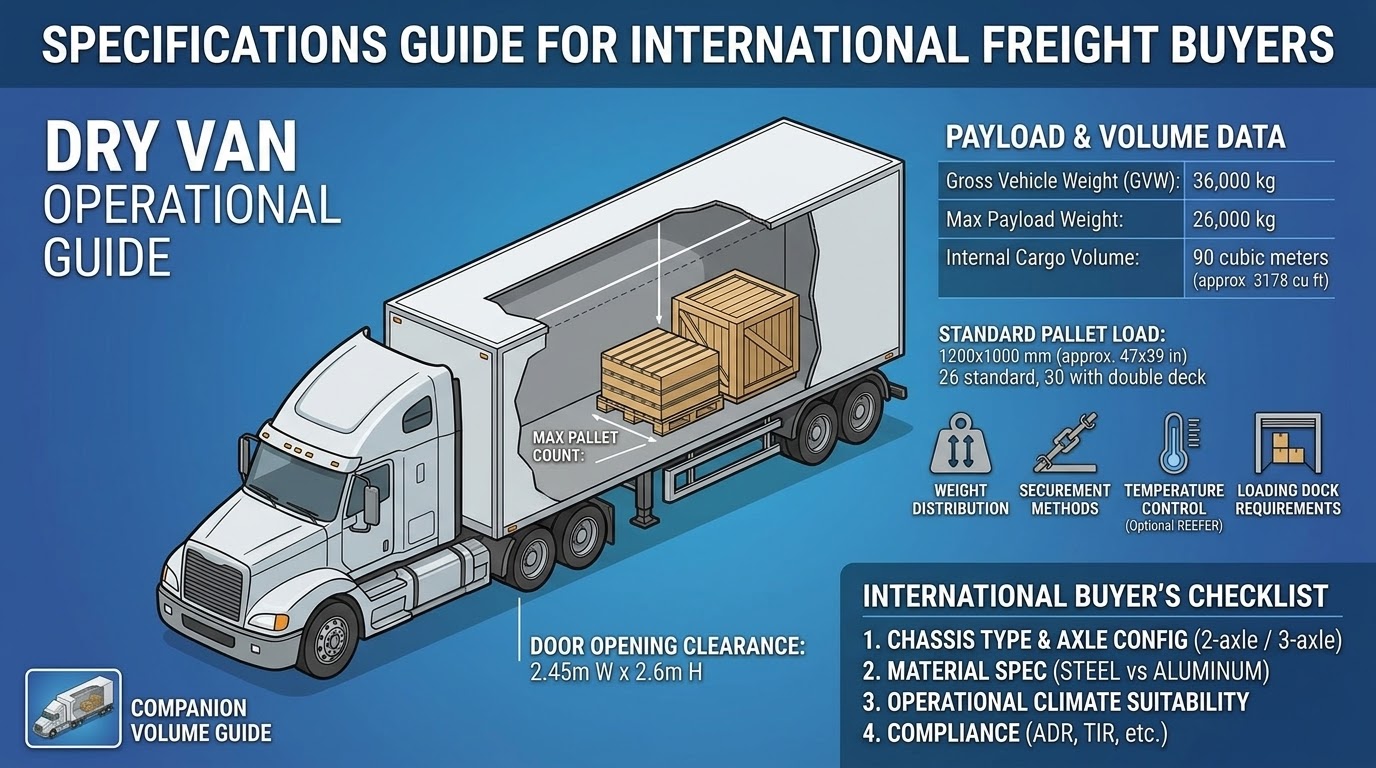
Lowbed trailers are designed for transporting heavy and oversized machinery.
Typical cargo includes:
- Excavators
- Bulldozers
- Loaders
- Cranes
- Construction equipment
The most important dimensional consideration is often loading height.
A lower deck can help reduce the overall height of the loaded vehicle.
Container Chassis
Container chassis are designed around standardized shipping container dimensions.
Their configuration depends on the container size being transported and the requirements of the local transportation system.
Buyers should confirm whether they need to transport:
- 20-foot containers
- 40-foot containers
- 45-foot containers
- Other container configurations
The chassis should be matched with the required container locking positions.
Dump Semi Trailer
Dump trailers are designed for bulk materials such as:
- Sand
- Gravel
- Coal
- Construction materials
- Mining materials
For dump trailers, buyers should pay attention not only to the external dimensions but also to:
- Body volume
- Loading height
- Hydraulic system
- Axle configuration
- Payload
A larger body does not always mean better performance.
The body volume should be matched with the density and weight of the cargo.
7. Dimensions and Payload Must Work Together
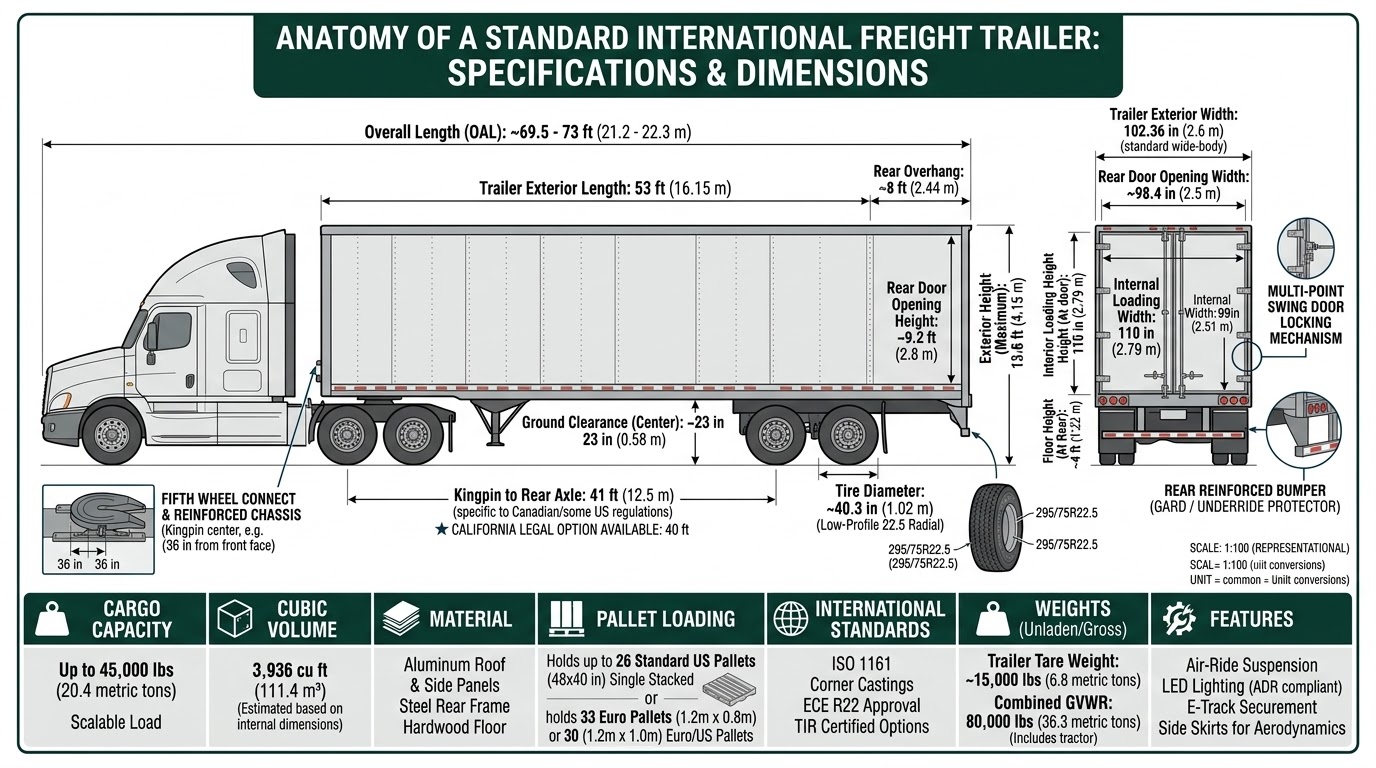
One of the biggest mistakes buyers can make is focusing on dimensions while ignoring weight.
A trailer may have a large loading area, but that does not mean it can legally carry an unlimited amount of cargo.
Payload depends on factors such as:
- Trailer tare weight
- Axle configuration
- Axle load limits
- Suspension
- Frame strength
- Tires
- Kingpin and coupling system
- Local regulations
Therefore:
Cargo volume ≠ Payload capacity
For example, lightweight cargo may require more loading volume, while dense materials may reach the legal weight limit before the trailer is physically full.
A professional trailer supplier should consider both volume and weight when recommending a configuration.
8. Why Axle Configuration Matters
Trailer dimensions should also be considered together with the number of axles.
Common configurations include:
- 2-axle trailers
- 3-axle trailers
- 4-axle trailers
- Specialized multi-axle trailers
More axles can increase the potential load distribution capacity, but the correct configuration depends on local regulations and the intended cargo.
The European Commission, for example, publishes different maximum authorized weights and axle-load provisions depending on vehicle configuration.
In the United States, cargo securement and commercial vehicle requirements are also governed by federal rules, with additional requirements applying to specific cargo categories and vehicle operations.
This is why international buyers should confirm the complete specification before production.
9. Don't Forget the Tractor-Trialer Combination
One important point is often overlooked:
A trailer does not operate alone.
It works together with the tractor.
The final vehicle combination can be affected by:
- Tractor wheelbase
- Fifth-wheel position
- Trailer length
- Kingpin position
- Rear overhang
- Turning radius
- Axle spacing
- Overall combination length
A trailer that appears suitable on paper may not work properly with a specific tractor configuration.
Before production, buyers should provide the manufacturer with the tractor specifications whenever possible.
This can help the manufacturer confirm compatibility before manufacturing begins.
10. How to Choose the Right Trailer Dimensions for Your Market
Before ordering a semi truck trailer from China, international buyers should prepare the following information:
Destination
Which country will the trailer operate in?
Cargo
What will the trailer transport?
Cargo Weight
What is the average and maximum cargo weight?
Cargo Dimensions
What are the length, width and height of the cargo?
Tractor
Which tractor model or fifth-wheel configuration will be used?
Road Conditions
Will the trailer mainly operate on highways, urban roads, ports, construction sites or mining roads?
Local Regulations
What are the maximum permitted:
- Length
- Width
- Height
- Axle load
- Gross combination weight?
With this information, the manufacturer can recommend a more appropriate configuration.
11. Semi Truck Trailer Dimensions: A Practical Checklist
Before confirming your order, check these specifications:
| Specification | What to Confirm |
|---|---|
| Overall Length | Trailer and combination length |
| Overall Width | Maximum legal width |
| Overall Height | Empty and loaded height |
| Loading Length | Usable deck length |
| Loading Width | Usable loading width |
| Deck Height | Especially important for lowbeds |
| Axles | Number and configuration |
| Payload | Actual working payload |
| Tare Weight | Trailer weight without cargo |
| Kingpin | Position and specification |
| Tires | Size and load rating |
| Suspension | Type and capacity |
| Tractor Compatibility | Fifth-wheel and coupling requirements |
A detailed specification sheet can help avoid misunderstandings between the buyer and manufacturer.
12. Why Correct Dimensions Matter for Export
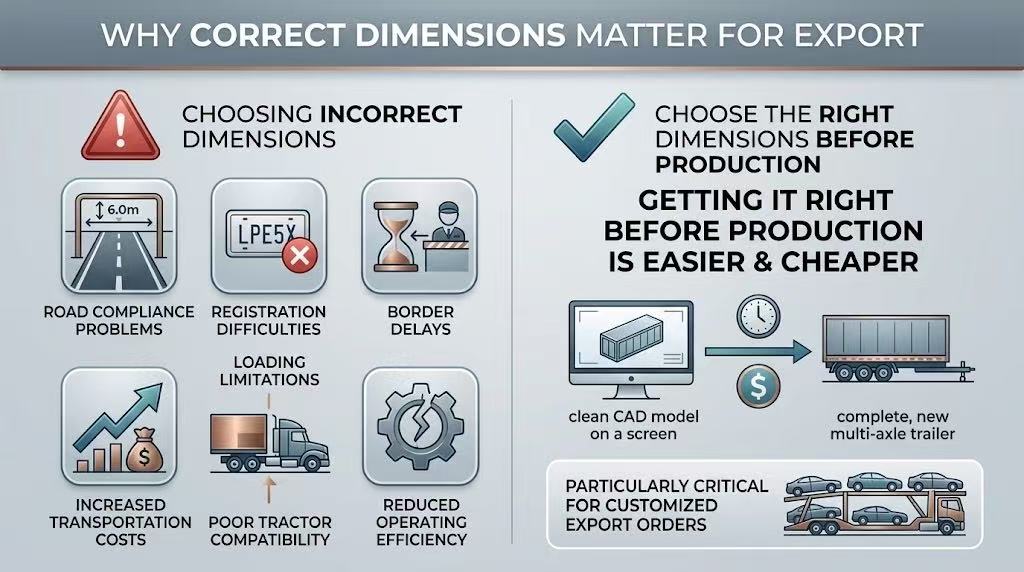
Choosing incorrect trailer dimensions can lead to much bigger problems than simply having less loading space.
Potential issues include:
- Road compliance problems
- Registration difficulties
- Border delays
- Loading limitations
- Increased transportation costs
- Poor tractor compatibility
- Reduced operating efficiency
For international buyers, getting the dimensions right before production starts is usually much easier than modifying the trailer after delivery.
This is particularly important for customized export orders.