
How Much Does a Semi Trailer Cost in 2026? Complete New & Used Price Guide
How Much Does a Semi Trailer Cost in 2026? Complete New & Used Price Guide
1. Introduction
If you are researching how much does a semi trailer cost, the short answer is: it depends heavily on the trailer type, size, axle configuration, materials, brand, specifications, and where the trailer is purchased.
In 2026, a commercial semi trailer can cost anywhere from several thousand dollars for a basic China-made export trailer to more than $80,000 for a highly specified new trailer in the North American market. Used trailers can be considerably cheaper, but their actual value depends on age, condition, maintenance history, and remaining service life.
For fleet owners, logistics companies, distributors, and international trailer buyers, the lowest purchase price is not always the best deal. A trailer with a lower initial price may require more maintenance, have lower resale value, or lack the braking, suspension, axle, or certification specifications required in the destination country.
This commercial semi trailer cost guide explains the major 2026 price ranges, compares new and used equipment, and shows how buyers can reduce total acquisition costs without sacrificing reliability.
The most important point is to compare trailers on an equivalent specification basis. A $10,000 export flatbed and a $40,000 North American flatbed may both be called “flatbed trailers,” but they are not necessarily built for the same market, regulations, equipment standards, or operating conditions.
2. 2026 Average Semi Trailer Price Range: New vs. Used
There is no single global 2026 semi trailer price.
The market can be divided into two broad purchasing channels:
-
Domestic-market trailers, such as new Wabash, Utility, Great Dane and similar products sold in North America.
-
China-manufactured export trailers, normally purchased directly from manufacturers or exporters and shipped to the buyer's destination country.
For example, current U.S. listings show new 53ft Wabash dry vans around $41,200–$42,600, while used 53ft Wabash units can be listed around $15,500 depending on model year and condition.
For Chinese export equipment, the pricing structure is different because buyers may purchase directly from the manufacturing source rather than through a domestic dealer network.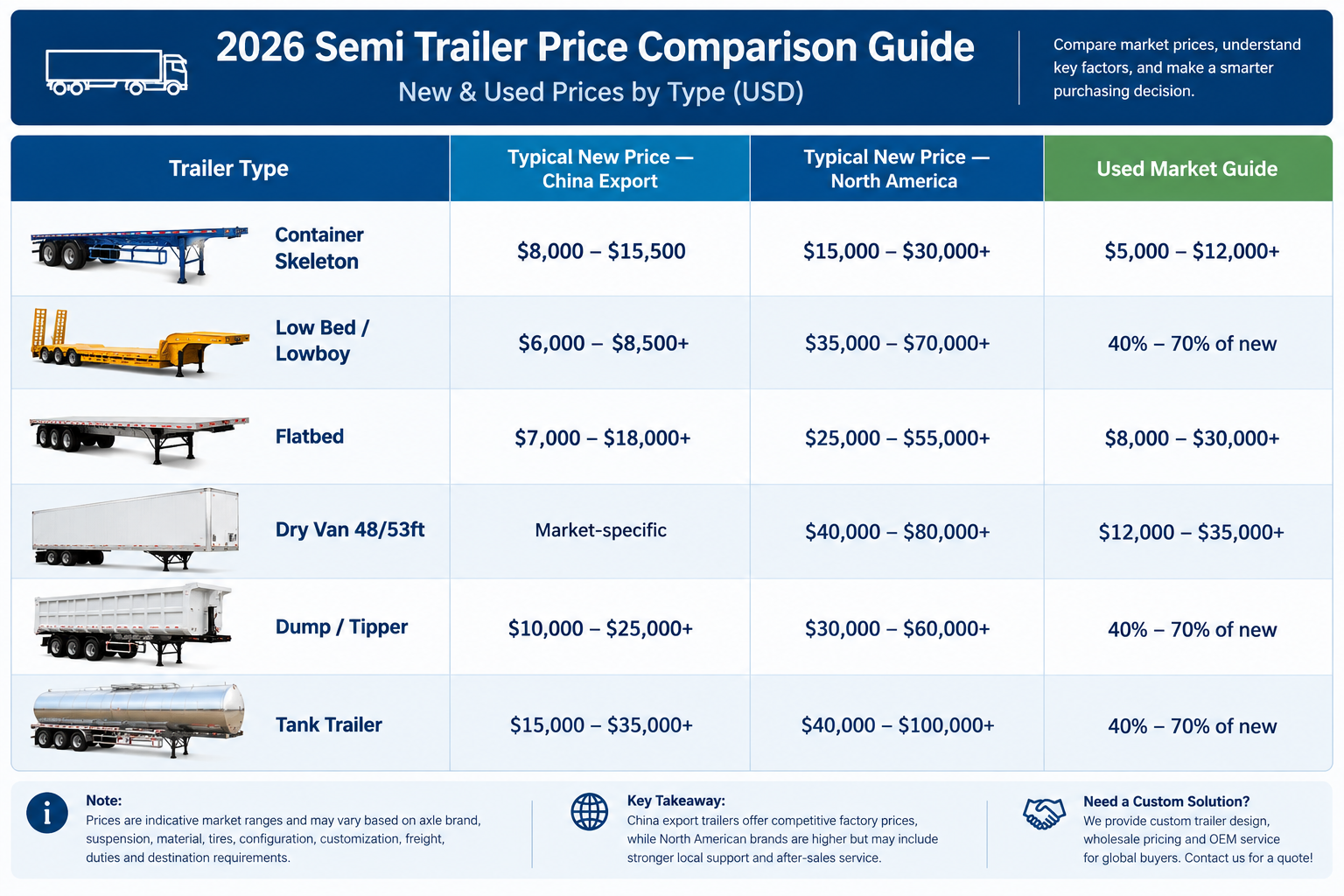
| Trailer Type | Typical New Price — China Export | Typical New Price — North America | Used Market Guide |
|---|---|---|---|
| Container Skeleton | $8,000–$15,500 | $15,000–$30,000+ | $5,000–$12,000+ |
| Low Bed / Lowboy | $6,000–$8,500+ | $35,000–$70,000+ | 40%–70% of new |
| Flatbed | $7,000–$18,000+ | $25,000–$55,000+ | $8,000–$30,000+ |
| Dry Van 48/53ft | Market-specific | $40,000–$80,000+ | $12,000–$35,000+ |
| Dump / Tipper | $10,000–$25,000+ | $30,000–$60,000+ | 40%–70% of new |
| Tank Trailer | $15,000–$35,000+ | $40,000–$100,000+ | 40%–70% of new |
These figures are indicative market ranges rather than fixed quotations. Exact prices change according to axle brand, suspension, steel grade, tire specifications, braking system, capacity, certification, customization, freight, and destination requirements.
For international buyers, the most useful question is therefore not simply “What is the cheapest trailer?” but “What is the delivered cost of a trailer that meets my operating requirements?”
3. Semi Trailer Cost by Type
Dry Van Trailer Price
A dry van is one of the most expensive standard semi trailer categories because it includes an enclosed body, flooring, doors, roof, sidewalls, insulation options, suspension, axles, and other components.
A new 48ft or 53ft dry van in the North American market commonly falls within approximately $40,000–$80,000+, depending on construction and specifications.
Current market listings provide a useful reference point. New 53ft Wabash dry vans have recently been listed around $41,200–$42,600, while older used 53ft units can be available at substantially lower prices.
If you are asking how much is a 40ft/53ft semi trailer, the answer depends heavily on whether you mean a dry van, container chassis, flatbed, or another trailer type.
A 53ft dry van is normally more expensive than a basic container chassis because the trailer has a complete enclosed cargo body.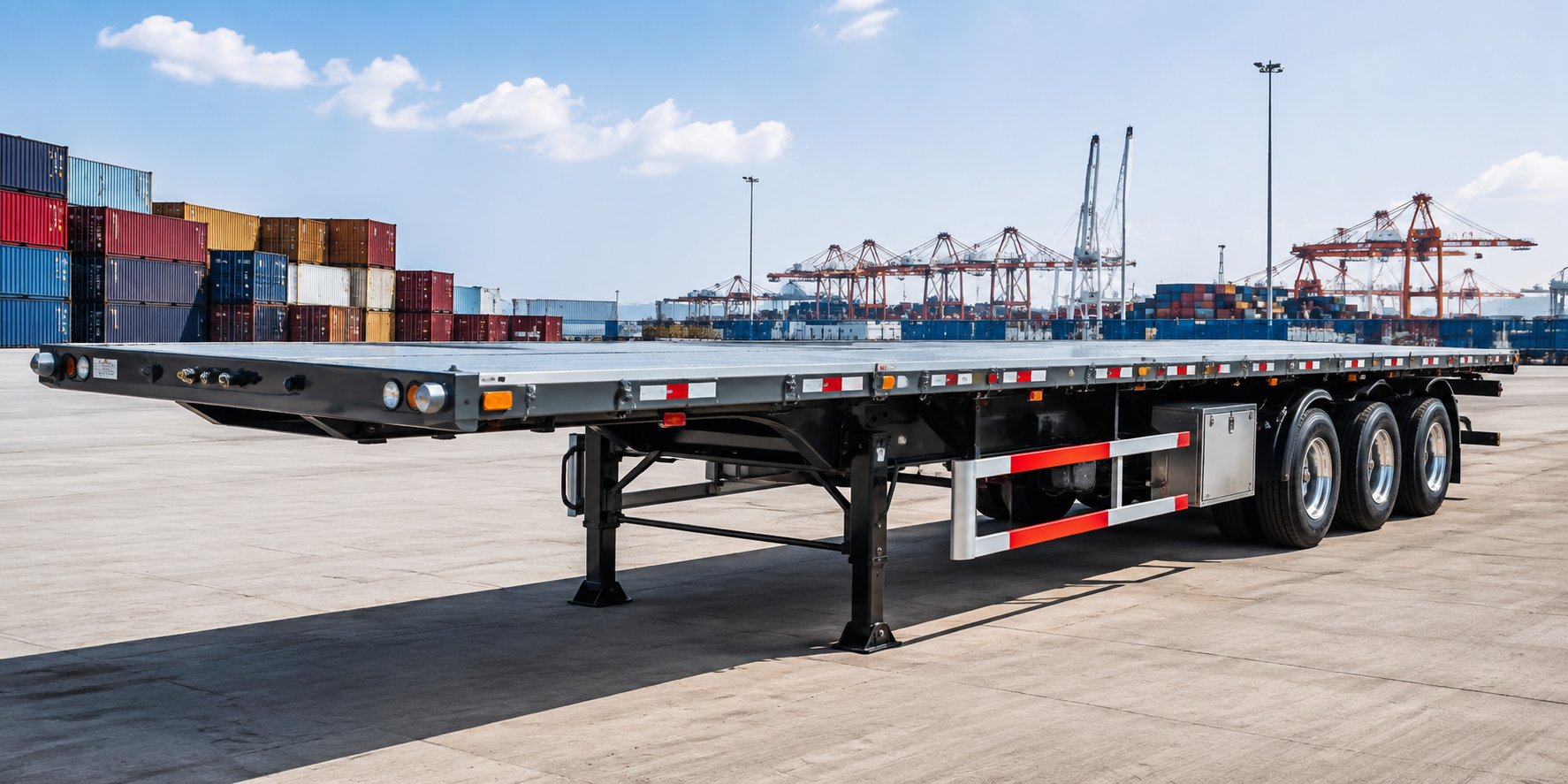
Flatbed Trailer Price
Flatbed trailers are simpler than enclosed trailers because they do not have walls or a roof. This reduces manufacturing complexity.
For China-export specifications, a basic flatbed can commonly fall around $7,000–$18,000, while premium configurations with heavier beams, upgraded axles, aluminum components, additional winches, or special cargo equipment cost more.
The North American market is considerably more expensive. A 2026 market review puts new 48–53ft flatbeds around $25,000–$55,000, while current dealer listings can exceed $40,000 for premium 48–53ft configurations.
For international buyers, this is one of the clearest categories where purchasing directly from a Chinese manufacturer can create a substantial price difference.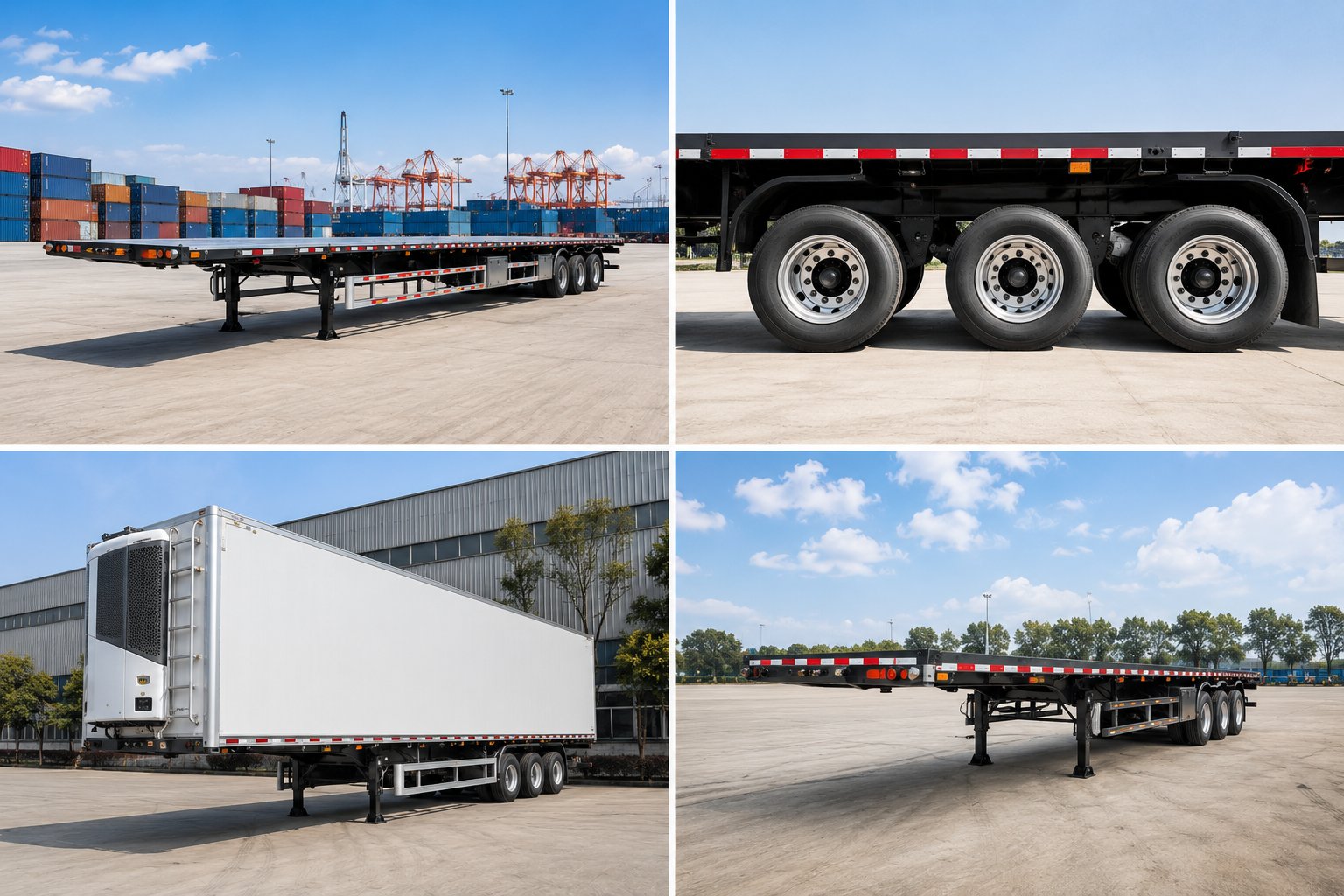
Lowboy / Low Bed Trailer Price
A low bed or lowboy trailer is designed to transport excavators, loaders, construction machinery, mining equipment, and other heavy or oversized cargo.
A basic China-export low bed trailer can start around $6,000–$8,500, but a heavy-duty configuration can be significantly more expensive.
The final new semi trailer cost depends on deck thickness, loading capacity, axle quantity, hydraulic ramps, suspension, kingpin design, tire configuration, and whether the trailer is designed for standard or extreme heavy-duty applications.
North American lowboy and double-drop equipment is typically much more expensive. A 2026 market guide places new double-drop/lowboy equipment broadly around $35,000–$70,000.
Container Skeleton Trailer Price
A container skeleton trailer, also known as a container chassis or skeletal trailer, is designed primarily for transporting ISO containers.
A standard China-manufactured skeleton trailer generally falls around $8,000–$15,500, depending on whether it is designed for 20ft, 40ft, 45ft, or extendable container applications.
Axle quantity has a major influence on price. A tandem-axle configuration may be suitable for many applications, while a tri-axle or heavy-duty configuration increases both purchase cost and payload capability.
Buyers should also check container locking mechanisms, chassis length, axle rating, suspension type, braking equipment, and local road regulations before comparing quotations.
Dump / Tipper Trailer Price
Dump trailers are designed for bulk cargo such as sand, gravel, coal, agricultural products, construction waste, and minerals.
A typical China-export dump semi trailer can fall approximately within the $10,000–$25,000+ range.
Hydraulic system capacity is an important cost factor. A heavier body, stronger chassis, larger hydraulic cylinder, thicker floor, higher sidewalls, and additional axles will increase the price.
For mining or severe-duty applications, buyers should focus less on the lowest quotation and more on structural strength, weld quality, axle capacity, hydraulic reliability, and after-sales support.
Tank Trailer Price
Tank trailers can carry fuel, chemicals, food-grade liquids, water, cement powder, and other specialized cargo.
Their prices vary much more widely than standard flatbeds or skeleton trailers because the tank material and certification requirements can be critical.
A basic China-export tank trailer may start around $15,000–$35,000+, while specialized North American tank trailers can cost substantially more.
For tank equipment, price should never be the only purchasing criterion. The buyer must confirm tank material, capacity, pressure rating, compartment design, valves, safety equipment, applicable certification, and destination-country regulations.
4. Key Factors That Affect Semi Trailer Prices
Axle Quantity and Capacity
The number and rating of axles directly affect both price and legal payload.
A two-axle trailer is normally cheaper than a three-axle or four-axle configuration. However, adding axles may be necessary for heavy cargo or local road regulations.
This is why semi trailer price by axle is an important consideration when comparing supplier quotations.
Material and Structural Design
Steel grade, beam thickness, cross-member spacing, floor material, and reinforcement all influence manufacturing cost.
Aluminum can reduce trailer weight but usually increases the initial purchase price.
For fleet operators, the correct comparison is not simply “steel versus aluminum.” Consider the expected payload, road conditions, corrosion environment, fuel savings, and resale value.
Suspension
Mechanical suspension is generally simpler and less expensive.
Air suspension normally costs more but may provide better ride quality and cargo protection.
The right choice depends on the road environment and the buyer's operating requirements.
Tires and Wheels
Tire brand and size can produce a noticeable difference in the quotation.
A trailer equipped with premium commercial tires and higher-quality wheels will cost more than a basic export configuration.
Buyers should request the exact tire size, brand, load rating, wheel material, and quantity rather than accepting a quotation that simply says “new tires.”
Braking and Electronic Systems
Modern commercial trailers may use ABS, EBS, automatic slack adjusters, tire pressure monitoring, or other electronic systems.
These features can increase the initial price but may be necessary for legal compliance or fleet requirements.
Size and Customization
A standard 40ft container chassis is generally easier to manufacture than a heavily customized extendable trailer.
Custom length, axle positions, hydraulic ramps, special kingpins, additional toolboxes, painted branding, and special cargo systems all increase the new semi trailer cost.
Brand and After-Sales Service
Established local brands often command higher prices because buyers are paying not only for the equipment but also for dealer support, parts availability, financing, warranties, and established resale value.
This does not automatically mean a Chinese trailer is inferior. It means the purchasing model is different.
5. New vs Used Semi Trailer: Cost & Pros and Cons
Used trailers can provide major upfront savings.
In general, a used semi trailer may cost approximately 40%–70% of the price of a comparable new unit, depending on age, condition, specifications, brand, and market demand.
For example, a five- to seven-year-old flatbed in good working condition can be significantly cheaper than a new unit. Current U.S. listings also demonstrate the substantial price gap between new and older dry vans.
Advantages of Buying Used
-
Lower initial investment
-
Faster availability in many markets
-
Lower depreciation in some cases
-
Useful for temporary fleet expansion
-
Attractive for smaller operators
Disadvantages of Buying Used
-
Unknown maintenance history
-
Possible frame fatigue
-
Worn suspension components
-
Tire replacement costs
-
Brake system repairs
-
Lower remaining service life
-
Potential difficulty obtaining replacement parts
For a fleet that operates trailers intensively every day, a new trailer may provide better long-term value.
For occasional use or short-term fleet expansion, a properly inspected used trailer may be financially attractive.
6. How to Save Money When Buying Semi Trailers in 2026
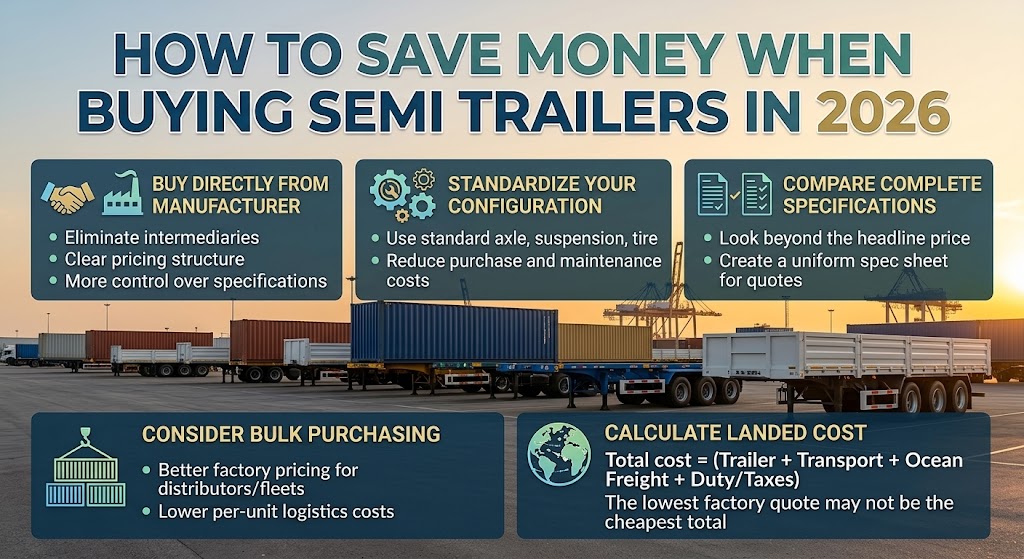
Buy Directly From the Manufacturer
One of the most effective ways to reduce acquisition cost is to eliminate unnecessary layers between the factory and the final buyer.
A direct manufacturer quotation can make the pricing structure easier to understand and gives the buyer more control over specifications.
This is especially relevant for international buyers purchasing multiple trailers.
Standardize Your Configuration
Customization is useful, but excessive customization increases cost and production complexity.
If your fleet can use a standard axle, suspension, tire, and brake configuration, standardization can reduce both purchase price and future maintenance costs.
Compare Complete Specifications
Never compare quotations based only on the headline price.
A $9,000 trailer may look cheaper than a $10,500 trailer until you discover that the more expensive trailer includes better tires, stronger axles, air suspension, upgraded braking components, and additional accessories.
The correct approach is to create a specification sheet and request every supplier to quote against exactly the same requirements.
Consider Bulk Purchasing
For distributors, logistics companies, and fleet operators, purchasing multiple units can create opportunities for better factory pricing.
It can also reduce per-unit logistics and documentation costs.
Calculate Landed Cost
For an international purchase, the trailer purchase price is only one part of the investment.
Your total cost may include:
Trailer price + inland transportation + export documentation + port charges + ocean freight + insurance + import duty + local taxes + destination delivery.
A low factory quotation is not necessarily the lowest landed cost.
7. Frequently Asked Questions
How much does a semi trailer cost in 2026?
The answer depends on the trailer type and market. China-export semi trailers can start from several thousand dollars for basic configurations, while new North American-market trailers commonly range from approximately $25,000 to $80,000 or more. Specialized equipment can cost significantly more.
How much is a 40ft/53ft semi trailer?
A 40ft or 53ft trailer can have very different prices depending on whether it is a dry van, flatbed, container chassis, or another configuration. A new 53ft dry van in the current North American market can be around $40,000–$80,000+, while a basic China-export trailer may cost substantially less. Current 2026 listings show new 53ft Wabash dry vans around $41,200–$42,600.
What is the cheapest semi trailer to buy?
Basic flatbeds and container skeleton trailers are generally among the more affordable commercial semi trailer categories. China-manufactured export models can offer particularly competitive factory-direct pricing, although shipping, duties, specifications, and certification must be included in the final calculation.
Is it cheaper to buy a semi trailer from China?
For many international buyers, China can offer a lower factory purchase price, particularly for flatbeds, low beds, skeleton trailers, dump trailers, and other steel-intensive equipment.
However, the buyer should compare the complete landed cost rather than comparing only the factory quotation with a local dealer price.
Is a new semi trailer worth the money?
For high-utilization fleets, a new trailer can make sense because it provides predictable specifications, longer service life, warranty support, and lower immediate repair risk.
For businesses with limited capital or temporary capacity requirements, a properly inspected used trailer can provide better short-term economics.
What affects semi trailer price the most?
The biggest factors are trailer type, dimensions, payload capacity, axle quantity, steel and aluminum usage, suspension, tires, braking system, brand, customization, and destination requirements.
For international purchases, freight and import costs can also materially change the final price.
How can I get the best semi trailer price?
Start with a clear technical specification. Ask several suppliers to quote the same configuration, confirm what is included, calculate the complete landed cost, and compare warranty and parts support.
For larger orders, negotiating directly with a manufacturer can also reduce the unit price.
Should I buy a Chinese manufacturer trailer or a local brand?
The right choice depends on your market.
A local brand may offer stronger local dealer networks, financing, resale support, and readily available parts. A Chinese manufacturer may offer more competitive factory pricing, customization, and flexible configurations.
For international fleet buyers, the best option is usually the supplier that provides the right combination of price, specifications, quality control, certification, delivery capability, and after-sales support.
8. Conclusion: What Should You Actually Pay for a Semi Trailer?
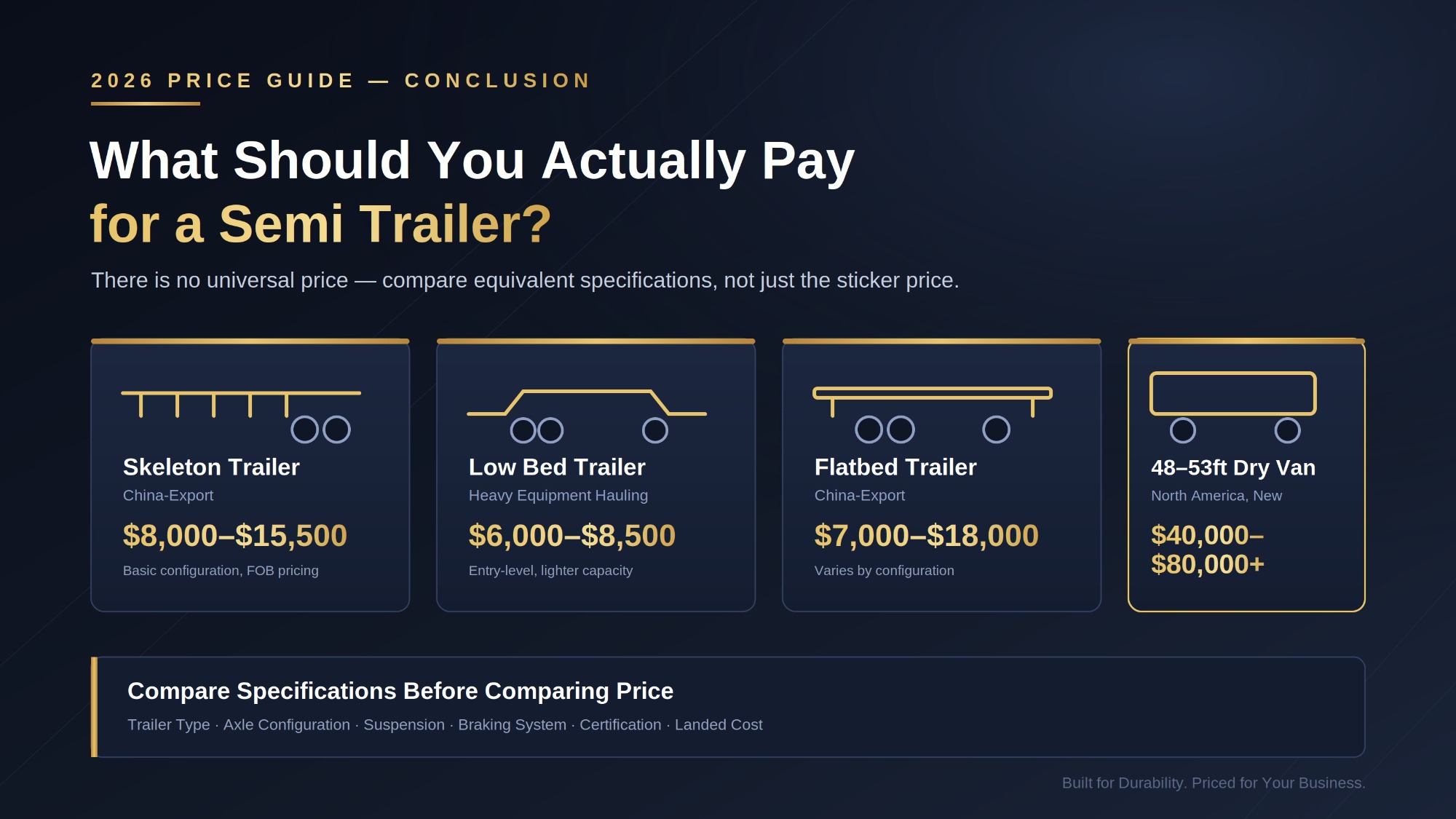
So, how much does a semi trailer cost in 2026?
There is no universal price.
A basic China-export skeleton trailer may be around $8,000–$15,500, a low bed trailer can start around $6,000–$8,500, and a China-export flatbed may fall around $7,000–$18,000 depending on configuration. At the other end of the market, new 48–53ft dry vans in North America can reach $40,000–$80,000+, while premium or specialized equipment can cost considerably more.
The key is to compare equivalent products.
Before placing an order, confirm the trailer type, dimensions, axle configuration, suspension, tire specifications, braking system, payload, materials, certification requirements, delivery terms, and total landed cost.
For overseas buyers, purchasing directly from an experienced Chinese semi trailer manufacturer can be an attractive option when competitive pricing, OEM customization, and international delivery are important. The goal should not simply be to find the cheapest semi trailer for sale. It should be to find a trailer that delivers the right balance of acquisition cost, operating reliability, payload capacity, compliance, and long-term value.
If you are planning a fleet purchase, wholesale order, or customized trailer project, a professional manufacturer can normally provide a configuration based on your cargo type, road conditions, axle requirements, destination regulations, and budget. Comparing the specification before comparing the price is usually the smartest way to buy.