
Skeletal Trailer vs. Flatbed Trailer: Key Differences, Uses, and How to Choose
Choosing the right semi-trailer is essential for improving transportation efficiency, controlling operating costs, and maximizing fleet utilization. Among the different types of semi-trailers available, skeletal trailers and flatbed trailers are two common options for logistics companies, freight operators, and transportation businesses.
Although both trailers feature open structures and can be used for transporting certain types of cargo, their designs, functions, and applications are quite different. A skeletal trailer is primarily designed for shipping container transportation, while a flatbed trailer offers a versatile loading platform for general cargo, steel products, construction materials, and heavy machinery.
So, which one is better for your transportation business?
In this guide, we will compare skeletal trailers and flatbed trailers in terms of structure, applications, payload considerations, loading methods, and operating costs. We will also explain how to choose the right configuration based on your cargo requirements and introduce the key factors to consider when purchasing a semi-trailer.
1. What Is a Skeletal Trailer?
A skeletal trailer, also known as a skeleton trailer or skeletal container chassis, is a specialized semi-trailer designed primarily for transporting shipping containers.
Unlike conventional trailers with a complete loading platform, a skeletal trailer features an open chassis frame. Its structure consists mainly of longitudinal beams, cross members, axles, suspension components, and container locking devices.
The open-frame design reduces unnecessary structural weight while providing designated positions for securing shipping containers.
Main Components of a Skeletal Trailer
A typical skeletal trailer consists of several important components:
-
Main Chassis Frame: The primary load-bearing structure, designed to support the container and distribute its weight.
-
Cross Members: Connect the longitudinal beams and help maintain structural strength and stability.
-
Twist Locks: Specialized locking devices that secure shipping containers through their corner castings.
-
Axles: Support the trailer and transfer the load to the road surface.
-
Suspension System: Helps absorb road impacts and maintain stable vehicle operation.
-
Braking System: Provides reliable braking performance under different loading conditions.
-
Landing Gear: Supports the trailer when it is disconnected from the tractor unit.
The arrangement of twist locks determines which container sizes and combinations the trailer can accommodate. Depending on the design, a skeletal trailer can be configured for 20ft, 40ft, 45ft, or multiple-container transportation.
Common Applications of Skeletal Trailers
Skeletal trailers are widely used in transportation operations involving:
-
Shipping container transportation between ports and warehouses.
-
Container transportation between terminals and distribution centers.
-
Intermodal freight transportation.
-
Logistics operations involving 20ft and 40ft containers.
-
Transportation of specialized tank containers with compatible chassis configurations.
 Skeletal trailer main components: twist lock, axles, suspension system and landing gear
2. What Is a Flatbed Trailer?
A flatbed trailer is a versatile semi-trailer featuring a continuous, open loading platform. Unlike a skeletal trailer, which has an open chassis frame, a flatbed trailer provides a relatively flat deck for carrying different types of cargo.
Its open design allows cargo to be loaded and unloaded from the top or sides, depending on the available equipment and operating conditions.
Flatbed trailers are commonly used in construction, manufacturing, industrial transportation, and general freight logistics.
Main Components of a Flatbed Trailer
A typical flatbed semi-trailer includes:
-
Main Beam: The primary structural component that supports the loading platform and distributes cargo weight.
-
Loading Deck: A continuous platform designed to accommodate different types of cargo.
-
Cross Members: Reinforce the frame and provide support beneath the loading deck.
-
Axles: Carry the trailer load and help maintain road stability.
-
Suspension System: Mechanical or air suspension can be selected according to road conditions and operating requirements.
-
Braking System: Ensures controlled braking and safe transportation.
-
Landing Gear: Supports the trailer when disconnected from the tractor.
-
Cargo Securing Points: Help secure loads using appropriate chains, straps, or other restraints.
Flatbed trailers can also feature different structural designs, including flat-deck, concave-beam, and exposed-tire configurations, depending on the cargo requirements.
Common Applications of Flatbed Trailers
Flatbed trailers are suitable for transporting a wide range of cargo, including:
-
Steel pipes, beams, and structural steel.
-
Construction materials and building components.
-
Industrial machinery and equipment.
-
Timber and wooden products.
-
Large tanks and industrial components.
-
Palletized and general freight.
-
Shipping containers when equipped with suitable container locking devices.
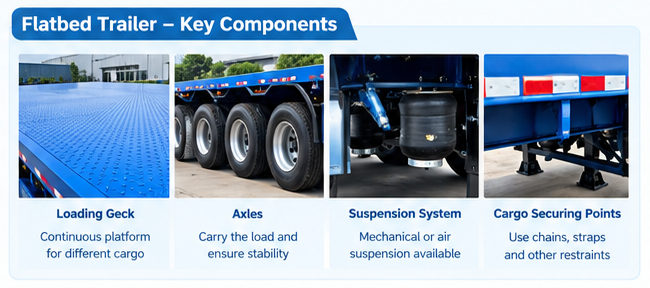
Flatbed trailer main components: loading deck, axles, suspension system and cargo securing points
3. Skeletal Trailer vs. Flatbed Trailer: Key Differences
The main difference between a skeletal trailer and a flatbed trailer lies in their structural design and intended transportation purposes.
A skeletal trailer is optimized for container transportation, while a flatbed trailer is designed to accommodate a wider variety of cargo.
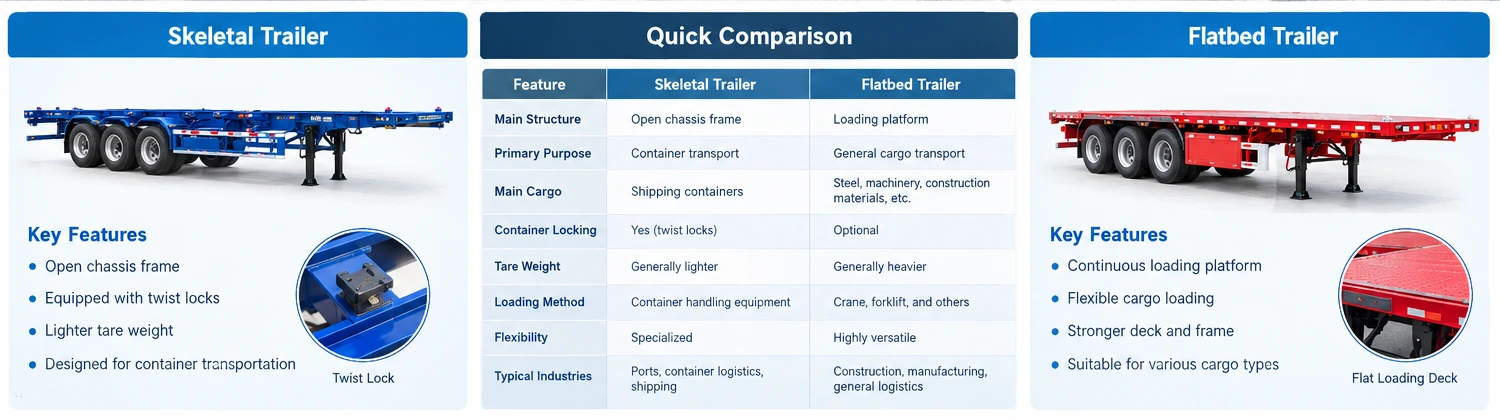
The following comparison highlights their major differences.
| Comparison Factor | Skeletal Trailer | Flatbed Trailer |
|---|---|---|
| Main Structure | Open chassis frame | Complete loading platform |
| Primary Purpose | Container transportation | General cargo transportation |
| Loading Surface | No continuous deck | Flat loading deck |
| Main Cargo | Shipping containers | Steel, machinery, construction materials, and general cargo |
| Container Locking | Integrated twist locks | Optional compatible twist locks |
| Cargo Flexibility | Specialized | Highly versatile |
| Tare Weight | Generally lighter in comparable configurations | Generally heavier due to the loading deck |
| Loading Methods | Usually requires container-handling equipment | Crane, forklift, and other suitable loading equipment |
| Typical Industries | Ports, container logistics, and shipping | Construction, manufacturing, and general logistics |
3.1 Structural Design
The most obvious difference is the loading structure.
A skeletal trailer features an open frame without a continuous loading deck. Its chassis is designed to support shipping containers at designated locking positions.
A flatbed trailer, on the other hand, has a complete loading platform supported by a reinforced chassis. This platform allows operators to transport different types of cargo without requiring a specialized container chassis.
The structural difference directly influences their transportation applications.
3.2 Cargo Compatibility
Skeletal trailers are primarily intended for shipping containers. Their twist-lock systems provide designated connection points for securing containers during transportation.
Flatbed trailers are more flexible because their loading platforms can accommodate cargo of different shapes and sizes.
However, a flatbed trailer can also transport shipping containers if it is properly designed and equipped with compatible twist locks and suitable load-bearing structures.
Therefore, the difference is not simply whether a trailer can carry containers. It is whether the trailer is specifically optimized for container transportation or designed for more general cargo applications.
3.3 Tare Weight and Payload Capacity
Skeletal trailers generally have a tare-weight advantage over comparable flatbed trailers because they do not require a complete loading deck.
A lower trailer tare weight may provide additional payload potential under applicable gross vehicle weight and axle-load limits.
However, actual payload capacity depends on several factors:
-
Trailer tare weight.
-
Chassis material and structural design.
-
Number of axles and axle ratings.
-
Kingpin load distribution.
-
Gross vehicle weight regulations.
-
Local road and transportation requirements.
It is important to understand that a lighter trailer does not automatically have a higher rated payload capacity. The complete vehicle configuration must be evaluated before making a purchasing decision.
3.4 Loading and Unloading Efficiency
Skeletal trailers are generally used with container-handling equipment, such as reach stackers and container cranes.
Once the container is properly positioned and secured, the trailer can transport it between designated locations.
Flatbed trailers offer more loading flexibility. Cargo can often be loaded from the top or sides using cranes, forklifts, and other suitable equipment.
This makes flatbed trailers convenient for businesses that handle different cargo types and loading requirements.
3.5 Transportation Flexibility
Skeletal trailers are highly efficient for dedicated container transportation operations.
Flatbed trailers offer greater flexibility because the same vehicle can handle various types of cargo, provided that the cargo dimensions, weight, securing arrangements, and road regulations are suitable.
For logistics companies with diverse customer orders, a flatbed trailer may provide greater operational flexibility.
For companies specializing in container transportation, a skeletal trailer is usually the more suitable choice.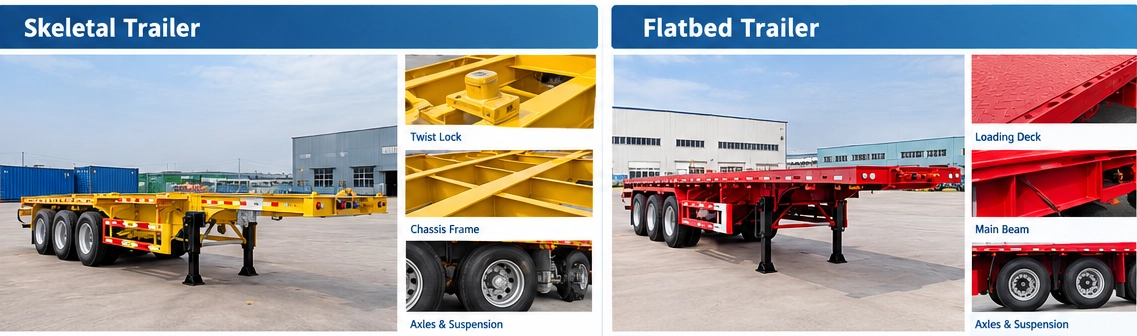
4. Skeletal Trailer vs. Flatbed Trailer: Which Is Better for Different Cargo Types?
The best trailer depends primarily on the cargo being transported and the operating conditions.
Understanding the differences in cargo compatibility can help businesses select a suitable trailer configuration.
4.1 Shipping Container Transportation
Recommended: Skeletal Trailer
Skeletal trailers are specifically designed for shipping container transportation.
They are commonly used for transporting:
-
20ft shipping containers.
-
40ft shipping containers.
-
45ft shipping containers, where supported by the chassis design.
-
Compatible combinations of multiple containers.
Their integrated twist-lock systems provide designated locking positions for securing containers during transportation.
For logistics companies operating between ports, container yards, warehouses, and distribution centers, skeletal trailers are generally the preferred option.
4.2 Steel and Metal Transportation
Recommended: Flatbed Trailer
Steel products often come in different shapes, lengths, and dimensions.
Examples include:
-
Steel pipes.
-
Steel beams.
-
Structural steel.
-
Metal sheets.
-
Steel profiles.
A flatbed trailer provides a continuous loading platform that makes it easier to position and secure these materials.
Depending on the cargo, operators can use appropriate chains, straps, supports, and other load-securing equipment.
4.3 Heavy Machinery and Industrial Equipment
Recommended: Flatbed Trailer or Specialized Lowbed Trailer
Flatbed trailers are suitable for transporting many types of industrial machinery and equipment that can be safely accommodated on the loading platform.
Common applications include:
-
Agricultural machinery.
-
Industrial equipment.
-
Highway construction equipment.
-
Manufacturing components.
-
Large industrial structures.
However, oversized or exceptionally heavy machinery may require a specialized lowbed trailer.
When selecting a trailer, buyers should consider cargo dimensions, total weight, loading height, axle configuration, and local transportation regulations.
4.4 Construction Materials Transportation
Recommended: Flatbed Trailer
Construction projects often involve transporting materials of different shapes and sizes.
Flatbed trailers can be used for:
-
Timber.
-
Steel structures.
-
Building materials.
-
Construction components.
-
Long industrial materials.
Their open loading platforms provide convenient access for loading and unloading operations.
4.5 Mixed Cargo Transportation
Recommended: Flatbed Trailer
Some transportation companies handle multiple types of cargo rather than specializing in one category.
For example, a logistics company may transport steel products, machinery, building materials, and other general freight depending on customer orders.
In these situations, a flatbed trailer offers greater versatility.
A skeletal trailer is generally less suitable for this type of operation because its structure is specifically designed around container transportation.
| Cargo Type | Recommended Trailer | Main Reason |
|---|---|---|
| 20ft/40ft Containers | Skeletal Trailer | Dedicated container locking system |
| Steel Pipes and Beams | Flatbed Trailer | Open and continuous loading deck |
| Construction Materials | Flatbed Trailer | Flexible cargo loading |
| Industrial Machinery | Flatbed or Lowbed Trailer | Depends on cargo dimensions and weight |
| General Freight | Flatbed Trailer | Greater cargo flexibility |
| Mixed Container and General Cargo | Depends on Operation | Consider dedicated equipment and container-locking requirements |
5. How to Choose Between a Skeletal Trailer and a Flatbed Trailer
Selecting the right trailer requires more than comparing the appearance or purchase price of two vehicles.
Businesses should evaluate their cargo requirements, transportation routes, operating costs, and future fleet plans.
Here are five important factors to consider.
5.1 Identify Your Main Cargo Type
Start by identifying the type of cargo your company transports most frequently.
If your business mainly handles shipping containers, a skeletal trailer is generally the more appropriate choice.
If you transport steel, machinery, timber, construction materials, and other general freight, a flatbed trailer may provide greater flexibility.
For businesses handling both container and general cargo, it may be worth considering separate trailers for different transportation tasks.
5.2 Evaluate Your Transportation Routes
Transportation routes can influence trailer selection.
For example:
-
Port-to-Warehouse Transportation: Skeletal trailers are suitable for dedicated container transportation.
-
Port-to-Distribution Center Operations: Skeletal trailers are practical when the cargo consists mainly of shipping containers.
-
Construction Site Transportation: Flatbed trailers are suitable for transporting construction materials and equipment.
-
Long-Distance General Freight: Flatbed trailers can accommodate different cargo types, subject to loading and road restrictions.
Buyers should also consider road conditions, turning requirements, loading facilities, and local vehicle regulations.
5.3 Consider Return Loads and Fleet Utilization
Return-load opportunities are an important factor in transportation profitability.
Suppose a logistics company regularly transports containers from a port to a warehouse.
If the return journey also involves container transportation, a skeletal trailer can be a practical solution.
However, if the company frequently receives return orders for steel products, timber, or industrial materials, a flatbed trailer may offer greater flexibility.
The right decision depends on actual freight demand, not simply the number of cargo types a trailer can theoretically transport.
Businesses should compare:
-
Average loaded trips per month.
-
Return-load availability.
-
Empty running distance.
-
Loading and unloading time.
-
Vehicle utilization rate.
-
Maintenance and operating expenses.
5.4 Compare Total Operating Costs
The initial purchase price is only one part of the total cost of owning a semi-trailer.
A more complete evaluation should include:
-
Purchase cost.
-
Fuel consumption and tare weight.
-
Routine maintenance.
-
Tire replacement.
-
Brake and suspension maintenance.
-
Loading and unloading expenses.
-
Downtime and repair costs.
-
Expected fleet utilization.
A skeletal trailer may offer advantages in dedicated container operations, while a flatbed trailer may be more economical for businesses handling varied cargo.
There is no universally cheaper option. The best choice is the one that delivers the most suitable operational performance for your business.
5.5 Check Local Transportation Regulations
Before purchasing a trailer, confirm that its specifications meet the regulations of the intended operating country.
Important considerations include:
-
Maximum gross vehicle weight.
-
Axle-load limits.
-
Overall vehicle dimensions.
-
Braking system requirements.
-
Lighting and reflective markings.
-
Cargo securing requirements.
These regulations vary between countries and regions.
For international buyers, it is important to communicate the destination market and intended operating conditions to the manufacturer before confirming the order.
6. What Specifications Should You Consider Before Buying?
After choosing between a skeletal trailer and a flatbed trailer, the next step is selecting the appropriate technical configuration.
A suitable configuration helps ensure that the trailer matches your transportation requirements and local operating conditions.
6.1 Axle Configuration
Axle configuration affects load distribution, carrying capacity, and vehicle compatibility.
Depending on the model and operating requirements, buyers may consider two-axle or three-axle configurations.
The correct choice should be based on:
-
Expected cargo weight.
-
Gross vehicle weight requirements.
-
Local axle-load regulations.
-
Road conditions.
-
Transportation frequency.
6.2 Suspension System
The suspension system plays an important role in driving stability and cargo protection.
Common options include:
Mechanical Suspension
Mechanical suspension is widely used in commercial semi-trailers. Its relatively simple structure makes it suitable for various operating conditions.
Air Suspension
Air suspension uses air springs to support the vehicle and absorb road impacts. It can provide improved ride characteristics and may be suitable for operations requiring better vibration control.
The choice should consider road conditions, cargo sensitivity, maintenance capabilities, and local service availability.
6.3 Braking System
A reliable braking system is essential for safe transportation, especially when operating under heavy loads.
Depending on the model and market requirements, buyers may consider:
-
Drum brakes.
-
Disc brakes.
-
ABS.
-
EBS.
The final braking configuration should comply with the applicable regulations and be compatible with the tractor unit.
6.4 Tires and Landing Gear
Tire selection should take into account load ratings, operating conditions, road surfaces, and local availability.
Landing gear is another important component because it supports the trailer when disconnected from the tractor unit.
Buyers can discuss different tire brands, landing gear options, and other component configurations with the manufacturer.
6.5 Chassis Material and Structural Design
The chassis is one of the most important factors affecting trailer strength and durability.
For flatbed trailers, structural design, loading deck dimensions, and beam reinforcement should match the expected cargo weight and distribution.
For skeletal trailers, particular attention should be paid to the main chassis frame, cross members, twist-lock positions, and container compatibility.
For example, Lucksun's flatbed trailer product range offers T700 steel configurations, with different structural designs available for different transportation requirements.
6.6 Custom Dimensions and Configuration
Standardized trailers may meet many transportation requirements, but customized configurations can provide a better fit for specific operating conditions.
Depending on the model, customization options may include:
-
Trailer length, width, and height.
-
Axle brands and configurations.
-
Tire brands.
-
Braking systems.
-
Suspension systems.
-
Landing gear types.
-
Vehicle colors.
-
Corporate logo painting.
-
Reflective strip positioning.
Before requesting a quotation, buyers should provide the main cargo type, expected payload, required dimensions, destination country, and preferred components.
These details help the manufacturer recommend a more appropriate trailer solution.
7. Why Choose Lucksun Trailer for Your Semi-Trailer Needs?
Selecting a reliable semi-trailer manufacturer is just as important as choosing the right trailer type.
Manufacturing quality, technical capabilities, customization options, delivery arrangements, and after-sales support all influence the long-term value of a trailer.
Lucksun Trailer is the dedicated export-oriented brand of Luoxiang Group, a company specializing in the research and development, manufacturing, and sales of semi-trailers.
With advanced manufacturing facilities, technical research capabilities, and international service experience, Luoxiang Group provides semi-trailer solutions for different transportation markets.
7.1 Advanced Intelligent Manufacturing
Luoxiang Group has invested in advanced automated production facilities to improve manufacturing efficiency and product consistency.
Its manufacturing capabilities include:
-
China's first robotic welding production line for trailers.
-
China's first electrophoretic coating production line for trailers.
-
China's first new national standard axle automation production line.
-
China's first whole-vehicle intelligent assembly production line.
-
The world's first new national standard disc brake automation production line.
These facilities support key manufacturing processes, including chassis welding, coating, axle production, and vehicle assembly.
The company's intelligent assembly production line integrates PLM, ERP, MES, and WMS systems through a centralized big data platform.
This enables coordinated production management, digital manufacturing, and improved process control.
7.2 Strong R&D and Technical Innovation
Luoxiang Group has established several research and development platforms, including:
-
Luoxiang Automotive Research Institute.
-
Jinan R&D Center.
-
Shanghai R&D Center.
-
Postdoctoral research workstations.
The company has obtained more than 200 national patents and special technical authorizations.
Its research activities focus on semi-trailer technology, structural optimization, intelligent manufacturing, and new-energy applications.
In August 2023, China's first hybrid semi-trailer developed by the company was officially launched and entered mass production.
These investments reflect Luoxiang Group's continued commitment to technical innovation and the development of specialized transportation equipment.
7.3 Standardized Products and Customized Solutions
Different transportation businesses have different requirements.
Some buyers need standard skeletal trailers for regular container transportation, while others require customized flatbed trailers for steel, machinery, or construction materials.
Lucksun offers both standardized products and customized services.
Customers can discuss suitable trailer dimensions, axle configurations, tire brands, braking systems, suspension systems, and landing gear options.
Appearance customization is also available, including vehicle colors, corporate logos, and reflective strip positioning.
Whether you need a skeletal container chassis or a heavy-duty flatbed semi-trailer, Lucksun can help evaluate your requirements and recommend a suitable configuration.
7.4 Quality Management and Global Delivery Experience
Quality management is an important part of Luoxiang Group's manufacturing operations.
The company holds ISO 9001 quality management system certification and has delivered more than 70,000 units to customers worldwide.
Its production capabilities and standardized manufacturing processes support different types of semi-trailer orders.
Lucksun also provides flexible purchasing arrangements:
| Item | Available Options |
|---|---|
| Product Type | Standardized and customized semi-trailers |
| Minimum Order Quantity | 1 unit |
| Standard Product Delivery | Approximately 15 days |
| Customized Product Delivery | Approximately 30 days |
| Payment Terms | T/T, L/C, and Sinosure-supported payment methods |
| Quality Certification | ISO 9001 |
Delivery schedules depend on the confirmed configuration, order details, and production arrangements.
7.5 Overseas Service and After-Sales Support
After-sales service is an important consideration for international semi-trailer buyers.
To support customers in different markets, Luoxiang Group maintains overseas offices in Tanzania, Guinea, Zambia, Nigeria, Vietnam, and Saudi Arabia.
Its service commitments include:
-
24-hour service hotline support.
-
Lifelong technical service.
-
Warranty coverage according to the purchased trailer model.
-
Technical guidance within two hours after receiving customer feedback.
-
Regular customer follow-ups.
-
Spare parts support and maintenance guidance.
For customers purchasing Lucksun trailers, professional technical support helps address questions related to operation, maintenance, and product configuration.
By combining manufacturing capabilities with international service support, Lucksun aims to provide reliable semi-trailer solutions for customers in different transportation markets.
8. Frequently Asked Questions About Skeletal Trailers and Flatbed Trailers
Q1: What is the main difference between a skeletal trailer and a flatbed trailer?
The main difference is their structural design and intended application.
A skeletal trailer features an open chassis frame designed primarily for shipping container transportation. A flatbed trailer has a continuous loading platform that can accommodate different types of cargo, including steel, machinery, construction materials, and general freight.
Q2: Can a flatbed trailer carry a shipping container?
Yes. A flatbed trailer can transport shipping containers if it is properly designed and equipped with compatible twist locks and suitable load-bearing structures.
However, skeletal trailers are specifically designed for container transportation and are generally more suitable for dedicated container logistics operations.
Q3: Is a skeletal trailer lighter than a flatbed trailer?
Generally, a skeletal trailer is lighter than a comparable flatbed trailer because it does not require a complete loading deck.
However, actual tare weight depends on chassis design, steel materials, axle configuration, and other components.
Buyers should compare the specifications of individual models rather than assume that every skeletal trailer is lighter than every flatbed trailer.
Q4: Which trailer is better for transporting heavy machinery?
A flatbed trailer is suitable for many types of industrial machinery that can be safely accommodated on its loading platform.
For oversized or exceptionally heavy equipment, a lowbed trailer may be a more appropriate option.
The final choice depends on cargo weight, dimensions, loading height, and applicable transportation regulations.
Q5: Which trailer is more cost-effective for a logistics company?
The answer depends on the company's transportation business.
Skeletal trailers are generally more suitable for dedicated container transportation, while flatbed trailers offer greater flexibility for mixed cargo operations.
To evaluate cost-effectiveness, businesses should consider purchase price, tare weight, fuel consumption, maintenance expenses, return-load opportunities, and fleet utilization.
Q6: What container sizes can a skeletal trailer carry?
Skeletal trailers can be designed for different shipping container sizes, including 20ft, 40ft, and 45ft containers.
The actual container combinations depend on chassis dimensions, twist-lock positions, axle configuration, and load distribution.
Buyers should confirm their required container sizes and combinations before placing an order.
Q7: Can I customize a skeletal trailer or flatbed trailer?
Yes. Depending on the trailer model and engineering requirements, buyers can customize dimensions, axle configurations, tire brands, braking systems, suspension systems, landing gear, and exterior appearance.
Lucksun provides both standardized products and customized semi-trailer solutions.
Q8: What information should I provide when requesting a trailer quotation?
To receive an accurate quotation, buyers should provide:
-
Required trailer type.
-
Main cargo type.
-
Expected payload.
-
Trailer dimensions.
-
Axle configuration.
-
Preferred tire and suspension brands.
-
Braking system requirements.
-
Operating country and road conditions.
For skeletal trailers, buyers should also specify the required container sizes and combinations.
Providing these details helps the manufacturer recommend a suitable configuration and prepare a more accurate quotation.
Conclusion: Choose the Right Trailer for Your Transportation Business
Both skeletal trailers and flatbed trailers play important roles in modern freight transportation, but they are designed for different operating requirements.
A skeletal trailer is generally the better choice for businesses specializing in shipping container transportation. Its open chassis structure and dedicated twist-lock system make it suitable for regular container logistics operations.
A flatbed trailer is more versatile and is suitable for transporting steel products, construction materials, industrial machinery, and other general cargo. It is a practical option for companies that handle different types of freight.
Before making a purchasing decision, consider your cargo requirements, transportation routes, return-load opportunities, payload needs, and local regulations.
If you are looking for a reliable skeletal trailer or flatbed semi-trailer manufacturer, Lucksun can provide standardized products and customized solutions to match your transportation requirements.