
Dump Semi Trailer: Types, Specifications, Applications and How to Choose the Right Model
Dump Semi Trailer: Types, Specifications, Applications and How to Choose the Right Model
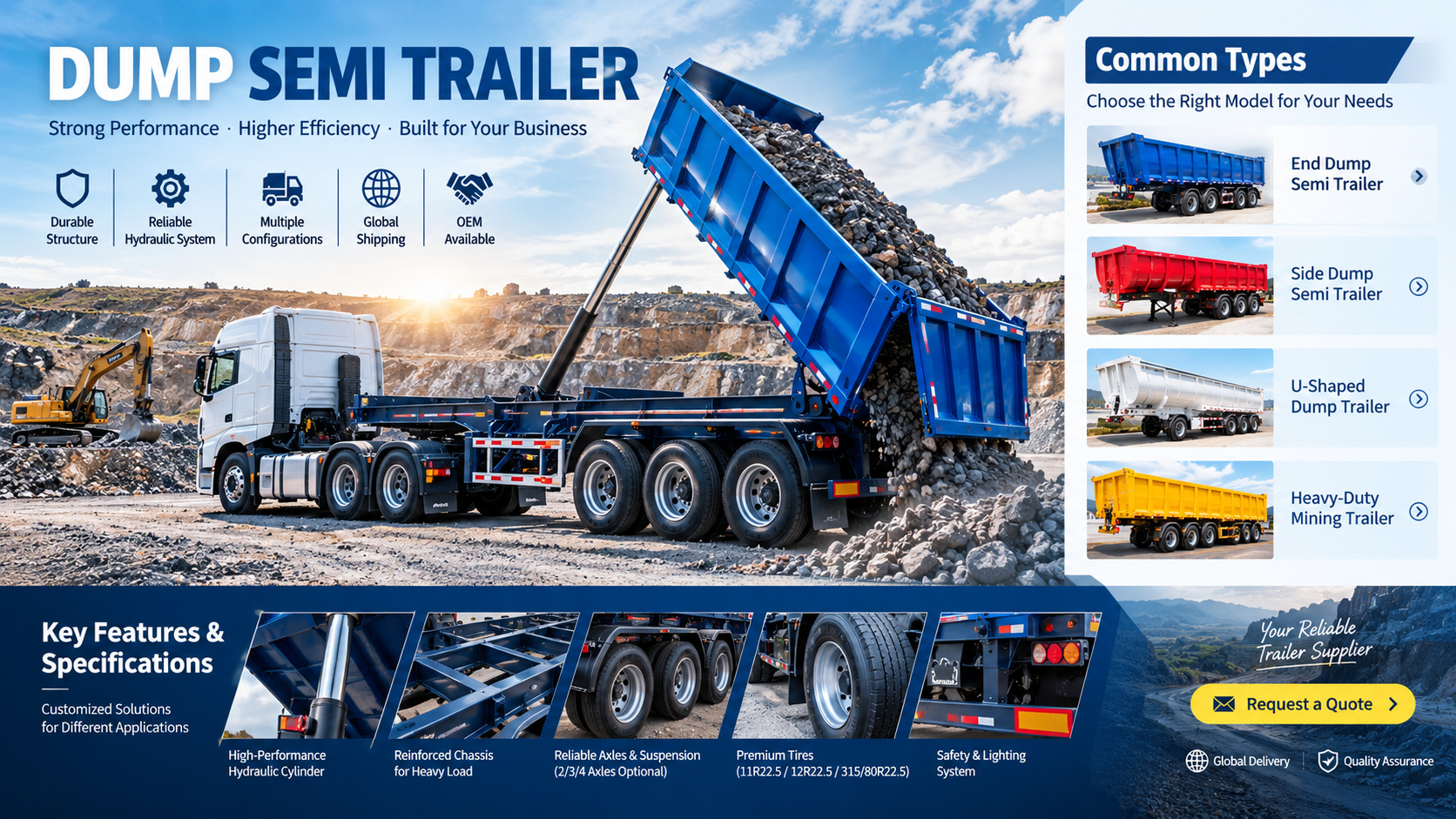
A dump semi trailer is designed to transport and unload bulk materials efficiently, making it an essential piece of equipment for construction companies, mining operations, infrastructure projects, agricultural businesses, and commercial transport fleets
Unlike a standard flatbed semi trailer, a dump semi trailer uses a hydraulic lifting system to raise its cargo body or tipping platform, allowing bulk materials to discharge with less manual handling. Depending on the design, it can transport sand, gravel, crushed stone, soil, coal, construction waste, and other suitable bulk materials.
However, not every dump trailer is suitable for every job. Body design, payload requirements, hydraulic performance, chassis strength, axle configuration, road conditions, and local regulations all influence the right choice.
For international buyers, selecting the right dump semi trailer is not simply about finding the lowest purchase price. It is about matching the trailer to actual working conditions, controlling operating costs, and maintaining reliable performance over time.
This guide explains the main types of dump semi trailers, their key specifications, and what buyers should consider before requesting a quotation.
What Is a Dump Semi Trailer?
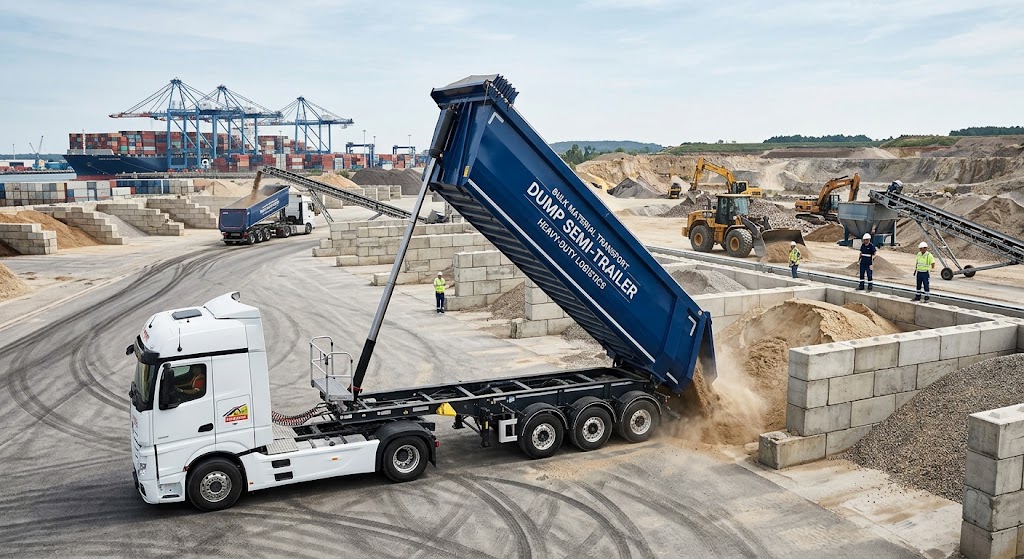
A dump semi trailer is a heavy-duty semi-trailer equipped with a tipping body or platform and a hydraulic lifting system. When connected to a compatible tractor unit, it transports bulk cargo and unloads it by raising the body at a controlled angle
Dump semi trailers are commonly used for:
-
Construction sand and gravel transportation
-
Mining and quarry material delivery
-
Soil and earthmoving operations
-
Coal and other suitable bulk material transport
-
Infrastructure and road construction projects
-
Construction waste and demolition material handling
-
Agricultural bulk material transportation, where the configuration is suitable
The trailer's performance depends on the complete vehicle configuration, including the tractor unit, hydraulic system, body structure, axles, suspension, tires, braking system, and operating environment.
For export buyers, the most important starting point is to define the material being transported, its typical load weight, the unloading location, and the road conditions.
Common Types of Dump Semi Trailers
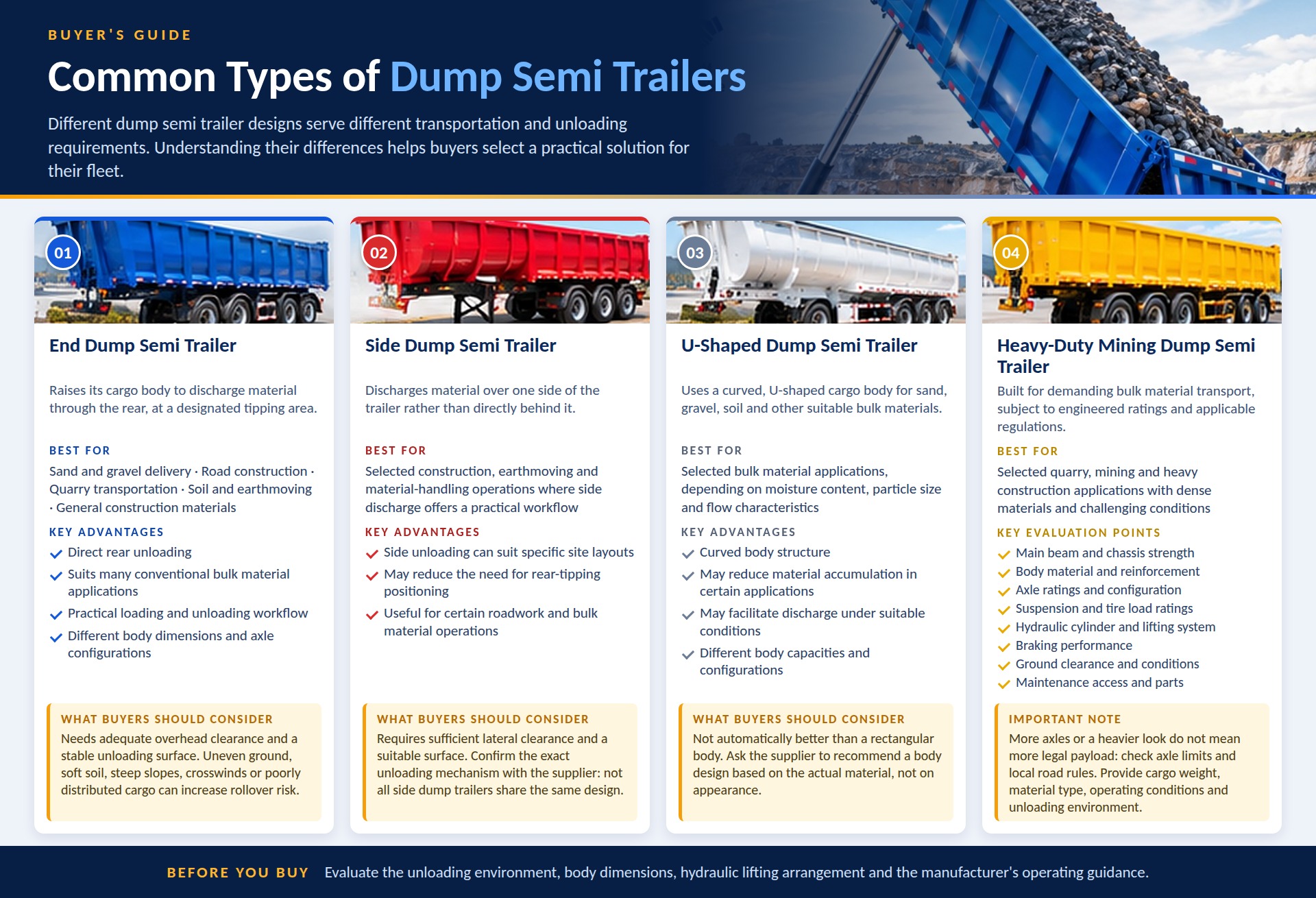
Different dump semi trailer designs serve different transportation and unloading requirements. Understanding their differences helps buyers select a practical solution for their fleet.
1. End Dump Semi Trailer
An end dump semi trailer raises its cargo body to discharge material through the rear. It is widely considered for applications where bulk materials need to be unloaded at a designated tipping area.
Typical applications include:
-
Sand and gravel delivery
-
Road construction projects
-
Quarry transportation
-
Soil and earthmoving operations
-
General construction material handling
Key advantages
-
Direct rear unloading
-
Suitable for many conventional bulk material applications
-
Practical loading and unloading workflow
-
Available in different body dimensions and axle configurations, depending on the design
What buyers should consider
End dumping requires adequate overhead clearance and a suitable, stable unloading surface. Uneven ground, soft soil, excessive slopes, strong crosswinds, or improperly distributed cargo can increase the risk of rollover during tipping.
Before purchasing, evaluate the unloading environment, body dimensions, hydraulic lifting arrangement, and the manufacturer's operating guidance.
2. Side Dump Semi Trailer
A side dump semi trailer is designed to discharge material over one side of the trailer rather than directly behind it. Depending on the design, the body or tipping mechanism moves laterally to unload cargo.
Potential applications include selected construction, earthmoving, and material-handling operations where side discharge offers a practical workflow.
Key advantages
-
Side unloading can suit specific site layouts
-
May reduce the need to position the trailer for conventional rear tipping
-
Can be useful for certain roadwork and bulk material operations
What buyers should consider
Side dump trailers require sufficient lateral clearance and a suitable operating surface. The tipping mechanism, load distribution, unloading direction, and stability characteristics must be evaluated for the intended application.
Buyers should confirm the exact unloading mechanism with the supplier rather than assuming all side dump trailers share the same design.
3. U-Shaped Dump Semi Trailer
A U-shaped dump semi trailer uses a curved or U-shaped cargo body, commonly considered for transporting sand, gravel, soil, and other suitable bulk materials.
The curved body design can help reduce material accumulation in certain applications, depending on the material's moisture content, particle size, and flow characteristics.
Key advantages
-
Curved body structure
-
Designed for selected bulk material applications
-
May facilitate material discharge under suitable operating conditions
-
Available with different body capacities and structural configurations
What buyers should consider
A U-shaped body is not automatically superior to every conventional rectangular body. The right design depends on the cargo characteristics, body material, floor structure, loading method, and unloading conditions.
Ask the supplier to recommend a body design based on the actual material rather than choosing solely by appearance.
4. Heavy-Duty Mining Dump Semi Trailer
A heavy-duty mining dump semi trailer is designed for demanding bulk material transportation, subject to its engineered ratings and the applicable operating regulations.
It may be considered for selected quarry, mining, and heavy construction applications involving dense materials and challenging working conditions.
Key evaluation points
-
Main beam and chassis strength
-
Cargo body material and reinforcement
-
Axle ratings and configuration
-
Suspension and tire load ratings
-
Hydraulic cylinder and lifting system
-
Braking performance
-
Ground clearance and operating conditions
-
Maintenance access and replacement parts availability
A higher axle count or heavier-looking structure does not automatically mean a trailer can legally carry more cargo. The complete vehicle combination, load distribution, axle limits, and local road regulations must be checked.
For demanding mining operations, provide the expected cargo weight, material type, daily operating conditions, and unloading environment before confirming the specification.
How to Choose the Right Dump Semi Trailer
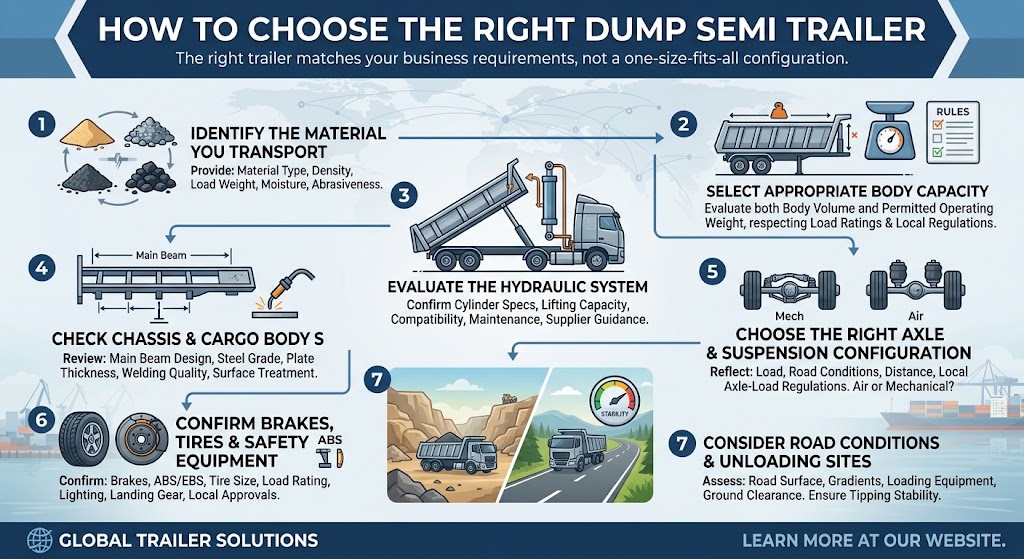
The right trailer should match your business requirements rather than follow a one-size-fits-all configuration
1. Identify the Material You Transport
Start by identifying the cargo.
Sand, gravel, crushed stone, soil, coal, and construction waste can differ significantly in density, moisture content, abrasiveness, and unloading behavior.
For example, dense materials may reach the trailer's permitted weight limit before the body is completely full. Lighter materials may require a larger body volume to make effective use of the available payload.
When requesting a quotation, provide the material type, approximate bulk density if known, typical load weight, and whether the material is wet, sticky, or abrasive.
2. Select the Appropriate Body Capacity
Cargo body volume is an important specification, but it should not be considered separately from payload.
A larger body does not necessarily mean greater legal carrying capacity. The permitted load depends on the trailer's engineered rating, tare weight, tractor configuration, axle loading, road conditions, and destination-market regulations.
When comparing different models, evaluate both the body volume and the permitted operating weight.
The objective is to find a configuration that transports your usual cargo efficiently without exceeding the applicable limits.
3. Evaluate the Hydraulic System
The hydraulic lifting system is one of the most important parts of a dump semi trailer.
Buyers should confirm:
-
Hydraulic cylinder configuration and specifications
-
Lifting capacity and operating requirements
-
Compatibility with the tractor's hydraulic system
-
Hydraulic connections and operating controls
-
Maintenance and replacement requirements
-
Supplier guidance for safe unloading
Hydraulic performance depends on the complete system and the actual load. A cylinder should not be selected based only on its appearance or nominal size.
For export orders, confirm the hydraulic interface and operating requirements with the tractor supplier before production.
4. Check the Chassis and Cargo Body Structure
The chassis transfers loads through the kingpin, suspension, and axle system. The cargo body must also withstand the stresses associated with loading, transportation, and repeated tipping cycles.
Important items to review include:
-
Main beam dimensions and structural design
-
Steel grade and specified plate thickness
-
Crossmember arrangement
-
Body floor and sidewall construction
-
Reinforcement in high-stress areas
-
Welding quality and surface treatment
When comparing quotations, ask suppliers to provide clear technical specifications. Two trailers with similar advertised capacities may use different structural designs and components.
5. Choose the Right Axle and Suspension Configuration
Axle and suspension selection should reflect the expected load, road conditions, operating distance, and local axle-load regulations.
Depending on the application, buyers may consider two-axle, three-axle, or other engineered configurations.
Mechanical suspension may be suitable for certain demanding or cost-sensitive operating environments. Air suspension may offer advantages for selected road transportation applications, depending on maintenance capabilities and local requirements.
Neither system is universally better. The correct choice depends on the operating environment, total cost of ownership, and local service support.
6. Confirm Brakes, Tires, and Safety Equipment
Braking and tire specifications should be matched to the trailer's intended load, tractor unit, operating conditions, and destination-market requirements.
Before placing an order, confirm:
-
Axle and brake specifications
-
ABS or EBS configuration, where required or selected
-
Tire size and load rating
-
Wheel specifications
-
Lighting and electrical connections
-
Landing gear capacity
-
Applicable approvals and technical requirements
For export customers, the availability of replacement tires, brake components, and other commonly serviced parts in the destination country can make a meaningful difference to long-term operating costs.
7. Consider Road Conditions and Unloading Sites
A trailer used primarily on paved highways may require a different configuration from one operating on rough construction roads or at a quarry.
Buyers should assess road surface, gradients, ground clearance, loading equipment, turning space, and the condition of unloading areas.
For end dump trailers in particular, unloading stability deserves careful attention. Tipping should only be carried out under suitable conditions and in accordance with the manufacturer's safety instructions.
The trailer should be specified for the actual working environment, not just for its nominal capacity.
Dump Semi Trailer Specifications: What Should Buyers Compare?
The following table provides a practical checklist for evaluating suppliers.
| Specification | What to Confirm |
|---|---|
| Trailer type | End dump, side dump, U-shaped body, or other design |
| Body volume | Required volume based on material and operating needs |
| Payload requirements | Expected cargo weight and applicable legal limits |
| Chassis | Main beam structure, dimensions, and specified steel grade |
| Cargo body | Body shape, floor thickness, sidewall structure, and reinforcement |
| Hydraulic system | Cylinder specifications, connections, and tractor compatibility |
| Axles | Quantity, ratings, brand, and service availability |
| Suspension | Mechanical or air suspension, according to application |
| Braking system | Brake configuration and ABS/EBS requirements |
| Tires and wheels | Size, load rating, and local availability |
| Surface treatment | Surface preparation, paint system, and corrosion protection |
| Export requirements | Dimensions, axle limits, approvals, and destination-market rules |
Actual specifications should be confirmed against the selected model and the supplier's technical documentation.
How Much Does a Dump Semi Trailer Cost?
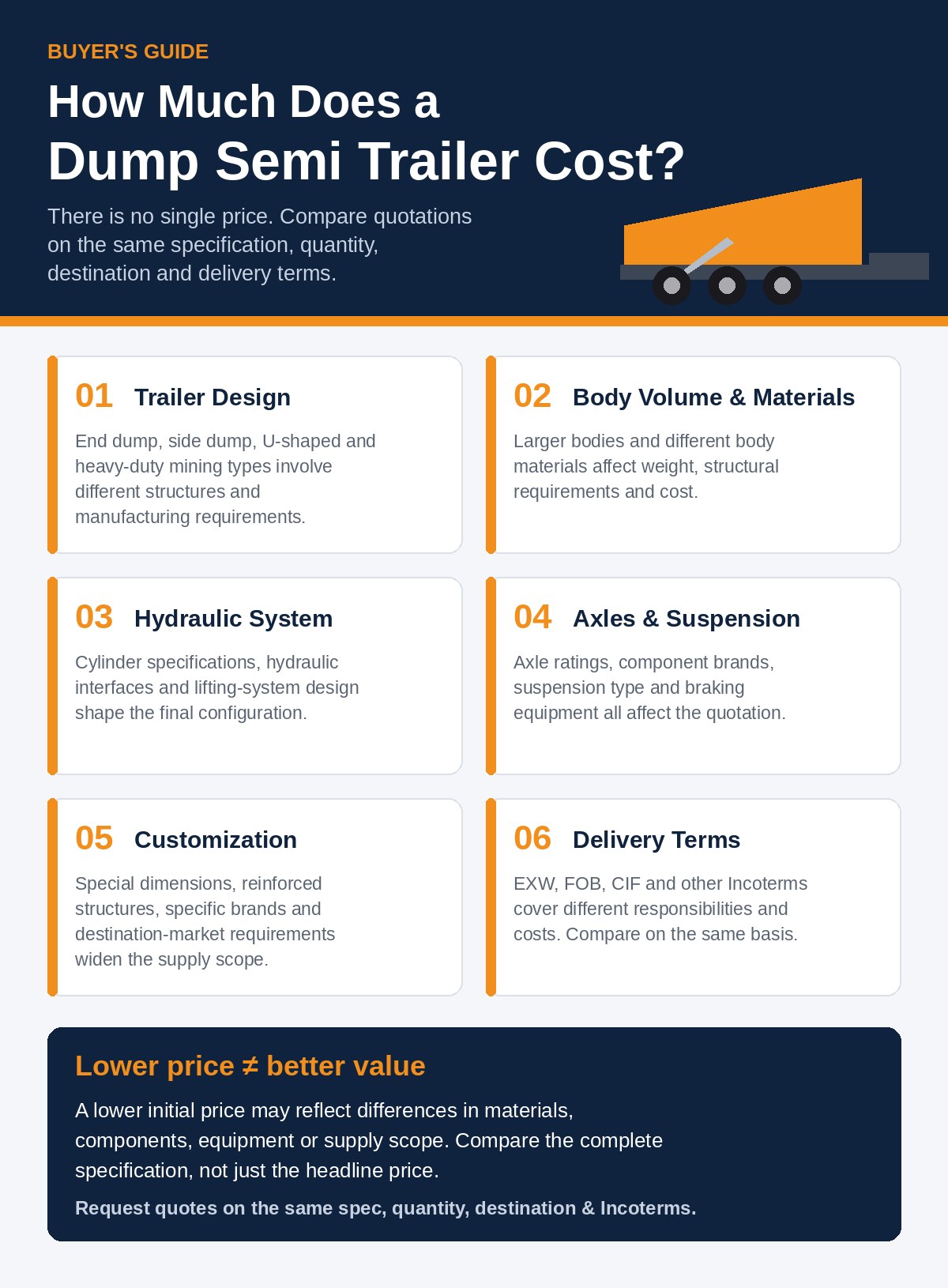
The price of a dump semi trailer varies according to its design, body volume, structural specifications, hydraulic system, axle configuration, components, and destination market
The main factors affecting the quotation include:
Trailer design: End dump, side dump, U-shaped, and heavy-duty mining configurations may involve different structural designs and manufacturing requirements.
Body volume and materials: Larger bodies and different body materials can affect weight, structural requirements, and cost.
Hydraulic system: Cylinder specifications, hydraulic interfaces, and lifting-system design influence the final configuration.
Axles and suspension: Axle ratings, component brands, suspension type, and braking equipment all affect the quotation.
Customization: Special dimensions, reinforced structures, specific component brands, and destination-market requirements may increase the scope of supply.
Delivery terms: EXW, FOB, CIF, and other agreed Incoterms cover different responsibilities and costs, so quotations should be compared on the same basis.
There is no single price that accurately represents every dump semi trailer. For a meaningful comparison, request a quotation based on the same technical specification, quantity, destination, and delivery terms.
A lower initial price may reflect differences in materials, components, equipment, or supply scope. Buyers should compare the complete specification rather than the headline price alone.
Buying a Dump Semi Trailer from China
For international importers, fleet operators, and construction businesses, sourcing a dump semi trailer from China can provide access to different configurations and component options.
However, a successful export purchase requires clear technical communication and an agreed supply scope.
Before placing an order, follow these steps.
Step 1: Define the application.
Explain whether the trailer will transport sand, gravel, mining materials, construction waste, or other bulk cargo.
Step 2: Confirm the required configuration.
Specify the trailer type, body volume, expected cargo weight, axle configuration, and unloading method.
Step 3: Review the technical specification.
Confirm the chassis structure, hydraulic system, suspension, brakes, tires, and other essential components.
Step 4: Check destination-market requirements.
Review applicable vehicle dimensions, axle loads, braking requirements, road restrictions, and approval requirements with qualified local professionals or the relevant authorities.
Step 5: Compare quotations and delivery terms.
Review component brands, quantity, unit price, production lead time, payment terms, inspection arrangements, export documentation, and agreed Incoterms.
Step 6: Confirm the final specification before production.
Ensure the technical drawing, component configuration, and agreed requirements are documented before manufacturing begins.
This process helps reduce specification misunderstandings and makes supplier comparisons more meaningful.
Frequently Asked Questions About Dump Semi Trailers
What is the difference between a dump semi trailer and a standard semi trailer?
A dump semi trailer has a tipping body or platform and a hydraulic lifting system for unloading suitable bulk materials. A standard flatbed or other non-tipping semi trailer does not necessarily have this equipment and may require different loading and unloading methods.
Which dump semi trailer is best for sand and gravel?
The best option depends on cargo weight, body volume, unloading conditions, road quality, and local regulations. End dump and U-shaped dump trailers may be suitable for many sand and gravel applications, but the final configuration should reflect the actual operating requirements.
Can a dump semi trailer be customized?
Depending on the model and supplier's capabilities, customization may include body volume, body dimensions, chassis structure, axle configuration, suspension, hydraulic components, tires, braking equipment, and surface treatment. All modifications should be checked against the trailer's engineered ratings and destination-market requirements.
How do I choose the right payload capacity?
Start with the expected cargo weight, material density, tractor specifications, trailer tare weight, axle loading, and applicable legal limits. Do not rely solely on advertised tonnage or axle count when determining the permitted payload.
What information is needed for a dump semi trailer quotation?
To prepare a relevant quotation, provide the following information:
-
Destination country
-
Cargo type and typical load weight
-
Required body volume or dimensions
-
Preferred dump trailer design
-
Axle and suspension requirements
-
Preferred component brands, if applicable
-
Order quantity
-
Required delivery terms, such as EXW, FOB, or CIF
A reference photograph, technical drawing, or description of the working environment can also help clarify the requirement.
Request a Dump Semi Trailer Quotation
Looking for a dump semi trailer for construction, mining, quarry operations, or bulk material transportation?
We supply semi-trailer solutions and components for export customers, with configurations discussed according to cargo requirements, operating conditions, component preferences, and destination-market needs.
Rather than recommending the same configuration for every buyer, we encourage customers to share their actual application so that the proposed specification can be evaluated more appropriately.
To help us prepare a quotation, please share:
-
Destination country: Where the trailer will operate
-
Cargo type: Sand, gravel, soil, crushed stone, or other bulk materials
-
Trailer type: End dump, side dump, U-shaped, or another configuration
-
Body volume: Required volume or preferred dimensions
-
Axle configuration: Preferred axle quantity and suspension type, if specified
-
Order quantity: Number of trailers required
-
Delivery terms: EXW, FOB, CIF, or another agreed Incoterm
I’ve seen buyers lose sleep over the wrong trailer. It wasn’t that the trailer was bad. It just wasn’t built for their job.
Sand, gravel, coal and ore all load and haul differently, so there’s no best trailer, only the right one for your material, your road and your site. An end dump is great for open construction work. A side dump saves time where space is tight. A U-shaped body holds up when the load is heavy and rough.
So don’t start by asking “what’s the price?” Start with “what am I hauling, and how far?” Then compare quotes on the same specs, the same axles, the same hydraulics and the same delivery terms.
A cheap trailer that breaks down on day 90 isn’t cheap. A trailer that fits your work and keeps earning is the one worth buying.
Tell us your load, your route and your market. We’ll help you pick the right model.
Contact our sales team to discuss your requirements and request a detailed dump semi trailer quotation.
A clearly defined specification is the first step toward selecting a trailer that fits your operation, budget, and local requirements.