
How Much Does a Reefer Trailer Cost? A Complete 2026 Price Guide
How Much Does a Reefer Trailer Cost? A Complete 2026 Price Guide
Buying a refrigerated semi-trailer is an important investment for any cold-chain transportation business. Whether you transport fresh produce, frozen food, dairy products or other temperature-sensitive cargo, choosing the right reefer trailer can directly affect your operating costs and delivery reliability.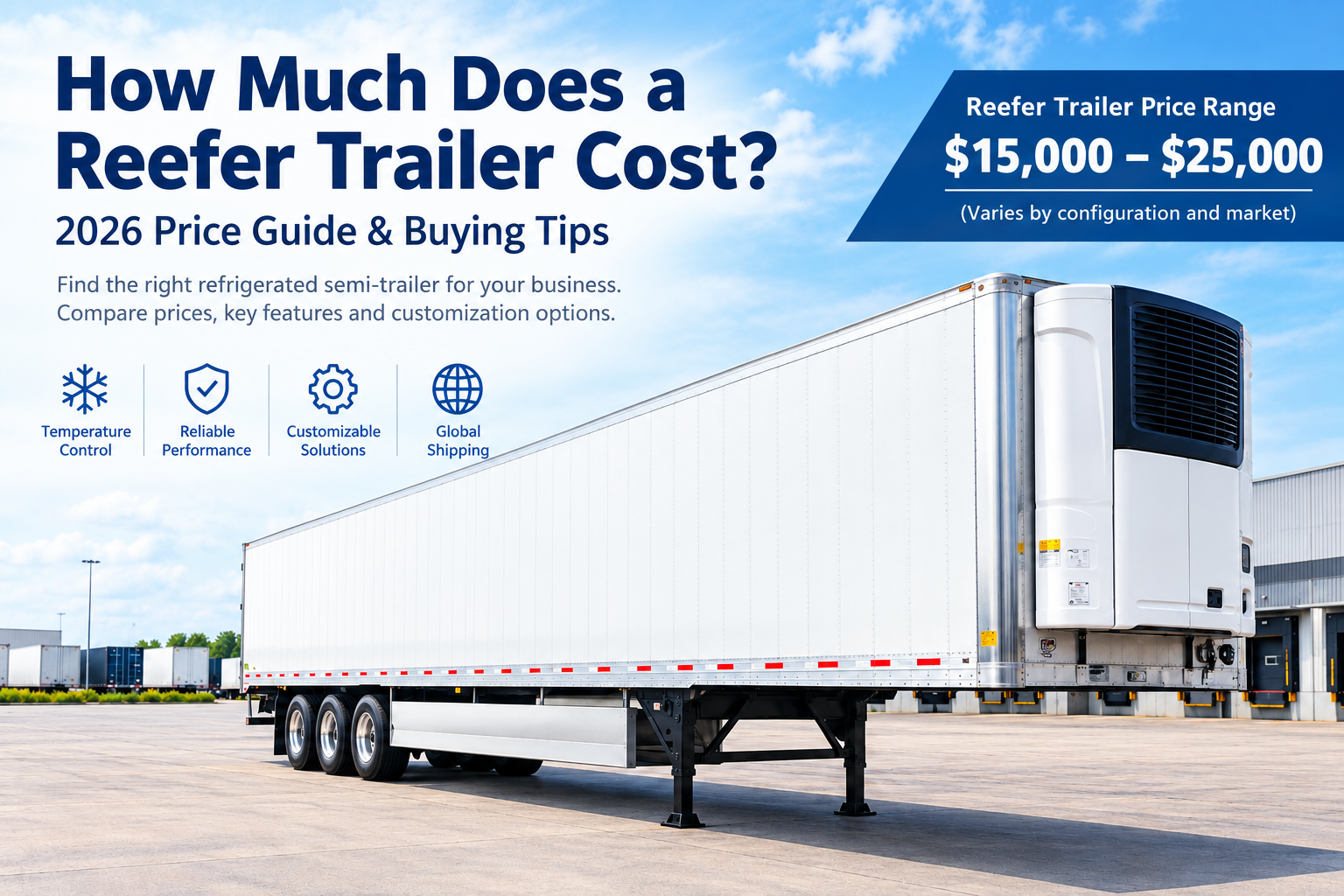
How Much Does a Reefer Trailer Cost? A Complete 2026 Price Guide,About 15,000 to 25,000 US dollars.
So, how much does a reefer trailer cost?
The answer depends on the trailer dimensions, refrigeration unit, insulation performance, axle configuration, component brands and destination market. A standard refrigerated semi-trailer manufactured in China may have a very different export price from a premium 53-foot reefer purchased from a North American dealer.
In this guide, we explain the main factors affecting reefer trailer prices, the specifications worth comparing and how international buyers can request a more accurate quotation.
Refrigerated trucks prepared for export to Africa. This video shows the finished units ready for shipment, built for fresh and frozen cargo transport in demanding operating conditions. Each unit is configured to the customer’s cargo, temperature range and local regulations, with attention to insulation, refrigeration performance and component availability for ongoing maintenance. Contact us with your cargo type, route and destination to receive a tailored quotation
1. How Much Does a Reefer Trailer Cost in 2026?
Reefer trailer prices vary considerably by market and configuration. The following figures are indicative budgeting references, not fixed quotations.
| Reefer Trailer Type | Indicative Price Range (USD) | Main Considerations |
|---|---|---|
| New reefer semi-trailer from China | $15,000–$25,000+ | Dimensions, insulation, refrigeration unit and export configuration |
| Custom refrigerated semi-trailer | Quotation required | Special dimensions, temperature requirements and market regulations |
Price references are indicative and may not be directly comparable. China export prices and North American dealer prices can differ in equipment scope, certification, taxes, freight and after-sales support. Confirm the final specification and Incoterm before comparing quotations.
For international importers, buying directly from a manufacturer can provide greater flexibility in selecting trailer dimensions, axle systems, tires, refrigeration equipment and other components. However, the most suitable option depends on the destination country's requirements and the availability of maintenance support.
2. What Factors Affect Reefer Trailer Prices?
Two refrigerated trailers with similar dimensions may have significantly different prices. Understanding the main cost factors helps buyers compare quotations on a like-for-like basis.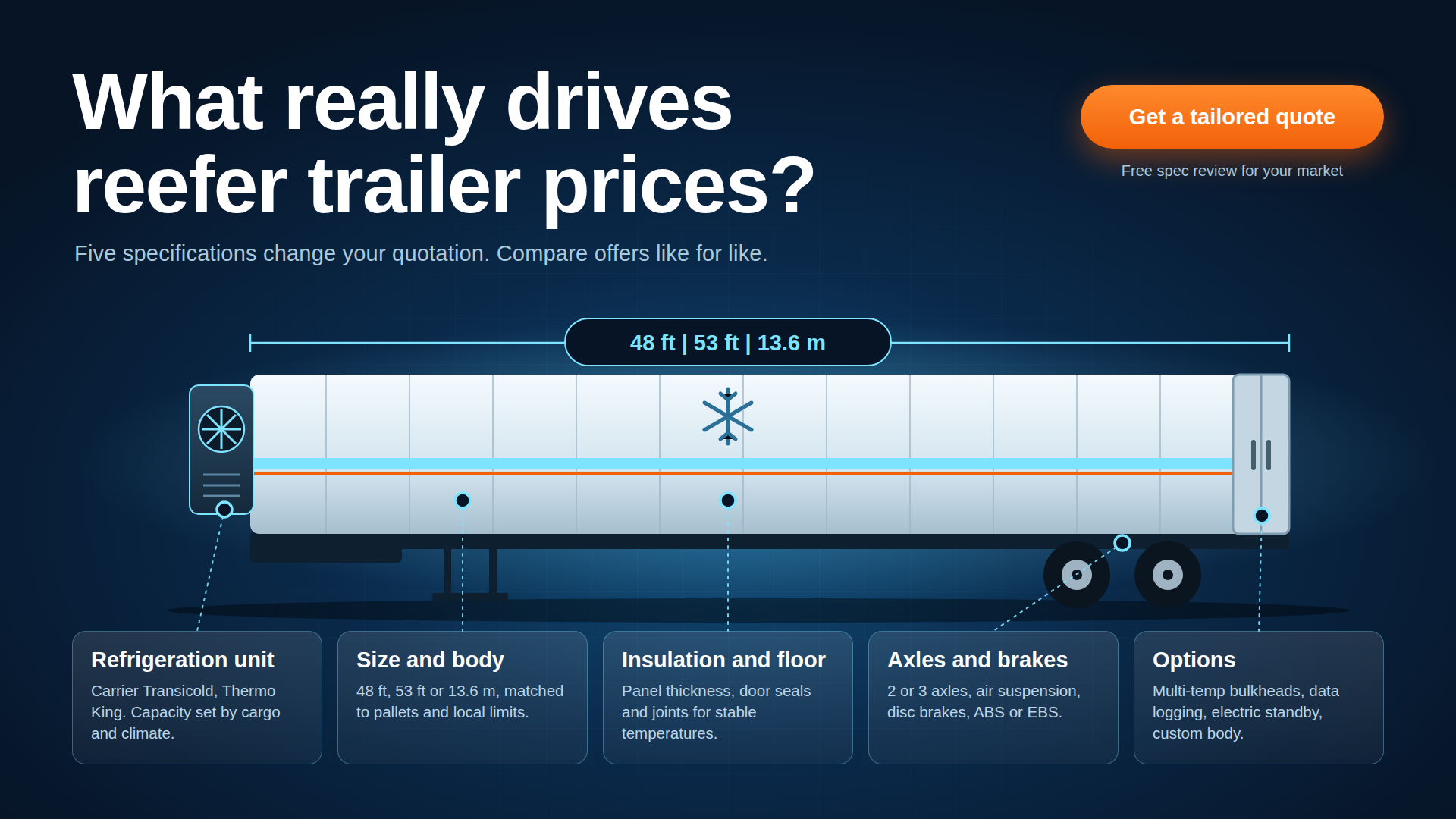
Five specifications that shape reefer trailer prices: refrigeration unit and cooling capacity, trailer size (48 ft, 53 ft or 13.6 m), insulation and floor construction, axles, suspension and brakes, and optional equipment. Use this guide to compare quotations on a like-for-like basis.
2.1 Trailer Dimensions and Body Design
Trailer length, internal height, body width and usable cargo volume affect the overall design and material requirements.
Common configurations include 48-foot and 53-foot refrigerated trailers for North American operations, as well as approximately 13.6-meter refrigerated semi-trailers for various international markets.
Before choosing a size, consider:
-
Cargo dimensions and required loading capacity
-
Pallet arrangement and loading methods
-
Local road regulations and maximum permitted dimensions
-
Container, port and warehouse access requirements, where applicable
The correct dimensions should support your actual transport operation rather than simply maximize cargo space.
2.2 Refrigeration Unit Brand and Cooling Capacity
The refrigeration unit is one of the most important components of a reefer trailer.
Depending on your market and operating requirements, available options may include Carrier Transicold, Thermo King or other suitable refrigeration systems.
When comparing options, confirm:
-
Required operating temperature range
-
Fresh-chilled or frozen cargo requirements
-
Ambient temperatures and expected operating conditions
-
Cooling capacity and temperature recovery requirements
-
Fuel consumption, maintenance access and spare-parts availability
A higher-capacity or specialized refrigeration system may increase the purchase price. The right choice should be based on cargo requirements and real operating conditions, not brand name alone.
2.3 Insulation and Refrigerated Body Construction
The insulated body helps maintain the required temperature and reduce unwanted heat transfer.
Important specifications include insulation thickness, panel materials, door sealing, floor construction and the quality of joints.
For operations in hot climates, insulation performance and door sealing deserve particular attention. Frequent door openings, high ambient temperatures and loading practices can all affect temperature stability.
Buyers should also confirm whether the floor design suits palletized goods, forklifts or other loading equipment used in daily operations.
2.4 Axles, Suspension and Braking Systems
Axle configuration and running gear influence the trailer's load distribution, road performance and maintenance requirements.
Depending on the design and destination market, specifications may include:
-
Two-axle or three-axle configurations
-
Mechanical or air suspension
-
Drum or disc brakes, where appropriate
-
ABS or EBS equipment
-
Different axle, tire and wheel brands
The final configuration must comply with applicable axle-load limits, braking regulations and vehicle approval requirements in the destination market.
2.5 Optional Equipment and Customization
Additional equipment may also affect the quotation, including:
-
Multi-temperature compartments and movable partitions
-
Rear doors and loading accessories
-
Temperature monitoring and data recording
-
Electric standby capability, where supported by the selected unit
-
Customized body dimensions and component specifications
For buyers purchasing multiple units, confirming a consistent specification before production can simplify procurement, maintenance planning and future spare-parts purchases.
3. China Factory Price vs. Local Dealer Price
For international buyers, the quoted price should always be evaluated together with the equipment scope and delivery terms.
| Comparison | Direct Factory Export | Local Dealer Purchase |
|---|---|---|
| Configuration | Flexible, subject to manufacturer capability | Often based on local standard specifications |
| Pricing structure | Commonly quoted under export Incoterms | May include local delivery and dealer costs |
| Customization | Can be arranged for suitable export markets | Depends on dealer and manufacturer |
| Compliance | Must be confirmed for the destination market | Local-market specifications may be easier to verify |
| Service support | Depends on export arrangements and local partners | May offer established local service networks |
A lower factory price does not automatically mean a lower total cost. International buyers should consider shipping, import duties, taxes, port charges, certification, spare parts and maintenance support.
When requesting a quotation, specify whether you need an EXW, FOB, CFR or CIF price. This helps ensure that all suppliers are quoting on a comparable basis.
4. How to Choose the Right Reefer Trailer for Your Market
Different operating environments call for different specifications.
How to Choose the Right Reefer Trailer for Africa, Middle East, and North America Cold Chain Logistics
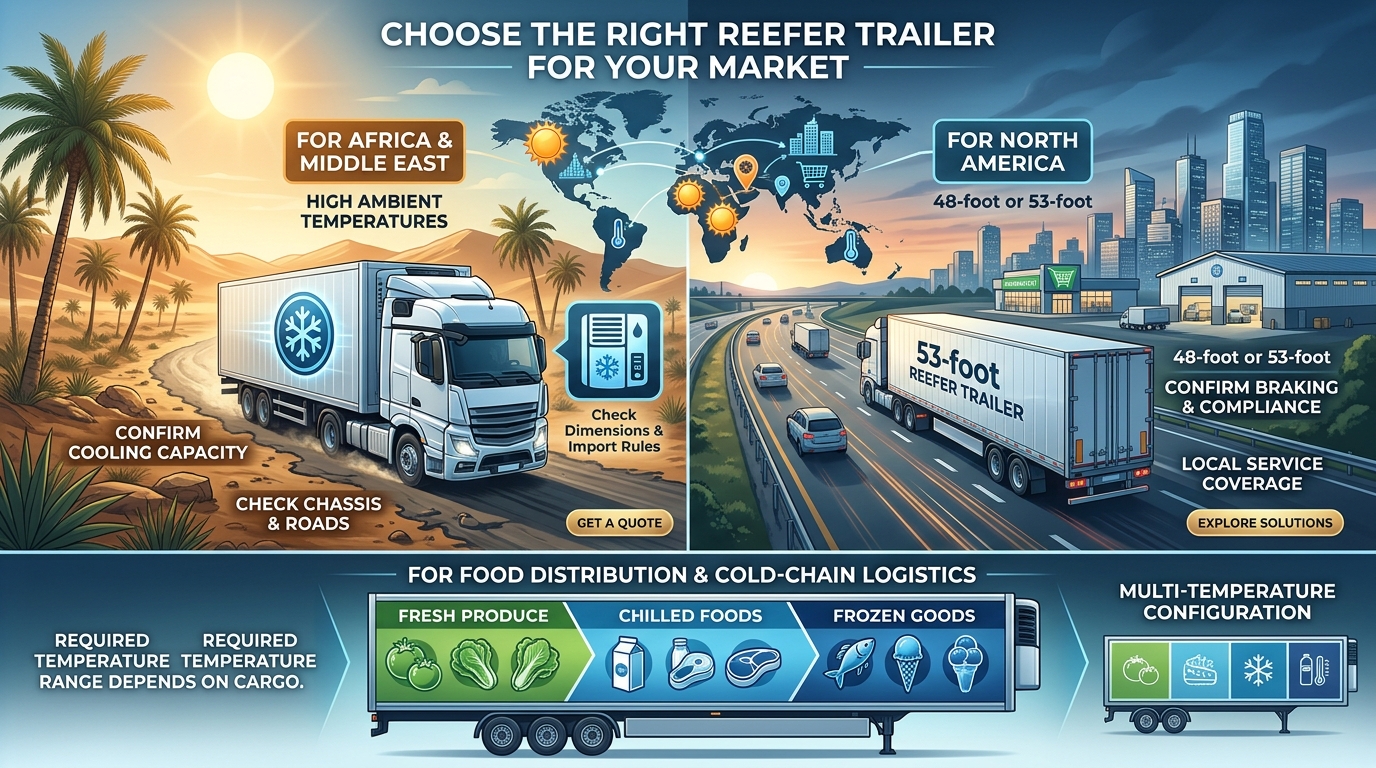
For Africa and the Middle East
High ambient temperatures can place additional demands on refrigeration performance and insulation. Buyers should confirm cooling capacity under expected conditions, parts availability and the suitability of the chassis for local roads and payload requirements.
Before ordering, check the applicable vehicle dimensions, axle-load restrictions and import requirements in the destination country.
For North America
Confirm whether a 48-foot or 53-foot configuration is appropriate for your routes and loading facilities. Refrigeration unit specifications, local service coverage, braking requirements and regulatory compliance should all be considered.
For Food Distribution and Cold-Chain Logistics
The required temperature range depends on the cargo. Fresh produce, chilled foods and frozen goods may have different operating requirements.
If you transport several cargo categories in the same trip, a multi-temperature configuration may be worth evaluating. Confirm the required temperature zones and loading arrangements before selecting the equipment.
5. How to Reduce Your Reefer Trailer Purchasing Cost
A competitive purchase price should not come at the expense of reliability or cargo protection.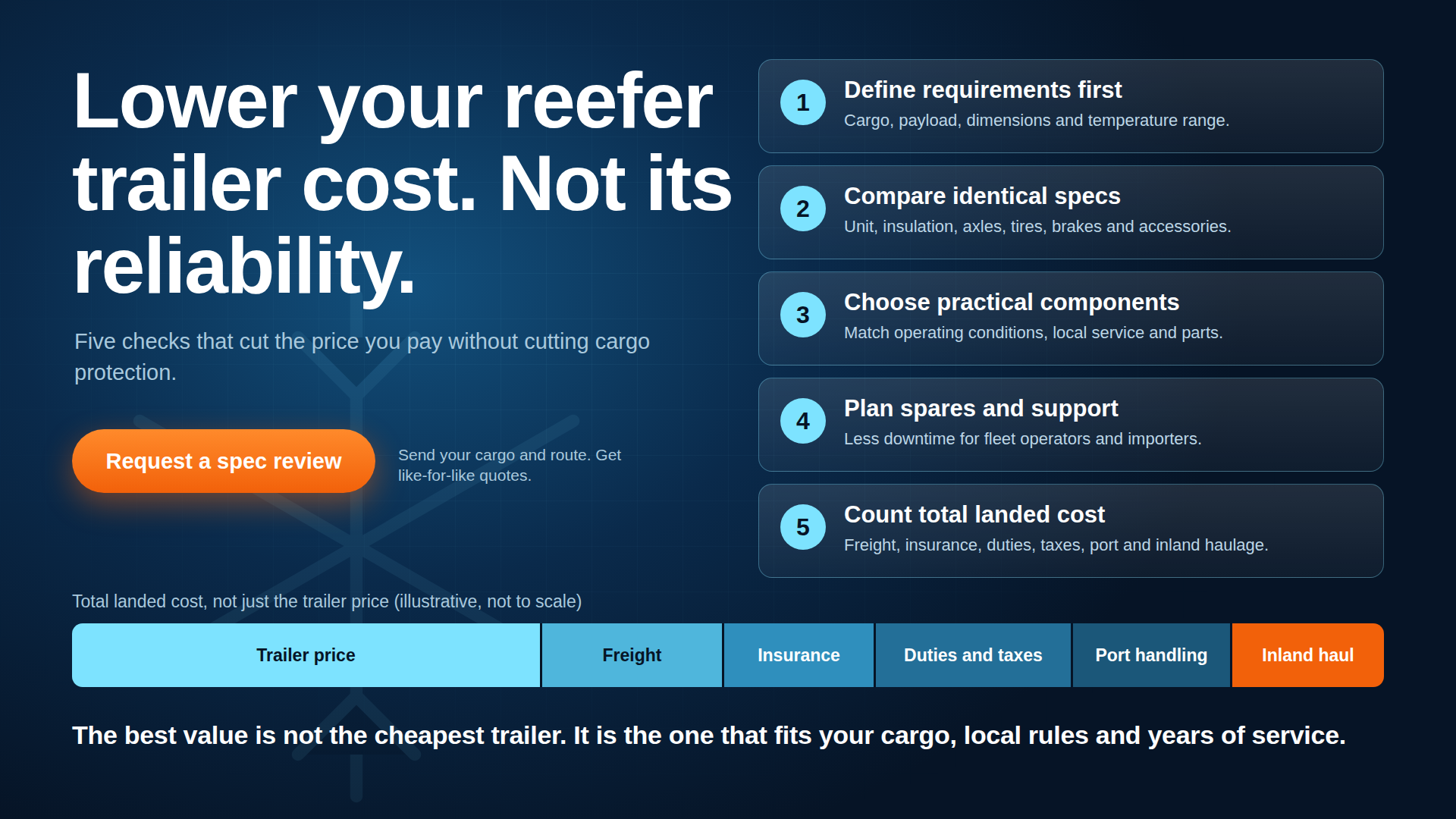
Five practical ways to lower reefer trailer purchasing cost without compromising reliability: define your requirements first, compare identical specifications, choose practical components, plan spare parts and after-sales support, and evaluate the total landed cost, including freight, insurance, duties, taxes, port handling and inland transport.
Define your requirements first. Confirm cargo type, target payload, trailer dimensions and required temperature range before requesting quotations.
Compare identical specifications. Check the refrigeration unit, insulation, axles, suspension, tires, braking system and included accessories.
Choose practical components. Select equipment based on operating conditions, local maintenance capability and the availability of replacement parts.
Plan spare parts and after-sales support. For fleet operators and importers, access to suitable spare parts can help reduce downtime.
Consider the total landed cost. Include freight, insurance where applicable, import duties, taxes, port handling and inland transportation when evaluating suppliers.
The best-value reefer trailer is not necessarily the cheapest one. It is the configuration that meets your cargo requirements, complies with local regulations and supports dependable operation over its service life.
6. Why Consider a Custom Reefer Trailer from a Chinese Manufacturer?
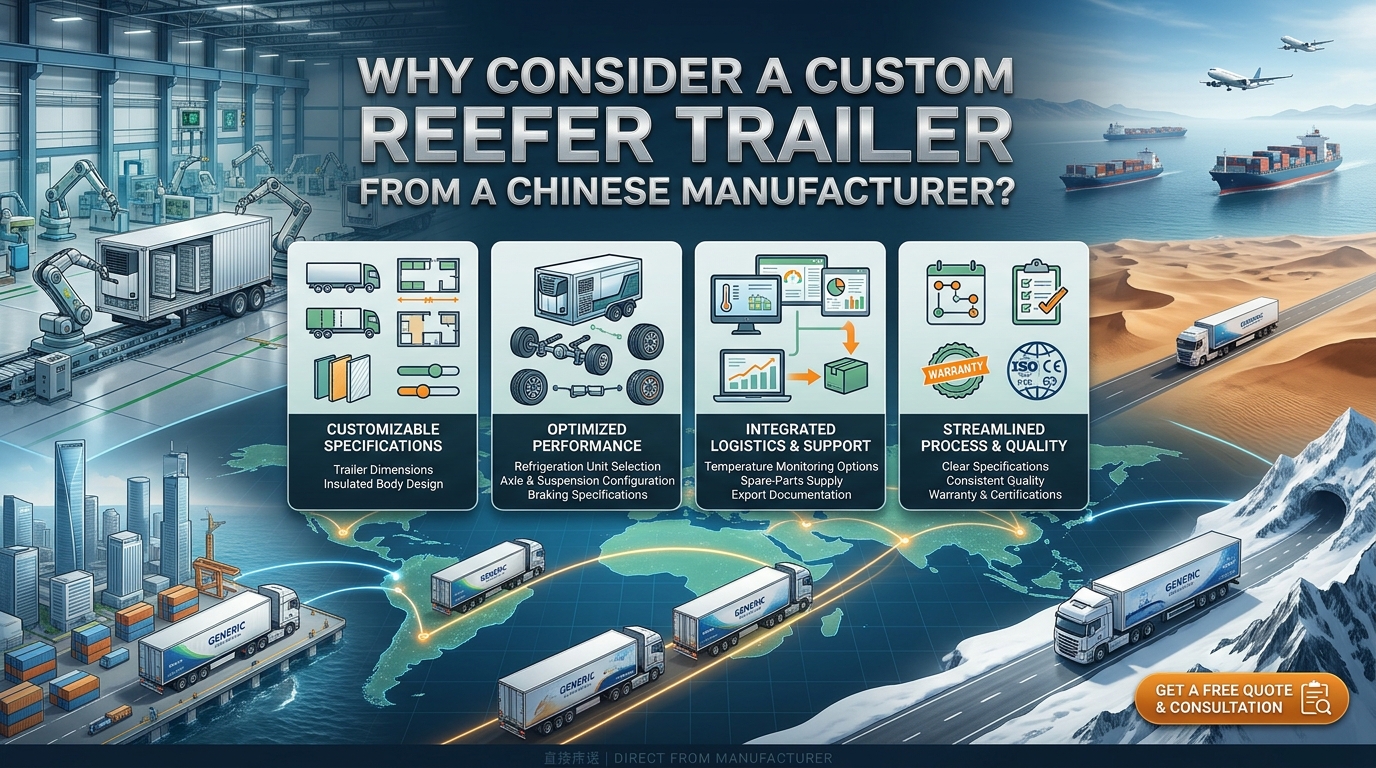
Why Choose Custom Reefer Trailers from Chinese Manufacturers - Specifications, Quality and Global Export Support
For importers, fleet operators and wholesale buyers, working directly with a manufacturer can make it easier to discuss product specifications and sourcing requirements.
Depending on the project, customization may cover:
-
Trailer dimensions and insulated body design
-
Refrigeration unit selection
-
Axle and suspension configuration
-
Tire, wheel and braking specifications
-
Temperature monitoring options
-
Spare-parts supply and export documentation
Before placing an order, confirm the manufacturing scope, delivery schedule, warranty terms, payment conditions and applicable certifications in writing.
For repeat orders, a clearly documented specification can also help maintain consistency across the fleet.
7. Request a Reefer Trailer Quotation
Looking for a refrigerated semi-trailer for your local market or export business?
We supply semi-trailers and related components for international buyers, with configuration discussions based on cargo requirements, operating conditions and destination-market needs.
To receive a more accurate quotation, please provide the following information:
-
Destination country: Where will the trailer be registered and operated?
-
Cargo type: Fresh produce, frozen food, dairy products or other goods?
-
Trailer dimensions: 48 ft, 53 ft, approximately 13.6 m or another size?
-
Temperature requirement: What operating temperature range do you need?
-
Axle configuration: Two axles, three axles or another arrangement?
-
Refrigeration unit: Preferred brand or an equivalent suitable option?
-
Order quantity: One unit or a fleet order?
-
Trade terms: EXW, FOB, CFR or CIF, including the destination port where applicable.
With these details, we can discuss a suitable configuration and prepare a quotation based on your actual requirements.
My Thoughts on Reefer Trailer Costs: More Than Just the Purchase Price
When I think about the cost of a reefer trailer, I believe the real question is not simply how much it costs to buy one, but how much value it can bring to a business over the years.
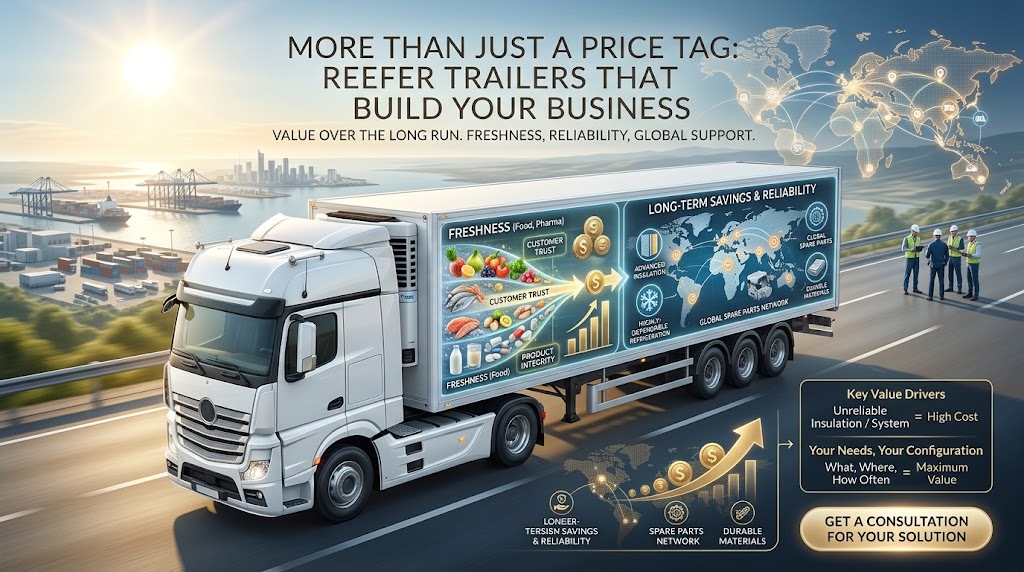
A refrigerated trailer carries more than goods. It carries the freshness of food, the trust of customers, and the responsibility of delivering products in the right condition. A lower purchase price may look attractive at first, but if the insulation is poor, the refrigeration system is unreliable, or spare parts are difficult to find, those initial savings can quickly disappear.
From my perspective, choosing a reefer trailer should start with understanding the buyer's actual needs. What will it carry? Where will it operate? How often will it run? These questions matter just as much as the price itself.
For international buyers, I also believe that honest communication and a suitable configuration are more valuable than promises of the lowest price. Every market has different challenges, and every customer deserves a solution that makes sense for their business.
In the long run, a good investment is not the trailer that costs the least today, but the one that continues to work reliably and earn its value tomorrow.
Contact us to discuss your reefer trailer project and request a customized quotation.