
Skeletal Trailer Dimensions: Complete Guide to 20ft, 40ft and 45ft Models
Choosing the right skeletal trailer dimensions is essential for efficient container transportation, safe road operation, and long-term fleet performance. Whether you transport 20ft, 40ft, or 45ft containers, understanding trailer length, width, chassis height, axle configuration, and container locking positions can help you select the right equipment for your business.
However, skeletal trailer dimensions are not determined by container length alone. The appropriate configuration also depends on the tractor unit, container type, payload requirements, road regulations, and operating environment.
At Lucksun Trailer, we provide semi-trailer manufacturing and customization solutions for customers in international markets. This guide explains the key dimensions of skeletal trailers, compares common configurations, and outlines what buyers should consider before placing an order.
What Are the Standard Skeletal Trailer Dimensions?
A skeletal trailer, also known as a container chassis trailer, is designed to transport shipping containers using a lightweight frame structure and dedicated container locking points. Unlike a flatbed trailer, its open chassis is specifically configured to support and secure compatible containers.
There is no single universal dimension for every skeletal trailer. Overall length, chassis width, chassis height, wheelbase, axle spacing, and container locking positions vary according to the model and intended application.
The most common configurations are designed for 20ft and 40ft containers, while some models support 45ft containers or multiple container combinations. Extendable skeletal trailers may accommodate different container lengths through an adjustable chassis structure.
The following table provides a general guide to common configurations. It describes typical applications rather than guaranteed dimensions for a particular manufacturer's model.
| Skeletal trailer configuration | Typical application | Key considerations |
|---|---|---|
| 20ft skeletal trailer | Transportation of a single 20ft container | Container locking positions, axle loads, and turning requirements |
| 40ft skeletal trailer | Transportation of a single 40ft container | Overall combination length, container support, and payload |
| 45ft skeletal trailer | Transportation of compatible 45ft containers | Chassis length, locking positions, and local road restrictions |
| Extendable skeletal trailer | Transportation of containers of different lengths, depending on design | Extension range, locking positions, structural capacity, and maintenance |
When comparing skeletal trailer dimensions, buyers should distinguish between container dimensions and trailer dimensions. A 40ft container does not mean the trailer's overall length is exactly 40ft. The chassis must also accommodate the container locking system, structural components, axle arrangement, and coupling requirements.
For accurate purchasing decisions, always request the manufacturer's technical drawing and confirmed specifications for the exact model.
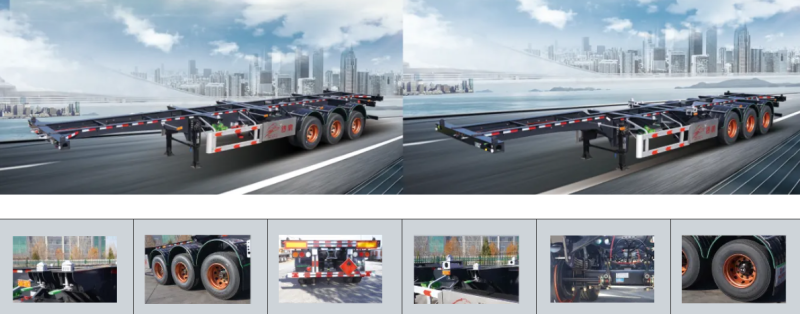
LUCKSUN Skeleton Semi-Trailer
20ft, 40ft and 45ft Skeletal Trailer Dimensions Compared
The best skeletal trailer size depends on the containers you transport most frequently and the routes your fleet operates.
20ft skeletal trailer dimensions
A 20ft skeletal trailer is commonly used for transporting individual 20ft shipping containers. It can be a practical option for port operations, container depots, and regional logistics where shorter containers are frequently handled.
When evaluating a 20ft skeletal trailer, check the distance between container locking points, the position of the kingpin, axle configuration, and compatibility with the tractor unit.
The container's gross weight and its distribution across the chassis are also important. A compact trailer must still be configured to handle the intended load safely and comply with applicable axle-load limits.
40ft skeletal trailer dimensions
A 40ft skeletal trailer is designed for the transportation of 40ft containers and is widely relevant to international container logistics.
Buyers should pay particular attention to overall vehicle combination length, chassis geometry, container support points, and the relationship between the trailer and tractor unit. These factors influence maneuverability, road clearance, and operating efficiency.
For fleets transporting both 20ft and 40ft containers, it is worth checking whether a compatible multi-container or extendable configuration would offer greater flexibility than a dedicated chassis.
45ft skeletal trailer dimensions
A 45ft skeletal trailer is intended for compatible 45ft containers and operations that require additional container length.
Because the trailer and container combination may exceed the limits permitted on certain roads, buyers should confirm the legal vehicle dimensions in the intended operating region before purchasing.
Other factors include container locking positions, chassis extension design where applicable, turning clearance, axle loads, and compatibility with existing tractors and terminal equipment.
Understanding the differences
The primary difference between these configurations is not simply the length of the container. Each configuration must provide the correct support points, structural strength, and vehicle geometry for its intended application.
For fleets handling multiple container sizes, the right choice depends on container frequency, loading requirements, route restrictions, and the total cost of operating the equipment.

Comparison of Skeletal Trailers of Different Sizes
Skeletal Trailer Dimensions vs. Container Dimensions
Container dimensions and skeletal trailer dimensions are related, but they describe different things.
Container dimensions refer to the physical measurements of the shipping container. Trailer dimensions describe the chassis itself, including its overall length, width, height, wheelbase, and other structural measurements.
The combined vehicle dimensions include the tractor unit and trailer and may also be affected by the container being transported.
This distinction matters because selecting a chassis based only on the nominal container length may result in an unsuitable configuration.
For example, a trailer designed for a particular container length must place its twist locks at the correct positions. The chassis also needs to provide suitable support, maintain the intended load distribution, and connect correctly to the tractor unit.
Before ordering a skeletal trailer, confirm the following:
-
The exact container length and type.
-
The container's external dimensions and gross weight.
-
The number and positions of the required container locking points.
-
The trailer's overall length, width, and chassis height.
-
Compatibility with the tractor unit and fifth-wheel coupling.
-
The applicable legal dimensions for the operating market.
These checks help reduce the risk of compatibility problems after delivery.
Standard Container Sizes and Skeletal Trailer Compatibility
Different container types may require different skeletal trailer configurations. Even when two containers share the same nominal length, their weight, height, construction, or intended use may affect equipment selection.
A standard dry container, high-cube container, refrigerated container, and specialized container may have different operational requirements. Buyers should therefore confirm the exact container specifications rather than relying on length alone.
For a 20ft container, the main considerations include the locking-point layout, gross weight, and suitability for the intended route.
For a 40ft container, buyers should verify the chassis configuration, container support points, tractor compatibility, and overall combination dimensions.
For a 45ft container, additional attention should be given to chassis length, locking positions, turning requirements, and road regulations.
When a fleet handles multiple container lengths, a multi-purpose or extendable skeletal trailer may be worth considering. However, not every extendable model supports every container combination. The available extension range and permitted locking positions must be confirmed with the manufacturer.
A useful purchasing practice is to provide the trailer supplier with the container specifications and a description of actual transport operations. This makes it easier to identify a suitable configuration and avoid unnecessary customization.
Key Skeletal Trailer Dimensions Explained
Understanding the main measurements makes it easier to compare products and evaluate technical drawings.
Overall trailer length
Overall trailer length is the distance from the frontmost to the rearmost point of the trailer, measured according to the manufacturer's stated method.
This measurement affects storage space, maneuverability, vehicle combination length, and compliance with local regulations.
Buyers should distinguish between the trailer's overall length and the nominal length of the container it carries. They should also confirm whether the quoted measurement includes any extendable sections in a specific position.
Trailer width
Trailer width affects road clearance, stability, and compatibility with the intended operating environment.
The width of the chassis is not necessarily identical to the overall width of the loaded vehicle. Depending on the configuration, other components or the container itself may determine the maximum width.
Before purchasing, confirm the manufacturer's stated overall width and check the relevant legal limits for the target market.
Chassis height
Chassis height influences the vertical position of the container when loaded. It can affect overall vehicle height, ground clearance, and compatibility with the tractor unit.
A suitable chassis height should account for container dimensions, suspension configuration, tire size, and the operating conditions expected by the customer.
Buyers should request a drawing that clearly identifies the measurement reference points instead of comparing height figures that may have been measured differently.
Wheelbase and axle spacing
Wheelbase and axle spacing influence load distribution, turning behavior, and the way forces are transferred through the trailer structure.
The appropriate layout depends on the trailer design, axle configuration, intended gross weight, and relevant road requirements. A longer or shorter spacing should not be evaluated in isolation from the rest of the chassis.
Kingpin position
The kingpin connects the semi-trailer to the tractor unit's fifth wheel. Its position affects coupling compatibility and the distribution of weight between the tractor's drive axles and the trailer axles.
An unsuitable kingpin position may create operational or loading problems. Buyers should confirm the kingpin specifications against the tractor unit before finalizing the order.
Container locking positions
Twist locks secure the container to the skeletal trailer. Their positions must match the intended container configuration.
A trailer may have several locking positions or support different container arrangements, depending on its design. Confirm the permitted combinations and locking-point layout in the technical drawing.

Key dimensions of a skeletal trailer.
How Axle Configuration Affects Skeletal Trailer Dimensions
Axle configuration is an important part of skeletal trailer design. Depending on the model, a trailer may use a two-axle, three-axle, or other manufacturer-defined arrangement.
The number of axles and their positioning influence load distribution, tire requirements, braking configuration, suspension selection, and compliance with local axle-load limits.
A three-axle skeletal trailer, for example, may be appropriate for certain heavier-duty applications, but the number of axles alone does not establish the trailer's legal payload or carrying capacity. These depend on the structural design, axle ratings, tires, braking system, and applicable regulations.
When comparing axle configurations, buyers should consider:
-
The intended container types and gross weights.
-
Permitted axle loads on the operating routes.
-
Suspension and braking requirements.
-
Tractor compatibility and coupling loads.
-
Maneuverability in ports, depots, and distribution centers.
-
Maintenance needs and total operating costs.
The best configuration is the one that meets the actual transportation requirements without compromising safety, compliance, or operational efficiency.
Skeletal Trailer Dimensions and Maximum Payload
Trailer dimensions and payload capacity are closely related, but they are not interchangeable.
A larger chassis does not automatically carry a heavier load. Payload depends on the trailer's own weight, structural design, axle ratings, tire capacity, braking and suspension systems, tractor capability, and the legal limits that apply to the complete vehicle combination.
Buyers should distinguish between three important terms:
-
Tare weight: The weight of the empty trailer.
-
Payload: The weight of the cargo the vehicle is permitted to carry under the applicable conditions.
-
Gross vehicle or combination weight: The total permitted weight of the relevant vehicle or vehicle combination, as defined by local regulations.
The exact definitions and calculation methods can vary by jurisdiction, so the manufacturer's technical specifications and local rules should be checked.
Container weight distribution is equally important. Even if the total weight is within a stated limit, an unsuitable distribution may overload individual axles or affect handling.
Before selecting a skeletal trailer, discuss the expected container weights, tractor specifications, operating routes, and axle-load requirements with the manufacturer. This helps ensure the proposed configuration is appropriate for real working conditions.
What Factors Affect Skeletal Trailer Dimensions?
Several technical and operational factors determine the most suitable skeletal trailer dimensions.
Container type and length
The container's nominal length is a starting point, but the complete container specifications determine the required locking positions, support arrangement, and compatibility.
If your fleet regularly handles several container sizes, explain the frequency of each size to the supplier. This helps determine whether a dedicated chassis or a multi-purpose configuration is more appropriate.
Tractor unit specifications
The tractor unit must be compatible with the trailer's kingpin, fifth wheel, coupling height, and expected loading conditions.
The tractor's permitted axle loads and gross combination weight may also influence the practical configuration. Confirm these details before approving the trailer design.
Payload and load distribution
The intended cargo weight affects the required structural design, axle arrangement, tires, suspension, and braking system.
A supplier should evaluate the complete loading scenario rather than recommending a trailer based only on container dimensions.
Operating environment
Port terminals, container yards, highways, construction sites, and regional distribution routes place different demands on equipment.
Frequent tight turns may make maneuverability particularly important, while rougher operating conditions may influence suspension selection, ground clearance, and structural requirements.
Local road regulations
Legal requirements may specify maximum vehicle dimensions, axle loads, gross weights, and other conditions. These limits can differ between countries and even between types of roads.
Confirm the applicable rules for the intended route before choosing a trailer configuration.
Maintenance and operating costs
The initial purchase price is only one part of the total cost of ownership. Tire replacement, brake maintenance, suspension servicing, fuel consumption, downtime, and spare-parts availability can all affect long-term value.
Choosing dimensions and specifications that match your actual transport work can help avoid paying for unnecessary features or using equipment that does not meet operational needs.
Fixed vs. Extendable Skeletal Trailers: Which Is Right for You?
Fixed and extendable skeletal trailers serve different operating needs. Neither design is automatically the better choice for every fleet.
A fixed skeletal trailer has a set chassis configuration. It can be a practical option for businesses that transport a consistent container size and prefer a straightforward operating setup.
An extendable skeletal trailer has an adjustable chassis section that allows the trailer length to be changed within its designed range. Depending on the model, this can support different container lengths and provide greater flexibility for mixed-container operations.
The following comparison summarizes the main purchasing considerations.
| Consideration | Fixed skeletal trailer | Extendable skeletal trailer |
|---|---|---|
| Main application | Repeated transport of a defined container size or configuration | Operations requiring different container lengths |
| Chassis design | Fixed-length structure | Adjustable structure with an extension mechanism |
| Operational flexibility | Depends on the specific configuration | Can accommodate multiple lengths within the approved range |
| Maintenance considerations | Focus on standard chassis components | Includes maintenance of the extension mechanism and associated components |
| Purchasing priority | Confirm the container configuration and route requirements | Confirm extension range, locking positions, operating procedure, and structural limits |
Before choosing an extendable model, ask the supplier to confirm the exact extension range, permitted container combinations, locking positions, and any operating restrictions.
The decision should be based on actual fleet requirements, container availability, operating frequency, and total cost of ownership.
Road Regulations and Legal Dimensions for Skeletal Trailers
Legal vehicle dimensions are an essential consideration when purchasing a skeletal trailer for domestic or international transportation.
Different markets may apply different requirements to maximum vehicle length, width, height, axle loads, gross combination weight, braking equipment, lighting, and safety markings.
A configuration suitable for one country may require adjustment or may not be permitted on certain routes in another country.
For export buyers, the purchasing process should include a review of the destination country's technical requirements. Where a trailer will operate across borders, the requirements of the relevant routes should also be considered.
Before confirming an order, verify:
-
The permitted overall dimensions of the vehicle combination.
-
Applicable gross weight and axle-load limits.
-
The required braking and lighting systems.
-
Any inspection, registration, or certification requirements.
-
Restrictions affecting container lengths or particular roads.
-
Requirements for reflective markings and other safety equipment.
Do not rely solely on a supplier's general product description to establish legal compliance. Ask for the relevant technical documentation and confirm the requirements with the responsible local authority or qualified compliance professional.
Lucksun can work with buyers to discuss intended operating conditions and the configuration requirements that should be considered during the quotation and manufacturing process. Final compliance must be verified for the destination market and specific vehicle configuration.
How to Choose the Right Skeletal Trailer Size
Selecting the right skeletal trailer starts with understanding how the equipment will be used. The lowest purchase price or the largest available chassis will not necessarily provide the best long-term value.
Use the following checklist to guide your decision.
| Selection factor | Questions to ask | Why it matters |
|---|---|---|
| Container requirements | Which container lengths and types will you transport? | Determines the required chassis and locking configuration |
| Tractor unit | What are the coupling, axle-load, and weight limitations? | Helps ensure safe and compatible operation |
| Payload | What container weights and load distributions are expected? | Influences structural, axle, tire, and braking specifications |
| Operating routes | Will the trailer operate on highways, in ports, or on rough roads? | Helps determine maneuverability and suitable components |
| Destination market | What dimensions and weight limits apply? | Supports regulatory compliance |
| Fleet flexibility | Will you transport different container sizes? | Helps determine whether an extendable or multi-purpose design is appropriate |
| Maintenance support | Are spare parts and technical support available? | Affects downtime and long-term operating costs |
It is also helpful to consider the frequency of each transport task. A fleet that mostly handles 40ft containers may benefit from a dedicated configuration, while a business with a varied container mix may need more flexibility.
Discuss these factors with the manufacturer before finalizing the specifications. A detailed requirements review can help prevent costly changes after production.
What Information Is Needed to Customize Skeletal Trailer Dimensions?
Customized skeletal trailers can help buyers align chassis dimensions and components with specific transport requirements. However, customization should be based on clear operating information and a technically suitable design.
When requesting a quotation from Lucksun Trailer, prepare as much of the following information as possible:
-
Container specifications: Container lengths, types, dimensions, and gross weights.
-
Tractor unit details: Tractor model, fifth-wheel specifications, coupling height, and relevant weight ratings.
-
Preferred trailer configuration: Fixed, extendable, or another suitable chassis arrangement.
-
Axle and suspension requirements: Intended axle configuration and preferred suspension type, subject to technical suitability.
-
Braking system: Required braking configuration and applicable market requirements.
-
Tires and landing gear: Preferred brands or specifications, where available.
-
Appearance and identification: Color, company logo, and reflective markings.
-
Operating environment: Typical routes, road conditions, loading frequency, and terminal operations.
-
Destination market: Country of use and any relevant technical or regulatory requirements.
Providing these details enables the supplier to evaluate the application and recommend a suitable specification.
Customization does not mean that every requested dimension or component combination will be technically appropriate. The final design must account for structural strength, load distribution, component compatibility, and legal requirements.
For customers who do not have a complete technical specification, sharing the container information and tractor details is a useful starting point.
Customized Skeletal Trailer Solutions from Lucksun
Lucksun Trailer is the export-oriented brand of Luoxiang Group, a manufacturer focused on semi-trailer research and development, manufacturing, and sales.
The company combines manufacturing processes with product development capabilities to support different customer requirements. Its production operations incorporate robotic welding, electrophoretic coating, axle automation, and intelligent assembly processes.
According to the company's profile, Luoxiang Group has established research and development platforms and accumulated more than 200 national patents and specialized technical authorizations. The company has also introduced intelligent production management integrating PLM, ERP, MES, and WMS systems.
For skeletal trailer buyers, product selection can involve more than chassis length alone. Depending on the model and technical feasibility, Lucksun can discuss customization options involving frame dimensions, axle configuration, tires, braking systems, suspension, landing gear, color, company logos, and reflective markings.
The company reports ISO 9001 certification and more than 70,000 units delivered globally. Warranty terms vary by model, and technical support is available. Lucksun also reports overseas offices in Tanzania, Guinea, Zambia, Nigeria, Vietnam, and Saudi Arabia.
For export customers, the quotation process should establish the target market, container requirements, tractor compatibility, preferred configuration, and required documentation. These details help the team assess the proposed specification before production.
Lucksun accepts orders starting from one unit, providing an option for customers evaluating a specific configuration as well as those planning larger fleet purchases. Payment arrangements may include T/T, L/C, and eligible Sinosure-supported arrangements, subject to the agreed transaction terms.
For an accurate quotation, request the technical specifications and drawings for the proposed model, together with confirmation of the applicable warranty and delivery terms.

It can be customized according to your requirements.
Frequently Asked Questions About Skeletal Trailer Dimensions
What are the standard skeletal trailer dimensions?
There is no single standard dimension that applies to every skeletal trailer. Dimensions vary by container length, chassis design, axle arrangement, tractor compatibility, and intended market. Buyers should consult the technical specifications for the exact model.
What is the difference between 20ft and 40ft skeletal trailers?
The main difference is the intended container configuration and the corresponding chassis geometry and locking positions. A 20ft model is designed for compatible 20ft container applications, while a 40ft model is configured for compatible 40ft containers. The overall trailer dimensions must be confirmed separately.
Can one skeletal trailer carry both 20ft and 40ft containers?
Some skeletal trailers support more than one container configuration, depending on their design and locking-point layout. Extendable or multi-purpose models may offer additional flexibility. Always confirm the permitted configurations with the manufacturer.
Are 45ft skeletal trailers available?
Skeletal trailers designed for compatible 45ft containers are available in the market. Suitability depends on the chassis design, container locking positions, tractor compatibility, and local regulations. Ask the supplier for the specifications of the exact model.
Does a longer skeletal trailer have a higher payload?
Not necessarily. Payload depends on the trailer's structural capacity, tare weight, axle and tire ratings, suspension, braking system, tractor capability, and applicable legal limits. Trailer length alone does not establish carrying capacity.
What should I check before buying a skeletal trailer?
Confirm the container dimensions and weight, chassis configuration, locking positions, overall vehicle dimensions, tractor compatibility, axle loads, braking system, and destination-market requirements. Request a technical drawing and a model-specific specification sheet before placing an order.
Can Lucksun customize skeletal trailer dimensions?
Lucksun can discuss customization options for frame dimensions and related components, subject to the selected model's design and technical feasibility. Buyers should provide container specifications, tractor details, intended operating conditions, and destination-market requirements to support the evaluation.
How can I obtain a quotation for a skeletal trailer?
Contact Lucksun Trailer with your required container size, preferred configuration, tractor specifications, destination country, and any customization requirements. The team can then evaluate the application and provide relevant model specifications and quotation details.
Request a Skeletal Trailer Quote from Lucksun
Choosing the right skeletal trailer dimensions requires more than matching the chassis to the nominal container length. Container compatibility, overall vehicle dimensions, axle configuration, payload, tractor specifications, and road regulations all contribute to the final decision.
By defining your transportation requirements before purchasing, you can identify a configuration that supports safe operation, efficient container handling, and long-term fleet performance.
Lucksun Trailer offers semi-trailer manufacturing and customization options for customers in international markets. Whether you need a skeletal trailer for 20ft, 40ft, or compatible 45ft containers, the next step is to confirm your application and review the relevant technical specifications.
Contact Lucksun Trailer to discuss your requirements and request a skeletal trailer quotation. Share your container specifications, destination market, and preferred configuration so the team can help evaluate a suitable solution.