
What Is a Step Deck Trailer? Step Deck vs Drop Deck: A Complete Buyer’s Guide
What Is a Step Deck Trailer? Step Deck vs Drop Deck: A Complete Buyer’s Guide
Choosing the right semi-trailer starts with understanding your cargo, loading requirements, and operating conditions. If you transport construction machinery, industrial equipment, agricultural machinery, or oversized freight, a step deck trailer may offer the clearance and loading flexibility you need.
But what is a step deck trailer? Is a step deck the same as a drop deck? And how do you decide whether this trailer type is suitable for your business?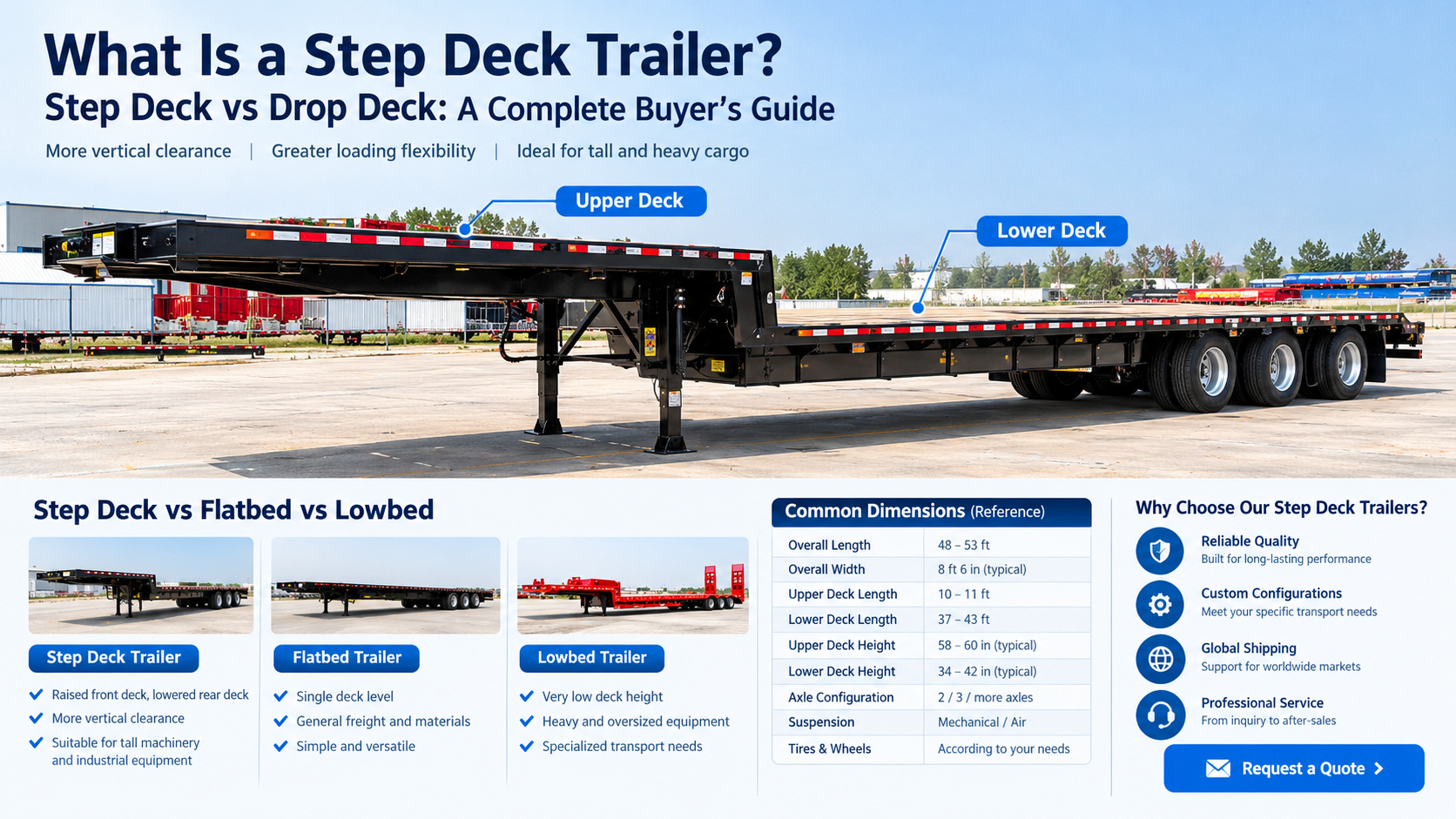
Step deck semi-trailer with upper and lower decks, ideal for tall and heavy cargo. Custom configurations available for global markets
In this guide, we explain the design, applications, common dimensions, and key purchasing considerations for step deck semi-trailers. We also compare step decks with flatbed and lowbed trailers to help you make a more informed purchasing decision.
Table of Contents
-
What Is a Step Deck Trailer?
-
How Does a Step Deck Trailer Work?
-
Step Deck vs Drop Deck: Are They the Same?
-
Step Deck vs Flatbed vs Lowbed Trailer
-
Common Step Deck Trailer Dimensions
-
What Is a Step Deck Trailer Used For?
-
Advantages and Limitations of Step Deck Trailers
-
How to Choose the Right Step Deck Semi-Trailer
-
Frequently Asked Questions
-
Request a Step Deck Trailer Quotation
1. What Is a Step Deck Trailer?
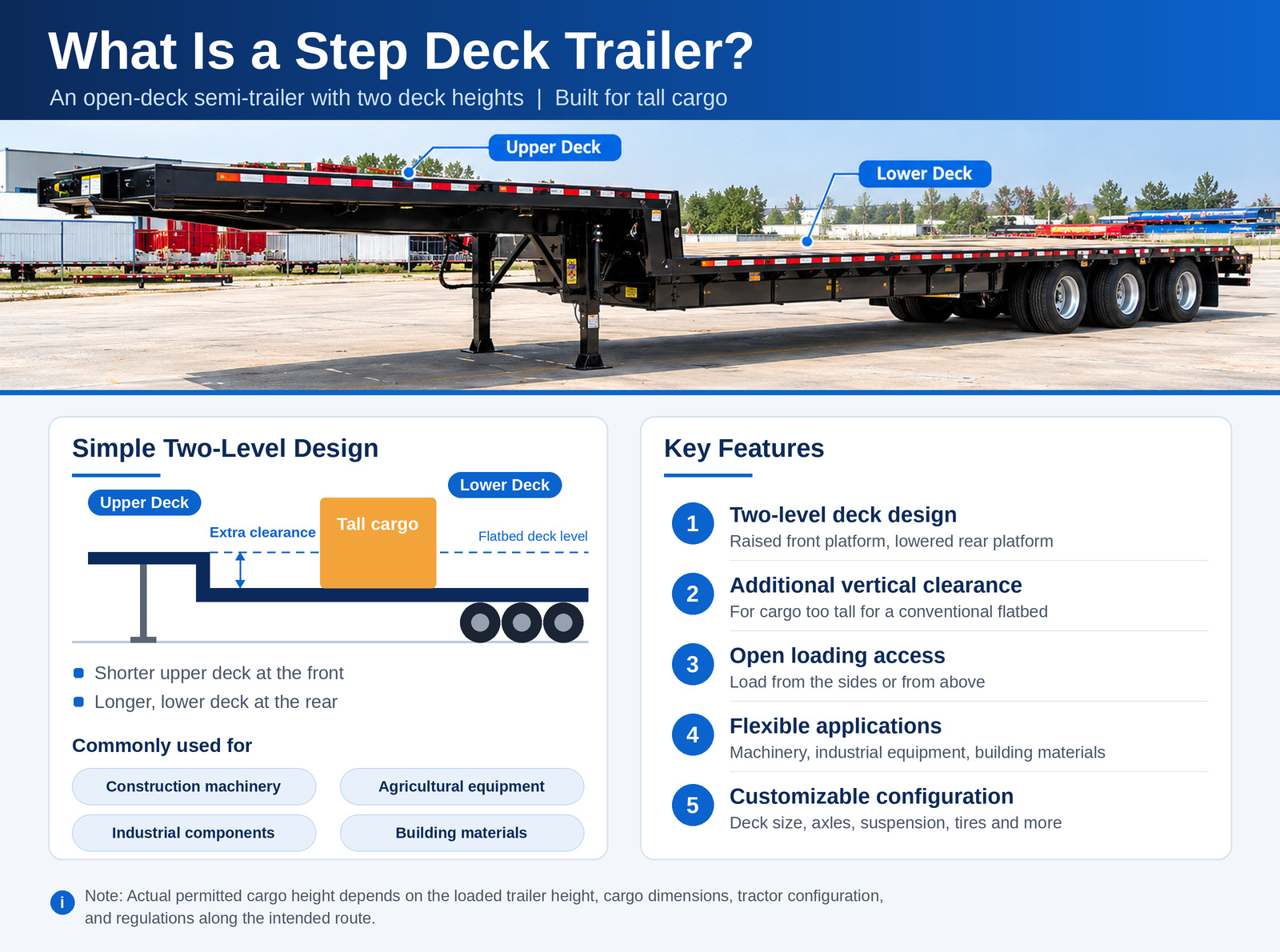
Step deck trailer with a raised upper deck and a lowered rear deck, providing extra vertical clearance for tall cargo
A step deck trailer is an open-deck semi-trailer with two different deck heights. It has a shorter upper deck at the front and a longer, lower deck at the rear.
Unlike a standard flatbed trailer, which has a single main loading surface, a step deck trailer features a lowered rear platform. This design provides additional vertical clearance for taller cargo.
Step deck trailers are commonly used to transport construction machinery, agricultural equipment, industrial components, building materials, and other freight that requires an open loading platform.
The lower deck is particularly useful when cargo height is a concern. By positioning the load closer to the road surface, the trailer can accommodate taller goods while helping operators stay within applicable overall vehicle height limits.
However, the actual permitted cargo height depends on the loaded trailer height, cargo dimensions, tractor configuration, and regulations along the intended route.
Key Features of a Step Deck Trailer
-
Two-level deck design: A raised front platform and a lowered rear platform.
-
Additional vertical clearance: Suitable for cargo that may be too tall for a conventional flatbed.
-
Open loading access: Allows cargo to be loaded from the sides or above, subject to the loading equipment and site conditions.
-
Flexible applications: Suitable for various types of machinery, industrial equipment, and construction materials.
-
Customizable configuration: Deck dimensions, axle arrangements, suspension systems, tires, and other components can be selected according to operating requirements.
For buyers transporting tall cargo regularly, a step deck semi-trailer can be a practical alternative to a standard flatbed.
2. How Does a Step Deck Trailer Work?
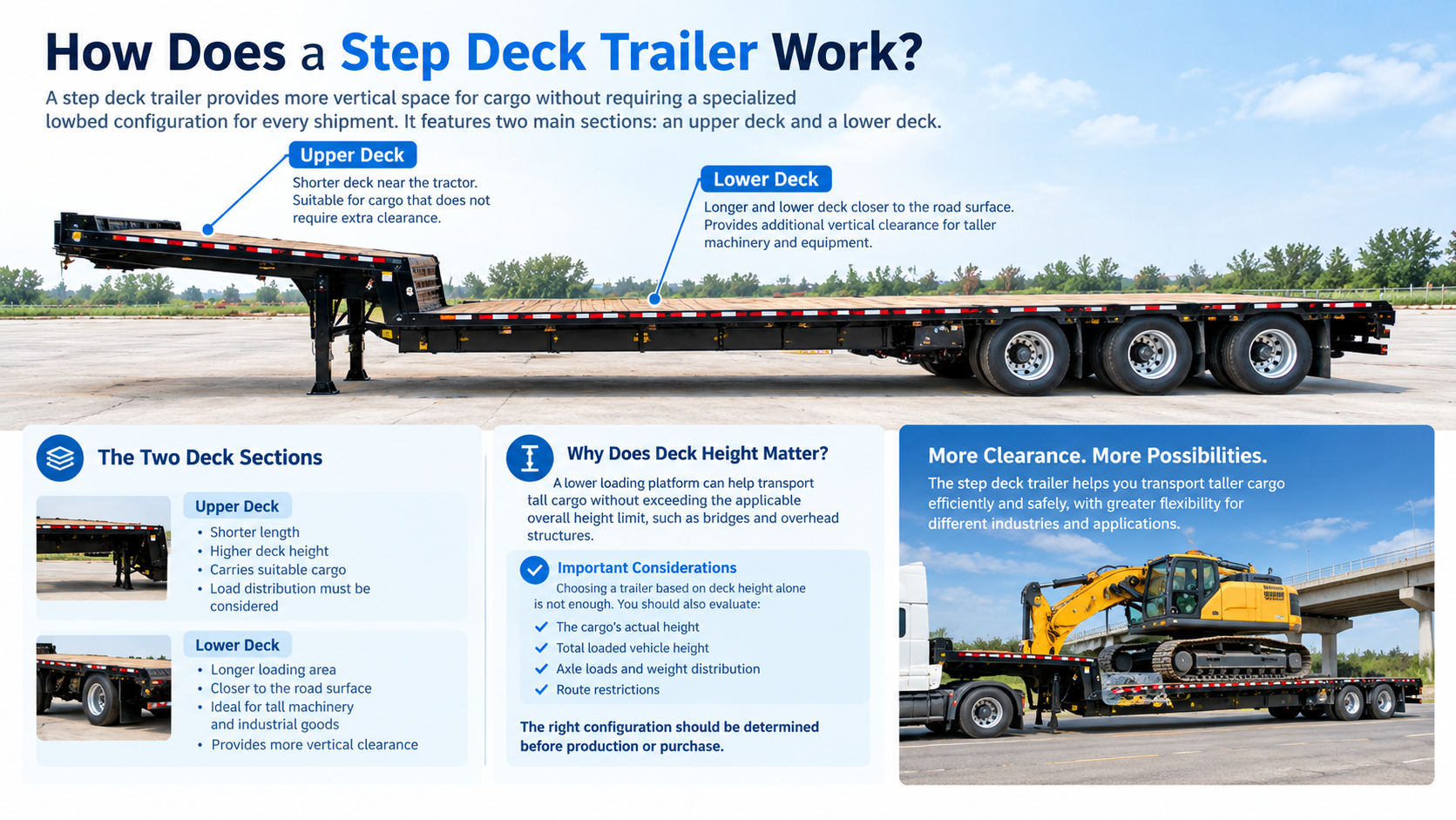
A step deck trailer features a raised upper deck and a lower rear platform, providing extra vertical clearance for transporting tall machinery, industrial equipment, and oversized cargo. Choosing the right deck height and configuration helps improve transport efficiency and meet road height requirements
The main purpose of a step deck trailer is to provide more vertical space for cargo without requiring a specialized lowbed configuration for every shipment.
Its structure consists of two main sections.
Upper Deck
The upper deck is positioned near the tractor and is typically shorter than the rear platform.
It can carry suitable cargo that does not require the additional clearance provided by the lower deck. Its dimensions and load distribution must be considered when planning a shipment.
Lower Deck
The lower deck is positioned closer to the road surface and generally provides the longer loading area.
This section is particularly useful for taller machinery, equipment, and industrial goods. The lower platform reduces the height of the cargo relative to the road, potentially allowing more vertical clearance beneath bridges and other overhead structures.
Why Does Deck Height Matter?
Consider a shipment of industrial machinery that is too tall for a standard flatbed.
A lower loading platform may provide the additional clearance needed to transport the equipment without exceeding the applicable overall height limit.
However, selecting a trailer based on deck height alone is not enough. Buyers should also evaluate the cargo's actual height, total loaded vehicle height, axle loads, weight distribution, and route restrictions.
The right configuration should be determined before production or purchase.
3. Step Deck vs Drop Deck: Are They the Same?
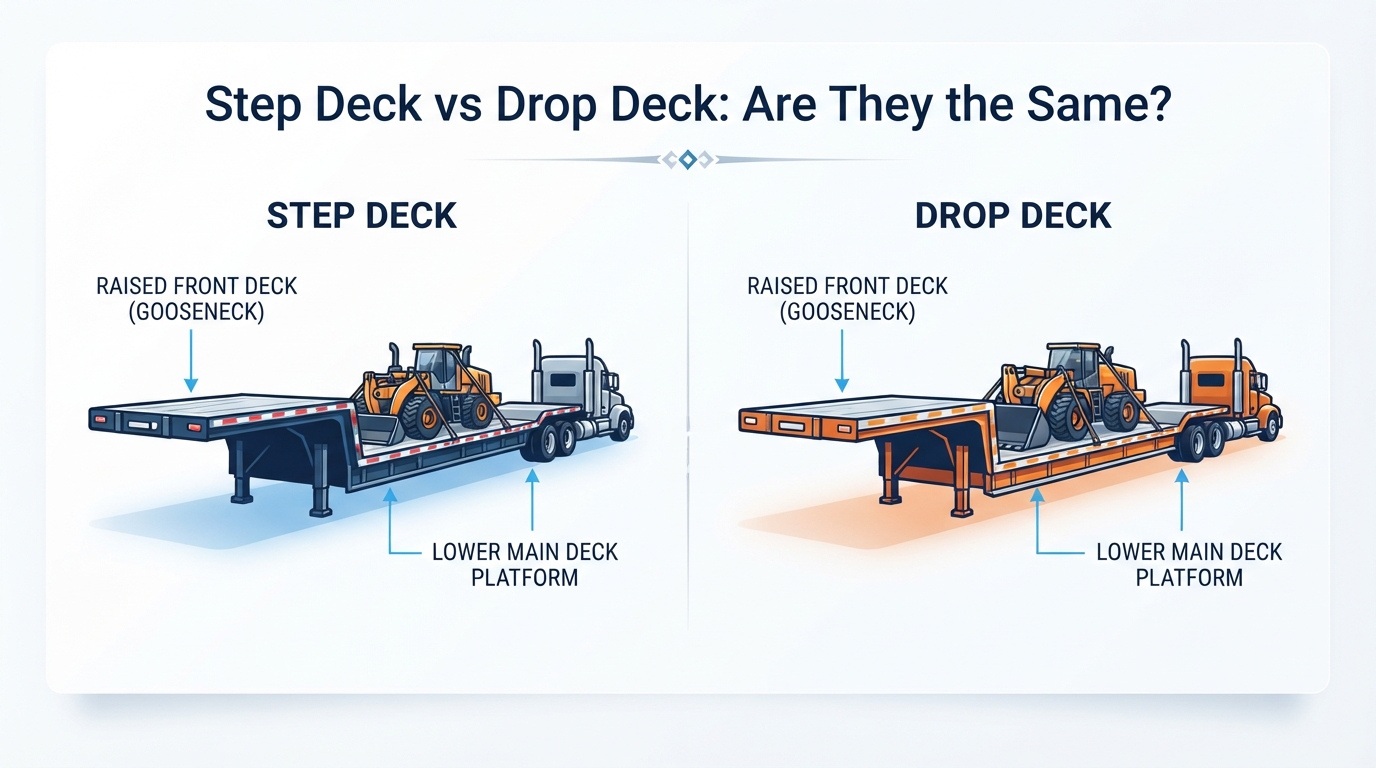
In the North American semi-trailer market, step deck trailer and drop deck trailer generally refer to the same type of trailer.
Both terms describe an open-deck trailer with a raised front section and a lower rear platform.
The name "step deck" describes the step between the two deck levels, while "drop deck" describes the lowered rear platform.
The terms are commonly used interchangeably in product descriptions, transportation discussions, and purchasing inquiries.
However, terminology can vary by region and supplier. Buyers should confirm the actual trailer structure rather than relying on the product name alone.
Step Deck vs Drop Deck: Key Comparison
| Comparison Item | Step Deck Trailer | Drop Deck Trailer |
|---|---|---|
| Basic design | Raised front deck and lowered rear deck | Generally the same two-level deck design |
| Deck structure | Single drop between the deck levels | Generally the same structure |
| Cargo applications | Tall machinery, equipment, and industrial freight | Similar applications |
| Loading method | Side loading or overhead loading, depending on the cargo | Similar loading methods |
| Main advantage | Additional cargo height clearance | Additional cargo height clearance |
| Purchasing considerations | Deck dimensions, axle configuration, payload, and height | The same key specifications should be checked |
Important: A standard step deck or single-drop trailer should not be confused with a double-drop trailer. A double-drop trailer has a different deck configuration, with a lower central section designed to accommodate certain taller loads.
When requesting a quotation, provide the required dimensions and a reference photograph if possible. This helps the supplier confirm the intended trailer type.
4. Step Deck vs Flatbed vs Lowbed Trailer
Step deck, flatbed, and lowbed trailers all serve different transportation needs. The best choice depends on cargo dimensions, weight, loading methods, and road conditions.
Comparison of Three Common Semi-Trailer Types
| Feature | Flatbed Trailer | Step Deck Trailer | Lowbed Trailer |
|---|---|---|---|
| Deck structure | One main deck level | Raised front deck and lowered rear deck | Very low main deck, depending on design |
| Cargo height clearance | Generally lower than a step deck | Greater clearance than a typical flatbed | Often greater clearance than a step deck |
| Typical applications | General freight, steel, timber, and construction materials | Tall machinery, industrial equipment, and building materials | Heavy construction machinery and specialized equipment |
| Loading flexibility | Side and overhead loading | Side and overhead loading; ramps may be available | Often designed for heavy equipment loading, depending on configuration |
| Main consideration | Cargo height and loading requirements | Deck length, lower-deck height, and cargo distribution | Equipment weight, loading method, ground clearance, and transport route |
This comparison is general guidance. Actual capabilities depend on the trailer design, specification, and applicable transport regulations.
When Should You Choose a Flatbed Trailer?
A flatbed is worth considering when your cargo fits comfortably within the permitted transport dimensions and requires a straightforward open loading platform.
It is widely used for general freight, steel products, timber, palletized goods, and many construction materials.
When Should You Choose a Step Deck Trailer?
A step deck is a strong option when your cargo is taller than a conventional flatbed can comfortably accommodate within the applicable height limit.
It is particularly useful when you need a longer open platform for machinery or industrial equipment without the more specialized structure of a lowbed trailer.
When Should You Choose a Lowbed Trailer?
A lowbed trailer is generally more suitable for heavy construction machinery and equipment that requires a much lower loading platform.
Depending on the design, a lowbed may offer a better solution for taller or heavier equipment, but axle capacity, deck dimensions, loading arrangements, and route restrictions must all be considered.
The key is to match the trailer to the actual cargo rather than choosing the lowest deck or highest rated capacity without considering the full transport requirements.
5. Common Step Deck Trailer Dimensions
Step deck trailer dimensions vary according to the manufacturer, intended market, axle arrangement, and customer requirements.
For North American applications, 48-foot and 53-foot models are common reference points. Other markets may use different dimensions and regulatory requirements.
The following table provides a preliminary reference for buyers.
Typical Step Deck Semi-Trailer Specifications
| Specification | Common Reference Range |
|---|---|
| Overall trailer length | Approximately 48–53 ft |
| Overall width | Approximately 8 ft 6 in for common North American configurations |
| Upper deck length | Approximately 10–11 ft |
| Lower deck length | Approximately 37–43 ft, depending on overall length and design |
| Upper deck height | Often around 58–60 in |
| Lower deck height | Often around 34–42 in |
| Axle configuration | Depends on payload, regulations, and operating conditions |
| Suspension | Mechanical or air suspension, depending on requirements |
| Tires and wheels | Selected according to axle ratings, road conditions, and market requirements |
These figures are indicative rather than universal specifications. Upper and lower deck lengths must be checked together with the overall design, and deck heights depend on the particular trailer configuration.
Payload should not be estimated from trailer dimensions alone. Axle ratings, tire capacity, structural ratings, load distribution, and local gross vehicle weight limits all affect the usable payload.
What Should Buyers Confirm Before Ordering?
Before selecting a step deck semi-trailer, confirm:
-
Required overall length and width.
-
Upper and lower deck lengths.
-
Empty deck height and loaded deck height, where relevant.
-
Cargo dimensions and maximum transport height.
-
Maximum payload and axle-load requirements.
-
Axle brand, suspension type, tires, and braking system.
-
Loading ramps or other loading equipment, if required.
-
Applicable road regulations and certification requirements.
For international buyers, it is especially important to confirm the destination country's vehicle regulations before finalizing the specifications.
6. What Is a Step Deck Trailer Used For?
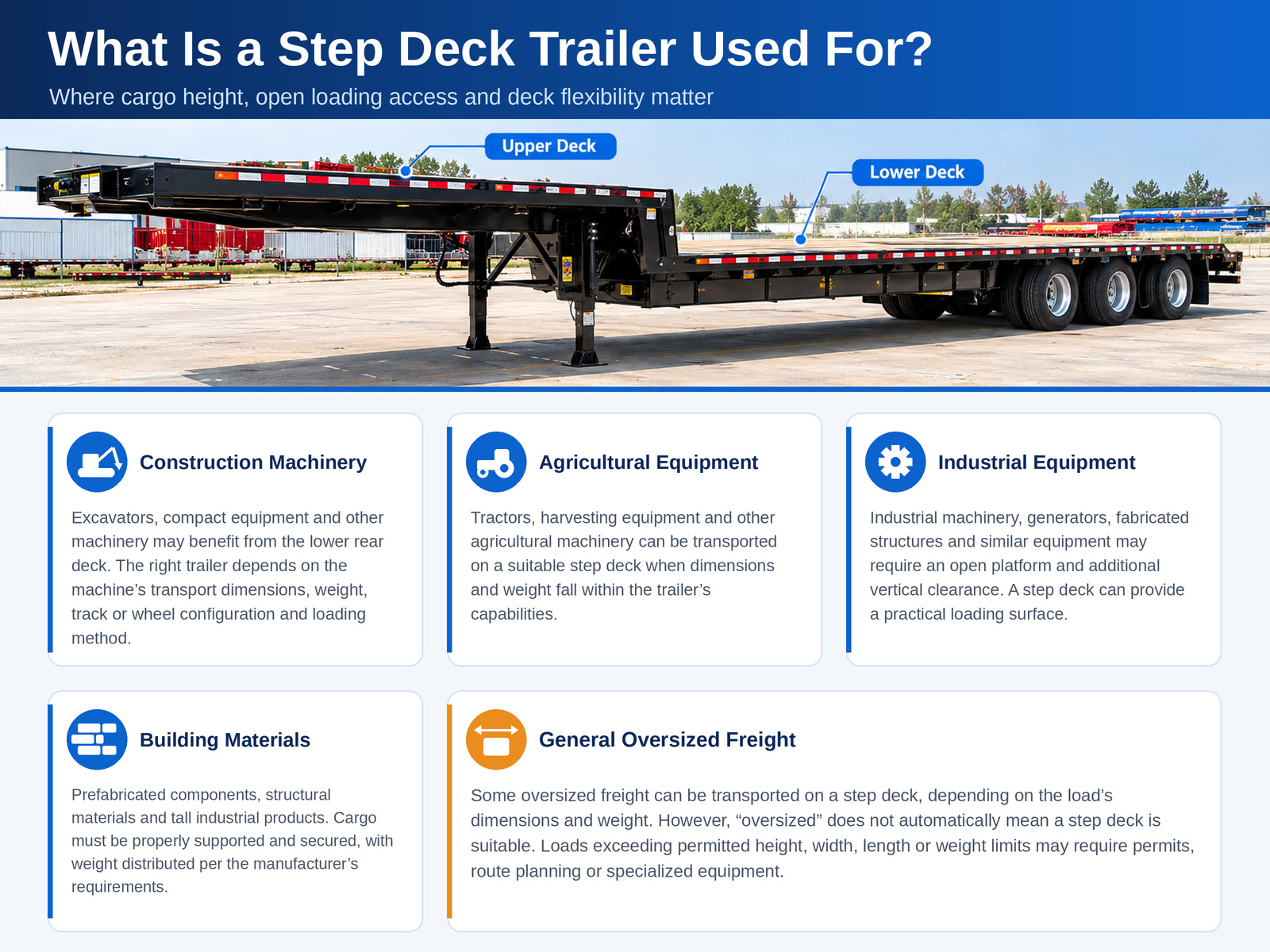
Common step deck trailer uses: construction machinery, agricultural equipment, industrial equipment, building materials, and general oversized freight
Step deck semi-trailers are used across several industries where cargo height, open loading access, and deck flexibility are important.
Construction Machinery
Excavators, compact construction equipment, and other machinery may benefit from the lower rear deck.
The appropriate trailer depends on the machine's transport dimensions, weight, track or wheel configuration, and loading method.
Agricultural Equipment
Tractors, harvesting equipment, and agricultural machinery can be transported on suitable step deck trailers when the dimensions and weight fall within the trailer's capabilities.
Industrial Equipment
Industrial machinery, generators, fabricated structures, and other equipment may require an open platform and additional vertical clearance.
A step deck can provide a practical loading surface for this type of cargo.
Building Materials
Certain prefabricated components, structural materials, and tall industrial products can also be transported on step deck trailers.
The cargo must be properly supported and secured, with its weight distributed according to the trailer manufacturer's requirements.
General Oversized Freight
Some oversized freight can be transported using a step deck, depending on the load's dimensions and weight.
However, the term "oversized" does not automatically mean that a step deck is suitable. Loads exceeding permitted height, width, length, or weight limits may require permits, route planning, or specialized equipment.
7. Advantages and Limitations of Step Deck Trailers
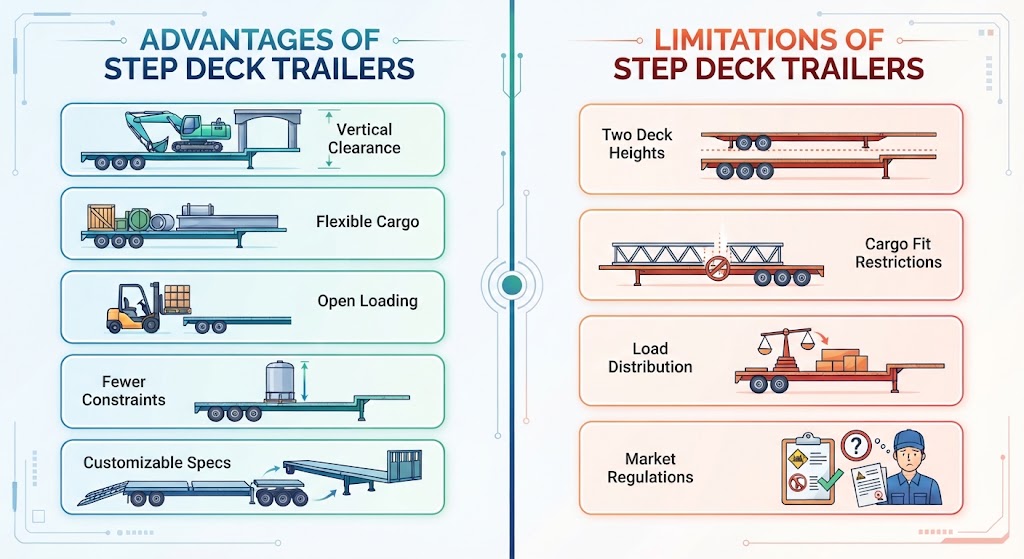
Advantages and limitations of step deck semi-trailers infographical guide
Understanding both the advantages and limitations helps buyers make a more informed investment.
Advantages
1. More vertical clearance
The lowered rear platform provides additional space for taller cargo compared with a typical flatbed.
2. Flexible cargo applications
Step deck trailers can transport a wide range of machinery, equipment, and industrial products.
3. Open loading access
The open platform supports side and overhead loading, depending on the cargo and available equipment.
4. Potentially fewer height-related transport constraints
For suitable loads, the lower deck can help keep the total vehicle height within applicable limits. Actual compliance must always be checked.
5. Configurable specifications
Axles, suspension, tires, deck dimensions, and optional loading equipment can be selected according to the intended application.
Limitations
1. The deck has two different heights
The change in deck level means that cargo placement and usable loading length must be planned carefully.
2. Not every load fits the lower platform
Very tall or heavy equipment may require a lowbed, double-drop, or another specialized trailer.
3. Load distribution is important
Incorrect weight distribution can overload axles or affect vehicle stability.
4. Regulations vary by market
A configuration suitable for one country may not meet the requirements of another.
For buyers, the best approach is to evaluate the full transportation task before deciding on a trailer model.
8. How to Choose the Right Step Deck Semi-Trailer
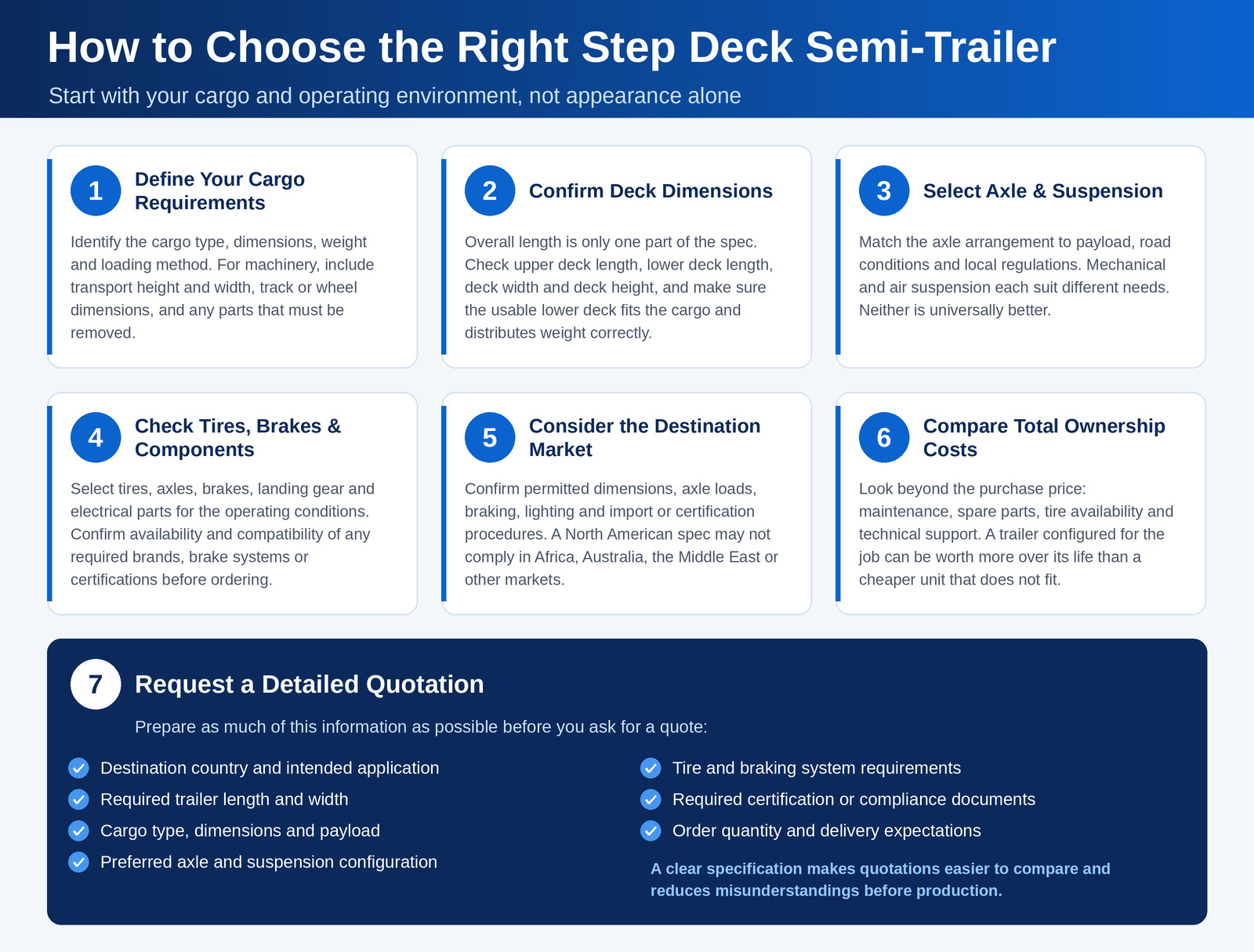
7 steps to choosing the right step deck semi-trailer, from defining your cargo requirements to requesting a detailed quotation
A reliable purchasing decision begins with a clear understanding of the cargo and operating environment.
Rather than choosing a trailer by appearance alone, consider the following factors.
1. Define Your Cargo Requirements
Identify the type of cargo, its dimensions, weight, and loading method.
For machinery, include its transport height and width, track or wheel dimensions, and any components that must be removed before transportation.
This information helps determine whether a step deck is suitable or whether another trailer type would be more practical.
2. Confirm the Required Deck Dimensions
The overall trailer length is only one part of the specification.
You should also confirm the upper deck length, lower deck length, deck width, and deck height.
Make sure the usable lower deck is long enough for the cargo and that the loading arrangement allows the weight to be distributed correctly.
3. Select the Axle and Suspension Configuration
The axle arrangement should match the intended payload, road conditions, and local regulations.
Mechanical suspension may suit certain applications where simplicity and maintenance considerations are important. Air suspension may be preferred for other operating requirements.
Neither option is universally better. The right choice depends on the application, budget, maintenance resources, and market requirements.
4. Check Tires, Brakes, and Other Components
Tires, axles, braking systems, landing gear, and electrical components should be selected according to the intended operating conditions.
Where specific brands, braking systems, or certification standards are required, confirm their availability and compatibility before placing the order.
5. Consider the Destination Market
For export buyers, trailer design must account for the regulations and operating environment of the destination country.
Confirm permitted vehicle dimensions, axle loads, braking requirements, lighting, and any applicable import or certification procedures.
Do not assume that a specification designed for North America will automatically comply with requirements in Africa, Australia, the Middle East, or another market.
6. Compare Total Ownership Costs
The purchase price matters, but it is not the only factor.
Consider maintenance, replacement parts, tire availability, expected operating conditions, and the availability of technical support.
A trailer configured for the actual job can be more valuable over its service life than a lower-priced unit that does not meet the fleet's requirements.
7. Request a Detailed Quotation
Before requesting a quotation, prepare as much information as possible:
-
Destination country and intended application.
-
Required trailer length and width.
-
Cargo type, dimensions, and payload.
-
Preferred axle and suspension configuration.
-
Tire and braking system requirements.
-
Required certification or compliance documentation.
-
Order quantity and delivery expectations.
A clear specification makes it easier to compare quotations on an equivalent basis and reduces the risk of misunderstandings before production.
9. Frequently Asked Questions
Is a step deck trailer the same as a drop deck trailer?
In most North American commercial trailer applications, yes. The terms generally describe the same trailer design, featuring a raised front deck and a lowered rear platform.
However, buyers should confirm the actual configuration because terminology may vary by supplier and market.
What is the main advantage of a step deck trailer?
Its main advantage is the additional vertical clearance provided by the lower rear deck.
This allows suitable tall cargo to be transported more easily than on a conventional flatbed, subject to applicable vehicle height limits.
What are the standard dimensions of a step deck trailer?
Common North American reference lengths include 48 and 53 feet. Typical configurations may have an upper deck around 10–11 feet long and a lower deck around 37–43 feet long.
These are general reference figures. Exact dimensions vary by manufacturer, design, and market.
How much weight can a step deck trailer carry?
There is no single payload figure that applies to every step deck trailer.
Usable payload depends on the trailer's structural rating, axle configuration, tires, tractor combination, weight distribution, and local legal limits.
Buyers should confirm both the manufacturer's rated capacity and the legally permitted operating weight.
Is a step deck trailer suitable for excavators?
It can be suitable for certain excavators and other construction machinery.
The decision depends on the machine's transport dimensions, operating weight, loading method, and the trailer's deck and axle specifications. Larger or heavier machines may require a lowbed or another specialized trailer.
Can a step deck trailer be customized for export?
Yes. Depending on the manufacturer and destination market, buyers may be able to specify deck dimensions, axle arrangements, suspension, tires, braking systems, and other components.
The final configuration should be confirmed against the destination country's technical and regulatory requirements.
What information do I need to request a step deck trailer quotation?
Start with the destination country, cargo type, required payload, trailer dimensions, preferred axle arrangement, suspension requirements, and any mandatory certification or component specifications.
If some details are not yet available, provide the information you have so the supplier can help identify a suitable configuration.
10. Find the Right Step Deck Trailer for Your Business
Choosing a step deck semi-trailer is not simply a matter of selecting a deck length or axle count. The right configuration must balance cargo dimensions, payload, road conditions, loading requirements, and destination-market regulations.
For fleet operators, importers, distributors, and construction companies, a well-matched trailer can support more efficient loading and help avoid unnecessary specification compromises.
At [Your Company Name], we focus on semi-trailers and trailer components for international customers. We can discuss customized configurations based on your cargo requirements, destination market, and operating conditions.
Whether you are sourcing a step deck trailer for machinery transportation or comparing step deck, flatbed, and lowbed options, our team can help you identify the key specifications to confirm before ordering.
Looking for a step deck trailer for your market?
Send us your destination country, required dimensions, cargo type, payload, and preferred configuration. We will review your requirements and help you identify a suitable trailer solution.
Contact us today to discuss your specifications and request a quotation.
Note: Dimensions and configurations in this article are general industry references, not guaranteed specifications for every trailer. Final specifications, payload, and road legality must be confirmed with the manufacturer and relevant authorities.